Global Agricultural Carbon Credit Market Size, Share, and Trends Analysis Report – Industry Overview and Forecast to 2033

Request for TOC Request for TOC Speak to Analyst Speak to Analyst Free Sample Report Free Sample Report Inquire Before Buying Inquire Before Buy Now Buy Now

Global Agricultural Carbon Credit Market Size, Share, and Trends Analysis Report – Industry Overview and Forecast to 2033

Global Agricultural Carbon Credit Market Segmentation, By Project Type (Forestry and Land Use, Soil Carbon Sequestration, Agroforestry, and Livestock Management), Nature (Organic Farming Practices and Conventional Farming Practices), Carbon Credit Type (Avoidance/Reduction Credits and Removal/Sequestration Credits), Certification Standard (Verra, Gold Standard, Climate Action Reserve, and Others), End Use (Voluntary Carbon Market and Compliance Carbon Market), Application (Crop Production, Soil Management, Livestock Farming, and Sustainable Land Management)- Industry Trends and Forecast to 2033

  • Agriculture And Animal Feed
  • May 2026
  • Global
  • 350 Pages
  • No of Tables: 220
  • No of Figures: 60

Global Agricultural Carbon Credit Market

Market Size in USD Billion

CAGR :  % Diagram

Bar chart comparing the Global Agricultural Carbon Credit Market size in 2025 - 1.50 and 2033 - 4.68, highlighting the projected market growth. USD 1.50 Billion USD 4.68 Billion 2025 2033
Diagram Forecast Period
2026 –2033
Diagram Market Size (Base Year)
USD 1.50 Billion
Diagram Market Size (Forecast Year)
USD 4.68 Billion
Diagram CAGR
%
Diagram Major Markets Players
  • Indigo Ag (U.S.)
  • Nori (U.S.)
  • Pachama (U.S.)
  • Boomitra (U.S.)
  • Regrow Ag (U.S.)

Agricultural Carbon Credit Market Size

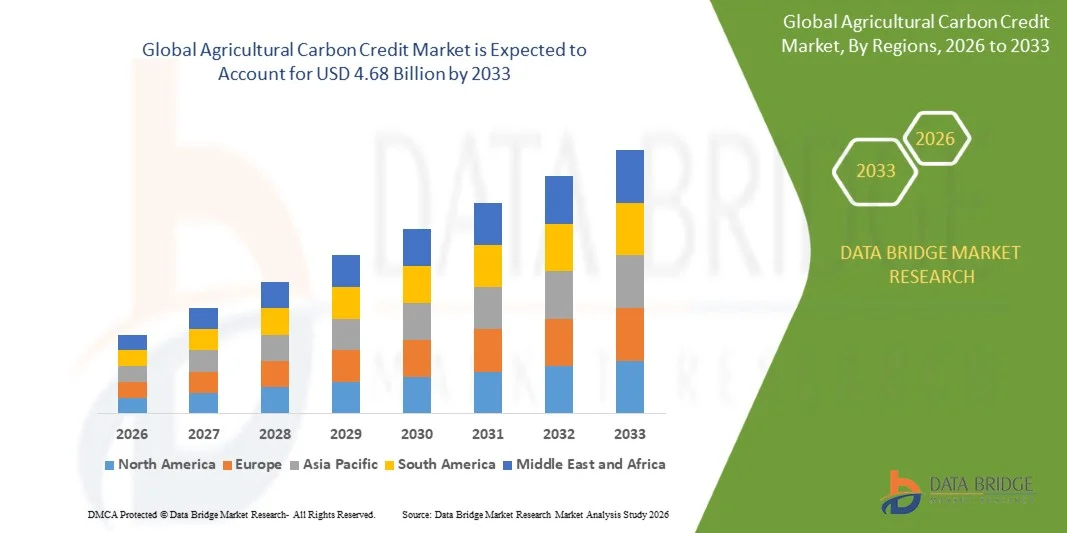
  • The global agricultural carbon credit market size was valued at USD 1.50 billion in 2025 and is expected to reach USD 4.68 billion by 2033, at a CAGR of 15.30% during the forecast period
  • The market growth is largely fuelled by the increasing global focus on climate change mitigation and net-zero emission targets, which is encouraging the adoption of carbon farming practices across agriculture
  • Rising participation of farmers in carbon trading programs and government-backed incentive schemes for sustainable land management is further accelerating market expansion

Agricultural Carbon Credit Market Analysis

  • The agricultural carbon credit market is witnessing strong momentum due to the expansion of regenerative agriculture practices such as cover cropping, reduced tillage, and agroforestry, which enhance soil carbon storage potential
  • Increasing integration of digital monitoring, reporting, and verification (MRV) technologies is improving transparency and credibility in carbon credit generation, thereby strengthening market trust and scalability
  • North America dominated the agricultural carbon credit market with the largest revenue share in 2025, driven by strong adoption of regenerative agriculture practices and well-established carbon trading ecosystems. The region benefits from advanced monitoring, reporting, and verification systems that enhance transparency and reliability in carbon credit generation. Increasing corporate demand for high-quality nature-based offsets and supportive climate policies further strengthen market growth
  • Asia-Pacific region is expected to witness the highest growth rate in the global agricultural carbon credit market, driven by rapid agricultural modernization, rising climate change initiatives, increasing adoption of sustainable farming practices, and expanding participation in voluntary carbon markets across emerging economies
  • The soil carbon sequestration segment held the largest market revenue share in 2025 driven by the widespread adoption of regenerative farming practices such as cover cropping, reduced tillage, and organic soil management that enhance carbon storage in agricultural soils. Soil-based projects are widely preferred due to their scalability, measurable impact, and strong participation from farmers across both developed and emerging economies

Agricultural Carbon Credit Market

Report Scope and Agricultural Carbon Credit Market Segmentation  

Attributes

Agricultural Carbon Credit Key Market Insights

Segments Covered

  • By Project Type: Forestry and Land Use, Soil Carbon Sequestration, Agroforestry, and Livestock Management
  • By Nature: Organic Farming Practices and Conventional Farming Practices
  • By Carbon Credit Type: Avoidance/Reduction Credits and Removal/Sequestration Credits
  • By Certification Standard: Verra, Gold Standard, Climate Action Reserve, and Others
  • By End Use: Voluntary Carbon Market and Compliance Carbon Market
  • By Application: Crop Production, Soil Management, Livestock Farming, and Sustainable Land Management

Countries Covered

North America

  • U.S.
  • Canada
  • Mexico

Europe

  • Germany
  • France
  • U.K.
  • Netherlands
  • Switzerland
  • Belgium
  • Russia
  • Italy
  • Spain
  • Turkey
  • Rest of Europe

Asia-Pacific

  • China
  • Japan
  • India
  • South Korea
  • Singapore
  • Malaysia
  • Australia
  • Thailand
  • Indonesia
  • Philippines
  • Rest of Asia-Pacific

Middle East and Africa

  • Saudi Arabia
  • U.A.E.
  • South Africa
  • Egypt
  • Israel
  • Rest of Middle East and Africa

South America

  • Brazil
  • Argentina
  • Rest of South America

Key Market Players

Indigo Ag (U.S.)
Nori (U.S.)
Pachama (U.S.)
Boomitra (U.S.)
Regrow Ag (U.S.)
• Truterra – Land O’Lakes (U.S.)
• Cargill (U.S.)
• Bayer (Germany)
• Syngenta (Switzerland)
• Yara International (Norway)
• Microsoft (U.S.)
• Shell plc (U.K.)
• Verra (U.S.)
• Gold Standard (Switzerland)
• Climate Action Reserve (U.S.)

Market Opportunities

• Expansion Of Regenerative Agriculture Practices
• Integration Of Digital Monitoring Reporting And Verification Technologies

Value Added Data Infosets

In addition to the insights on market scenarios such as market value, growth rate, segmentation, geographical coverage, and major players, the market reports curated by the Data Bridge Market Research also include import export analysis, production capacity overview, production consumption analysis, price trend analysis, climate change scenario, supply chain analysis, value chain analysis, raw material/consumables overview, vendor selection criteria, PESTLE Analysis, Porter Analysis, and regulatory framework.

Agricultural Carbon Credit Market Trends

“Rising Adoption Of Regenerative Farming And Soil Carbon Sequestration”

• The increasing focus on sustainable agriculture practices is significantly shaping the agricultural carbon credit market, as farmers and agribusinesses adopt regenerative farming methods to enhance soil carbon storage. Practices such as reduced tillage, cover cropping, and agroforestry are gaining traction due to their ability to improve soil health while generating verifiable carbon credits. This trend is strengthening participation in carbon trading systems and encouraging long-term sustainability in agricultural production systems

• Growing awareness of climate change and the need for greenhouse gas reduction has accelerated the adoption of carbon farming initiatives across both developed and emerging economies. Governments and private organizations are promoting soil carbon sequestration programs, enabling farmers to monetize sustainable practices. This has increased collaboration between agritech companies, carbon registries, and agricultural stakeholders to improve measurement and verification processes

• Demand for high-quality and traceable carbon offsets is influencing the development of advanced monitoring, reporting, and verification (MRV) systems. Digital platforms, satellite monitoring, and AI-based analytics are being increasingly used to ensure transparency and credibility in carbon credit generation. These innovations are helping build trust among corporate buyers participating in voluntary carbon markets

• For instance, in 2024, Indigo Ag in the U.S. and Nori in the U.S. expanded their soil carbon credit programs by enrolling more farmers in regenerative agriculture initiatives. These programs were designed to generate verified carbon credits through improved soil management practices and were marketed to corporate buyers seeking high-integrity offsets. The initiatives also included digital MRV tools to enhance transparency and data accuracy

• While adoption is increasing, long-term market growth depends on improved verification standards, scalable measurement systems, and consistent farmer participation. Strengthening carbon credit pricing mechanisms and ensuring regulatory alignment across regions will also be critical for sustained market expansion

Agricultural Carbon Credit Market Dynamics

Driver

“Rising Demand For Climate-Smart Agriculture And Net-Zero Commitments”

• Increasing global pressure to achieve net-zero emission targets is a major driver for the agricultural carbon credit market. Governments, corporations, and financial institutions are investing in carbon offset programs linked to agriculture to reduce overall emissions. This is encouraging widespread adoption of climate-smart farming practices that generate measurable carbon credits

• Expansion of voluntary carbon markets is further supporting market growth, as corporations seek nature-based solutions to offset their emissions. Agricultural carbon credits are gaining preference due to their co-benefits such as improved soil fertility, water retention, and biodiversity enhancement. This is increasing farmer participation in carbon trading ecosystems

• Growing integration of digital agriculture technologies is enabling efficient carbon tracking and verification. Remote sensing, blockchain-based registries, and farm management software are improving transparency and reducing transaction complexities. This is helping scale carbon credit generation across diverse agricultural landscapes

• For instance, in 2023, Microsoft in the U.S. and Bayer in Germany expanded partnerships with agricultural carbon programs to source high-quality soil carbon credits for their sustainability commitments. These initiatives supported farmers adopting regenerative practices while ensuring verified carbon offset supply for corporate net-zero goals. The programs also emphasized data-driven monitoring to improve credit reliability

• Despite strong demand, long-term growth depends on improving data accuracy, standardizing verification protocols, and ensuring fair revenue distribution to farmers. Policy support and investment in digital infrastructure will be essential for scaling adoption globally

Restraint/Challenge

“High Verification Costs And Limited Standardization Of Carbon Measurement”

• High costs associated with carbon measurement, reporting, and verification remain a significant challenge for the agricultural carbon credit market. Small and medium-scale farmers often face barriers in accessing certification systems due to expensive monitoring requirements and complex compliance procedures. This limits broader participation in carbon credit programs

• Lack of uniform global standards for agricultural carbon accounting creates inconsistencies in credit valuation and verification processes. Different methodologies across certification bodies can lead to uncertainty in credit pricing and reduced buyer confidence. This slows down market integration across regions

• Limited awareness among farmers regarding carbon credit monetization opportunities also restricts adoption in developing agricultural economies. Many smallholder farmers lack access to technical knowledge and digital tools required for participation in carbon markets, reducing overall scalability

• For instance, in 2024, carbon farming initiatives in Kenya and Brazil reported challenges in scaling participation due to high certification costs and inconsistent measurement frameworks. Programs involving smallholder farmers faced delays in credit issuance due to verification complexities and limited access to digital MRV infrastructure. These issues affected timely monetization of carbon credits

• Addressing these challenges will require cost-effective verification technologies, standardized global frameworks, and increased capacity-building programs for farmers. Strengthening public-private partnerships and expanding digital MRV adoption will be key to improving accessibility and accelerating market growth

Agricultural Carbon Credit Market Scope

The market is segmented on the basis of project type, nature, carbon credit type, certification standard, end use, and application.

• By Project Type

On the basis of project type, the agricultural carbon credit market is segmented into forestry and land use, soil carbon sequestration, agroforestry, and livestock management. The soil carbon sequestration segment held the largest market revenue share in 2025 driven by the widespread adoption of regenerative farming practices such as cover cropping, reduced tillage, and organic soil management that enhance carbon storage in agricultural soils. Soil-based projects are widely preferred due to their scalability, measurable impact, and strong participation from farmers across both developed and emerging economies.

The agroforestry segment is expected to witness the fastest growth rate from 2026 to 2033, driven by its dual benefits of carbon sequestration and improved agricultural productivity. Agroforestry systems integrate trees with crops and livestock, enabling long-term carbon storage while improving biodiversity, soil fertility, and farm resilience. Increasing government support and sustainability funding are further accelerating adoption of agroforestry-based carbon credit projects.

• By Nature

On the basis of nature, the market is segmented into organic farming practices and conventional farming practices. The organic farming practices segment held the largest market share in 2025 driven by the increasing adoption of chemical-free and sustainable farming methods that naturally support carbon sequestration in soil. Organic systems improve soil health and reduce emissions, making them highly suitable for generating high-integrity carbon credits.

The conventional farming practices segment is expected to witness the fastest growth rate from 2026 to 2033, driven by the gradual integration of sustainable farming techniques into large-scale commercial agriculture. Farmers using conventional methods are increasingly adopting hybrid approaches such as precision agriculture and reduced chemical input systems to participate in carbon credit programs while maintaining productivity.

• By Carbon Credit Type

On the basis of carbon credit type, the market is segmented into avoidance/reduction credits and removal/sequestration credits. The removal/sequestration credits segment held the largest market revenue share in 2025 driven by strong demand for nature-based carbon removal solutions such as soil carbon storage and afforestation projects. These credits are highly valued due to their long-term climate impact and credibility in voluntary carbon markets.

The avoidance/reduction credits segment is expected to witness the fastest growth rate from 2026 to 2033, driven by increasing implementation of emission reduction practices in agriculture such as methane reduction in livestock management and optimized fertilizer use. These credits are widely used by companies seeking cost-effective short-term carbon offset solutions.

• By Certification Standard

On the basis of certification standard, the market is segmented into Verra, Gold Standard, Climate Action Reserve, and others. The Verra segment held the largest market share in 2025 driven by its widely recognized Verified Carbon Standard (VCS) framework, which is extensively used for agricultural soil and land-based carbon projects. Its global acceptance and strong credibility make it the preferred certification for carbon credit generation.

The Gold Standard segment is expected to witness the fastest growth rate from 2026 to 2033, driven by increasing demand for high-quality and socially impactful carbon credits. Projects certified under Gold Standard often deliver additional environmental and community benefits, making them attractive to corporate buyers focused on sustainability and ESG goals.

• By End Use

On the basis of end use, the market is segmented into voluntary carbon market and compliance carbon market. The voluntary carbon market segment held the largest market revenue share in 2025 driven by rising corporate commitments to net-zero emissions and increasing demand for nature-based offset solutions. Companies are actively purchasing agricultural carbon credits to meet sustainability targets and improve environmental branding.

The compliance carbon market segment is expected to witness the fastest growth rate from 2026 to 2033, driven by the gradual integration of agricultural carbon credits into regulated emission trading systems. Governments are increasingly recognizing agriculture-based offsets as part of national climate strategies, supporting structured market participation.

• By Application

On the basis of application, the market is segmented into crop production, soil management, livestock farming, and sustainable land management. The soil management segment held the largest market share in 2025 driven by widespread adoption of practices such as regenerative agriculture, composting, and reduced tillage that significantly enhance carbon sequestration potential.

The livestock farming segment is expected to witness the fastest growth rate from 2026 to 2033, driven by increasing focus on methane reduction strategies, improved feed efficiency, and manure management systems. These practices are generating new opportunities for carbon credit generation within the animal agriculture sector.

Agricultural Carbon Credit Market Regional Analysis

• North America dominated the agricultural carbon credit market with the largest revenue share in 2025, driven by strong adoption of regenerative agriculture practices and well-established carbon trading ecosystems. The region benefits from advanced monitoring, reporting, and verification systems that enhance transparency and reliability in carbon credit generation. Increasing corporate demand for high-quality nature-based offsets and supportive climate policies further strengthen market growth

• Farmers and agribusinesses in the region highly value the financial incentives provided through carbon credit programs, along with the environmental benefits of improved soil health, biodiversity, and long-term land productivity. The integration of digital agriculture platforms with carbon tracking systems is also accelerating participation across large-scale farming operations and sustainable land management initiatives

• This widespread adoption is further supported by strong government support, high technological penetration in agriculture, and increasing participation of corporations in voluntary carbon markets, establishing agricultural carbon credits as a key sustainability tool for both environmental compliance and net-zero commitments

U.S. Agricultural Carbon Credit Market Insight

The U.S. agricultural carbon credit market captured the largest revenue share in 2025 within North America, fueled by rapid expansion of carbon farming programs and strong participation from private agritech companies. Farmers are increasingly adopting soil carbon sequestration practices such as reduced tillage, cover cropping, and rotational farming to generate tradable carbon credits. The growing involvement of corporate buyers such as food and beverage companies and technology firms is further strengthening demand. In addition, the integration of digital MRV platforms and blockchain-based carbon registries is significantly improving market transparency and credit verification.

Europe Agricultural Carbon Credit Market Insight

The Europe agricultural carbon credit market is expected to witness the fastest growth rate from 2026 to 2033, primarily driven by stringent climate policies and strong emphasis on achieving net-zero emissions targets. The region’s focus on sustainable agriculture and the European Green Deal is encouraging widespread adoption of carbon farming practices. Increasing demand for high-integrity carbon credits from corporates, along with strong certification frameworks, is fostering market expansion across both smallholder and large-scale farms.

U.K. Agricultural Carbon Credit Market Insight

The U.K. agricultural carbon credit market is expected to witness the fastest growth rate from 2026 to 2033, driven by growing government initiatives supporting sustainable land use and carbon neutrality goals. Farmers are increasingly participating in carbon offset schemes to diversify income sources while improving soil health and productivity. Rising corporate demand for verified carbon offsets and expanding voluntary carbon market participation are further accelerating market development.

Germany Agricultural Carbon Credit Market Insight

The Germany agricultural carbon credit market is expected to witness the fastest growth rate from 2026 to 2033, fueled by strong sustainability policies and increasing investment in climate-smart agriculture. The country’s emphasis on environmental innovation and precision farming is promoting the adoption of soil carbon sequestration and agroforestry projects. Integration of advanced digital farming technologies is also enhancing measurement accuracy and supporting scalable carbon credit generation.

Asia-Pacific Agricultural Carbon Credit Market Insight

The Asia-Pacific agricultural carbon credit market is expected to witness the fastest growth rate from 2026 to 2033, driven by rapid agricultural transformation, rising awareness of climate change, and increasing government support for sustainable farming practices. Countries such as China, India, and Australia are promoting carbon farming initiatives through policy incentives and pilot programs. Growing participation of agritech companies and expansion of voluntary carbon markets are further boosting regional adoption.

Japan Agricultural Carbon Credit Market Insight

The Japan agricultural carbon credit market is expected to witness strong growth from 2026 to 2033 due to the country’s focus on sustainable agriculture and climate resilience. Limited arable land and high emphasis on efficiency are driving adoption of advanced soil management and carbon sequestration practices. Integration of smart agriculture technologies and strong corporate sustainability commitments are further supporting market expansion across the agricultural sector.

China Agricultural Carbon Credit Market Insight

The China agricultural carbon credit market accounted for the largest market revenue share in Asia-Pacific in 2025, attributed to large-scale agricultural activities, strong government-led sustainability initiatives, and rapid adoption of climate-smart farming practices. The push towards carbon neutrality goals and development of national carbon trading systems are encouraging widespread participation in agricultural carbon credit programs. Expanding use of digital agriculture and strong domestic agritech capabilities are also key factors propelling market growth.

Agricultural Carbon Credit Market Share

The Agricultural Carbon Credit industry is primarily led by well-established companies, including:

• Indigo Ag (U.S.)
• Nori (U.S.)
• Pachama (U.S.)
• Boomitra (U.S.)
• Regrow Ag (U.S.)
• Truterra – Land O’Lakes (U.S.)
• Cargill (U.S.)
• Bayer (Germany)
• Syngenta (Switzerland)
• Yara International (Norway)
• Microsoft (U.S.)
• Shell plc (U.K.)
• Verra (U.S.)
• Gold Standard (Switzerland)
• Climate Action Reserve (U.S.)


SKU-

Get online access to the report on the World's First Market Intelligence Cloud

  • Interactive Data Analysis Dashboard
  • Company Analysis Dashboard for high growth potential opportunities
  • Research Analyst Access for customization & queries
  • Competitor Analysis with Interactive dashboard
  • Latest News, Updates & Trend analysis
  • Harness the Power of Benchmark Analysis for Comprehensive Competitor Tracking
Request for Demo

Research Methodology

Data collection and base year analysis are done using data collection modules with large sample sizes. The stage includes obtaining market information or related data through various sources and strategies. It includes examining and planning all the data acquired from the past in advance. It likewise envelops the examination of information inconsistencies seen across different information sources. The market data is analysed and estimated using market statistical and coherent models. Also, market share analysis and key trend analysis are the major success factors in the market report. To know more, please request an analyst call or drop down your inquiry.

The key research methodology used by DBMR research team is data triangulation which involves data mining, analysis of the impact of data variables on the market and primary (industry expert) validation. Data models include Vendor Positioning Grid, Market Time Line Analysis, Market Overview and Guide, Company Positioning Grid, Patent Analysis, Pricing Analysis, Company Market Share Analysis, Standards of Measurement, Global versus Regional and Vendor Share Analysis. To know more about the research methodology, drop in an inquiry to speak to our industry experts.

Customization Available

Data Bridge Market Research is a leader in advanced formative research. We take pride in servicing our existing and new customers with data and analysis that match and suits their goal. The report can be customized to include price trend analysis of target brands understanding the market for additional countries (ask for the list of countries), clinical trial results data, literature review, refurbished market and product base analysis. Market analysis of target competitors can be analyzed from technology-based analysis to market portfolio strategies. We can add as many competitors that you require data about in the format and data style you are looking for. Our team of analysts can also provide you data in crude raw excel files pivot tables (Fact book) or can assist you in creating presentations from the data sets available in the report.

Frequently Asked Questions

The agricultural carbon credit market size was valued at USD 1.50 billion in 2025.
The agricultural carbon credit market is to grow at a CAGR of 15.30% during the forecast period of 2026 to 2033.
The agricultural carbon credit market is segmented into six notable segments based on project type, nature, carbon credit type, certification standard, end use, and application. On the basis of project type, the market is segmented into forestry and land use, soil carbon sequestration, agroforestry, and livestock management. On the basis of nature, the market is segmented into organic farming practices and conventional farming practices. On the basis of carbon credit type, the market is segmented into avoidance/reduction credits and removal/sequestration credits. On the basis of certification standard, the market is segmented into Verra, Gold Standard, Climate Action Reserve, and others. On the basis of end use, the market is segmented into voluntary carbon market and compliance carbon market. On the basis of application, the market is segmented into crop production, soil management, livestock farming, and sustainable land management.
Companies such as Indigo Ag (U.S.), Nori (U.S.), Pachama (U.S.), Boomitra (U.S.), and Regrow Ag (U.S.), are major players in agricultural carbon credit market.

Industry Related Reports

Testimonial