



Global Artificial Intelligence in Agriculture Market, By Offering (Hardware, Software, and Services), Technology (Machine Learning (ML), Computer Vision, Natural Language Processing (NLP), Robotics & Automation, and Others), Application (Precision Farming, Livestock Monitoring, Weather Forecasting, Soil Management, Crop Health Monitoring, Supply Chain Optimization, and Others), Deployment Mode (On-Premise, and Cloud), End User (Farms, Agro-Tech Companies. Agrochemical Companies, Research Institutes, and Others) - Industry Trends and Forecast to 2032
Artificial Intelligence in Agriculture Market Size
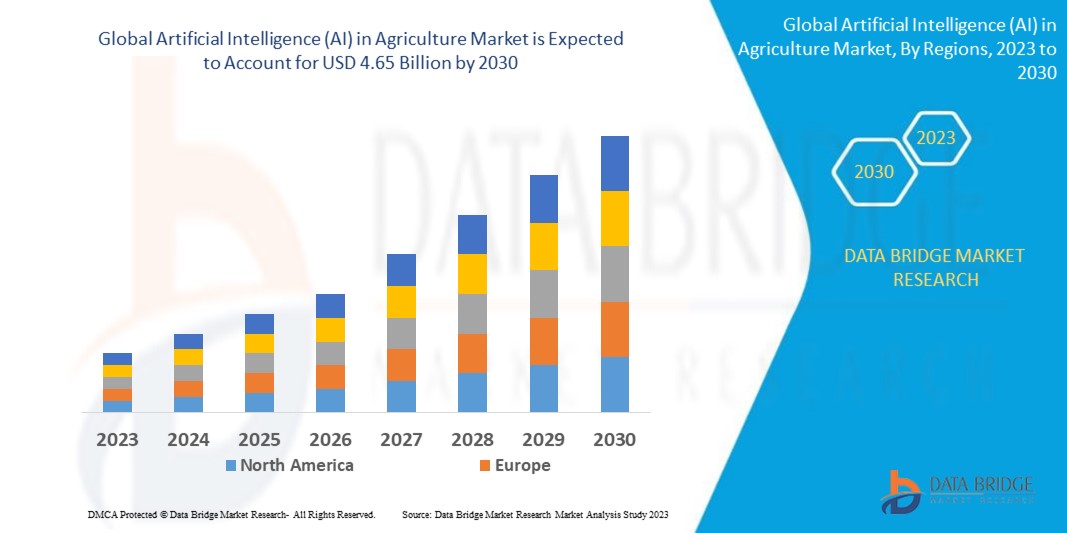
Data Bridge Market Research analyses that the global artificial intelligence in agriculture market is expected to reach a value of USD 10.49 billion by 2032 with 2.08 billion in 2025 at a CAGR of 22.39% during the forecast period. Global artificial intelligence in agriculture market report also comprehensively covers pricing analysis, patent analysis, and technological advancements.
Artificial Intelligence in Agriculture Market Analysis
Global artificial intelligence in agriculture market is poised for substantial growth, driven by several key factors. The primary driver is the significant cost reduction TEM solutions offer, which appeals to businesses aiming to optimize their telecom expenditures. The increasing adoption of mobile phones and other portable devices further fuels the demand for effective expense management solutions. TEM provides critical expense transparency, enabling organizations to better understand and control their telecom spending. Additionally, the rise of IoT and cloud-based applications has led to a higher demand for TEM solutions, as these technologies introduce new complexities in telecom expense management. However, the market faces restraints, notably the challenge of adhering to varying telecom regulations and compliance requirements across different regions, which complicates implementation and management. Despite these challenges, there are considerable opportunities for growth. Automation technology for telecom expense management presents a significant opportunity, as does the outsourcing of TEM solutions, which can offer cost efficiencies and expertise.
|
Report Metric |
Details |
|
Forecast Period |
2025 to 2032 |
|
Base Year |
2024 |
|
Historic Years |
2023 (2018-2022) |
|
Quantitative Units |
Revenue in USD Billion |
|
Segments Covered |
By Offering (Hardware, Software, and Services), Technology [Machine Learning (ML), Computer Vision, Natural Language Processing (NLP), Robotics & Automation, and Others), Application (Precision Farming, Livestock Monitoring, Weather Forecasting, Soil Management, Crop Health Monitoring, Supply Chain Optimization, and Others), Deployment Mode (On-Premise, and Cloud), End-User (Farms, Agro-Tech Companies. Agrochemical Companies, Research Institutes, Others) |
|
Countries Covered |
U.S., Canada and Mexico, Germany, France, U.K., Netherlands, Switzerland, Belgium, Russia, Italy, Spain, Turkey, rest of Europe, China, Japan, India, South Korea, Singapore, Malaysia, Australia, Thailand, Indonesia, Philippines, rest of Asia-Pacific, Saudi Arabia, U.A.E, South Africa, Egypt, Israel, rest of Middle East and Africa, Brazil, Argentina and rest of South America |
|
Market Players Covered |
Deere & Company, IBM, Microsoft, Google, OpenAI, Open Text Corporation, ClimateAi, AgEagle Aerial Systems Inc., CNH Industrial N.V., AGCO Corporation, KUBOTA Corporation, YANMAR HOLDINGS CO., LTD., DeLaval, Lely, Raven Industries, Inc., Gamaya, Bayer AG, VALMONT INDUSTRIES, INC., Cisco Systems, Inc., Oracle, Harvest CROO Robotics LLC, ADM, SYNGENTA GLOBAL, Corteva, and Bowery Farming Inc. among others |
Market Definition
The global artificial intelligence in agriculture market encompasses technologies and solutions that leverage AI to enhance agricultural practices. This includes machine learning, computer vision, and robotics to optimize crop management, precision farming, and resource allocation. The market covers AI-driven tools for data analysis, autonomous machinery, and predictive analytics aimed at increasing efficiency, yield, and sustainability in agricultural operations. It serves a broad range of applications including crop monitoring, soil management, pest control, and supply chain optimization.
Global Artificial Intelligence in Agriculture Market Dynamics
Drivers
- Increasing Crop Monitoring and Yield Prediction Accuracy
Artificial Intelligence (AI) in agriculture enhances crop monitoring and yield prediction accuracy. By leveraging machine learning algorithms and data analytics, AI can analyze vast amounts of data from various sources, such as satellite imagery, soil sensors, and weather forecasts. This enables farmers to monitor crop health, identify pest infestations, and predict yields more accurately. Consequently, AI-driven insights help optimize resource allocation, improve decision-making, and increase overall agricultural productivity.
For instance,
- In July 2021, according to the blog published by Gramener, predicting crop yield using machine learning and AI became increasingly relevant. The article discussed how spatial analysis and IoT devices enhanced crop monitoring and yield prediction. AI and machine learning models utilizing satellite imagery and climate data, improved accuracy in predicting crop yields by assessing soil conditions and weather patterns. The use of these technologies benefited agricultural producers by enabling remote monitoring, efficient resource mapping, and predictive analytics, which facilitated better decision-making and planning. This advancement supports more effective crop management
Increasing Implementation of Better Farming Techniques with AI
Increasing the implementation of better farming techniques with AI involves optimizing the use of inputs such as water, fertilizers, and pesticides. AI-driven solutions enable precise management of these resources, ensuring they are applied efficiently and only where needed. This reduces costs and enhances productivity by minimizing waste and maximizing crop yields, ultimately leading to more sustainable and profitable farming practices.
For instance,
- In January 2024, according to an article published by Intellias, AI significantly impacted agriculture by enhancing farming techniques. AI enabled precise management of water, fertilizers, and pesticides, reducing costs and boosting productivity. Automated systems optimized irrigation and fertilizer application, leading to better crop yields and resource efficiency. These advancements supported more sustainable and profitable farming practices, ultimately benefiting farmers through improved yields and cost savings
Opportunity
- Automation Technology for Telecom Expense Management
Automation technology for Telecom Expense Management (TEM) streamlines processes, enhances accuracy, and reduces costs. By leveraging automated tools and software, telecom operators and businesses efficiently manage invoices, track expenses, and analyse usage patterns in real-time. This technology improves transparency, control, and enables proactive decision-making based on data-driven insights. Moreover, automation minimizes human error, ensures compliance with regulatory requirements, and optimizes resource allocation, transforming TEM into a strategic asset
For instance,
- In July 2022, according to an article published by Brightfin, switching to an automated telecom expense management system brought several benefits. First, it significantly reduced the number of helpdesk tickets related to telecom issues, freeing up IT resources. This automation also saved employees' time by handling routine tasks like invoice processing and expense management, allowing them to focus on more critical projects. Furthermore, automation reduced human errors, ensuring consistency and efficiency in operations. Finally, the system provided valuable data insights and helped lower costs through streamlined telecom management processes
- According to an article published by the PAG, automation is transforming telecom expense management. It has streamlined tasks such as monitoring usage and reconciling invoices, particularly beneficial for hospitals and healthcare organizations. Automated solutions reduce the time and effort spent on audits, identifying significant savings by optimizing equipment usage and telecom contracts
Restraint/Challenge
- Persistent Data Privacy and Security Concerns
Despite the promising advancements in AI for agriculture, persistent data privacy and security concerns overshadow these benefits. As AI systems collect and analyse vast amounts of sensitive agricultural data, including crop yields, soil conditions, and farm operations, they expose farmers to significant risks. Unauthorized access and breaches of this data can lead to severe consequences, including loss of intellectual property, manipulation of sensitive information, and increased vulnerability to cyberattacks. These security issues undermine trust in AI technologies and hinder their widespread adoption.
For instance
- In August 2023, according to blog published by ShardSecure, agriculture faced increasing data privacy and security concerns. Cyberattacks, such as the 2021 ransomware attack on JBS Foods, highlighted the sector's vulnerability. With precision farming generating vast amounts of data and the rise of IoT devices, the risks have amplified. The newly established Food and Agriculture Information Sharing and Analysis Center aimed to address these issues. However, many agribusinesses still struggle with data security, compliance, and protecting against AI-related threats. Improved security measures can benefit companies by safeguarding sensitive data and reducing the risk of costly disruptions
Post Covid-19 Impact on Global Artificial Intelligence in Agriculture Market
The post COVID-19 landscape has significantly impacted the global market. However, as the economy gradually recovers, there is an increased focus on infrastructure development, leading to a resurgence in projects. The industry is adapting to new norms with enhanced safety protocols and digital technologies to streamline processes. The demand for telecom services is rebounding as construction projects regain momentum, presenting opportunities for market players to contribute to the nation's infrastructure growth in the post-pandemic era.
Recent Developments
For instance,
- In June 2024, TeeJet Technologies launched the FM9380-F75 electromagnetic flow meter, featuring innovative no-moving-parts design for maintenance-free operation, optimized performance across fluid conditions, and wide application compatibility, benefiting their precision farming product portfolio and enhancing operational efficiency
- In November 2023, Kubota Corporation, showcased the Agri Robo KVT at Agritechnica marking a significant advancement in autonomous farming technology. This enhanced tractor addressed labour shortages, enhanced safety, and promoted efficient farming, benefiting Kubota with increased market competitiveness and innovation leadership
Global Artificial Intelligence in Agriculture Market Scope
The artificial intelligence in agriculture market is segmented into five notable segments, which are based on the basis of offering, technology, application, deployment mode and end user. The growth amongst these segments will help you analyse meagre growth segments in the industries and provide the users with a valuable market overview and market insights to help them make strategic decisions for identifying core market applications.
This research report categorizes the global artificial intelligence in agriculture market into the following segments:
OFFERING
- HARDWARE
- SOFTWARE
- SERVICES
On the basis of offering, the market is segmented into hardware, software and services.
TECHNOLOGY
- MACHINE LEARNING (ML)
- COMPUTER VISION
- NATURAL LANGUAGE PROCESSING (NLP)
- ROBOTICS & AUTOMATION
- OTHERS
On the basis of technology, the market is segmented into machine learning (ML), computer vision, natural language processing (NLP), robotics & automation and others.
APPLICATION
- PRECISION FARMING
- LIVESTOCK MONITORING
- WEATHER FORECASTING
- SOIL MANAGEMENT
- CROP HEALTH MONITORING
- SUPPLY CHAIN OPTIMIZATION
- OTHERS
On the basis of application, the market is segmented into precision farming, livestock monitoring, weather forecasting, soil management, crop health monitoring, supply chain optimization and others.
DEPLOYMENT MODE
- CLOUD
- ON-PREMISE
On the basis of deployment mode, the market is segmented into cloud and on-premise.
END USER
- FARMS
- AGRO-TECH COMPANIES
- AGROCHEMICAL COMPANIES
- RESEARCH INSTITUTES
- OTHERS
On the basis of end user, the market is segmented into farms, agro-tech companies, agrochemical companies, research institutes and others.
Global Artificial Intelligence in Agriculture Market
Global artificial intelligence in agriculture market is segmented into five notable segments, which are based on the basis of offering, technology, application, deployment mode and end user. The countries covered in the global internet of things (IOT) in agriculture market is U.S., Canada and Mexico in North America, Germany, France, U.K., Netherlands, Switzerland, Belgium, Russia, Italy, Spain, Turkey, rest of Europe, China, Japan, India, South Korea, Singapore, Malaysia, Australia, Thailand, Indonesia, Philippines, rest of Asia-Pacific, Saudi Arabia, U.A.E, South Africa, Egypt, Israel, rest of Middle East and Africa, Brazil, Argentina and rest of South America.
In North America, U.S. is dominating as the country as highest number of hardware component providers. Also, in Europe, U.K. is dominating owing to its technological advancement across the country. In Asia-Pacific, China is dominating as the country have largest manufactures of the hardware components in the region.
The country section of the report also provides individual market-impacting factors and changes in market regulation that impact the current and future trends of the market. Data points like downstream and upstream value chain analysis, technical trends, and Porter’s five forces analysis, case studies are some of the pointers used to forecast the market scenario for individual countries. Also, the presence and availability of APAC brands and their challenges faced due to large or scarce competition from local and domestic brands, the impact of domestic tariffs, and trade routes are considered while providing forecast analysis of the country data.
Competitive Landscape and Global Artificial Intelligence in Agriculture Market Share Analysis
Global artificial intelligence in agriculture market competitive landscape provides details of the competitor. Details included are company overview, company financials, revenue generated, market potential, investment in research and development, new market initiatives, APAC & SEA presence, production sites and facilities, production capacities, company strengths and weaknesses, product launch, product width and breadth, application dominance. The above data points provided are only related to the companies' focus related to global artificial intelligence in agriculture market. Some of the major players operating in the global artificial intelligence in agriculture market are: Open Text Corporation, OpenAI, VALMONT INDUSTRIES, INC., AGCO Corporation, and IBM among others.
SKU-
세계 최초의 시장 정보 클라우드 보고서에 온라인으로 접속하세요

- 대화형 데이터 분석 대시보드
- 높은 성장 잠재력 기회를 위한 회사 분석 대시보드
- 사용자 정의 및 질의를 위한 리서치 분석가 액세스
- 대화형 대시보드를 통한 경쟁자 분석
- 최신 뉴스, 업데이트 및 추세 분석
- 포괄적인 경쟁자 추적을 위한 벤치마크 분석의 힘 활용
연구 방법론
데이터 수집 및 기준 연도 분석은 대규모 샘플 크기의 데이터 수집 모듈을 사용하여 수행됩니다. 이 단계에는 다양한 소스와 전략을 통해 시장 정보 또는 관련 데이터를 얻는 것이 포함됩니다. 여기에는 과거에 수집한 모든 데이터를 미리 검토하고 계획하는 것이 포함됩니다. 또한 다양한 정보 소스에서 발견되는 정보 불일치를 검토하는 것도 포함됩니다. 시장 데이터는 시장 통계 및 일관된 모델을 사용하여 분석하고 추정합니다. 또한 시장 점유율 분석 및 주요 추세 분석은 시장 보고서의 주요 성공 요인입니다. 자세한 내용은 분석가에게 전화를 요청하거나 문의 사항을 드롭하세요.
DBMR 연구팀에서 사용하는 주요 연구 방법론은 데이터 마이닝, 시장에 대한 데이터 변수의 영향 분석 및 주요(산업 전문가) 검증을 포함하는 데이터 삼각 측량입니다. 데이터 모델에는 공급업체 포지셔닝 그리드, 시장 타임라인 분석, 시장 개요 및 가이드, 회사 포지셔닝 그리드, 특허 분석, 가격 분석, 회사 시장 점유율 분석, 측정 기준, 글로벌 대 지역 및 공급업체 점유율 분석이 포함됩니다. 연구 방법론에 대해 자세히 알아보려면 문의를 통해 업계 전문가에게 문의하세요.
사용자 정의 가능
Data Bridge Market Research는 고급 형성 연구 분야의 선두 주자입니다. 저희는 기존 및 신규 고객에게 목표에 맞는 데이터와 분석을 제공하는 데 자부심을 느낍니다. 보고서는 추가 국가에 대한 시장 이해(국가 목록 요청), 임상 시험 결과 데이터, 문헌 검토, 재생 시장 및 제품 기반 분석을 포함하도록 사용자 정의할 수 있습니다. 기술 기반 분석에서 시장 포트폴리오 전략에 이르기까지 타겟 경쟁업체의 시장 분석을 분석할 수 있습니다. 귀하가 원하는 형식과 데이터 스타일로 필요한 만큼 많은 경쟁자를 추가할 수 있습니다. 저희 분석가 팀은 또한 원시 엑셀 파일 피벗 테이블(팩트북)로 데이터를 제공하거나 보고서에서 사용 가능한 데이터 세트에서 프레젠테이션을 만드는 데 도움을 줄 수 있습니다.











