


Global Antimicrobial Polymer Films Market Segmentation, By Material (Natural Polymers, Synthetic Polymers, and Biodegradable PolymersAntimicrobial Agent (Metal-Based Agents, Organic Agents, Quaternary Ammonium Compounds (QACs), Chitosan and Derivatives, and Others), Application (Food Packaging, Healthcare and Medical, Industrial, Consumer Goods, and Others), Thickness (Up to 50 Microns, 50-100 Microns, and Above 100 Microns) - Industry Trends and Forecast to 2032
Antimicrobial Polymer Films Market Analysis
The antimicrobial polymer films market is experiencing significant growth due to rising concerns about hygiene and infection control across various industries, including healthcare, food packaging, and consumer goods. These films are designed to prevent the growth of bacteria, fungi, and other harmful microorganisms, enhancing product safety and longevity. Innovations in antimicrobial agents, such as silver, copper, and zinc-based compounds, have advanced the functionality of these films, making them more effective in various applications. The healthcare industry is a major driver for this market, with antimicrobial polymer films being widely used in wound care, medical device packaging, and surgical drapes. In addition, food packaging is another key area of growth, with antimicrobial films helping to extend shelf life and reduce contamination risks. The increasing adoption of sustainable materials is also pushing the development of biodegradable antimicrobial polymers, offering eco-friendly alternatives to traditional plastic films. Market players are investing in research and development to improve film durability, effectiveness, and cost efficiency, which further supports market expansion. Regulatory approvals and growing consumer awareness of hygiene benefits are expected to drive market demand in the coming years.
Antimicrobial Polymer Films Market Size
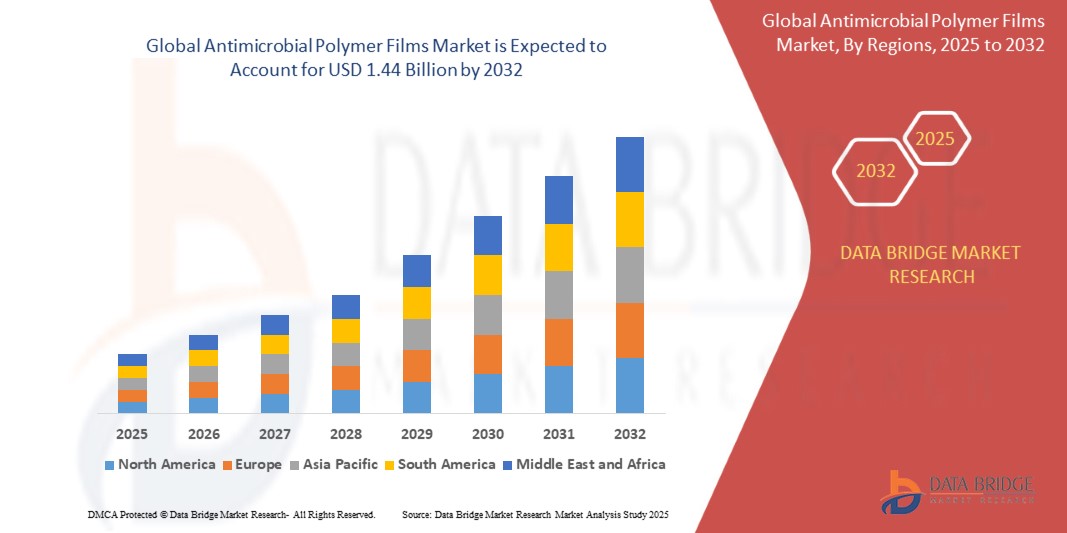
The global antimicrobial polymer films market size was valued at USD 1.09 billion in 2024 and is projected to reach USD 1.44 billion by 2032, with a CAGR of 3.50% during the forecast period of 2025 to 2032. In addition to the insights on market scenarios such as market value, growth rate, segmentation, geographical coverage, and major players, the market reports curated by the Data Bridge Market Research also include import export analysis, production capacity overview, production consumption analysis, price trend analysis, climate change scenario, supply chain analysis, value chain analysis, raw material/consumables overview, vendor selection criteria, PESTLE Analysis, Porter Analysis, and regulatory framework.
Antimicrobial Polymer Films Market Trends
“Growing Demand for Sustainable and Eco-Friendly Materials”
A key trend in the antimicrobial polymer films market is the growing demand for sustainable and eco-friendly materials. With increasing environmental concerns, consumers and businesses are seeking biodegradable antimicrobial polymer films as alternatives to traditional plastics. Companies are now focusing on developing films made from renewable resources such as biopolymers, which are effective in preventing microbial growth but also environmentally friendly. For instance, some companies have introduced antimicrobial films made from plant-based materials such as polylactic acid (PLA), offering the benefits of antimicrobial protection while reducing the environmental impact. The healthcare and food packaging sectors are particularly adopting these sustainable films, as they align with both hygiene and sustainability goals. As the market for eco-conscious products continues to expand, this trend is expected to drive the development and adoption of biodegradable antimicrobial polymer films, thereby increasing their prevalence in packaging, medical, and consumer goods applications.
Report Scope and Antimicrobial Polymer Films Market Segmentation
|
Attributes |
Antimicrobial Polymer Films Key Market Insights |
|
Segments Covered |
|
|
Countries Covered |
U.S., Canada and Mexico in North America, Germany, France, U.K., Netherlands, Switzerland, Belgium, Russia, Italy, Spain, Turkey, Rest of Europe in Europe, China, Japan, India, South Korea, Singapore, Malaysia, Australia, Thailand, Indonesia, Philippines, Rest of Asia-Pacific (APAC) in the Asia-Pacific (APAC), Saudi Arabia, U.A.E., South Africa, Egypt, Israel, Rest of Middle East and Africa (MEA) as a part of Middle East and Africa (MEA), Brazil, Argentina and Rest of South America as part of South America |
|
Key Market Players |
Alta Max LLC (U.S.), Addmaster (U.K.) Limited (U.K.), Dow (U.S.), Microban International (U.S.), Sciessent (U.S.), Avient Corporation (U.S.), Sanitized AG (Switzerland), Ampacet Corporation (U.S.), BioCote Limited (U.K.), Parx Materials N.V. (Belgium), Tredegar Corporation (U.S.), DFP Holding BV (Netherlands), ENVIRONMENT PROTECTION TECHNOLOGY CO., LTD. (China), Kitozyme, LLC. (Belgium), Mujo Learning Systems Inc. (U.S.), Aldzhipak LLC (Kazakhstan), Thermo Fisher Scientific Inc. (U.S.), DUNMORE (U.S.), Silver Polycoat Industries (India), Filiriko (Italy), and BWAY Corporation (U.S.) |
|
Market Opportunities |
|
|
Value Added Data Infosets |
In addition to the insights on market scenarios such as market value, growth rate, segmentation, geographical coverage, and major players, the market reports curated by the Data Bridge Market Research also include import export analysis, production capacity overview, production consumption analysis, price trend analysis, climate change scenario, supply chain analysis, value chain analysis, raw material/consumables overview, vendor selection criteria, PESTLE Analysis, Porter Analysis, and regulatory framework. |
Antimicrobial Polymer Films Market Definition
Antimicrobial polymer films are thin layers of polymer materials that are infused with antimicrobial agents designed to prevent the growth and spread of harmful microorganisms, such as bacteria, fungi, and viruses. These films are commonly used in applications where hygiene and microbial control are essential, including medical devices, food packaging, and protective coatings.
Antimicrobial Polymer Films Market Dynamics
Drivers
- Increasing Demand for Hygiene and Safety
The increasing demand for hygiene and safety, fueled by heightened awareness around health risks, especially due to the COVID-19 pandemic, is a key driver for the growth of the antimicrobial polymer films market. In healthcare settings, these films are widely used in medical devices, surgical instruments, and hospital equipment to reduce the risk of infections caused by bacteria, viruses, and fungi. For instance, antimicrobial polymer films are used in wound dressings and hospital bedding, providing an added layer of protection against pathogens. In addition, the food packaging industry is adopting antimicrobial films to extend the shelf life of perishable products and prevent microbial growth, ensuring the safety and freshness of foods. Consumer goods, such as antimicrobial-treated textiles and coatings for electronic devices, further contribute to the market’s expansion. These films offer a convenient and highly effective solution for maintaining hygiene in various industries, thus supporting the growing demand for protective measures against harmful microorganisms.
- Rising Prevalence of Healthcare-Associated Infections (HAIs)
The rising prevalence of healthcare-associated infections (HAIs) is a significant driver for the antimicrobial polymer films market, particularly in medical devices, hospital equipment, and surgical instruments. With HAIs being a major concern in healthcare settings, there is an increasing focus on preventing the spread of harmful microorganisms such as bacteria and fungi. Antimicrobial polymer films provide a highly effective solution by inhibiting microbial growth on surfaces, thus reducing the risk of infections. For instance, antimicrobial films are commonly applied to surfaces of medical devices such as catheters, surgical instruments, and ventilators, where they help minimize bacterial colonization and subsequent infections. These films are also used on hospital bed linens and medical packaging to prevent contamination. As healthcare providers continue to prioritize patient safety and infection control, the demand for antimicrobial polymer films in the healthcare sector continues to rise, further fueling the market growth.
Opportunities
- Growing Food Packaging Industry
The growth in the food packaging industry is driving the increasing adoption of antimicrobial polymer films, as these films play a vital role in enhancing food safety and extending shelf life. With rising consumer demand for fresh, safe, and long-lasting food products, the need to prevent microbial growth, which can lead to spoilage and foodborne illnesses, has become more critical. Antimicrobial films are now being used in various food packaging applications, including meat, dairy, and ready-to-eat meals, to inhibit the growth of bacteria, fungi, and mold. For instance, antimicrobial polymer films are used in packaging for fresh produce to reduce spoilage and extend the freshness of fruits and vegetables. These films are also being integrated into vacuum-sealed packages to preserve meat and seafood, preventing bacterial contamination. As consumers become more health-conscious and the demand for convenient, safe food continues to rise, the antimicrobial polymer films market sees significant growth opportunities in food packaging, offering an effective solution to meet these demands.
- Increasing Technological Advancements in Antimicrobial Agents and Polymer Materials
Technological advancements in antimicrobial agents and polymer materials are significantly enhancing the performance and versatility of antimicrobial polymer films, opening up new market opportunities across various industries. Innovations such as the development of more effective and longer-lasting antimicrobial agents, including silver-based, copper-based, and natural antimicrobial compounds, are improving the efficiency of these films in preventing bacterial, viral, and fungal growth. In addition, advancements in polymer materials, such as biodegradable and bio-based polymers, are making antimicrobial films more sustainable, which is appealing to environmentally-conscious consumers and industries. For instance, the integration of silver nanoparticles in antimicrobial films has shown improved efficacy in combating a wide range of pathogens, making these films ideal for use in healthcare environments, food packaging, and consumer goods. As these technological developments continue, antimicrobial polymer films are becoming more adaptable and cost-effective, creating opportunities for widespread adoption in sectors such as medical devices, food packaging, and electronics, where hygiene and safety are paramount.
Restraints/Challenges
- High Production Costs
High production costs are a significant challenge in the antimicrobial polymer films market, as the incorporation of advanced antimicrobial agents and specialized polymers increases the overall manufacturing expenses. These films require precise and often complex production processes to ensure the effective embedding of antimicrobial agents, which can raise the cost per unit when compared to traditional, non-antimicrobial materials. For instance, antimicrobial agents such as silver nanoparticles or copper compounds, while highly effective, are expensive and require advanced technology for integration into polymer films. This results in a higher price point for the end product. In industries such as food packaging or healthcare, where cost-effectiveness is a critical factor, the high production costs of antimicrobial polymer films can limit their adoption, as companies may opt for more affordable alternatives, such as conventional plastics or lower-cost coatings. The high price barrier therefore restricts the market potential of antimicrobial films, especially in price-sensitive sectors, making it a key challenge in driving widespread usage and market growth.
- Rigorous Approval Processes
Regulatory hurdles are a significant challenge in the antimicrobial polymer films market, as these products are subject to rigorous approval processes, especially in critical industries such as healthcare and food packaging. Regulatory agencies such as the FDA and EPA require extensive testing to ensure that antimicrobial polymer films meet safety and efficacy standards, which can delay product development and market entry. For instance, in healthcare applications, antimicrobial films must be thoroughly tested for their safety in medical environments, ensuring they do not cause adverse reactions in patients or degrade over time. Similarly, in food packaging, these films must be proven to be safe for direct contact with food and comply with regulations on chemical leaching or toxicity. This extensive documentation and testing add to the time and cost of development but also increase the complexity of introducing new products. The lengthy regulatory processes may cause delays in bringing innovative antimicrobial films to market, making it a significant barrier to growth and adoption, particularly in regions with strict regulatory frameworks. This challenge can deter manufacturers and limit the market expansion of antimicrobial polymer films.
This market report provides details of new recent developments, trade regulations, import-export analysis, production analysis, value chain optimization, market share, impact of domestic and localized market players, analyses opportunities in terms of emerging revenue pockets, changes in market regulations, strategic market growth analysis, market size, category market growths, application niches and dominance, product approvals, product launches, geographic expansions, technological innovations in the market. To gain more info on the market contact Data Bridge Market Research for an Analyst Brief, our team will help you take an informed market decision to achieve market growth.
Impact and Current Market Scenario of Raw Material Shortage and Shipping Delays
Data Bridge Market Research offers a high-level analysis of the market and delivers information by keeping in account the impact and current market environment of raw material shortage and shipping delays. This translates into assessing strategic possibilities, creating effective action plans, and assisting businesses in making important decisions. Apart from the standard report, we also offer in-depth analysis of the procurement level from forecasted shipping delays, distributor mapping by region, commodity analysis, production analysis, price mapping trends, sourcing, category performance analysis, supply chain risk management solutions, advanced benchmarking, and other services for procurement and strategic support.
Expected Impact of Economic Slowdown on the Pricing and Availability of Products
When economic activity slows, industries begin to suffer. The forecasted effects of the economic downturn on the pricing and accessibility of the products are taken into account in the market insight reports and intelligence services provided by DBMR. With this, our clients can typically keep one step ahead of their competitors, project their sales and revenue, and estimate their profit and loss expenditures.
Antimicrobial Polymer Films Market Scope
The market is segmented on the basis of material, antimicrobial agent, application, and thickness. The growth amongst these segments will help you analyse meagre growth segments in the industries and provide the users with a valuable market overview and market insights to help them make strategic decisions for identifying core market applications.
Material
- Natural Polymers
- Chitosan-based Films
- Alginate-based Films
- Gelatin-based Films
- Synthetic Polymers
- Polyethylene (PE)
- Polypropylene (PP)
- Polyethylene Terephthalate (PET)
- Polyvinyl Chloride (PVC)
- Others (PU, PS)
- Biodegradable Polymers
- Polylactic Acid (PLA)
- Polyhydroxyalkanoates (PHA)
Antimicrobial Agent
- Metal-Based Agents
- Silver
- Copper
- Zinc Oxide
- Organic Agents
- Essential oils
- Enzymes
- Quaternary Ammonium Compounds (QACs)
- Chitosan and Derivatives
- Others
- Biguanides
- Halogenated agents
Application
- Food Packaging
- Fresh Produce
- Meat, Poultry, and Seafood
- Bakery Products
- Dairy Products
- Ready-to-Eat Foods
- Healthcare and Medical
- Wound Dressings
- Surgical Drapes
- Medical Device Packaging
- Pharmaceutical Packaging
- Industrial
- Protective Films for Equipment
- Electronics Packaging
- Consumer Goods
- Hygiene Products
- Personal Care Products
- Others
- Agricultural Films
- Building and Construction
Thickness
- Up to 50 Microns
- 50-100 Microns
- Above 100 Microns
Antimicrobial Polymer Films Market Regional Analysis
The market is analysed and market size insights and trends are provided by country, material, antimicrobial agent, application, and thickness as referenced above.
The countries covered in the market report are U.S., Canada and Mexico in North America, Germany, France, U.K., Netherlands, Switzerland, Belgium, Russia, Italy, Spain, Turkey, Rest of Europe in Europe, China, Japan, India, South Korea, Singapore, Malaysia, Australia, Thailand, Indonesia, Philippines, Rest of Asia-Pacific (APAC) in the Asia-Pacific (APAC), Saudi Arabia, U.A.E., South Africa, Egypt, Israel, Rest of Middle East and Africa (MEA) as a part of Middle East and Africa (MEA), Brazil, Argentina and Rest of South America as part of South America.
Asia-Pacific is experiencing highest growth in the antimicrobial polymer films market due to increasing industrialization, rising healthcare demands, and a growing awareness of hygiene. Countries such as China, India, and Japan are witnessing high adoption rates of antimicrobial films in sectors such as packaging, medical, and consumer goods. In addition, the region's expanding population and the need for improved sanitation are contributing to market growth. Strong investments in research and development are further driving innovation in antimicrobial technologies within this region.
The country section of the report also provides individual market impacting factors and changes in regulation in the market domestically that impacts the current and future trends of the market. Data points such as down-stream and upstream value chain analysis, technical trends and porter's five forces analysis, case studies are some of the pointers used to forecast the market scenario for individual countries. Also, the presence and availability of global brands and their challenges faced due to large or scarce competition from local and domestic brands, impact of domestic tariffs and trade routes are considered while providing forecast analysis of the country data.
Antimicrobial Polymer Films Market Share
The market competitive landscape provides details by competitor. Details included are company overview, company financials, revenue generated, market potential, investment in research and development, new market initiatives, global presence, production sites and facilities, production capacities, company strengths and weaknesses, product launch, product width and breadth, application dominance. The above data points provided are only related to the companies' focus related to market.
Antimicrobial Polymer Films Market Leaders Operating in the Market Are:
- Alta Max LLC (U.S.)
- Addmaster (U.K.) Limited (U.K.)
- Dow (U.S.)
- Microban International (U.S.)
- Sciessent (U.S.)
- Avient Corporation (U.S.)
- Sanitized AG (Switzerland)
- Ampacet Corporation (U.S.)
- BioCote Limited (U.K.)
- Parx Materials N.V. (Belgium)
- Tredegar Corporation (U.S.)
- DFP Holding BV (Netherlands)
- ENVIRONMENT PROTECTION TECHNOLOGY CO., LTD. (China)
- Kitozyme, LLC. (Belgium)
- Mujo Learning Systems Inc. (U.S.)
- Aldzhipak LLC (Kazakhstan)
- Thermo Fisher Scientific Inc. (U.S.)
- DUNMORE (U.S.)
- Silver Polycoat Industries (India)
- Filiriko (Italy)
- BWAY Corporation (U.S.)
Latest Developments in Antimicrobial Polymer Films Market
- In November 2024, Cedo, one of Europe’s largest manufacturers of household waste bags made from recycled plastics, launched the UK’s first antibacterial refuse sack for domestic use
- In November 2023, Coveris, a medical packaging manufacturer, announced the upcoming launch of Formpeel P, a new recyclable, flexible thermoforming film solution designed for various medical packaging applications
- In October 2021, Berlin-based startup Muj revealed a development cooperation with Institut für Fasern & Papier GmbH to create alginate-based packaging films
- In May 2021, Canadian bioplastics manufacturer TerraVerdae Bioworks Inc. introduced new polyhydroxyalkanoate (PHA) resins for blown and cast films, injection molding, and thermoforming
- In February 2021, Toppan Printing, a global leader in communication, security, packaging, décor materials, and electronics solutions, developed film-type Virusweeper packaging with antiviral and antibacterial functions, part of its “SMART LIFE-VALUE Packaging” lineup within the “TOPPAN S-VALUE Packaging” range
SKU-
세계 최초의 시장 정보 클라우드 보고서에 온라인으로 접속하세요

- 대화형 데이터 분석 대시보드
- 높은 성장 잠재력 기회를 위한 회사 분석 대시보드
- 사용자 정의 및 질의를 위한 리서치 분석가 액세스
- 대화형 대시보드를 통한 경쟁자 분석
- 최신 뉴스, 업데이트 및 추세 분석
- 포괄적인 경쟁자 추적을 위한 벤치마크 분석의 힘 활용
연구 방법론
데이터 수집 및 기준 연도 분석은 대규모 샘플 크기의 데이터 수집 모듈을 사용하여 수행됩니다. 이 단계에는 다양한 소스와 전략을 통해 시장 정보 또는 관련 데이터를 얻는 것이 포함됩니다. 여기에는 과거에 수집한 모든 데이터를 미리 검토하고 계획하는 것이 포함됩니다. 또한 다양한 정보 소스에서 발견되는 정보 불일치를 검토하는 것도 포함됩니다. 시장 데이터는 시장 통계 및 일관된 모델을 사용하여 분석하고 추정합니다. 또한 시장 점유율 분석 및 주요 추세 분석은 시장 보고서의 주요 성공 요인입니다. 자세한 내용은 분석가에게 전화를 요청하거나 문의 사항을 드롭하세요.
DBMR 연구팀에서 사용하는 주요 연구 방법론은 데이터 마이닝, 시장에 대한 데이터 변수의 영향 분석 및 주요(산업 전문가) 검증을 포함하는 데이터 삼각 측량입니다. 데이터 모델에는 공급업체 포지셔닝 그리드, 시장 타임라인 분석, 시장 개요 및 가이드, 회사 포지셔닝 그리드, 특허 분석, 가격 분석, 회사 시장 점유율 분석, 측정 기준, 글로벌 대 지역 및 공급업체 점유율 분석이 포함됩니다. 연구 방법론에 대해 자세히 알아보려면 문의를 통해 업계 전문가에게 문의하세요.
사용자 정의 가능
Data Bridge Market Research는 고급 형성 연구 분야의 선두 주자입니다. 저희는 기존 및 신규 고객에게 목표에 맞는 데이터와 분석을 제공하는 데 자부심을 느낍니다. 보고서는 추가 국가에 대한 시장 이해(국가 목록 요청), 임상 시험 결과 데이터, 문헌 검토, 재생 시장 및 제품 기반 분석을 포함하도록 사용자 정의할 수 있습니다. 기술 기반 분석에서 시장 포트폴리오 전략에 이르기까지 타겟 경쟁업체의 시장 분석을 분석할 수 있습니다. 귀하가 원하는 형식과 데이터 스타일로 필요한 만큼 많은 경쟁자를 추가할 수 있습니다. 저희 분석가 팀은 또한 원시 엑셀 파일 피벗 테이블(팩트북)로 데이터를 제공하거나 보고서에서 사용 가능한 데이터 세트에서 프레젠테이션을 만드는 데 도움을 줄 수 있습니다.











