



Global Biotechnology Tools Market Segmentation, By Product Type (Instruments, Consumables, and Software and Services), Technology (Genomics, Proteomics, Cell Biology, Molecular Biology, and Bioinformatics), Application (Drug Discovery and Development, Diagnostics, Agriculture Biotechnology, Forensic Science, Environmental Biotechnology, and Industrial Biotechnology), End-User (Academic and Research Institutes, Pharmaceutical and Biotechnology Companies, Contract Research Organizations (CROs), Clinical Laboratories, and Government Agencies) – Industry Trends and Forecast to 2032
Biotechnology Tools Market Analysis
The global biotechnology tools market is driven by advancements in genomic research, proteomics, and the increasing adoption of molecular diagnostics in clinical and research applications. The rise in the prevalence of chronic and genetic diseases has significantly propelled the demand for advanced biotechnological tools. For instance, the World Health Organization (WHO) estimates that approximately 10 million people globally succumb to cancer annually, highlighting the growing need for tools such as NGS and PCR in early diagnosis and precision treatment. Additionally, increasing agricultural biotechnology adoption to enhance crop yield and resistance has augmented the market growth. The rapid advancements in bioinformatics and computational biology further bolster the market, providing critical support for drug discovery and personalized medicine initiatives.
Biotechnology Tools Market Size
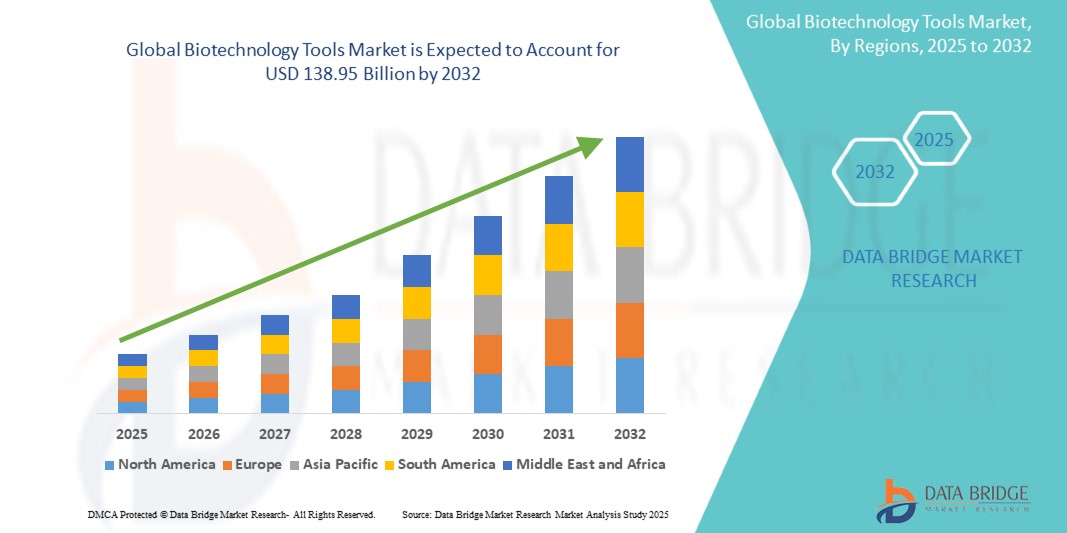
Global biotechnology tools market size was valued at USD 76.84 billion in 2024 and is projected to reach USD 138.95 billion by 2032, with a CAGR of 7.70% during the forecast period of 2025 to 2032. In addition to the insights on market scenarios such as market value, growth rate, segmentation, geographical coverage, and major players, the market reports curated by the Data Bridge Market Research also include depth expert analysis, patient epidemiology, pipeline analysis, pricing analysis, and regulatory framework.
Biotechnology Tools Market Trends
“Growth of CRISPR-Cas9 and Gene Editing Technologies”
The advancement of CRISPR-Cas9 and other gene-editing technologies reflects a shift toward precise genetic manipulation techniques in various sectors. In healthcare, these technologies are enabling targeted approaches in gene therapy, addressing genetic disorders at their root by correcting mutations. Agricultural biotechnology is also benefiting, as CRISPR is being utilized to enhance crop resilience, improve nutritional profiles, and increase yields without relying on traditional breeding methods. Functional genomics studies have seen significant progress, as CRISPR tools allow researchers to systematically study gene function by enabling knockouts or alterations in specific genes. This trend highlights a growing reliance on gene-editing platforms to address complex biological challenges efficiently.
Report Scope and Biotechnology Tools Market Segmentation
|
Attributes |
Biotechnology Tools Key Market Insights |
|
Segments Covered |
|
|
Countries Covered |
U.S., Canada, Mexico, Germany, France, U.K., Netherlands, Switzerland, Belgium, Russia, Italy, Spain, Turkey, Rest of Europe, China, Japan, India, South Korea, Singapore, Malaysia, Australia, Thailand, Indonesia, Philippines, Rest of Asia-Pacific, Saudi Arabia, U.A.E., South Africa, Egypt, Israel, Rest of Middle East and Africa, Brazil, Argentina, Rest of South America |
|
Key Market Players |
Thermo Fisher Scientific Inc. (U.S.), Illumina, Inc. (U.S.), Agilent Technologies, Inc. (U.S.), Bio-Rad Laboratories, Inc. (U.S.), QIAGEN N.V. (Netherlands), PerkinElmer, Inc. (U.S.), Merck KGaA (Germany), Danaher Corporation (U.S.), GE HealthCare Technologies Inc. (U.S.), F. Hoffmann-La Roche AG (Switzerland), BD (U.S.), Waters Corporation (U.S.), Bruker Corporation (U.S.), Eppendorf AG (Germany), Promega Corporation (U.S.), Oxford Nanopore Technologies plc (U.K.), and Takara Bio, Inc. (Japan) |
|
Market Opportunities |
|
|
Value Added Data Infosets |
In addition to the insights on market scenarios such as market value, growth rate, segmentation, geographical coverage, and major players, the market reports curated by the Data Bridge Market Research also include depth expert analysis, patient epidemiology, pipeline analysis, pricing analysis, and regulatory framework. |
Biotechnology Tools Market Definition
Biotechnology Tools refer to the instruments, devices, reagents, software, and techniques used in biotechnology to analyze, manipulate, or modify biological systems at molecular, cellular, or organismal levels. These tools support applications such as genetic engineering, drug development, molecular diagnostics, and agricultural improvements.
Biotechnology Tools Market Dynamics
Drivers
- Rising Prevalence of Chronic and Genetic Diseases
The rising prevalence of chronic and genetic diseases is a significant factor driving the use of biotechnology tools in healthcare and research. Chronic conditions such as cancer, diabetes, and cardiovascular diseases are among the leading causes of mortality globally, with cancer alone accounting for approximately 10 million deaths annually, according to the World Health Organization (WHO). The increasing incidence of genetic disorders has further amplified the demand for advanced tools that aid in early diagnosis, precise treatment planning, and therapeutic development. Technologies such as PCR, next-generation sequencing (NGS), and CRISPR are integral in detecting genetic mutations and identifying biomarkers for targeted therapies. These tools also support advancements in personalized medicine by enabling a deeper understanding of disease mechanisms. In research, they help scientists unravel complex biological pathways, paving the way for innovative treatments. The increasing healthcare burden emphasizes the role of biotechnology tools in improving patient outcomes and advancing medical science. For instance, in March 2024, according to an article published by nature, epidemiologic studies suggest that 2–6% of the global population is affected by rare diseases, with up to 80% of these conditions being of genetic origin. This growing prevalence of genetic disorders is expected to drive demand for advanced biotechnology tools, as they are essential for the diagnosis, treatment, and research of rare and genetic diseases in the Global Biotechnology Tools Market.
- Advancements in Genomics and Proteomics Research
Advancements in genomics and proteomics research are reshaping the biotechnology landscape by driving the demand for cutting-edge tools and technologies. Understanding the intricate structures and functions of genes and proteins is crucial for unraveling the molecular basis of diseases and developing targeted therapies. Next-generation sequencing (NGS) has revolutionized genomics by enabling rapid, high-throughput analysis of genetic material, facilitating breakthroughs in areas such as personalized medicine, where treatments are tailored to an individual’s genetic profile. Similarly, mass spectrometry has emerged as a cornerstone in proteomics, offering precise analysis of protein expression, structure, and post-translational modifications. These technologies are critical for identifying biomarkers, improving disease diagnostics, and accelerating drug discovery efforts. Enhanced by bioinformatics, genomics and proteomics research continues to generate valuable insights into complex biological systems, fueling the innovation of novel diagnostic tools and therapies that address unmet medical needs and improve healthcare outcomes globally. In April 2024, according to an article published by nature, the CRISPR-Cas system is a crucial tool for genome engineering, enabling precise genetic modifications and the functional characterization of variants of uncertain significance (VUSs). When combined with sequencing technologies, it allows for high-throughput mutation analysis, turning unclear genetic data into valuable insights. This innovation is expected to drive growth in the global biotechnology tools market by enhancing genetic research and diagnostic capabilities.
Opportunities
- Integration of Artificial Intelligence (AI) and Machine Learning (ML)
The integration of Artificial Intelligence (AI) and Machine Learning (ML) with biotechnology tools is transforming research and diagnostics by enhancing the capabilities of traditional technologies. AI and ML algorithms can analyze vast amounts of biological data, including genomic sequences and proteomic profiles, more efficiently and accurately than conventional methods. This integration improves data interpretation, enabling researchers to identify patterns and correlations that would be difficult to detect manually. In drug discovery, AI and ML help optimize the identification of potential drug candidates by predicting molecular interactions and analyzing the efficacy of compounds, significantly speeding up the development process. Additionally, these technologies automate repetitive tasks, reduce human error, and enable more personalized approaches to healthcare. The convergence of AI, ML, and biotechnology tools is driving innovations in diagnostics, personalized medicine, and therapeutic development, unlocking new opportunities for precision healthcare and accelerating the advancement of biotechnological research. For instance, in November 2024, according to an article published by Information Technology & Innovation Foundation, AI is transforming drug development by speeding up processes from discovery to manufacturing. In September 2019, Deep Genomics, a Canadian biotech company, unveiled its first AI-discovered drug candidate for Wilson's disease, a genetic disorder. This innovation presents an opportunity for the Global Biotechnology Tools Market by driving the adoption of AI in drug discovery and accelerating therapeutic development.
- Increasing Demand for Molecular Diagnostics
The increasing demand for molecular diagnostics is significantly influencing the biotechnology tools market, as healthcare systems prioritize early disease detection, monitoring, and personalized treatments. Technologies such as Polymerase Chain Reaction (PCR), Next-Generation Sequencing (NGS), and mass spectrometry are crucial for accurately identifying genetic mutations, infectious diseases, and cancers at molecular levels. These tools allow for precise diagnostics, enabling healthcare providers to make informed decisions and deliver targeted therapies. Furthermore, the rise of point-of-care diagnostics and non-invasive testing methods, such as liquid biopsies, is expanding the adoption of biotechnology tools in clinical settings. These advancements offer faster, more convenient testing options, reducing the need for costly and time-consuming procedures. As molecular diagnostics continue to evolve, they align with the growing demand for personalized healthcare, where treatments are tailored to an individual’s genetic profile, further driving the growth and innovation of biotechnology tools in both research and clinical environments.
Restraints/Challenges
- High Cost of Biotechnology Tools
The high cost of advanced biotechnology tools presents a significant challenge to the growth of the market. Technologies such as next-generation sequencing (NGS), mass spectrometry, and CRISPR-based platforms require substantial upfront investment in both the equipment and the specialized reagents needed for their operation. This can make them prohibitively expensive for smaller research institutions, laboratories, and healthcare providers, particularly in emerging markets with limited budgets. In addition to the high initial purchase cost, ongoing expenses, such as maintenance, consumables, and the need for highly skilled personnel to operate the tools, further increase the financial burden. Training costs to ensure proper use and interpretation of results also add to the overall expense. This makes advanced biotechnology tools less accessible in resource-constrained settings, slowing their adoption and limiting their potential for widespread use. Consequently, these financial barriers hinder the overall growth of the biotechnology tools market in various regions.
- Regulatory and Compliance Challenges
Navigating the regulatory and compliance landscape is a significant challenge for the Global biotechnology tools market. Tools used in diagnostics and therapeutics must meet rigorous standards set by health authorities such as the U.S. FDA, EMA in Europe, and other regulatory bodies worldwide. The approval process for new biotechnology tools is complex, involving extensive clinical trials, testing, and documentation to demonstrate their safety and effectiveness. This lengthy and costly process can delay the introduction of innovative tools to the market, hindering technological advancement. Additionally, the variations in regulatory requirements across different countries further complicate the situation, as companies need to meet specific standards for each market they wish to enter. These regulatory hurdles not only increase the time and cost associated with product development but also limit the ability of companies to quickly scale and implement their tools globally, slowing down the adoption of new technologies in biotechnology.
This market report provides details of new recent developments, trade regulations, import-export analysis, production analysis, value chain optimization, market share, impact of domestic and localized market players, analyses opportunities in terms of emerging revenue pockets, changes in market regulations, strategic market growth analysis, market size, category market growths, application niches and dominance, product approvals, product launches, geographic expansions, technological innovations in the market. To gain more info on the market contact Data Bridge Market Research for an Analyst Brief, our team will help you take an informed market decision to achieve market growth.
Biotechnology Tools Market Scope
The market is segmented on the basis of product type, technology, application, and end-user. The growth amongst these segments will help you analyze meagre growth segments in the industries and provide the users with a valuable market overview and market insights to help them make strategic decisions for identifying core market applications.
Product Type
- Instruments
- Consumables
- Software & Services
Technology
- Genomics, Proteomics
- Cell Biology
- Molecular Biology
- Bioinformatics
Application
- Drug Discovery and Development
- Diagnostics
- Agriculture Biotechnology
- Forensic Science
- Environmental Biotechnology
- Industrial Biotechnology
End-User
- Academic and Research Institutes
- Pharmaceutical and Biotechnology Companies
- Contract Research Organizations (CROs)
- Clinical Laboratories
- Government Agencies
Global Biotechnology Tools Market Regional Analysis
The market is analyzed and market size insights and trends are provided by country, product type, technology, application, and end-user as referenced above.
The countries covered in the market are U.S., Canada, Mexico, Germany, France, U.K., Netherlands, Switzerland, Belgium, Russia, Italy, Spain, Turkey, rest of Europe, China, Japan, India, South Korea, Singapore, Malaysia, Australia, Thailand, Indonesia, Philippines, rest of Asia-Pacific, Saudi Arabia, U.A.E., South Africa, Egypt, Israel, rest of Middle East and Africa, Brazil, Argentina, and rest of South America.
North America is expected to dominate the market due to several key factors. The region boasts a highly advanced healthcare infrastructure, which facilitates the rapid adoption of innovative biotechnology solutions. Strong investments in research and development (R&D) by both private companies and government agencies further drive market growth, enabling the development of cutting-edge tools for various biotechnological applications, including drug discovery, diagnostics, and personalized medicine.
Asia-Pacific is expected to be the fastest growing due to its expanding biotechnology sector, which is fueled by increasing investments in research and development, particularly in countries such as China, India, and Japan. These countries are focusing on strengthening their biotechnology industries, attracting both domestic and foreign investments, which is contributing to the growth of the biotechnology tools market.
The country section of the report also provides individual market impacting factors and changes in regulation in the market domestically that impacts the current and future trends of the market. Data points such as down-stream and upstream value chain analysis, technical trends and porter's five forces analysis, case studies are some of the pointers used to forecast the market scenario for individual countries. Also, the presence and availability of global brands and their challenges faced due to large or scarce competition from local and domestic brands, impact of domestic tariffs and trade routes are considered while providing forecast analysis of the country data.
Biotechnology Tools Market Share
The market competitive landscape provides details by competitor. Details included are company overview, company financials, revenue generated, market potential, investment in research and development, new market initiatives, global presence, production sites and facilities, production capacities, company strengths and weaknesses, product launch, product width and breadth, application dominance. The above data points provided are only related to the companies' focus related to market.
Biotechnology Tools Market Leaders Operating in the Market Are:
- Thermo Fisher Scientific Inc. (U.S.)
- Illumina, Inc. (U.S.)
- Agilent Technologies, Inc. (U.S.)
- Bio-Rad Laboratories, Inc. (U.S.)
- QIAGEN N.V. (Netherlands)
- PerkinElmer, Inc. (U.S.)
- Merck KGaA (Germany)
- Danaher Corporation (U.S.)
- GE HealthCare Technologies Inc. (U.S.)
- F. Hoffmann-La Roche AG (Switzerland)
- BD (U.S.)
- Waters Corporation (U.S.)
- Bruker Corporation (U.S.)
- Eppendorf AG (Germany)
- Promega Corporation (U.S.)
- Oxford Nanopore Technologies plc (U.K)
- Takara Bio, Inc. (Japan)
Latest Developments in Biotechnology Tools Market
- In November 2024, BASF has partnered with Acies Bio, to advance a fermentation technology platform for producing fatty alcohols from methanol. This collaboration will strengthen BASF's sustainability efforts by enhancing its production capabilities for eco-friendly fatty alcohols
- In September 2024, Gilead Sciences and Genesis Therapeutics have entered into a strategic collaboration to discover and develop small molecule therapies across multiple targets. Genesis will utilize its advanced AI platform, GEMS, to generate and optimize molecules for targets chosen by Gilead. This partnership will enhance Gilead's drug discovery process by leveraging cutting-edge AI to accelerate the development of novel therapeutics
- In July 2022, BeiGene has formed a global strategic partnership with InnoRNA, a biotechnology company specializing in LNP-based delivery and mRNA drug discovery, to utilize its innovative platform for developing mRNA-based therapeutics. This collaboration will enhance BeiGene’s capabilities in mRNA therapeutic development, accelerating their pipeline and expanding their research potential
SKU-
세계 최초의 시장 정보 클라우드 보고서에 온라인으로 접속하세요

- 대화형 데이터 분석 대시보드
- 높은 성장 잠재력 기회를 위한 회사 분석 대시보드
- 사용자 정의 및 질의를 위한 리서치 분석가 액세스
- 대화형 대시보드를 통한 경쟁자 분석
- 최신 뉴스, 업데이트 및 추세 분석
- 포괄적인 경쟁자 추적을 위한 벤치마크 분석의 힘 활용
연구 방법론
데이터 수집 및 기준 연도 분석은 대규모 샘플 크기의 데이터 수집 모듈을 사용하여 수행됩니다. 이 단계에는 다양한 소스와 전략을 통해 시장 정보 또는 관련 데이터를 얻는 것이 포함됩니다. 여기에는 과거에 수집한 모든 데이터를 미리 검토하고 계획하는 것이 포함됩니다. 또한 다양한 정보 소스에서 발견되는 정보 불일치를 검토하는 것도 포함됩니다. 시장 데이터는 시장 통계 및 일관된 모델을 사용하여 분석하고 추정합니다. 또한 시장 점유율 분석 및 주요 추세 분석은 시장 보고서의 주요 성공 요인입니다. 자세한 내용은 분석가에게 전화를 요청하거나 문의 사항을 드롭하세요.
DBMR 연구팀에서 사용하는 주요 연구 방법론은 데이터 마이닝, 시장에 대한 데이터 변수의 영향 분석 및 주요(산업 전문가) 검증을 포함하는 데이터 삼각 측량입니다. 데이터 모델에는 공급업체 포지셔닝 그리드, 시장 타임라인 분석, 시장 개요 및 가이드, 회사 포지셔닝 그리드, 특허 분석, 가격 분석, 회사 시장 점유율 분석, 측정 기준, 글로벌 대 지역 및 공급업체 점유율 분석이 포함됩니다. 연구 방법론에 대해 자세히 알아보려면 문의를 통해 업계 전문가에게 문의하세요.
사용자 정의 가능
Data Bridge Market Research는 고급 형성 연구 분야의 선두 주자입니다. 저희는 기존 및 신규 고객에게 목표에 맞는 데이터와 분석을 제공하는 데 자부심을 느낍니다. 보고서는 추가 국가에 대한 시장 이해(국가 목록 요청), 임상 시험 결과 데이터, 문헌 검토, 재생 시장 및 제품 기반 분석을 포함하도록 사용자 정의할 수 있습니다. 기술 기반 분석에서 시장 포트폴리오 전략에 이르기까지 타겟 경쟁업체의 시장 분석을 분석할 수 있습니다. 귀하가 원하는 형식과 데이터 스타일로 필요한 만큼 많은 경쟁자를 추가할 수 있습니다. 저희 분석가 팀은 또한 원시 엑셀 파일 피벗 테이블(팩트북)로 데이터를 제공하거나 보고서에서 사용 가능한 데이터 세트에서 프레젠테이션을 만드는 데 도움을 줄 수 있습니다.











