Global Controlled Environment Agriculture Cea Equipment Market
Market Size in USD Billion
CAGR :
%
USD
6.30 Billion
USD
13.02 Billion
2025
2033
| 2026 –2033 | |
| USD 6.30 Billion | |
| USD 13.02 Billion | |
|
|
|
|
Controlled Environment Agriculture (CEA) Equipment Market Size
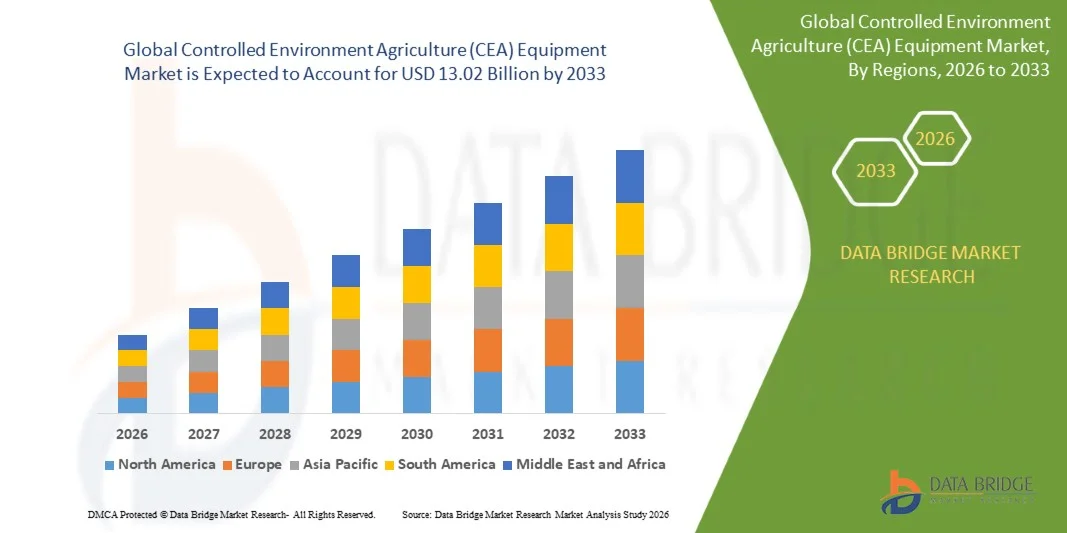
- The global Controlled Environment Agriculture (CEA) Equipment market size was valued at USD 6.3 billion in 2025 and is expected to reach USD 13.02 billion by 2033, at a CAGR of 9.50% during the forecast period
- The market growth is largely fueled by the rising demand for high-yield, resource-efficient farming systems driven by increasing global food security concerns and shrinking arable land availability, which is accelerating the adoption of Controlled Environment Agriculture (CEA) Equipment across commercial farming operations
- Furthermore, rapid technological advancements in automation, hydroponics, aeroponics, LED grow lighting, and AI-based monitoring systems are enhancing productivity, reducing resource consumption, and enabling year-round crop production, thereby strengthening the overall market expansion
Controlled Environment Agriculture (CEA) Equipment Market Analysis
- Controlled Environment Agriculture (CEA) Equipment, which enables precise control of temperature, humidity, lighting, irrigation, and nutrients in indoor farming environments, is becoming a critical solution for sustainable food production in both urban and commercial agricultural settings due to its ability to maximize yield efficiency and minimize environmental dependency
- The growing adoption of Controlled Environment Agriculture (CEA) systems is primarily driven by increasing investments in vertical farming and greenhouse automation, rising demand for pesticide-free and locally grown produce, and the integration of smart agriculture technologies that improve operational efficiency and ensure consistent crop output
- North America dominated the Controlled Environment Agriculture (CEA) Equipment market with a share of 41.5% in 2025, due to strong adoption of advanced farming technologies and high investment in vertical farming and greenhouse automation
- Asia-Pacific is expected to be the fastest growing region in the Controlled Environment Agriculture (CEA) Equipment market during the forecast period due to rapid urbanization, rising food demand, and shrinking arable land in countries such as China, India, and Japan
- Hardware segment dominated the market with a market share of 60.5% in 2025, due to strong demand for core infrastructure such as climate control systems, LED grow lights, irrigation systems, and sensors used in controlled farming environments. Hardware forms the foundational requirement for any Controlled Environment Agriculture (CEA) setup, making it indispensable for both large-scale vertical farms and greenhouse operations
Report Scope and Controlled Environment Agriculture (CEA) Equipment Market Segmentation
|
Attributes |
Controlled Environment Agriculture (CEA) Equipment Key Market Insights |
|
Segments Covered |
|
|
Countries Covered |
North America · U.S. · Canada · Mexico Europe · Germany · France · U.K. · Netherlands · Switzerland · Belgium · Russia · Italy · Spain · Turkey · Rest of Europe Asia-Pacific · China · Japan · India · South Korea · Singapore · Malaysia · Australia · Thailand · Indonesia · Philippines · Rest of Asia-Pacific Middle East and Africa · Saudi Arabia · U.A.E. · South Africa · Egypt · Israel · Rest of Middle East and Africa South America · Brazil · Argentina · Rest of South America |
|
Key Market Players |
· Netafim (Israel) · Priva (Netherlands) · Heliospectra (Sweden) · Agritecture (U.S.) · Ridder (Netherlands) · Fluence (U.S.) · OSRAM (Germany) · Koidra (U.S.) · Grodan (Netherlands) · Freight Farms (U.S.) · Urban Crop Solutions (Belgium) · Hoogendoorn (Netherlands) · Argus Controls (Canada) · iFarm (Finland) · Signify (Netherlands) |
|
Market Opportunities |
· Expansion of Vertical Farming in Urban Areas · Growth in Smart Greenhouse Infrastructure Development |
|
Value Added Data Infosets |
In addition to the insights on market scenarios such as market value, growth rate, segmentation, geographical coverage, and major players, the market reports curated by the Data Bridge Market Research also include import export analysis, production capacity overview, production consumption analysis, price trend analysis, climate change scenario, supply chain analysis, value chain analysis, raw material/consumables overview, vendor selection criteria, PESTLE Analysis, Porter Analysis, and regulatory framework. |
Controlled Environment Agriculture (CEA) Equipment Market Trends
“Rising Adoption of AI-Driven and Automated Farming Systems”
- A significant trend in the controlled environment agriculture equipment market is the increasing deployment of AI-driven monitoring systems and automation technologies that optimize crop growth conditions across indoor farms and greenhouse facilities. This shift is strengthening precision control over lighting, irrigation, nutrient delivery, and climate regulation to maximize yield consistency and reduce resource wastage
- For instance, Priva and Siemens provide advanced climate control and automation solutions used in greenhouse operations that enable real-time environmental adjustments based on crop requirements
- Companies such as Signify through its Philips horticulture lighting systems are integrating intelligent LED solutions that adapt light spectra to different growth stages of crops, improving productivity in vertical farming setups
- Vertical farming operators such as Bowery Farming and Plenty are implementing AI-based sensing and robotics to automate planting and harvesting processes, enhancing operational efficiency
- The integration of connected sensors and data analytics platforms is enabling predictive farming decisions that improve output quality while reducing dependency on manual intervention
- This trend is reinforcing the transition toward fully controlled digital agriculture ecosystems that support scalable and resource-efficient food production systems
Controlled Environment Agriculture (CEA) Equipment Market Dynamics
Driver
“Increasing Demand for Sustainable and Resource-Efficient Food Production”
- The rising need for sustainable agricultural practices and efficient food production systems is driving strong demand for controlled environment agriculture equipment that reduces water usage, land dependency, and chemical inputs
- For instance, Netafim provides precision irrigation systems widely used in greenhouse farming to optimize water efficiency and nutrient distribution across crops
- Companies such as Signify supply energy-efficient LED grow lights that reduce electricity consumption while enhancing plant growth efficiency in controlled environments. Richel Group is involved in greenhouse infrastructure development that supports year-round crop production with optimized environmental control systems
- This driver is further supported by global concerns over food security and climate variability that are pushing adoption of indoor farming and greenhouse-based cultivation models
- The expansion of urban farming initiatives and commercial vertical farms such as Infarm is accelerating the adoption of resource-efficient cultivation technologies. This sustained demand for sustainable food production is reinforcing long-term growth prospects for advanced Controlled Environment Agriculture (CEA) equipment solutions
Restraint/Challenge
“High Initial Investment and Operational Cost Constraints”
- The controlled environment agriculture equipment market faces significant limitations due to high initial capital requirements for infrastructure setup, advanced automation systems, and climate control technologies. These cost burdens create entry barriers for small and medium scale growers and slow down large-scale commercialization of indoor farming systems
- For instance, AeroFarms has invested heavily in vertical farming infrastructure that involves advanced aeroponic systems, lighting, and climate control technologies requiring substantial upfront expenditure
- Plenty operates large-scale indoor farms that depend on sophisticated AI-enabled systems and precision equipment, contributing to high operational and maintenance costs
- The requirement for specialized components such as LED horticulture lighting from companies such as ams OSRAM further increases equipment procurement costs. Energy consumption for maintaining controlled environments remains a persistent cost challenge, particularly in regions with high electricity pricing
- These financial constraints continue to limit rapid scalability of controlled environment agriculture projects despite strong technological advancements
Controlled Environment Agriculture (CEA) Equipment Market Scope
The market is segmented on the basis of component, technology, and end use.
- By Component
On the basis of component, the Controlled Environment Agriculture (CEA) Equipment Market is segmented into hardware, software, and service. The hardware segment dominated the market with the largest revenue share of 60.5% in 2025, driven by strong demand for core infrastructure such as climate control systems, LED grow lights, irrigation systems, and sensors used in controlled farming environments. Hardware forms the foundational requirement for any Controlled Environment Agriculture (CEA) setup, making it indispensable for both large-scale vertical farms and greenhouse operations. Rising investments in high-efficiency farming systems and automation technologies further strengthen hardware adoption across commercial farming facilities.
The software segment is expected to witness the fastest growth from 2026 to 2033, supported by increasing adoption of AI-driven farm management platforms and data analytics solutions. Software enables real-time monitoring of crop conditions, resource optimization, and predictive yield analysis, improving operational efficiency in Controlled Environment Agriculture (CEA) systems. Growing integration of IoT and cloud-based control systems is accelerating demand for smart agricultural software solutions.
- By Technology
On the basis of technology, the Controlled Environment Agriculture (CEA) Equipment Market is segmented into hydroponics, aeroponics, and soil-based undercover systems. The hydroponics segment dominated the market with the largest revenue share in 2025, driven by its efficient nutrient delivery system that eliminates soil dependency and enables higher yield in limited space. Hydroponics is widely adopted in vertical farms and commercial greenhouse operations due to its water-saving capabilities and faster crop growth cycles. Increasing urban farming initiatives and demand for year-round crop production further support its dominance.
The aeroponics segment is expected to witness the fastest growth from 2026 to 2033, driven by its advanced soilless cultivation technique that uses minimal water and maximizes oxygen exposure to plant roots. Aeroponics enables faster plant growth and higher productivity compared to traditional methods, making it highly suitable for research facilities and high-tech commercial farms. Rising investments in precision agriculture and space-efficient farming systems are accelerating its adoption.
- By End Use
On the basis of end use, the Controlled Environment Agriculture (CEA) Equipment Market is segmented into commercial, residential, and research & institutional applications. The commercial segment dominated the market with the largest revenue share in 2025, driven by large-scale adoption of controlled farming systems by commercial growers, greenhouse operators, and urban farming companies. High demand for consistent crop supply, improved yield efficiency, and reduced dependency on climatic conditions supports strong commercial deployment. Expansion of retail supply chains and increasing demand for fresh produce further strengthen this segment.
The residential segment is expected to witness the fastest growth from 2026 to 2033, driven by increasing consumer interest in home gardening and self-sustained food production. Compact Controlled Environment Agriculture (CEA) systems designed for indoor use and smart home integration are making controlled farming accessible to urban households. Rising awareness of pesticide-free food consumption and space-efficient gardening solutions is accelerating residential adoption.
Controlled Environment Agriculture (CEA) Equipment Market Regional Analysis
- North America dominated the Controlled Environment Agriculture (CEA) Equipment market with the largest revenue share of 41.5% in 2025, driven by strong adoption of advanced farming technologies and high investment in vertical farming and greenhouse automation
- The region benefits from well-established agritech infrastructure, high consumer demand for pesticide-free and year-round fresh produce, and increasing focus on sustainable food production systems
- This widespread adoption is further supported by strong participation from commercial growers, advanced research initiatives, and rapid integration of IoT-based monitoring systems, establishing North America as a key hub for Controlled Environment Agriculture (CEA) equipment deployment
U.S. Controlled Environment Agriculture (CEA) Equipment Market Insight
The U.S. Controlled Environment Agriculture (CEA) Equipment market captured the largest revenue share in North America in 2025, driven by rapid expansion of vertical farming facilities and increasing investment in high-tech greenhouse infrastructure. The growing need for local food production, supply chain resilience, and reduced dependence on imports is significantly supporting market growth. Strong adoption of hydroponics and automated climate control systems across commercial farms is further accelerating demand. In addition, the presence of major agritech companies and increasing venture capital funding is strengthening technological innovation in the sector.
Europe Controlled Environment Agriculture (CEA) Equipment Market Insight
The Europe Controlled Environment Agriculture (CEA) Equipment market is projected to expand at a steady CAGR during the forecast period, primarily driven by strict sustainability regulations and rising demand for organic and locally grown food products. Increasing urban farming initiatives and government support for sustainable agriculture practices are encouraging adoption of controlled environment systems. The region is witnessing strong growth in greenhouse-based cultivation supported by energy-efficient technologies. Growing awareness regarding food security and climate-resilient farming is further strengthening market expansion across residential and commercial applications.
U.K. Controlled Environment Agriculture (CEA) Equipment Market Insight
The U.K. Controlled Environment Agriculture (CEA) Equipment market is anticipated to grow at a notable CAGR during the forecast period, driven by increasing investment in indoor farming projects and rising concerns over food supply stability post-Brexit. Demand for locally produced fresh vegetables and herbs is supporting the expansion of controlled farming systems. The country is also witnessing growing adoption of vertical farming solutions in urban areas to optimize limited land availability. In addition, strong retail demand for sustainable produce is further contributing to market growth.
Germany Controlled Environment Agriculture (CEA) Equipment Market Insight
The Germany Controlled Environment Agriculture (CEA) Equipment market is expected to expand at a considerable CAGR during the forecast period, fueled by strong emphasis on sustainable agriculture and energy-efficient farming technologies. The country’s advanced engineering capabilities support the development of highly automated greenhouse systems and precision farming solutions. Increasing adoption of hydroponics in commercial cultivation is further driving market demand. In addition, government initiatives promoting resource-efficient agriculture are encouraging wider adoption of controlled environment systems across farming enterprises.
Asia-Pacific Controlled Environment Agriculture (CEA) Equipment Market Insight
The Asia-Pacific Controlled Environment Agriculture (CEA) Equipment market is poised to grow at the fastest CAGR during 2026 to 2033, driven by rapid urbanization, rising food demand, and shrinking arable land in countries such as China, India, and Japan. Increasing investment in smart agriculture technologies and large-scale greenhouse farming is significantly accelerating market growth. The region is also benefiting from government-led initiatives supporting food security and agricultural modernization. In addition, lower production costs and strong manufacturing capabilities are expanding accessibility of Controlled Environment Agriculture (CEA) equipment across developing economies.
Japan Controlled Environment Agriculture (CEA) Equipment Market Insight
The Japan Controlled Environment Agriculture (CEA) Equipment market is gaining strong momentum due to advanced technological adoption, high urban population density, and limited agricultural land availability. The country is increasingly deploying automated vertical farming systems and hydroponic solutions to ensure stable food production. Strong integration of robotics, AI-based monitoring, and climate control technologies is further enhancing efficiency in controlled farming. In addition, the aging farming population is encouraging automation-driven agriculture solutions to maintain productivity levels.
China Controlled Environment Agriculture (CEA) Equipment Market Insight
The China Controlled Environment Agriculture (CEA) Equipment market accounted for the largest revenue share in Asia-Pacific in 2025, driven by rapid urbanization, large-scale government support for smart agriculture, and strong domestic manufacturing capabilities. Expanding demand for safe and high-quality food products is pushing adoption of greenhouse and vertical farming systems across urban and peri-urban areas. The country’s strong focus on smart city development and agricultural modernization is further boosting market growth. In addition, cost-effective production of Controlled Environment Agriculture (CEA) equipment within China is making advanced farming systems more widely accessible.
Controlled Environment Agriculture (CEA) Equipment Market Share
The Controlled Environment Agriculture (CEA) Equipment industry is primarily led by well-established companies, including:
- Netafim (Israel)
- Priva (Netherlands)
- Heliospectra (Sweden)
- Agritecture (U.S.)
- Ridder (Netherlands)
- Fluence (U.S.)
- OSRAM (Germany)
- Koidra (U.S.)
- Grodan (Netherlands)
- Freight Farms (U.S.)
- Urban Crop Solutions (Belgium)
- Hoogendoorn (Netherlands)
- Argus Controls (Canada)
- iFarm (Finland)
- Signify (Netherlands)
Latest Developments in Global Controlled Environment Agriculture (CEA) Equipment Market
- In March 2025, Source.ag expanded its AI-driven greenhouse technology portfolio by launching Source Workspace, Harvest Forecast, and Cultivation Management, strengthening its position in the Controlled Environment Agriculture (CEA) Equipment market. These solutions improve data integration, yield prediction accuracy up to eight weeks, and simulation-based decision-making for commercial growers. The development enhances operational efficiency, reduces reliance on spot markets through better forecasting, and optimizes resource utilization. With deployment across 300+ greenhouses in 19 countries, the innovation reinforces Source.ag’s leadership in AI-enabled Controlled Environment Agriculture (CEA) optimization and accelerates digital transformation in commercial greenhouse operations globally
- In July 2024, Plenty entered a $680 million joint venture with Mawarid Group to scale large vertical farming facilities across the Middle East, marking a major expansion in the Controlled Environment Agriculture (CEA) Equipment market. This collaboration strengthens access to a water-scarce, high-demand region where localized food production is critical. The partnership enables rapid scaling of vertical farming infrastructure while leveraging regional investment and distribution capabilities. It significantly enhances Plenty’s global footprint beyond North America and supports increased adoption of controlled environment farming in emerging high-growth markets
- In March 2024, Source.ag introduced Source Irrigation Control, an AI-based autonomous irrigation system designed for greenhouse operations, further advancing innovation in the Controlled Environment Agriculture (CEA) Equipment market. The solution improves irrigation accuracy by achieving 87% dry-down target precision during pilot testing, significantly outperforming manual systems. This advancement reduces water and nutrient wastage, enhances crop consistency, and improves scalability for commercial growers. It also strengthens adoption of data-driven automation technologies in greenhouse farming, positioning Source.ag strongly within the precision agriculture segment
- In March 2024, Skytree launched the Stratus Direct Air Capture (DAC) unit for greenhouses and vertical farms, impacting the Controlled Environment Agriculture (CEA) Equipment market by enabling on-site CO2 generation. The system captures up to 1,250 kg of CO2 per day per unit, supporting scalable and flexible deployment in controlled farming environments. This innovation enhances crop yield through optimized CO2 enrichment while reducing dependence on external industrial gas supply chains. It also lowers operational risks linked to price volatility and improves sustainability by reducing carbon footprint in intensive agricultural production systems
- In October 2023, Eden Green Technologies initiated a $40 million expansion of its Cleburne, Texas facility, significantly influencing the Controlled Environment Agriculture (CEA) Equipment market through large-scale capacity growth. The expansion adds multiple greenhouse units aimed at increasing production of leafy greens and strengthening domestic supply chains in the U.S. It supports rising demand for locally produced fresh food while reducing transportation distances and improving distribution efficiency. The long-term plan to develop 20 facilities nationwide further enhances food system resilience and accelerates adoption of distributed indoor farming infrastructure
SKU-
Get online access to the report on the World's First Market Intelligence Cloud
- Interactive Data Analysis Dashboard
- Company Analysis Dashboard for high growth potential opportunities
- Research Analyst Access for customization & queries
- Competitor Analysis with Interactive dashboard
- Latest News, Updates & Trend analysis
- Harness the Power of Benchmark Analysis for Comprehensive Competitor Tracking
Research Methodology
Data collection and base year analysis are done using data collection modules with large sample sizes. The stage includes obtaining market information or related data through various sources and strategies. It includes examining and planning all the data acquired from the past in advance. It likewise envelops the examination of information inconsistencies seen across different information sources. The market data is analysed and estimated using market statistical and coherent models. Also, market share analysis and key trend analysis are the major success factors in the market report. To know more, please request an analyst call or drop down your inquiry.
The key research methodology used by DBMR research team is data triangulation which involves data mining, analysis of the impact of data variables on the market and primary (industry expert) validation. Data models include Vendor Positioning Grid, Market Time Line Analysis, Market Overview and Guide, Company Positioning Grid, Patent Analysis, Pricing Analysis, Company Market Share Analysis, Standards of Measurement, Global versus Regional and Vendor Share Analysis. To know more about the research methodology, drop in an inquiry to speak to our industry experts.
Customization Available
Data Bridge Market Research is a leader in advanced formative research. We take pride in servicing our existing and new customers with data and analysis that match and suits their goal. The report can be customized to include price trend analysis of target brands understanding the market for additional countries (ask for the list of countries), clinical trial results data, literature review, refurbished market and product base analysis. Market analysis of target competitors can be analyzed from technology-based analysis to market portfolio strategies. We can add as many competitors that you require data about in the format and data style you are looking for. Our team of analysts can also provide you data in crude raw excel files pivot tables (Fact book) or can assist you in creating presentations from the data sets available in the report.