



Global Decentralized Identity Market Segmentation, By Identity Type (Non- biometrics and Biometrics), End-User (Enterprises, and Individual), Organization Size (Large Enterprises, and SMEs), Verticals (BFSI, Government, Healthcare and life sciences, Telecom and IT, Retail and E-Commerce, Transport and Logistics, Real Estate, Media and Entertainment, Travel and Hospitality, and Other Verticals) – Industry Trends and Forecast to 2032
Decentralized Identity Market Analysis
The decentralized identity market has seen significant advancements, with blockchain technology at the forefront. The latest methods focus on leveraging blockchain to create verifiable, self-sovereign identities, which enable users to control and manage their data without relying on centralized authorities. The use of Zero-Knowledge Proofs (ZKPs) is a breakthrough in ensuring privacy, allowing users to authenticate their identity without revealing sensitive information.
Decentralized identifiers (DIDs) and verifiable credentials (VCs) are pivotal components, enabling seamless verification of identity across platforms. These advancements are used in applications such as digital wallets, secure online transactions, and identity verification in banking, healthcare, and government services.
The market is growing due to the increasing need for privacy and security in online interactions. The rise in data breaches, identity theft, and fraud is prompting businesses to adopt decentralized solutions for enhanced security. In addition, regulatory frameworks such as the European Union's eIDAS are propelling the adoption of decentralized identities. This market is expected to experience rapid growth, with forecasts predicting significant expansion in the coming years as the demand for secure, privacy-focused digital identity solutions increases.
Decentralized Identity Market Size
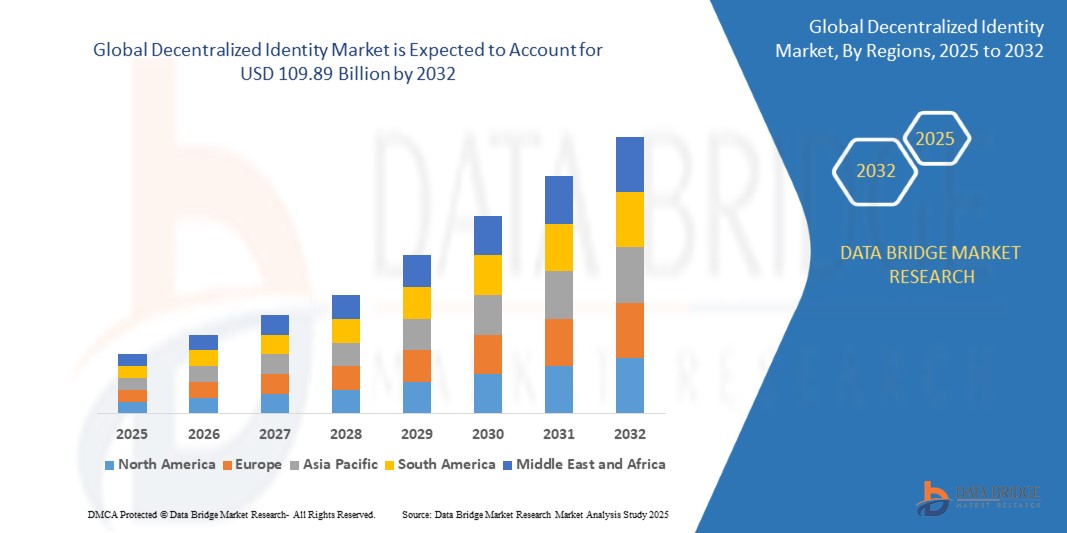
The global decentralized identity market size was valued at USD 1.18 billion in 2024 and is projected to reach USD 109.89 billion by 2032, with a CAGR of 79.35% during the forecast period of 2025 to 2032. In addition to the market insights such as market value, growth rate, market segments, geographical coverage, market players, and market scenario, the market report curated by the Data Bridge Market Research team includes in-depth expert analysis, import/export analysis, pricing analysis, production consumption analysis, and pestle analysis.
Decentralized Identity Market Trends
“Growth of Blockchain Technology in Decentralized Identity Market”
A key trend fueling the growth of the decentralized identity market is the integration of blockchain technology. Blockchain offers a secure, transparent, and tamper-proof way to manage identities, making it an ideal solution for eliminating the vulnerabilities associated with centralized identity management systems. The increasing adoption of blockchain in sectors such as healthcare, banking, and government is driving this trend. For instance, the use of blockchain-based identity verification by projects such as the Sovrin Foundation is empowering individuals to control their personal data securely. This is reducing identity theft and fraud, enhancing privacy, and streamlining processes, ultimately boosting the market’s expansion.
Report Scope and Decentralized Identity Market Segmentation
|
Attributes |
Decentralized Identity Key Market Insights |
|
Segments Covered |
|
|
Countries Covered |
U.S., Canada and Mexico in North America, Germany, France, U.K., Netherlands, Switzerland, Belgium, Russia, Italy, Spain, Turkey, Rest of Europe in Europe, China, Japan, India, South Korea, Singapore, Malaysia, Australia, Thailand, Indonesia, Philippines, Rest of Asia-Pacific (APAC) in the Asia-Pacific (APAC), Saudi Arabia, U.A.E, South Africa, Egypt, Israel, Rest of Middle East and Africa (MEA) as a part of Middle East and Africa (MEA), Brazil, Argentina and Rest of South America as part of South America |
|
Key Market Players |
Microsoft (U.S.), Accenture (Ireland), Persistent Systems (India), Wipro (India), Deloitte Touche Tohmatsu Limited (U.K.), R3 (U.S.), Avast Software s.r.o. (Czech Republic), Validated ID, SL (Spain), Alchemy Insights, Inc. (U.S.), Ping Identity (U.S.), NuID, Inc. (U.S.), Dragonchain (U.S.), Nuggets (U.K.), Finema Co., Ltd. (Thailand), Datarella GmbH (Germany), Civic Technologies, Inc. (U.S.), 1Kosmos Inc. (U.S.), Affinidi Pte. Ltd. (Singapore), Hu-manity (U.S.), SelfKey (Mauritius) and Gataca (Spain) |
|
Market Opportunities |
|
|
Value Added Data Infosets |
In addition to the market insights such as market value, growth rate, market segments, geographical coverage, market players, and market scenario, the market report curated by the Data Bridge Market Research team includes in-depth expert analysis, import/export analysis, pricing analysis, production consumption analysis, and pestle analysis. |
Decentralized Identity Market Definition
Decentralized identity (DID) is a new model for managing and verifying digital identities without relying on central authorities, such as governments or corporations. It uses blockchain or distributed ledger technology (DLT) to provide individuals with control over their personal data. DIDs enable secure, verifiable, and privacy-preserving interactions online by allowing individuals to manage their identity and credentials through cryptographic methods. Users can share verified information selectively, reducing the risk of data breaches and identity theft. This technology supports self-sovereign identities, where users own, control, and share their digital identities on their terms, offering greater autonomy and security.
Decentralized Identity Market Dynamics
Drivers
- Increasing Digital Identity Fraud and Data Breaches
The rising number of digital identity frauds and data breaches is significantly driving the adoption of decentralized identity solutions. The Identity Theft Resource Center’s 2021 Annual Data Breach Report revealed 1,862 data breaches in 2021, marking a 68% increase in the number of compromised victims compared to the previous year. This surge in breaches highlights the growing vulnerability of centralized systems, prompting both individuals and organizations to turn to decentralized identity management solutions. These solutions, built on secure blockchain technology, offer enhanced protection against identity theft and data tampering, addressing the increasing demand for robust, self-sovereign identity systems that prioritize privacy and security.
- Demand for Self-Sovereign Identity (SSI)
The demand for Self-Sovereign Identity (SSI) is significantly driving the decentralized identity market, as users seek greater control over their personal data. SSI allows individuals to manage their identity without relying on centralized authorities, promoting enhanced privacy, security, and trust. This shift is particularly relevant in industries such as healthcare and finance, where personal data protection is crucial. For instance, platforms such as Microsoft’s ION, a blockchain-based SSI solution, offer users full ownership of their identity, fostering trust in digital interactions. This trend creates opportunities for businesses to develop innovative SSI solutions, capitalizing on the growing demand for secure, user-controlled digital identity systems.
Opportunities
- Stringent Data Protection Regulations
The introduction of stringent data protection regulations globally is significantly increasing the demand for decentralized identity solutions. The European Union’s General Data Protection Regulation (GDPR) has played a pivotal role in this shift. A June 2021 report from the European Commission revealed that 69% of the EU population aged 16 and above is familiar with GDPR, while 71% are aware of their new privacy rights. As awareness of data privacy grows and regulatory pressure intensifies, organizations are turning to decentralized identity systems to ensure compliance with privacy-centric policies. This shift toward user-controlled data management is propelling the market for decentralized identity solutions, offering enhanced security and privacy for individuals.
- Shift Towards User-Centric Identity Management
The decentralized identity market is experiencing significant growth due to the shift towards user-centric identity management. Different from traditional systems that rely on centralized authorities, decentralized models empower individuals to own and control their digital identities. This shift enables users to decide what information they share and with whom, enhancing privacy and security. For instance, platforms such as Sovrin and Microsoft’s decentralized identity initiative provide users with self-sovereign identities, enabling them to manage personal data securely. As data breaches and privacy concerns rise, the demand for these user-centric solutions is growing, creating new opportunities in the market for secure and scalable identity management systems.
Restraints/Challenges
- Data Privacy Concerns
Data privacy concerns are a significant restraint for the decentralized identity treatment market. While decentralized identity systems aim to provide greater control over personal data, managing sensitive information without compromising privacy remains a complex issue. Users may be hesitant to fully embrace these systems due to fears of data breaches, misuse, or unauthorized access. The lack of clarity in how personal data is protected and the potential for vulnerabilities in blockchain or decentralized platforms can exacerbate these concerns. This mistrust limits market growth, as individuals and businesses may prefer traditional identity management systems that offer more established privacy controls and compliance with existing regulations.
- Regulatory and Legal Barriers
Regulatory and legal barriers are a significant challenge for the decentralized identity treatment market. Governments and regulators have yet to establish standardized frameworks for decentralized identity systems, leading to a lack of consistency in policies. This uncertainty creates obstacles for businesses and consumers, as they face unclear regulations surrounding data privacy, security, and compliance. Without clear legal guidelines, organizations are reluctant to adopt decentralized identity solutions, fearing potential legal repercussions or violations. Furthermore, the absence of universal standards complicates cross-border interoperability, limiting the scalability of these solutions. As a result, the market faces slow growth and limited adoption due to these regulatory uncertainties.
This market report provides details of new recent developments, trade regulations, import-export analysis, production analysis, value chain optimization, market share, impact of domestic and localized market players, analyses opportunities in terms of emerging revenue pockets, changes in market regulations, strategic market growth analysis, market size, category market growths, application niches and dominance, product approvals, product launches, geographic expansions, technological innovations in the market. To gain more info on the market contact Data Bridge Market Research for an Analyst Brief, our team will help you take an informed market decision to achieve market growth.
Decentralized Identity Market Scope
The market is segmented on the basis of identity type, end-user, organization size, and verticals. The growth amongst these segments will help you analyze meagre growth segments in the industries and provide the users with a valuable market overview and market insights to help them make strategic decisions for identifying core market applications.
Identity Type
- Non- biometrics
- Biometrics
End-User
- Enterprises
- Individual
Organization Size
- Large Enterprises
- SMEs
Verticals
- BFSI
- Government
- Healthcare and Life Sciences
- Telecom and IT
- Retail and E-Commerce
- Transport and Logistics
- Real Estate
- Media and Entertainment
- Travel and Hospitality
- Other Verticals
Decentralized Identity Market Regional Analysis
The market is analyzed and market size insights and trends are provided by identity type, end-user, organization size, and verticals as referenced above.
The countries covered in the market report are U.S., Canada, Mexico in North America, Germany, Sweden, Poland, Denmark, Italy, U.K., France, Spain, Netherland, Belgium, Switzerland, Turkey, Russia, Rest of Europe in Europe, Japan, China, India, South Korea, New Zealand, Vietnam, Australia, Singapore, Malaysia, Thailand, Indonesia, Philippines, Rest of Asia-Pacific (APAC) in Asia-Pacific (APAC), Brazil, Argentina, Rest of South America as a part of South America, U.A.E, Saudi Arabia, Oman, Qatar, Kuwait, South Africa, Rest of Middle East and Africa (MEA) as a part of Middle East and Africa (MEA).
North America is expected to dominate the decentralized identity market due to its diverse industries such as financial services, healthcare, government, and e-commerce. The demand for secure identity authentication and data sharing, coupled with a tech-savvy, privacy-conscious population, is driving the region's market growth in decentralized identity solutions.
Asia Pacific is expected to show significant growth in the decentralized identity market, driven by increasing cybersecurity awareness in countries such as India, China, and Japan. Aggressive initiatives by organizations to protect consumer identity are further fueling this growth, making the region a key player in the decentralized identity sector.
The country section of the report also provides individual market impacting factors and changes in market regulation that impact the current and future trends of the market. Data points such as down-stream and upstream value chain analysis, technical trends and porter's five forces analysis, case studies are some of the pointers used to forecast the market scenario for individual countries. Also, the presence and availability of global brands and their challenges faced due to large or scarce competition from local and domestic brands, impact of domestic tariffs and trade routes are considered while providing forecast analysis of the country data.
Decentralized Identity Market Share
The market competitive landscape provides details by competitor. Details included are company overview, company financials, revenue generated, market potential, investment in research and development, new market initiatives, global presence, production sites and facilities, production capacities, company strengths and weaknesses, product launch, product width and breadth, application dominance. The above data points provided are only related to the companies' focus related to market.
Decentralized Identity Market Leaders Operating in the Market Are:
- Microsoft (U.S.)
- Accenture (Ireland)
- Persistent Systems (India)
- Wipro (India)
- Deloitte Touche Tohmatsu Limited (U.K.)
- R3 (U.S.)
- Avast Software s.r.o. (Czech Republic)
- Validated ID, SL (Spain)
- Alchemy Insights, Inc. (U.S.)
- Ping Identity (U.S.)
- NuID, Inc. (U.S.)
- Dragonchain (U.S.)
- Nuggets (U.K.)
- Finema Co., Ltd. (Thailand)
- Datarella GmbH (Germany)
- Civic Technologies, Inc. (U.S.)
- 1Kosmos Inc. (U.S.)
- Affinidi Pte. Ltd. (Singapore)
- Hu-manity (U.S.)
- SelfKey (Mauritius)
- Gataca (Spain)
Latest Developments in Decentralized Identity Market
- In January 2023, Quadrata, a Web3 identity solution, partnered with nine major DeFi protocols such as CR Square, Frigg.Eco, and TrueFi. This collaboration enabled users to access robust identity verification through Quadrata’s passport network, enhancing security in decentralized finance. The partnership underscored the commitment to user safety and a trustworthy DeFi ecosystem
- In May 2022, Collab. Land, a cryptocurrency community management platform, joined forces with Nuggets, a digital identity and payment platform. The collaboration aimed to empower users to control and transfer their identities across Web3 and the metaverse, leveraging biometrics for seamless and secure digital identity management
- In March 2022, Microsoft launched its Entra identity and access management portfolio, introducing Cloud Infrastructure Entitlement Management (CIEM) and Decentralized Identity solutions alongside Azure AD. The Entra suite provides security teams with the tools to manage multi-cloud environments and protect digital identities, enhancing user access control to various applications and resources
- In March 2022, Avast acquired SecureKey Technologies to expand its offerings in decentralized digital identity management. This acquisition aimed to strengthen Avast’s digital security solutions by incorporating blockchain identity management, positioning the company to better support secure digital transactions and user verification in a decentralized landscape
- In January 2022, Liquid Meta Capital Holdings partnered with Civic Technologies to integrate blockchain-powered digital identity solutions into decentralized finance. This collaboration aimed to offer secure, blockchain-based identification methods, enhancing the DeFi ecosystem by providing users with seamless, verified access while safeguarding sensitive information in the decentralized space
SKU-
세계 최초의 시장 정보 클라우드 보고서에 온라인으로 접속하세요

- 대화형 데이터 분석 대시보드
- 높은 성장 잠재력 기회를 위한 회사 분석 대시보드
- 사용자 정의 및 질의를 위한 리서치 분석가 액세스
- 대화형 대시보드를 통한 경쟁자 분석
- 최신 뉴스, 업데이트 및 추세 분석
- 포괄적인 경쟁자 추적을 위한 벤치마크 분석의 힘 활용
연구 방법론
데이터 수집 및 기준 연도 분석은 대규모 샘플 크기의 데이터 수집 모듈을 사용하여 수행됩니다. 이 단계에는 다양한 소스와 전략을 통해 시장 정보 또는 관련 데이터를 얻는 것이 포함됩니다. 여기에는 과거에 수집한 모든 데이터를 미리 검토하고 계획하는 것이 포함됩니다. 또한 다양한 정보 소스에서 발견되는 정보 불일치를 검토하는 것도 포함됩니다. 시장 데이터는 시장 통계 및 일관된 모델을 사용하여 분석하고 추정합니다. 또한 시장 점유율 분석 및 주요 추세 분석은 시장 보고서의 주요 성공 요인입니다. 자세한 내용은 분석가에게 전화를 요청하거나 문의 사항을 드롭하세요.
DBMR 연구팀에서 사용하는 주요 연구 방법론은 데이터 마이닝, 시장에 대한 데이터 변수의 영향 분석 및 주요(산업 전문가) 검증을 포함하는 데이터 삼각 측량입니다. 데이터 모델에는 공급업체 포지셔닝 그리드, 시장 타임라인 분석, 시장 개요 및 가이드, 회사 포지셔닝 그리드, 특허 분석, 가격 분석, 회사 시장 점유율 분석, 측정 기준, 글로벌 대 지역 및 공급업체 점유율 분석이 포함됩니다. 연구 방법론에 대해 자세히 알아보려면 문의를 통해 업계 전문가에게 문의하세요.
사용자 정의 가능
Data Bridge Market Research는 고급 형성 연구 분야의 선두 주자입니다. 저희는 기존 및 신규 고객에게 목표에 맞는 데이터와 분석을 제공하는 데 자부심을 느낍니다. 보고서는 추가 국가에 대한 시장 이해(국가 목록 요청), 임상 시험 결과 데이터, 문헌 검토, 재생 시장 및 제품 기반 분석을 포함하도록 사용자 정의할 수 있습니다. 기술 기반 분석에서 시장 포트폴리오 전략에 이르기까지 타겟 경쟁업체의 시장 분석을 분석할 수 있습니다. 귀하가 원하는 형식과 데이터 스타일로 필요한 만큼 많은 경쟁자를 추가할 수 있습니다. 저희 분석가 팀은 또한 원시 엑셀 파일 피벗 테이블(팩트북)로 데이터를 제공하거나 보고서에서 사용 가능한 데이터 세트에서 프레젠테이션을 만드는 데 도움을 줄 수 있습니다.











