



Global Defibrillators Market Segmentation, By Product (Implantable Cardioverter Defibrillators and External Defibrillators), End User (Hospitals, Clinics, and Cardiac Centres, Pre-Hospital Care Settings, Public Access Markets, Home Care Settings, and Alternate Care Facilities), Patient Type (Adult and Pediatric) - Industry Trends and Forecast to 2032
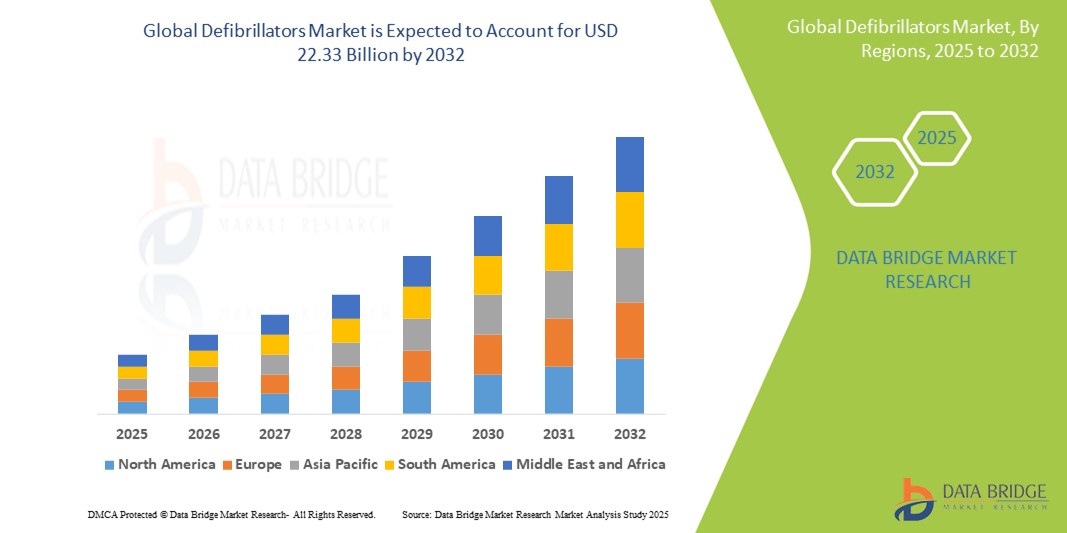
Defibrillators Market Size
- The global defibrillators market size was valued atUSD 13.69 billion in 2024and is expected to reachUSD 22.33 billion by 2032, at aCAGR of 6.31%during the forecast period
- This growth is driven by factors such as the rising prevalence of cardiovascular diseases, increasing geriatric population, advancements in defibrillator technology, greater awareness about sudden cardiac arrest (SCA), and expansion of healthcare infrastructure in developing countries
Defibrillators Market Analysis
- The defibrillators market is experiencing steady growth due to the increasing adoption of advanced medical technologies across healthcare institutions. Rising demand for effective emergency response solutions is contributing to market expansion
- The market is characterized by the presence of numerous players, including both established companies and new entrants. Ongoing innovation and product developments are fostering competition and improving the availability of diverse defibrillator models
- North America is expected to dominate the defibrillators market due to its advanced healthcare infrastructure, high prevalence of cardiovascular diseases, and significant investments in medical research and innovation.
- Asia-Pacific is expected to be the fastest-growing region in the defibrillators market during the forecast period due to increasing healthcare investments, rising cardiovascular disease rates, and improvements in healthcare accessibility across countries such as China and India.
- The implantable cardioverter defibrillators segment is expected to dominate the defibrillators market with the largest share of 52.5% in 2025 due to its proven effectiveness in preventing sudden cardiac deaths in high-risk patients.
Report Scope and Defibrillators Market Segmentation
|
Attributes |
Defibrillators Key Market Insights |
|
Segments Covered |
|
|
Countries Covered |
North America
Europe
Asia-Pacific
Middle East and Africa
South America
|
|
Key Market Players |
|
|
Market Opportunities |
|
|
Value Added Data Infosets |
In addition to the insights on market scenarios such as market value, growth rate, segmentation, geographical coverage, and major players, the market reports curated by the Data Bridge Market Research also include depth expert analysis, patient epidemiology, pipeline analysis, pricing analysis, and regulatory framework. |
Defibrillators Market Trends
“Increasing Adoption of Wearable Defibrillators”
- The adoption of wearable defibrillators is revolutionizing cardiac care by providing a continuous, non-invasive monitoring solution for individuals at risk of sudden cardiac arrest
- For instance, the LifeVest wearable defibrillator continuously tracks heart rhythm and delivers a shock if needed
- These devices offer patients the freedom to go about their daily activities while being closely monitored, significantly improving their quality of life
- For instance, patients can work, exercise, or travel with the assurance that the wearable defibrillator is protecting them from sudden cardiac events
- Wearable defibrillators benefit from advancements inbiosensor technologyand wireless connectivity, enabling real-time data transmission to healthcare providers. This allows doctors to monitor the device’s performance and intervene promptly, even remotely
- By facilitating remote monitoring, wearable defibrillators reduce hospital visits and readmissions, providing a more efficient healthcare approach. This proactive monitoring helps healthcare providers catch potential issues before they escalate
- The increasing adoption of wearable defibrillators aligns with the growing trend of personalized, preventative healthcare, offering patients greater autonomy in managing their heart health while reducing hospital dependency and enhancing outcomes
Defibrillators Market Dynamics
Driver
“Rising Incidence of Cardiovascular Diseases”
- The increasing prevalence of cardiovascular diseases, particularly sudden cardiac arrest, is driving the demand for defibrillators. Sudden cardiac arrest accounts for a significant portion of fatalities, making timely defibrillation crucial for survival.
- According to the World Health Organization, cardiovascular diseases remain the leading cause of death globally, with sudden cardiac arrest being a key contributor to this statistic.
- Healthcare providers are investing in advanced defibrillation technologies to improve patient outcomes
- For instance, the integration of artificial intelligence into defibrillators allows for real-time monitoring, helping to detect arrhythmias quickly and initiate intervention.
- The expansion of emergency medical services (EMS) and public access defibrillator programs has made defibrillators more widely available
- For instance, cities such as Seattle have implemented public access defibrillator programs, ensuring defibrillators are easily accessible in public places
- The availability and use of automated external defibrillators (AEDs) in schools, airports, and shopping centers are increasing, allowing for rapid response in case of sudden cardiac arrest and further boosting market growth
Opportunity
“Technological Advancements in Defibrillator Devices”
- Advancements in defibrillator technology are creating significant opportunities for market expansion, particularly with innovations such as wearable cardioverter defibrillators (WCDs). These devices provide continuous monitoring and immediate response to life-threatening arrhythmias, offering patients greater mobility and peace of mind
- Wearable cardioverter defibrillators (WCDs) have revolutionized patient care by allowing those at risk of sudden cardiac arrest to go about their daily activities while being monitored, enhancing their quality of life
- The development of automated external defibrillators (AEDs) with improved user interfaces and connectivity features has made them easier to use
- For instance, modern AEDs with step-by-step voice prompts are making it possible for laypeople to operate these devices effectively in emergency situations
- The integration of AEDs into public spaces such as airports, malls, and sports stadiums has expanded the availability of life-saving devices in various environments, thus increasing their usage
- The incorporation of telemedicine capabilities in defibrillators allows healthcare providers to remotely monitor patients
- For instance, certain defibrillators transmit real-time data to medical professionals, ensuring faster intervention and improved management of cardiac care
Restraint/Challenge
“High Costs Associated with Acquiring and Maintaining These Devices”
- One of the key challenges in the defibrillators market is the high cost associated with acquiring and maintaining these devices. This financial burden can be prohibitive, particularly for healthcare facilities in low-resource settings, limiting their ability to invest in life-saving technology
- Healthcare facilities in developing regions often struggle to afford defibrillators, which impedes the widespread adoption of these devices
- For instance, smaller hospitals and clinics in rural areas may find it difficult to allocate funds for high-cost defibrillator units
- The initial purchase cost is compounded by ongoing maintenance and replacement of components, making it a significant financial commitment. This makes it harder for healthcare institutions in underserved areas to maintain up-to-date defibrillator technology
- Obtaining regulatory approvals for new defibrillator models adds another layer of cost. The rigorous testing and compliance with international standards, such as those set by the FDA, contribute to delays in product availability and higher development costs
- These financial and regulatory challenges hinder market growth, highlighting the need for strategic initiatives to make defibrillators more affordable and accessible, particularly in developing regions where the need for these devices is most critical
Defibrillators Market Scope
The market is segmented on the basis of product, end user, and patient type.
|
Segmentation |
Sub-Segmentation |
|
By Product |
|
|
By End User |
|
|
By Patient Type |
|
In 2025, the implantable cardioverter defibrillators is projected to dominate the market with a largest share in product segment
The implantable cardioverter defibrillators segment is expected to dominate the defibrillators market with the largest share of 52.5% in 2025 due to its proven effectiveness in preventing sudden cardiac deaths in high-risk patients.
The adult is expected to account for the largest share during the forecast period in patient type market
In 2025, the adult segment is expected to dominate the market with the largest market share of 52.5% due to its high prevalence of cardiovascular diseases and growing adoption of defibrillators among the aging population.
Defibrillators Market Regional Analysis
“North America Holds the Largest Share in the Defibrillators Market”
- North America dominates the defibrillator market by holding the largest revenue share of over 42% in 2023, driven by advanced healthcare infrastructure and a high prevalence of cardiovascular diseases
- The presence of major industry players such as Medtronic, Boston Scientific, and Abbott Laboratories, along with significant investments in R&D, contributes to the region's market dominance
- Supportive policies promoting the adoption of public access automated external defibrillators (AEDs) have increased the penetration of technologically advanced devices
- Higher healthcare spending and strong intellectual property protections lead to greater demand for premium defibrillator devices in the region
“Asia-Pacific is Projected to Register the Highest CAGR in the Defibrillators Market”
- Asia Pacific is anticipated to register the highest compound annual growth rate over the forecast period, owing to the high prevalence of cardiovascular diseases in countries such as China and India
- Rising medical needs due to large populations and improving economic conditions are driving heavier investments in healthcare infrastructure and services across developing nations
- The region is witnessing steady growth in medical device manufacturing, with emerging multinational players setting up production bases to cater to local and export markets
Defibrillators Market Share
The market competitive landscape provides details by competitor. Details included are company overview, company financials, revenue generated, market potential, investment in research and development, new market initiatives, global presence, production sites and facilities, production capacities, company strengths and weaknesses, product launch, product width and breadth, application dominance. The above data points provided are only related to the companies' focus related to market.
The Major Market Leaders Operating in the Market Are:
- Medtronic(Ireland)
- Boston Scientific Corporation(U.S.)
- Koninklijke Philips N.V.(Netherlands)
- Stryker(U.S.)
- NIHON KOKEN KOGYO CO., LTD.(Tokyo)
- ZOLL Medical Corporation (U.S.)
- BIOTRONIK SE & Co KG (Germany)
- Shenzhen Mindray Bio-Medical Electronics Co., Ltd. (China)
- Physio-Control, Inc. (U.S.)
- LivaNova PLC (U.K.)
- Asahi Kasei Corporation (Japan)
- SCHILLER (Switzerland)
- MEDIANA Co., Ltd. (Korea)
- Metrax GmbH (Germany)
- Abbott (U.S.)
- FUKUDA DENSHI (Japan)
- Progetti srl (Italy)
- HeartSine Technologies LLC. (U.S.)
- Defibtech LLC (U.S.)
Latest Developments in Global Defibrillators Market
- In April 2025, Medtronic received FDA approval for its OmniaSecure defibrillation lead, the smallest-diameter, lumenless defibrillation lead designed for implantable cardioverter-defibrillators (ICDs). This innovation aims to enhance patient safety and device reliability by reducing complications associated with larger leads, such as venous occlusion and tricuspid valve issues. The OmniaSecure lead demonstrated a 97.5% success rate in defibrillation testing and a 97.1% complication-free rate at six months in the LEADR Pivotal Trial, exceeding prespecified performance goals. Its successful development and clinical performance are expected to strengthen Medtronic's position in the cardiac rhythm management market and potentially set a new standard for ICD lead design
- In October 2023, Medtronic received FDA approval for its Aurora Extravascular Implantable Cardioverter-Defibrillator (EV-ICD) System, a first-of-its-kind device designed to treat life-threatening ventricular arrhythmias. Unlike traditional ICDs that require leads to be placed inside the heart and veins, the Aurora EV-ICD features a lead positioned under the sternum, outside the heart and vascular system. This design aims to reduce complications associated with transvenous leads, such as vascular injury and vessel occlusion. The system provides life-saving defibrillation, anti-tachycardia pacing, and back-up pacing therapies, all within a device similar in size and longevity to conventional ICDs. Clinical studies demonstrated a 98.7% success rate in terminating ventricular arrhythmias at implant, with a 92.6% freedom from major system or procedure-related complications at six months. The approval of the Aurora EV-ICD is expected to expand treatment options for patients at risk of sudden cardiac arrest and potentially set a new standard in ICD therapy
SKU-
세계 최초의 시장 정보 클라우드 보고서에 온라인으로 접속하세요

- 대화형 데이터 분석 대시보드
- 높은 성장 잠재력 기회를 위한 회사 분석 대시보드
- 사용자 정의 및 질의를 위한 리서치 분석가 액세스
- 대화형 대시보드를 통한 경쟁자 분석
- 최신 뉴스, 업데이트 및 추세 분석
- 포괄적인 경쟁자 추적을 위한 벤치마크 분석의 힘 활용
연구 방법론
데이터 수집 및 기준 연도 분석은 대규모 샘플 크기의 데이터 수집 모듈을 사용하여 수행됩니다. 이 단계에는 다양한 소스와 전략을 통해 시장 정보 또는 관련 데이터를 얻는 것이 포함됩니다. 여기에는 과거에 수집한 모든 데이터를 미리 검토하고 계획하는 것이 포함됩니다. 또한 다양한 정보 소스에서 발견되는 정보 불일치를 검토하는 것도 포함됩니다. 시장 데이터는 시장 통계 및 일관된 모델을 사용하여 분석하고 추정합니다. 또한 시장 점유율 분석 및 주요 추세 분석은 시장 보고서의 주요 성공 요인입니다. 자세한 내용은 분석가에게 전화를 요청하거나 문의 사항을 드롭하세요.
DBMR 연구팀에서 사용하는 주요 연구 방법론은 데이터 마이닝, 시장에 대한 데이터 변수의 영향 분석 및 주요(산업 전문가) 검증을 포함하는 데이터 삼각 측량입니다. 데이터 모델에는 공급업체 포지셔닝 그리드, 시장 타임라인 분석, 시장 개요 및 가이드, 회사 포지셔닝 그리드, 특허 분석, 가격 분석, 회사 시장 점유율 분석, 측정 기준, 글로벌 대 지역 및 공급업체 점유율 분석이 포함됩니다. 연구 방법론에 대해 자세히 알아보려면 문의를 통해 업계 전문가에게 문의하세요.
사용자 정의 가능
Data Bridge Market Research는 고급 형성 연구 분야의 선두 주자입니다. 저희는 기존 및 신규 고객에게 목표에 맞는 데이터와 분석을 제공하는 데 자부심을 느낍니다. 보고서는 추가 국가에 대한 시장 이해(국가 목록 요청), 임상 시험 결과 데이터, 문헌 검토, 재생 시장 및 제품 기반 분석을 포함하도록 사용자 정의할 수 있습니다. 기술 기반 분석에서 시장 포트폴리오 전략에 이르기까지 타겟 경쟁업체의 시장 분석을 분석할 수 있습니다. 귀하가 원하는 형식과 데이터 스타일로 필요한 만큼 많은 경쟁자를 추가할 수 있습니다. 저희 분석가 팀은 또한 원시 엑셀 파일 피벗 테이블(팩트북)로 데이터를 제공하거나 보고서에서 사용 가능한 데이터 세트에서 프레젠테이션을 만드는 데 도움을 줄 수 있습니다.











