


Global Electrochemical Gas Sensor Market Segmentation, By Type (Oxygen, Carbon Monoxide (CO), Carbon Dioxide (CO2), Nitrogen Oxide, Ammonia, Hydrogen Sulfide (H2S), Chlorine (CL), Volatile Organic Compound (VOC), Methane, Propane, Butane, and Others), Connectivity (Wired and Wireless), Output Type (Analog and Digital), Product (Gas Analyzers and Monitors, Gas Detectors, Air Quality Monitors, Air Purifiers/Air Cleaners, HVAC, Medical Equipment, and Consumer Devices), End User (Water and Wastewater Treatment, Automotive, Metal and Chemical Industry, Medical, Environmental, Food Industry, Oil and Gas, Consumer Electronics, Transport and Logistics, Power Stations, Building Automation and Domestic Application, and Others) - Industry Trends and Forecast to 2033
What is the Global Electrochemical Gas Sensor Market Size and Growth Rate?
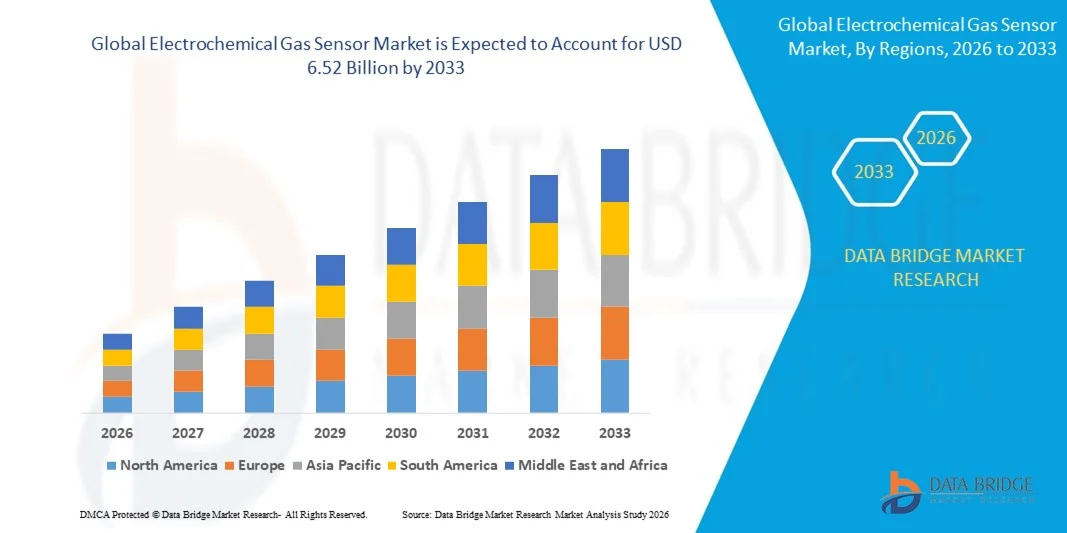
- The global electrochemical gas sensor market size was valued at USD 3.47 billion in 2025 and is expected to reach USD 6.52 billion by 2033, at a CAGR of 8.20% during the forecast period
- The formulation and implementation of various health and safety regulations across the globe is expected to influence the growth of the electrochemical gas sensor market
- Such aswise the high demand for gas sensors in critical industries and increase in the integration of gas sensors in HVAC systems and air quality monitors are also expected to flourish the growth of the electrochemical gas sensor market
What are the Major Takeaways of Electrochemical Gas Sensor Market?
- Rise in air pollution level and need for air quality monitoring in smart cities is also anticipated to positively impact the growth of the market. In addition, the high demand for gas sensors in healthcare industry during COVID-19 pandemic also projected to act as an active growth driver towards the growth of the electrochemical gas sensor market
- However, the growth of new and innovative gas sensors is time consuming along with decline in demand from oil and gas industry due to COVID-19 are expected to act as the major restrictions for the growth of electrochemical gas sensor in the above mentioned forecasted period
- Asia-Pacific dominated the electrochemical gas sensor market with the largest revenue share of 34.49% in 2025, driven by rapid industrialization, expanding manufacturing activities, and rising enforcement of environmental and worker safety regulations across China, Japan, India, South Korea, and Southeast Asia
- North America is expected to grow at the fastest CAGR of 8.31% from 2026 to 2033, driven by strict occupational safety regulations, rising investments in environmental monitoring, and increasing adoption of smart sensing technologies across the U.S. and Canada
- The Carbon Monoxide (CO) segment dominated the market with a 34.6% share in 2025, driven by its widespread use in industrial safety systems, residential gas alarms, automotive cabins, and indoor air quality monitoring
Report Scope and Electrochemical Gas Sensor Market Segmentation
|
Attributes |
Electrochemical Gas Sensor Key Market Insights |
|
Segments Covered |
|
|
Countries Covered |
North America
Europe
Asia-Pacific
Middle East and Africa
South America
|
|
Key Market Players |
|
|
Market Opportunities |
|
|
Value Added Data Infosets |
In addition to the insights on market scenarios such as market value, growth rate, segmentation, geographical coverage, and major players, the market reports curated by the Data Bridge Market Research also include in-depth expert analysis, pricing analysis, brand share analysis, consumer survey, demography analysis, supply chain analysis, value chain analysis, raw material/consumables overview, vendor selection criteria, PESTLE Analysis, Porter Analysis, and regulatory framework. |
What is the Key Trend in the Electrochemical Gas Sensor Market?
Rising Adoption of Compact, Intelligent, and IoT-Integrated Electrochemical Gas Sensors
- The electrochemical gas sensor market is witnessing strong adoption of compact, low-power, and high-sensitivity sensors designed for continuous monitoring of toxic and combustible gases across industrial, environmental, and healthcare applications
- Manufacturers are increasingly introducing miniaturized, multi-gas, and digitally enabled electrochemical sensors with improved selectivity, faster response times, and extended operational lifespans
- Growing demand for portable, cost-efficient, and field-deployable gas sensing solutions is driving adoption across industrial safety, air quality monitoring, smart buildings, and wearable safety devices
- For instance, companies such as Honeywell, ABB, Sensirion, and Alphasense are enhancing sensor accuracy through advanced materials, digital calibration, and onboard signal conditioning
- Increasing need for real-time gas detection, regulatory compliance, and predictive maintenance is accelerating the shift toward smart, network-connected electrochemical gas sensors
- As industrial processes and urban environments become more safety- and data-driven, Electrochemical Gas Sensors will remain critical for accurate, reliable, and continuous gas monitoring
What are the Key Drivers of Electrochemical Gas Sensor Market?
- Rising demand for accurate, reliable, and low-cost gas detection solutions to ensure worker safety and environmental compliance across industrial and commercial settings
- For instance, in 2024–2025, leading players such as Honeywell, ABB, and Siemens expanded their electrochemical sensor portfolios to address stricter emission norms and safety standards
- Growing adoption of IoT-enabled monitoring systems, smart cities, and industrial automation is boosting demand for real-time gas sensing across North America, Europe, and Asia-Pacific
- Advancements in electrode materials, electrolyte chemistry, and microfabrication technologies are improving sensor sensitivity, stability, and energy efficiency
- Increasing deployment in healthcare, automotive cabins, residential safety systems, and air quality monitoring is expanding the application scope of electrochemical gas sensors
- Supported by tightening safety regulations, rising environmental awareness, and smart infrastructure investments, the Electrochemical Gas Sensor market is expected to witness sustained long-term growth
Which Factor is Challenging the Growth of the Electrochemical Gas Sensor Market?
- High costs associated with advanced, multi-gas, and long-life electrochemical sensors can limit adoption among small enterprises and cost-sensitive markets
- For instance, during 2024–2025, fluctuations in raw material prices and supply chain constraints impacted electrode and electrolyte sourcing for several manufacturers
- Limited sensor lifespan, periodic calibration requirements, and sensitivity to temperature and humidity variations increase maintenance complexity
- Lack of technical awareness and skilled personnel in emerging markets slows deployment of advanced gas sensing solutions
- Competition from alternative sensing technologies such as infrared, semiconductor, and photoionization detectors creates pricing pressure and challenges differentiation
- To overcome these barriers, companies are focusing on durability enhancement, self-calibration features, cost optimization, and digital integration to expand global adoption of electrochemical gas sensors
How is the Electrochemical Gas Sensor Market Segmented?
The market is segmented on the basis of type, connectivity, output type, product, and end user.
- By Type
On the basis of type, the electrochemical gas sensor market is segmented into Oxygen, Carbon Monoxide (CO), Carbon Dioxide (CO₂), Nitrogen Oxide, Ammonia, Hydrogen Sulfide (H₂S), Chlorine (Cl), Volatile Organic Compounds (VOC), Methane, Propane, Butane, and Others. The Carbon Monoxide (CO) segment dominated the market with a 34.6% share in 2025, driven by its widespread use in industrial safety systems, residential gas alarms, automotive cabins, and indoor air quality monitoring. Rising awareness of CO poisoning and stringent safety regulations across industries continue to support strong demand.
The VOC segment is expected to grow at the fastest CAGR from 2026 to 2033, supported by increasing deployment in environmental monitoring, smart buildings, and air quality management systems. Growing concerns over indoor pollution, industrial emissions, and urban air quality are accelerating adoption of VOC electrochemical sensors globally.
- By Connectivity
Based on connectivity, the market is segmented into Wired and Wireless. The Wired segment dominated the market with a 61.2% share in 2025, owing to its reliability, stable signal transmission, and extensive use in fixed industrial installations, power plants, oil & gas facilities, and manufacturing units. Wired sensors are preferred for mission-critical safety applications due to minimal interference and consistent performance.
The Wireless segment is projected to grow at the fastest CAGR during 2026–2033, driven by rising adoption of IoT-enabled monitoring, smart infrastructure, wearable safety devices, and remote environmental sensing. Wireless electrochemical sensors enable real-time data transmission, flexible deployment, and lower installation costs, supporting rapid expansion across smart cities and industrial automation.
- By Output Type
On the basis of output type, the electrochemical gas sensor market is segmented into Analog and Digital. The Analog segment accounted for the largest market share of 55.8% in 2025, supported by its simplicity, cost-effectiveness, and widespread integration in legacy industrial systems and basic gas detection equipment. Analog sensors remain highly reliable for continuous monitoring in industrial and commercial environments.
The Digital segment is expected to grow at the fastest CAGR from 2026 to 2033, fueled by increasing demand for high accuracy, noise immunity, onboard calibration, and seamless integration with cloud platforms, IoT networks, and smart monitoring systems. Digital outputs support advanced analytics and predictive maintenance applications.
- By Product
Based on product, the market is segmented into Gas Analyzers and Monitors, Gas Detectors, Air Quality Monitors, Air Purifiers/Air Cleaners, HVAC, Medical Equipment, and Consumer Devices. The Gas Detectors segment dominated the market with a 38.9% share in 2025, driven by extensive use in industrial safety, oil & gas operations, mining, and manufacturing facilities. Mandatory safety compliance and workplace hazard prevention strongly support this segment.
The Air Quality Monitors segment is expected to register the fastest CAGR from 2026 to 2033, owing to rising environmental concerns, urban pollution monitoring, and adoption in smart buildings and smart cities.
- By End User
On the basis of end user, the electrochemical gas sensor market is segmented into Water & Wastewater Treatment, Automotive, Metal & Chemical Industry, Medical, Environmental, Food Industry, Oil & Gas, Consumer Electronics, Transport & Logistics, Power Stations, Building Automation & Domestic Applications, and Others. The Oil & Gas segment dominated the market with a 29.7% share in 2025, supported by stringent safety norms, continuous gas leak monitoring, and hazardous environment detection requirements.
The Building Automation & Domestic Application segment is projected to grow at the fastest CAGR from 2026 to 2033, driven by smart home adoption, indoor air quality awareness, and increased use of connected safety devices worldwide.
Which Region Holds the Largest Share of the Electrochemical Gas Sensor Market?
- Asia-Pacific dominated the electrochemical gas sensor market with the largest revenue share of 34.49% in 2025, driven by rapid industrialization, expanding manufacturing activities, and rising enforcement of environmental and worker safety regulations across China, Japan, India, South Korea, and Southeast Asia. High demand from chemical processing, oil & gas, metal manufacturing, and automotive industries continues to fuel large-scale deployment of electrochemical gas sensors for toxic gas detection and emission monitoring
- Strong electronics manufacturing ecosystems, cost-efficient sensor production, and growing adoption of air quality monitoring systems in smart cities and industrial zones further strengthen Asia-Pacific’s leadership. Increasing government initiatives focused on pollution control and industrial safety standards accelerate long-term market growth
- Rising urbanization, population density, and indoor air quality awareness across residential and commercial buildings reinforce sustained demand across the region
China Electrochemical Gas Sensor Market Insight
China is the largest contributor within Asia-Pacific, supported by extensive industrial output, strict emission control policies, and large-scale deployment of gas monitoring systems in factories, power plants, and urban infrastructure. Strong domestic manufacturing capabilities and competitive pricing drive widespread adoption across industrial and environmental applications.
Japan Electrochemical Gas Sensor Market Insight
Japan shows steady growth driven by advanced industrial automation, precision manufacturing, and stringent safety regulations. High demand from automotive manufacturing, electronics plants, and smart building applications supports continued market expansion.
India Electrochemical Gas Sensor Market Insight
India is emerging rapidly due to expanding chemical, oil & gas, and wastewater treatment sectors. Government initiatives on air quality monitoring, smart cities, and industrial safety are accelerating adoption across public and private sectors.
South Korea Electrochemical Gas Sensor Market Insight
South Korea contributes significantly through strong demand from electronics manufacturing, semiconductor fabs, and industrial safety systems. Advanced technology adoption and smart factory initiatives support market growth.
North America Electrochemical Gas Sensor Market Insight
North America is expected to grow at the fastest CAGR of 8.31% from 2026 to 2033, driven by strict occupational safety regulations, rising investments in environmental monitoring, and increasing adoption of smart sensing technologies across the U.S. and Canada. Growing deployment in oil & gas facilities, healthcare settings, smart buildings, and industrial automation fuels demand for high-accuracy electrochemical gas sensors. Strong R&D capabilities, rapid integration of IoT-enabled monitoring systems, and continuous innovation by leading sensor manufacturers further accelerate regional market expansion.
Which are the Top Companies in Electrochemical Gas Sensor Market?
The electrochemical gas sensor industry is primarily led by well-established companies, including:
- ABB (Switzerland)
- Bosch Sensortec GmbH (Germany)
- Siemens (Germany)
- Emerson Electric Co. (U.S.)
- Figaro Engineering Inc. (Japan)
- City Technology Ltd. (U.K.)
- Sensirion AG (Switzerland)
- DYNAMENT Limited (U.K.)
- Alphasense (U.K.)
- ams AG (Austria)
- Amphenol Corporation (U.S.)
- Honeywell International Inc. (U.S.)
- Membrapor (Switzerland)
- BlueSens gas sensor GmbH (Germany)
- Nissha Co., Ltd. (Japan)
- Renesas Electronics Corporation (Japan)
- Breeze Technologies (Germany)
- Danfoss (Denmark)
- FLIR Systems, Inc. (U.S.)
- Pepperl+Fuchs (Germany)
SKU-
세계 최초의 시장 정보 클라우드 보고서에 온라인으로 접속하세요

- 대화형 데이터 분석 대시보드
- 높은 성장 잠재력 기회를 위한 회사 분석 대시보드
- 사용자 정의 및 질의를 위한 리서치 분석가 액세스
- 대화형 대시보드를 통한 경쟁자 분석
- 최신 뉴스, 업데이트 및 추세 분석
- 포괄적인 경쟁자 추적을 위한 벤치마크 분석의 힘 활용
연구 방법론
데이터 수집 및 기준 연도 분석은 대규모 샘플 크기의 데이터 수집 모듈을 사용하여 수행됩니다. 이 단계에는 다양한 소스와 전략을 통해 시장 정보 또는 관련 데이터를 얻는 것이 포함됩니다. 여기에는 과거에 수집한 모든 데이터를 미리 검토하고 계획하는 것이 포함됩니다. 또한 다양한 정보 소스에서 발견되는 정보 불일치를 검토하는 것도 포함됩니다. 시장 데이터는 시장 통계 및 일관된 모델을 사용하여 분석하고 추정합니다. 또한 시장 점유율 분석 및 주요 추세 분석은 시장 보고서의 주요 성공 요인입니다. 자세한 내용은 분석가에게 전화를 요청하거나 문의 사항을 드롭하세요.
DBMR 연구팀에서 사용하는 주요 연구 방법론은 데이터 마이닝, 시장에 대한 데이터 변수의 영향 분석 및 주요(산업 전문가) 검증을 포함하는 데이터 삼각 측량입니다. 데이터 모델에는 공급업체 포지셔닝 그리드, 시장 타임라인 분석, 시장 개요 및 가이드, 회사 포지셔닝 그리드, 특허 분석, 가격 분석, 회사 시장 점유율 분석, 측정 기준, 글로벌 대 지역 및 공급업체 점유율 분석이 포함됩니다. 연구 방법론에 대해 자세히 알아보려면 문의를 통해 업계 전문가에게 문의하세요.
사용자 정의 가능
Data Bridge Market Research는 고급 형성 연구 분야의 선두 주자입니다. 저희는 기존 및 신규 고객에게 목표에 맞는 데이터와 분석을 제공하는 데 자부심을 느낍니다. 보고서는 추가 국가에 대한 시장 이해(국가 목록 요청), 임상 시험 결과 데이터, 문헌 검토, 재생 시장 및 제품 기반 분석을 포함하도록 사용자 정의할 수 있습니다. 기술 기반 분석에서 시장 포트폴리오 전략에 이르기까지 타겟 경쟁업체의 시장 분석을 분석할 수 있습니다. 귀하가 원하는 형식과 데이터 스타일로 필요한 만큼 많은 경쟁자를 추가할 수 있습니다. 저희 분석가 팀은 또한 원시 엑셀 파일 피벗 테이블(팩트북)로 데이터를 제공하거나 보고서에서 사용 가능한 데이터 세트에서 프레젠테이션을 만드는 데 도움을 줄 수 있습니다.











