Global Energy Management Market Size, Share, and Trends Analysis Report – Industry Overview and Forecast to 2033

Request for TOC Request for TOC Speak to Analyst Speak to Analyst Free Sample Report Free Sample Report Inquire Before Buying Inquire Before Buy Now Buy Now

Global Energy Management Market Size, Share, and Trends Analysis Report – Industry Overview and Forecast to 2033

Global Energy Management Market Segmentation, By System Type (Industrial Energy Management System (IEMS), Building Energy Management System (BEMS) and Home Energy Management System (HEMS)), Component (Hardware, Software and Services), Deployment Mode (On-Premises and Cloud), By Application (Residential, Energy & Power, Telecom & IT, Manufacturing, Retail, Healthcare and Others) – Industry Trends and Forecast to 2033

  • Semiconductors and Electronics
  • May 2026
  • Global
  • 350 Pages
  • No of Tables: 220
  • No of Figures: 60

Global Energy Management Market

Market Size in USD Billion

CAGR :  % Diagram

Bar chart comparing the Global Energy Management Market size in 2025 - 60.61 and 2033 - 158.55, highlighting the projected market growth. USD 60.61 Billion USD 158.55 Billion 2025 2033
Diagram Forecast Period
2026 –2033
Diagram Market Size (Base Year)
USD 60.61 Billion
Diagram Market Size (Forecast Year)
USD 158.55 Billion
Diagram CAGR
%
Diagram Major Markets Players
  • Schneider Electric (France)
  • Siemens AG (Germany)
  • Honeywell International Inc. (U.S.)
  • Johnson Controls (Ireland)
  • ABB Ltd. (Switzerland)

Energy Management Market Size

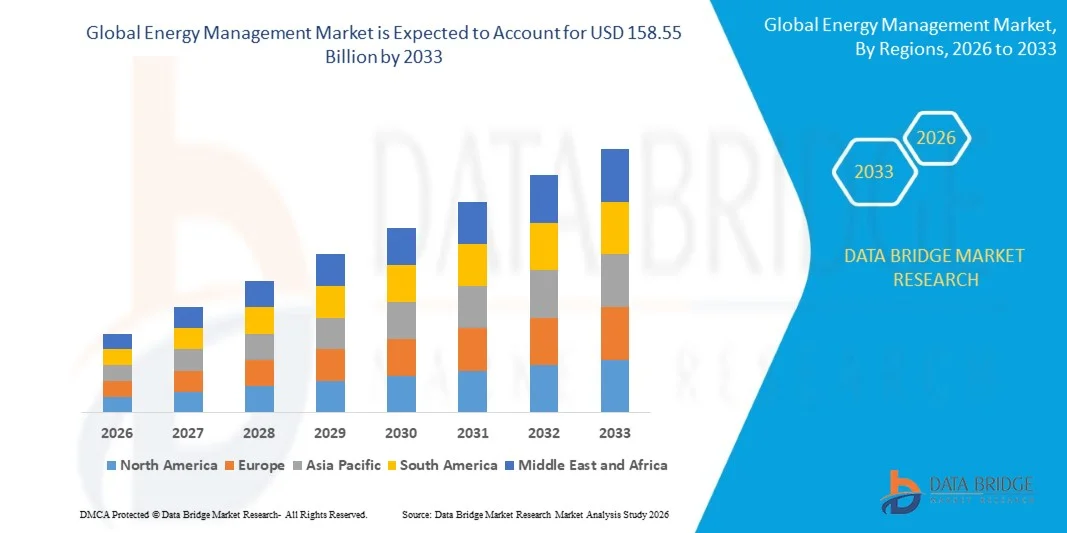
  • The global energy management market size was valued at USD 60.61 billion in 2025 and is expected to reach USD 158.55 billion by 2033, at a CAGR of 12.7% during the forecast period.
  • The market growth is primarily driven by increasing demand for energy efficiency, rising electricity costs, and global decarbonization initiatives aimed at reducing carbon emissions across industrial and commercial sectors.
  • In addition, rapid adoption of smart grids, IoT-enabled energy monitoring systems, and AI-based optimization platforms is significantly transforming how organizations monitor, control, and reduce energy consumption.

Energy Management Market Analysis

  • Energy management systems (EMS), which enable real-time monitoring, optimization, and control of energy consumption, are becoming essential across industrial, commercial, and residential environments due to rising energy costs and sustainability regulations.
  • The escalating demand for energy management solutions is primarily driven by stringent government energy efficiency policies, increasing integration of renewable energy sources, and growing awareness of carbon footprint reduction across industries.
  • North America dominated the energy management market with the largest revenue share of approximately 35% in 2025, supported by strong regulatory frameworks, advanced smart grid infrastructure, and high adoption of industrial automation systems.
  • Asia-Pacific is expected to be the fastest growing region in the energy management market during the forecast period, with a CAGR of 13%, due to rapid industrialization, urbanization, and large-scale smart city initiatives across China, India, and Southeast Asia.
  • The Industrial Energy Management System (IEMS) segment dominated the market in 2025, driven by high energy consumption in manufacturing and heavy industries and increasing focus on operational efficiency and cost reduction.

Energy Management Market

Report Scope and Energy Management Market Segmentation

Attributes

Energy Management Key Market Insights

Segments Covered

  • By System Type: Industrial energy management system (IEMS), Building energy management system (BEMS), and Home energy management system (HEMS)
  • By Component: Hardware, Software, and Services
  • By Deployment Mode: On Premises and Cloud
  • By Application: Residential, Energy & Power, Telecom & IT, Manufacturing, Retail, Healthcare, and Others

Countries Covered

North America

· U.S.

· Canada

· Mexico

Europe

· Germany

· France

· U.K.

· Netherlands

· Switzerland

· Belgium

· Russia

· Italy

· Spain

· Turkey

· Rest of Europe

Asia-Pacific

· China

· Japan

· India

· South Korea

· Singapore

· Malaysia

· Australia

· Thailand

· Indonesia

· Philippines

· Rest of Asia-Pacific

Middle East and Africa

· Saudi Arabia

· U.A.E.

· South Africa

· Egypt

· Israel

· Rest of Middle East and Africa

South America

· Brazil

· Argentina

· Rest of South America

Key Market Players

  • Schneider Electric (France)
  • Siemens AG (Germany)
  • Honeywell International Inc. (U.S.)
  • Johnson Controls (Ireland)
  • ABB Ltd. (Switzerland)
  • Cisco Systems Inc. (U.S.)
  • IBM Corporation (U.S.)
  • General Electric (U.S.)
  • Eaton Corporation (Ireland)
  • Emerson Electric Co. (U.S.)
  • Enel X (Italy)
  • Delta Electronics (Taiwan)
  • Landis+Gyr (Switzerland)
  • Oracle Corporation (U.S.)
  • Rockwell Automation (U.S.)

Market Opportunities

· Expansion of smart grid and renewable energy integration

· Growing adoption of AI and IoT-based energy optimization platforms

Value Added Data Infosets

In addition to the insights on market scenarios such as market value, growth rate, segmentation, geographical coverage, and major players, the market reports curated by the Data Bridge Market Research also include in-depth expert analysis, geographically represented company-wise production and capacity, network layouts of distributors and partners, detailed and updated price trend analysis and deficit analysis of supply chain and demand.

Energy Management Market Trends

“Shift Toward AI-Driven, Cloud-Based, and Decentralized Energy Optimization Systems”

  • A major accelerating trend in the global energy management market is the shift toward cloud-based and AI-powered energy optimization platforms that enable real-time monitoring and predictive energy control.
  • For instance, advanced EMS platforms now integrate machine learning algorithms to forecast energy demand and automatically adjust consumption patterns in industrial and commercial facilities.
  • The integration of IoT sensors and smart meters enables continuous data collection, allowing organizations to identify inefficiencies and optimize energy usage at granular levels.
  • Increasing deployment of cloud-based EMS solutions is supporting scalability, remote access, and centralized energy monitoring across multi-site enterprises.
  • Growing adoption of renewable energy sources such as solar and wind is driving demand for intelligent energy balancing and grid integration solutions.
  • The trend toward decentralized energy systems, including microgrids and distributed energy resources (DERs), is reshaping traditional energy infrastructure models.
  • Rising corporate ESG commitments are pushing industries to adopt advanced energy tracking and carbon reporting systems.

Energy Management Market Dynamics

Driver

“Rising Demand for Energy Efficiency and Sustainability Regulations”

  • Increasing global energy consumption and rising electricity costs are driving organizations to adopt energy management systems to optimize operational efficiency.
  • Governments worldwide are implementing strict carbon reduction targets and energy efficiency mandates, accelerating EMS adoption across industries.
  • For instance, industrial manufacturers are deploying IEMS platforms to reduce operational costs and improve energy utilization efficiency.
  • Growing integration of renewable energy sources is increasing the need for advanced monitoring and balancing systems.
  • Corporate sustainability goals and ESG reporting requirements are further pushing adoption of digital energy monitoring solutions.
  • Expanding smart city initiatives are accelerating deployment of building and home energy management systems.
  • Increasing digitalization in industrial operations is enhancing real-time energy optimization capabilities.

Restraint/Challenge

“High Implementation Cost and Integration Complexity”

  • High initial investment costs for deploying advanced energy management systems remain a significant barrier, particularly for small and medium enterprises.
  • Integration of EMS with legacy infrastructure in industrial facilities can be complex and time-consuming.
  • Lack of standardized protocols across energy systems creates interoperability challenges.
  • Limited technical expertise in developing regions restricts large-scale adoption.
  • Cybersecurity concerns associated with cloud-based energy platforms pose additional risks.
  • Data management complexity due to large-scale IoT deployment can affect system efficiency.

Energy Management Market Scope

The market is segmented on the basis of system type, component, deployment mode, and application.

  • By System Type

On the basis of system type, the global energy management market is segmented into industrial energy management system (IEMS), building energy management system (BEMS), and home energy management system (HEMS). The industrial energy management system (IEMS) segment dominated the market in 2025, accounting for 45% share, driven by high energy consumption across manufacturing, utilities, and heavy industrial sectors, along with increasing demand for cost optimization, real-time monitoring, and regulatory compliance in energy-intensive operations.

The home energy management system (HEMS) segment is expected to be the fastest growing segment during the forecast period, driven by rapid adoption of smart homes, increasing penetration of IoT-enabled devices, rising electricity costs, and growing consumer focus on energy efficiency and sustainability.

  • By Component

On the basis of component, the global energy management market is segmented into hardware, software, and services. The hardware segment dominated the market in 2025, driven by large-scale deployment of smart meters, sensors, controllers, and energy monitoring devices across industrial and commercial infrastructure.

The software segment is expected to be the fastest growing segment during the forecast period, driven by increasing adoption of AI-powered analytics platforms, cloud-based energy management solutions, and predictive energy optimization tools that enable real-time decision-making and efficiency improvements.

  • By Deployment Mode

On the basis of deployment mode, the global energy management market is segmented into on-premises and cloud. The on-premises segment dominated the market in 2025, particularly in industrial environments, due to high requirements for data security, operational control, and compliance with regulatory frameworks.

The cloud segment is expected to be the fastest growing segment during the forecast period, driven by scalability, remote accessibility, lower upfront investment, and increasing adoption of digital energy platforms across enterprises and utilities.

  • By Application

On the basis of application, the global energy management market is segmented into residential, energy & power, telecom & it, manufacturing, retail, healthcare, and others. The manufacturing segment dominated the market in 2025, driven by high energy consumption in industrial operations and strong focus on improving operational efficiency, reducing energy waste, and achieving sustainability targets.

The residential segment is expected to be the fastest growing segment during the forecast period, driven by rising smart home adoption, increasing consumer awareness of energy savings, growing electricity costs, and expanding deployment of IoT-based home energy management systems.

Energy Management Market Regional Analysis

  • North America dominated the energy management market with the largest revenue share of 35% in 2025, supported by advanced smart grid infrastructure, strong regulatory frameworks for energy efficiency, and the presence of leading technology providers and industrial automation companies.
  • Enterprises and utilities in the region place significant emphasis on energy optimization, carbon emission reduction, and digital transformation of energy systems, leading to widespread adoption of energy management solutions across industrial, commercial, and residential applications.
  • This strong market position is further supported by high investments in smart infrastructure, rapid adoption of IoT and AI-based energy monitoring systems, and growing deployment of cloud-based energy platforms, establishing energy management as a critical component of modern energy efficiency and sustainability strategies.

U.S. Energy Management Market Insight

The U.S. energy management market is the largest contributor within North America, driven by strong adoption of smart grid technologies, advanced industrial automation, and increasing focus on energy efficiency and decarbonization goals. High penetration of IoT-enabled energy monitoring systems, coupled with widespread deployment of cloud-based energy management platforms across manufacturing, commercial buildings, and utilities, is supporting market expansion. Additionally, favorable regulatory policies, strong presence of leading technology providers, and rising investments in renewable energy integration are further accelerating the adoption of advanced energy management solutions across the country.

Europe Energy Management Market Insight

The Europe energy management market is witnessing steady growth, driven by stringent energy efficiency regulations, ambitious carbon neutrality targets, and increasing adoption of renewable energy sources across the region. Strong emphasis on reducing industrial energy consumption and improving building efficiency is accelerating the deployment of advanced energy management systems in commercial, residential, and manufacturing sectors. Widespread smart grid modernization initiatives, coupled with government incentives for sustainable energy practices, are further supporting market expansion. Additionally, rising investments in digital energy platforms and IoT-based monitoring solutions are enhancing real-time energy optimization capabilities across European industries.

U.K. Energy Management Market Insight

The U.K. energy management market is growing steadily, driven by strong national commitments toward net-zero emissions and increasing adoption of energy efficiency solutions across residential, commercial, and industrial sectors. Rising deployment of smart meters, building energy management systems, and cloud-based energy monitoring platforms is supporting improved energy optimization and cost reduction. The country’s well-established regulatory framework, along with government-led sustainability initiatives and smart grid modernization programs, is further accelerating market adoption. Additionally, growing consumer awareness regarding energy conservation and increasing integration of renewable energy sources are strengthening demand for advanced energy management solutions.

Germany Energy Management Market Insight

The Germany energy management market is expanding steadily, supported by the country’s strong focus on energy transition (Energiewende), strict energy efficiency regulations, and ambitious carbon neutrality goals. High adoption of industrial automation and smart manufacturing practices is driving demand for advanced energy management systems across the manufacturing and utilities sectors. Increasing integration of renewable energy sources such as wind and solar is further boosting the need for real-time energy monitoring and grid optimization solutions. Additionally, strong investments in smart building infrastructure and digital energy platforms are enhancing energy efficiency across commercial and residential applications in the country.

Asia-Pacific Energy Management Market Insight

The Asia-Pacific energy management market is expected to witness the fastest growth during the forecast period, driven by rapid industrialization, urbanization, and increasing energy demand across emerging economies such as China, India, and Southeast Asia. Growing investments in smart city projects, smart grid infrastructure, and renewable energy integration are significantly boosting the adoption of advanced energy management systems across industrial, commercial, and residential sectors. Rising government initiatives focused on energy efficiency, coupled with increasing awareness of carbon emission reduction, are further accelerating market expansion. Additionally, the strong presence of manufacturing hubs and expanding digital infrastructure is enhancing demand for IoT-enabled and cloud-based energy management solutions in the region.

Japan Energy Management Market Insight

The Japan energy management market is steadily expanding, driven by the country’s strong focus on energy efficiency, sustainability, and advanced technological adoption. Rising implementation of smart grid systems and IoT-enabled energy monitoring solutions is supporting efficient energy utilization across industrial, commercial, and residential sectors. Japan’s aging infrastructure is increasingly being upgraded with smart building and automation technologies to improve energy optimization and reduce operational costs. Additionally, growing integration of renewable energy sources and strong government initiatives promoting carbon neutrality are further accelerating the adoption of advanced energy management systems in the country.

India Energy Management Market Insight

The India energy management market is witnessing strong growth, driven by rapid urbanization, rising electricity demand, and increasing focus on energy efficiency across industrial, commercial, and residential sectors. Expanding adoption of smart grids, smart meters, and IoT-based energy monitoring solutions is improving real-time energy optimization and reducing operational costs. Government initiatives such as smart city programs, renewable energy expansion, and energy conservation policies are further accelerating market adoption. Additionally, the growing manufacturing base, increasing digital infrastructure, and rising awareness of sustainability practices are significantly boosting demand for advanced energy management systems in the country.

Energy management Market Share

The Energy management industry is primarily led by well-established companies, including:

  • Schneider Electric (France)
  • Siemens AG (Germany)
  • Honeywell International Inc. (U.S.)
  • Johnson Controls (Ireland)
  • ABB Ltd. (Switzerland)
  • Cisco Systems Inc. (U.S.)
  • IBM Corporation (U.S.)
  • General Electric (U.S.)
  • Eaton Corporation (Ireland)
  • Emerson Electric Co. (U.S.)
  • Enel X (Italy)
  • Delta Electronics (Taiwan)
  • Landis+Gyr (Switzerland)
  • Oracle Corporation (U.S.)
  • Rockwell Automation (U.S.)

What are the Recent Developments in Global Energy management Market?

  • In 2025, Schneider Electric reported strong growth in its energy management business, driven by rising demand for data center energy optimization, AI-based analytics, and electrification solutions. The company’s energy management revenue grew significantly as enterprises increased adoption of smart energy platforms for efficiency and sustainability goals.
  • In 2025, Siemens advanced its energy management and grid software portfolio, focusing on improving renewable energy integration and smart grid automation to enhance energy efficiency in utilities and industrial systems.
  • In 2025–2026, ABB expanded its ABB Ability Energy Management Suite, focusing on industrial decarbonization, predictive energy analytics, and renewable integration across manufacturing facilities.
  • In 2025, Honeywell enhanced its Honeywell Forge Energy Optimization platform, integrating AI-based predictive maintenance and building energy analytics to help enterprises reduce energy consumption and operational costs.


SKU-

Get online access to the report on the World's First Market Intelligence Cloud

  • Interactive Data Analysis Dashboard
  • Company Analysis Dashboard for high growth potential opportunities
  • Research Analyst Access for customization & queries
  • Competitor Analysis with Interactive dashboard
  • Latest News, Updates & Trend analysis
  • Harness the Power of Benchmark Analysis for Comprehensive Competitor Tracking
Request for Demo

Global Energy Management Market, Supply Chain Analysis and Ecosystem Framework

To support market growth and help clients navigate the impact of geopolitical shifts, DBMR has integrated in-depth supply chain analysis into its Global Energy Management Market research reports. This addition empowers clients to respond effectively to global changes affecting their industries. The supply chain analysis section includes detailed insights such as Global Energy Management Market consumption and production by country, price trend analysis, the impact of tariffs and geopolitical developments, and import and export trends by country and HSN code. It also highlights major suppliers with data on production capacity and company profiles, as well as key importers and exporters. In addition to research, DBMR offers specialized supply chain consulting services backed by over a decade of experience, providing solutions like supplier discovery, supplier risk assessment, price trend analysis, impact evaluation of inflation and trade route changes, and comprehensive market trend analysis.

Research Methodology

Data collection and base year analysis are done using data collection modules with large sample sizes. The stage includes obtaining market information or related data through various sources and strategies. It includes examining and planning all the data acquired from the past in advance. It likewise envelops the examination of information inconsistencies seen across different information sources. The market data is analysed and estimated using market statistical and coherent models. Also, market share analysis and key trend analysis are the major success factors in the market report. To know more, please request an analyst call or drop down your inquiry.

The key research methodology used by DBMR research team is data triangulation which involves data mining, analysis of the impact of data variables on the market and primary (industry expert) validation. Data models include Vendor Positioning Grid, Market Time Line Analysis, Market Overview and Guide, Company Positioning Grid, Patent Analysis, Pricing Analysis, Company Market Share Analysis, Standards of Measurement, Global versus Regional and Vendor Share Analysis. To know more about the research methodology, drop in an inquiry to speak to our industry experts.

Customization Available

Data Bridge Market Research is a leader in advanced formative research. We take pride in servicing our existing and new customers with data and analysis that match and suits their goal. The report can be customized to include price trend analysis of target brands understanding the market for additional countries (ask for the list of countries), clinical trial results data, literature review, refurbished market and product base analysis. Market analysis of target competitors can be analyzed from technology-based analysis to market portfolio strategies. We can add as many competitors that you require data about in the format and data style you are looking for. Our team of analysts can also provide you data in crude raw excel files pivot tables (Fact book) or can assist you in creating presentations from the data sets available in the report.

Frequently Asked Questions

The energy management market size was valued at USD 60.61 billion in 2025.
The energy management market is to grow at a CAGR of 12.7% during the forecast period of 2026 to 2033.
The energy management market is segmented into multiple notable segments based on system type, component, deployment mode, and application. On the basis of system type, the market is segmented into industrial energy management system (IEMS), building energy management system (BEMS), and home energy management system (HEMS). On the basis of component, the market is segmented into hardware, software, and services. On the basis of deployment mode, the market is segmented into on-premises and cloud. On the basis of application, the market is segmented into residential, energy & power, telecom & IT, manufacturing, retail, healthcare, and others.
Companies such as Schneider Electric (France), Siemens AG (Germany), Honeywell International Inc. (U.S.), ABB Ltd. (Switzerland), and Johnson Controls (U.S.) are major players in the energy management market.

Industry Related Reports

Testimonial