Global Fiber Optic Cable Market Size, Share, and Trends Analysis Report – Industry Overview and Forecast to 2033

Request for TOC Request for TOC Speak to Analyst Speak to Analyst Free Sample Report Free Sample Report Inquire Before Buying Inquire Before Buy Now Buy Now

Global Fiber Optic Cable Market Size, Share, and Trends Analysis Report – Industry Overview and Forecast to 2033

Global Fiber Optic Cable Market Segmentation, By Fiber Type (Single-mode Fiber (SMF), Multi-mode Fiber (MMF)), Cable Type (Loose Tube Cables, Ribbon Cables, Micro Cables / Microduct Cables, Armored Cables / ADSS, Submarine Cables), Installation Type (Aerial / Overhead, Underground / Buried, Submarine / Under-Water, Indoor / Drop Cables), End-User Industry (Telecommunications, Data Centers and Cloud Providers, Power Utilities and Smart Grid, Defense and Aerospace, Industrial Automation and Control, Healthcare and Medical, Oil & Gas and Offshore, Others) – Industry Trends and Forecast to 2033

  • Semiconductors and Electronics
  • May 2026
  • Global
  • 350 Pages
  • No of Tables: 220
  • No of Figures: 60

Global Fiber Optic Cable Market

Market Size in USD Billion

CAGR :  % Diagram

Bar chart comparing the Global Fiber Optic Cable Market size in 2025 - 13.90 and 2033 - 30.20, highlighting the projected market growth. USD 13.90 Billion USD 30.20 Billion 2025 2033
Diagram Forecast Period
2026 –2033
Diagram Market Size (Base Year)
USD 13.90 Billion
Diagram Market Size (Forecast Year)
USD 30.20 Billion
Diagram CAGR
%
Diagram Major Markets Players
  • YOFC (Yangtze Optical Fibre and Cable) (China)
  • Hengtong Group (China)
  • OFS Fitel LLC (U.S.)
  • Belden Inc. (U.S.)
  • Finolex Cables Ltd. (India)

Fiber Optic Cable Market Size

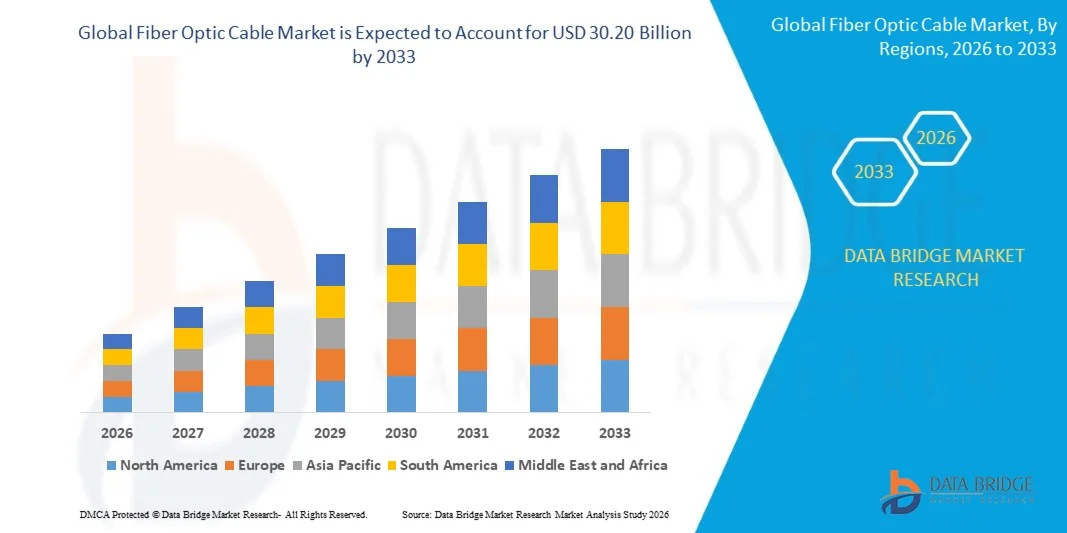
  • The global fiber optic cable market size was valued at approximately USD 13.90 billion in 2025 and is expected to reach USD 30.20 billion by 2033, at a CAGR of 2% during the forecast period.
  • The market growth is primarily driven by the exponential rise in global internet traffic, 5G deployment, cloud computing expansion, and hyperscale data center investments, which are increasing demand for high-speed, low-latency communication infrastructure.
  • In addition, growing adoption of FTTH (Fiber-to-the-Home), smart city projects, AI-driven data centers, and submarine cable expansion projects is significantly accelerating global fiber optic deployment across industries.

Fiber Optic Cable Market Analysis

  • Fiber optic cables, which enable high-speed transmission of data using light signals, are a critical backbone of modern digital infrastructure, supporting telecommunications, internet services, cloud computing, and enterprise connectivity worldwide.
  • The rising demand for high-bandwidth, low-latency, and reliable communication networks is a major factor driving adoption across developed and emerging economies.
  • North America dominated the fiber optic cable market with a revenue share of around 35–38% in 2025, driven by strong data center expansion, 5G rollout, and high cloud adoption rates.
  • Asia-Pacific is expected to be the fastest-growing region due to rapid urbanization, large-scale 5G deployment in China and India, and massive submarine cable investments, with the region projected to grow at a CAGR of 12% during the forecast period.
  • The single-mode fiber (SMF) segment dominates the global fiber optic cable market due to its superior capability for long-distance transmission, higher bandwidth capacity, and minimal signal loss. It is widely deployed in telecommunications backbone networks, 5G infrastructure, submarine cables, and hyperscale data centers, where efficient high-speed data transfer is essential. Its strong performance in long-range and high-capacity communication applications makes it the preferred choice over multi-mode fiber (MMF) in most large-scale network deployments worldwide.

Fiber Optic Cable Market

Report Scope and Fiber Optic Cable Market Segmentation

Attributes

Fiber Optic Cable Key Market Insights

Segments Covered

  • By Fiber Type: Single-mode fiber and Multi-mode fiber
  • By Cable Type: Loose tube, Ribbon, Micro cables, Armored/ADSS and Submarine cables
  • By Installation Type: Aerial / Overhead, Underground / Buried, Submarine / Under-Water and Indoor / Drop Cables
  • By End-Use Industry: Telecommunications, Data Centers, Power Utilities, Defense, Industrial, Healthcare, Oil & Gas and Others

Countries Covered

North America

· U.S.

· Canada

· Mexico

Europe

· Germany

· France

· U.K.

· Netherlands

· Switzerland

· Belgium

· Russia

· Italy

· Spain

· Turkey

· Rest of Europe

Asia-Pacific

· China

· Japan

· India

· South Korea

· Singapore

· Malaysia

· Australia

· Thailand

· Indonesia

· Philippines

· Rest of Asia-Pacific

Middle East and Africa

· Saudi Arabia

· U.A.E.

· South Africa

· Egypt

· Israel

· Rest of Middle East and Africa

South America

· Brazil

· Argentina

· Rest of South America

Key Market Players

  • Corning Incorporated (U.S.)
  • Prysmian Group (Italy)
  • CommScope Holding Company (U.S.)
  • Furukawa Electric Co., Ltd. (Japan)
  • Fujikura Ltd. (Japan)
  • Sumitomo Electric Industries (Japan)
  • Sterlite Technologies Ltd. (India)
  • Nexans S.A. (France)
  • YOFC (Yangtze Optical Fibre and Cable) (China)
  • Hengtong Group (China)
  • OFS Fitel LLC (U.S.)
  • Belden Inc. (U.S.)
  • Finolex Cables Ltd. (India)

Market Opportunities

· Rapid expansion of 5G infrastructure and fiberized mobile networks

· Rising demand for hyperscale and AI-driven data centers

· Increasing deployment of submarine cable systems for global connectivity

Value Added Data Infosets

In addition to the insights on market scenarios such as market value, growth rate, segmentation, geographical coverage, and major players, the market reports curated by the Data Bridge Market Research also include in-depth expert analysis, geographically represented company-wise production and capacity, network layouts of distributors and partners, detailed and updated price trend analysis and deficit analysis of supply chain and demand.

Fiber Optic Cable Market Trends

“Rapid Shift Toward High-Capacity, Low-Latency Global Connectivity Infrastructure”

  • A major trend shaping the fiber optic cable market is the accelerating demand for high-capacity and ultra-low latency fiber networks. This is being driven by exponential growth in AI workloads, cloud computing, video streaming, and 5G/6G network evolution, which require massive bandwidth and real-time data transmission capabilities.
  • Telecom operators globally are aggressively transitioning from legacy copper-based infrastructure to full-fiber networks. This shift is essential to support rising data consumption, improve network reliability, and meet the performance demands of modern digital applications.
  • At the same time, increasing investments in submarine cable systems are significantly strengthening intercontinental connectivity. These undersea networks form the backbone of global internet traffic and are expanding rapidly to support hyperscale cloud ecosystems and international data exchange.
  • The adoption of microduct systems and ribbon fiber technology is improving deployment efficiency by enabling higher fiber density in smaller spaces. This enhances scalability and reduces installation complexity, especially in urban and high-demand environments.
  • Additionally, growing integration of fiber networks with edge computing, IoT ecosystems, and smart infrastructure projects is transforming global communication architecture. This convergence is enabling faster data processing closer to end users, improving performance and reducing latency.

Fiber Optic Cable Market Dynamics

Driver

“Rising Global Data Consumption and 5G Expansion”

  • The rapid increase in global internet usage, video streaming, cloud-based applications, and enterprise digital transformation is significantly boosting demand for fiber optic cables. As data traffic continues to surge, high-speed fiber infrastructure has become essential for modern connectivity needs.
  • The global rollout of 5G networks requires dense fiber backhaul infrastructure, as wireless systems depend heavily on fiber for high-capacity data transmission. This requirement is driving large-scale fiber deployment across urban and semi-urban regions worldwide.
  • Expansion of hyperscale data centers by major technology companies such as Amazon, Google, and Microsoft is further accelerating fiber adoption. These facilities rely on ultra-fast and high-capacity fiber networks to manage massive volumes of cloud and AI-driven workloads.
  • In addition, governments across regions are investing heavily in national broadband expansion and digital connectivity programs. These initiatives are improving rural and urban internet access, thereby increasing fiber optic cable deployment globally.

Restraint/Challenge

“High Installation Cost and Complex Deployment”

  • One of the major challenges in the fiber optic cable market is the high capital expenditure required for installation and deployment. Activities such as trenching, laying underground cables, and submarine installations involve significant infrastructure and labor costs.
  • Deployment is also complicated by geographical barriers, regulatory approvals, and right-of-way restrictions. These factors often delay large-scale projects, particularly in densely populated urban areas or environmentally sensitive regions.
  • Additionally, fiber optic networks face cable damage risks in underground and submarine environments, which can lead to costly repairs and maintenance. Natural disasters, construction activities, and marine hazards further increase operational risks.
  • Lastly, the availability of alternative technologies such as fixed wireless access (FWA) and satellite-based internet solutions can limit fiber adoption in certain regions. These alternatives are often preferred in remote or low-density areas due to lower deployment costs.

Fiber Optic Cable Market Scope

The market is segmented on the basis of fiber type, cable type, installation type, and end-user industry.

  • By Fiber Type

On the basis of fiber type, the global fiber optic cable market is segmented into single-mode fiber (SMF) and multi-mode fiber (MMF). The single-mode fiber (SMF) segment dominated the market in 2025, accounting for 63% of the total market share, due to its superior long-distance transmission capability, ultra-low signal attenuation, and high bandwidth efficiency. It is widely used in telecom backbone networks, 5G infrastructure, and hyperscale data centers, where long-range, high-capacity connectivity is essential.

The multi-mode fiber (MMF) segment is expected to be the fastest-growing segment during the forecast period, driven by increasing adoption in short-distance communication networks such as enterprise LANs, campus networks, and intra-data center connectivity, where cost-effectiveness and ease of deployment are key priorities.

  • By Cable Type

On the basis of cable type, the market is segmented into loose tube cables, ribbon cables, micro/microduct cables, armored/ADSS cables, and submarine cables. The loose tube cables segment dominated the market in 2025 due to its high durability, water resistance, and strong performance in harsh outdoor environments, making it ideal for long-distance telecom and broadband infrastructure.

The submarine (undersea) cables segment is expected to be the fastest-growing segment during the forecast period, driven by rising demand for global intercontinental data traffic, cloud connectivity expansion, and large-scale investments in subsea communication networks.

  • By Installation Type

On the basis of installation type, the market is segmented into underground/buried, aerial/overhead, submarine/under-water, and indoor/drop cables. The underground/buried installation segment dominated the market in 2025 due to its high reliability, protection from environmental damage, and suitability for long-term urban and intercity fiber network deployment.

The submarine installation segment is expected to be the fastest-growing segment during the forecast period, driven by increasing global internet traffic, cross-border data exchange, and expansion of international submarine cable systems connecting continents.

  • By End-User Industry

On the basis of end-user industry, the market is segmented into telecommunications, data centers & cloud providers, power utilities & smart grid, defense & aerospace, industrial automation, healthcare, oil & gas, and others. The telecommunications segment dominated the market in 2025 due to continuous expansion of 5G networks, broadband penetration, and large-scale fiber backbone infrastructure upgrades across both developed and emerging economies.

The data centers and cloud providers segment is expected to be the fastest-growing segment during the forecast period, driven by rapid growth in AI workloads, hyperscale cloud infrastructure, edge computing deployment, and global data traffic expansion.

Fiber Optic Cable Market Regional Analysis

  • North America dominated the global fiber optic cable market in 2025 with a market share of approximately 38%, supported by strong digital infrastructure development and early adoption of advanced communication technologies.
  • The region benefits from large-scale deployment of 5G networks, hyperscale data centers, and cloud computing infrastructure, which significantly drives demand for high-capacity fiber optic networks. Continuous upgrades in telecom backbone systems further strengthen market leadership.

U.S. Fiber Optic Cable Market Insight

The U.S. fiber optic cable market holds the largest share in North America, driven by rapid expansion of 5G networks, hyperscale data centers, and cloud infrastructure. Strong investments from major technology companies such as Amazon, Google, and Microsoft are accelerating large-scale fiber deployment. Increasing demand for high-speed broadband, coupled with ongoing fiberization of telecom backhaul networks, continues to strengthen market growth. In addition, favorable government initiatives for nationwide broadband expansion further support long-term market development.

Europe Fiber Optic Cable Market Insight

The Europe fiber optic cable market is witnessing steady growth, driven by widespread FTTH (fiber-to-the-home) deployments, 5G rollout, and increasing demand for high-speed broadband connectivity. Strong regulatory support and government-backed digital infrastructure initiatives are accelerating fiber adoption across the region. Countries such as Germany, the U.K., and France are leading investments in telecom modernization and smart city projects. Rising data consumption and growing cloud adoption are further supporting long-term market expansion across both urban and industrial networks.

U.K. Fiber Optic Cable Market Insight

The U.K. fiber optic cable market is experiencing strong growth driven by rapid nationwide full-fiber broadband rollout and 5G network expansion. Increasing demand for high-speed internet services across residential, commercial, and enterprise sectors is accelerating fiber deployment. Government-supported initiatives such as nationwide gigabit broadband programs are significantly boosting infrastructure investments. In addition, rising adoption of cloud services and digital transformation across industries continues to strengthen long-term market growth.

Germany Fiber Optic Cable Market Insight

The Germany fiber optic cable market is witnessing steady expansion driven by strong demand for high-speed broadband, industrial digitalization, and 5G network deployment. The country’s focus on upgrading legacy communication infrastructure is accelerating fiber optic installations across urban and rural areas. Germany’s leadership in Industry 4.0, smart manufacturing, and automation is further increasing the need for reliable, high-capacity fiber networks in industrial applications. In addition, government-backed broadband expansion programs and rising data center investments continue to support long-term market growth.

Asia-Pacific Fiber Optic Cable Market Insight

The Asia-Pacific fiber optic cable market is the fastest-growing region, driven by rapid urbanization, increasing 5G deployment, and rising broadband penetration across emerging economies. Countries such as China, India, and Japan are making significant investments in telecom infrastructure, smart city development, and hyperscale data centers. Growing internet usage, cloud adoption, and strong government-led digital transformation initiatives are further accelerating demand for fiber optic networks. In addition, expanding submarine cable projects are enhancing both regional and global connectivity, supporting long-term market growth.

Japan Fiber Optic Cable Market Insight

The Japan fiber optic cable market is witnessing steady growth driven by increasing demand for high-speed connectivity, 5G network expansion, and advanced digital infrastructure development. The country’s strong focus on smart cities, IoT integration, and industrial automation is further boosting fiber deployment across multiple sectors. In addition, rising adoption of cloud services and data-intensive applications is accelerating the need for reliable, high-capacity fiber networks. Japan’s aging population is also contributing to greater demand for efficient telecommunication and remote connectivity solutions.

India Fiber Optic Cable Market Insight

The India fiber optic cable market is experiencing strong growth driven by rapid digital transformation, rising internet penetration, and large-scale 5G rollout initiatives. Government programs such as Digital India and BharatNet are significantly boosting rural and urban fiber connectivity across the country. Increasing demand for high-speed broadband, cloud services, and data center expansion is further accelerating fiber optic deployment. In addition, growing investments from telecom operators and rising adoption of FTTH (fiber-to-the-home) services are strengthening long-term market growth.

Fiber Optic Cable Market Share

The Fiber Optic Cable industry is primarily led by well-established companies, including:

  • Corning Incorporated (U.S.)
  • Prysmian Group (Italy)
  • CommScope Holding Company (U.S.)
  • Furukawa Electric Co., Ltd. (Japan)
  • Fujikura Ltd. (Japan)
  • Sumitomo Electric Industries (Japan)
  • Sterlite Technologies Ltd. (India)
  • Nexans S.A. (France)
  • YOFC (Yangtze Optical Fibre and Cable) (China)
  • Hengtong Group (China)
  • OFS Fitel LLC (U.S.)
  • Belden Inc. (U.S.)
  • Finolex Cables Ltd. (India)

What are the Recent Developments in Global Fiber Optic Cable Market?

  • In January 2026, Corning signed a multi-year agreement worth up to USD 6 billion with Meta to supply advanced fiber optic cables for AI-driven data centers in the U.S. The partnership focuses on expanding domestic manufacturing capacity in North Carolina and strengthening high-speed connectivity infrastructure for hyperscale AI workloads.
  • In March 2025, Prysmian partnered with Relativity Networks to develop next-generation hollow-core fiber optic cables for hyperscale data centers supporting AI applications. This collaboration aims to improve data transmission speed and reduce latency while addressing the rising demand for high-capacity global data infrastructure.
  • In 2026, Sterlite Technologies expanded its focus on advanced fiber manufacturing and automation-driven production upgrades to improve efficiency and meet growing global demand for FTTH and 5G networks. The company is also strengthening its presence in international markets through large-scale telecom infrastructure contracts.
  • In 2025, both companies initiated joint R&D programs for next-generation optical fiber technologies, targeting higher bandwidth capacity and improved network performance. These developments focus on supporting future 5G/6G networks, data centers, and ultra-high-speed communication systems.


SKU-

Get online access to the report on the World's First Market Intelligence Cloud

  • Interactive Data Analysis Dashboard
  • Company Analysis Dashboard for high growth potential opportunities
  • Research Analyst Access for customization & queries
  • Competitor Analysis with Interactive dashboard
  • Latest News, Updates & Trend analysis
  • Harness the Power of Benchmark Analysis for Comprehensive Competitor Tracking
Request for Demo

Global Fiber Optic Cable Market, Supply Chain Analysis and Ecosystem Framework

To support market growth and help clients navigate the impact of geopolitical shifts, DBMR has integrated in-depth supply chain analysis into its Global Fiber Optic Cable Market research reports. This addition empowers clients to respond effectively to global changes affecting their industries. The supply chain analysis section includes detailed insights such as Global Fiber Optic Cable Market consumption and production by country, price trend analysis, the impact of tariffs and geopolitical developments, and import and export trends by country and HSN code. It also highlights major suppliers with data on production capacity and company profiles, as well as key importers and exporters. In addition to research, DBMR offers specialized supply chain consulting services backed by over a decade of experience, providing solutions like supplier discovery, supplier risk assessment, price trend analysis, impact evaluation of inflation and trade route changes, and comprehensive market trend analysis.

Research Methodology

Data collection and base year analysis are done using data collection modules with large sample sizes. The stage includes obtaining market information or related data through various sources and strategies. It includes examining and planning all the data acquired from the past in advance. It likewise envelops the examination of information inconsistencies seen across different information sources. The market data is analysed and estimated using market statistical and coherent models. Also, market share analysis and key trend analysis are the major success factors in the market report. To know more, please request an analyst call or drop down your inquiry.

The key research methodology used by DBMR research team is data triangulation which involves data mining, analysis of the impact of data variables on the market and primary (industry expert) validation. Data models include Vendor Positioning Grid, Market Time Line Analysis, Market Overview and Guide, Company Positioning Grid, Patent Analysis, Pricing Analysis, Company Market Share Analysis, Standards of Measurement, Global versus Regional and Vendor Share Analysis. To know more about the research methodology, drop in an inquiry to speak to our industry experts.

Customization Available

Data Bridge Market Research is a leader in advanced formative research. We take pride in servicing our existing and new customers with data and analysis that match and suits their goal. The report can be customized to include price trend analysis of target brands understanding the market for additional countries (ask for the list of countries), clinical trial results data, literature review, refurbished market and product base analysis. Market analysis of target competitors can be analyzed from technology-based analysis to market portfolio strategies. We can add as many competitors that you require data about in the format and data style you are looking for. Our team of analysts can also provide you data in crude raw excel files pivot tables (Fact book) or can assist you in creating presentations from the data sets available in the report.

Frequently Asked Questions

The Fiber optic cable market size was valued at USD 13.90 billion in 2025.
The Fiber optic cable market is to grow at a CAGR of 10.2% during the forecast period of 2026 to 2033.
The Fiber optic cable market is segmented into four notable categories based on fiber type, cable type, installation type, and end-user industry. On the basis of fiber type, the market is segmented into single-mode fiber (SMF) and multi-mode fiber (MMF). On the basis of cable type, the market is segmented into loose tube cables, ribbon cables, micro/microduct cables, armored cables/ADSS, and submarine cables. On the basis of installation type, the market is segmented into aerial/overhead, underground/buried, submarine/under-water, and indoor/drop cables. On the basis of end-user industry, the market is segmented into telecommunications, data centers and cloud providers, power utilities and smart grid, defense and aerospace, industrial automation and control, healthcare and medical, oil & gas and offshore, and others.
Companies such as Corning Incorporated (U.S.), Prysmian Group (Italy), Furukawa Electric Co., Ltd. (Japan), Sumitomo Electric Industries (Japan) and CommScope Holding Company (U.S.) are major players in Fiber Optic Cable market.

Industry Related Reports

Testimonial