


Global Fungi Resistant Seeds Market Segmentation, By Crop Type (Cereals and Grains, Oilseeds and Pulses, Vegetables, and Other Crop Types), Key Crop (Corn, Rice, Soybean, Cotton, Canola, Tomato, Hot pepper, Cucumber, Watermelon, and Other Key Crops), Cultivation Type (Open Field Cultivation and Protected Cultivation) - Industry Trends and Forecast to 2033
What is the Global Fungi Resistant Seeds Market Size and Growth Rate?
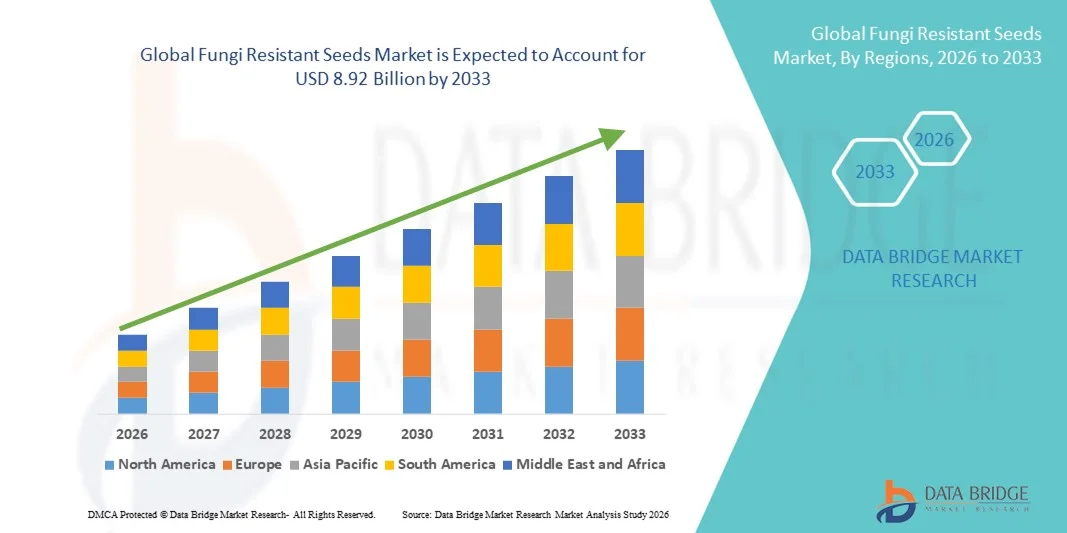
- The global fungi resistant seeds market size was valued at USD 6.09 billion in 2025 and is expected to reach USD 8.92 billion by 2033, at a CAGR of 4.9% during the forecast period
- Major factors are expected to boost the fungi resistant seeds market in the forecast period are the increase in the need for fruits and vegetables around the world
- Furthermore, the utilization of hybrid seeds with several technological components is further anticipated to propel the growth of the fungi resistant seeds market
What are the Major Takeaways of Fungi Resistant Seeds Market?
- The increase in the mechanization of farms is further estimated to cushion the growth of the fungi resistant seeds market. On the other hand, effect of climate change on crop production and once used hybrid seeds cannot be reproduced is further projected to impede the growth of the fungi resistant seeds market in the timeline period
- In addition, the need for healthy and organic processed products and the development in the acceptance of hybrid seed technology for vegetables will further provide potential opportunities for the growth of the fungi resistant seeds market in the coming years
- North America dominated the fungi resistant seeds market with a 38.7% revenue share in 2025, driven by advanced agricultural biotechnology adoption, high awareness of crop protection strategies, and strong presence of global seed companies across the U.S. and Canada
- Asia-Pacific is projected to register the fastest CAGR of 9.14% from 2026 to 2033, driven by expanding population, rising food security concerns, and increasing fungal disease pressure in rice, wheat, and vegetable crops across China, India, Japan, and Southeast Asia
- The Cereals and Grains segment dominated the market with a 41.6% share in 2025, driven by large-scale global cultivation of wheat, rice, and maize and their high vulnerability to fungal diseases such as rust, blast, and smut
Report Scope and Fungi Resistant Seeds Market Segmentation
|
Attributes |
Fungi Resistant Seeds Key Market Insights |
|
Segments Covered |
|
|
Countries Covered |
North America
Europe
Asia-Pacific
Middle East and Africa
South America
|
|
Key Market Players |
|
|
Market Opportunities |
|
|
Value Added Data Infosets |
In addition to the insights on market scenarios such as market value, growth rate, segmentation, geographical coverage, and major players, the market reports curated by the Data Bridge Market Research also include in-depth expert analysis, pricing analysis, brand share analysis, consumer survey, demography analysis, supply chain analysis, value chain analysis, raw material/consumables overview, vendor selection criteria, PESTLE Analysis, Porter Analysis, and regulatory framework. |
What is the Key Trend in the Fungi Resistant Seeds Market?
Growing Adoption of Climate-Resilient and Disease-Tolerant Seed Varieties
- The fungi resistant seeds market is witnessing strong demand for genetically enhanced and hybrid seed varieties that offer improved resistance against fungal pathogens such as rust, blight, mildew, and smut
- Seed manufacturers are increasingly focusing on biotechnology, marker-assisted breeding, and gene-editing technologies to develop high-yield crops with durable fungal resistance and enhanced stress tolerance
- Rising preference for sustainable agriculture practices and reduced chemical fungicide dependency is accelerating the adoption of resistant seed varieties across cereals, oilseeds, fruits, and vegetables
- For instance, in 2025, companies such as Bayer AG, Syngenta Group, Corteva Agriscience, and BASF SE expanded their disease-resistant hybrid seed portfolios targeting wheat, corn, soybean, and rice crops across North America and Asia-Pacific
- Increasing regulatory pressure to limit chemical fungicide usage and promote environmentally safe crop protection solutions is strengthening the market outlook for resistant seed technologies
- As climate variability intensifies fungal outbreaks globally, Fungi Resistant Seeds are expected to remain critical for improving crop productivity, ensuring food security, and supporting sustainable farming systems
What are the Key Drivers of Fungi Resistant Seeds Market?
- Rising incidence of fungal crop diseases due to climate change, humidity variations, and global trade is driving demand for resistant seed varieties to minimize yield losses
- For instance, in 2024–2025, leading agricultural biotechnology firms including Bayer AG, Corteva Agriscience, and Syngenta Group increased investments in R&D programs focused on multi-disease-resistant crop traits
- Growing global demand for high-yield, quality crops to support expanding population and food consumption is encouraging farmers to adopt advanced hybrid and GM seed varieties
- Government initiatives promoting integrated pest management (IPM) and sustainable farming practices are accelerating the shift toward disease-resistant seeds in emerging economies
- Expansion of commercial farming, contract agriculture, and export-oriented crop production in Asia-Pacific and Latin America is boosting market penetration
- Supported by continuous innovation in seed genetics, biotechnology partnerships, and increasing awareness among farmers, the Fungi Resistant Seeds market is projected to experience steady long-term growth
Which Factor is Challenging the Growth of the Fungi Resistant Seeds Market?
- High development costs associated with biotechnology research, trait integration, and regulatory approvals limit the rapid commercialization of new resistant seed varieties
- For instance, during 2024–2025, stringent biosafety regulations and lengthy approval timelines in regions such as Europe delayed the launch of certain genetically modified fungal-resistant crops
- Risk of fungal pathogen mutation and resistance breakdown over time creates uncertainty regarding long-term effectiveness of specific seed traits
- Limited awareness and affordability among small-scale farmers in developing regions restrict widespread adoption of premium hybrid and GM seeds
- Concerns related to genetically modified organisms (GMOs), intellectual property rights, and seed pricing policies create market entry barriers and regional trade challenges
- To overcome these constraints, companies are focusing on cost-efficient breeding technologies, public–private partnerships, farmer education programs, and region-specific disease-resistant seed development strategies
How is the Fungi Resistant Seeds Market Segmented?
The market is segmented on the basis of species, lifecycle, and form.
- By Crop Type
On the basis of crop type, the fungi resistant seeds market is segmented into Cereals and Grains, Oilseeds and Pulses, Vegetables, and Other Crop Types. The Cereals and Grains segment dominated the market with a 41.6% share in 2025, driven by large-scale global cultivation of wheat, rice, and maize and their high vulnerability to fungal diseases such as rust, blast, and smut. Farmers increasingly prefer resistant seed varieties to ensure yield stability and minimize fungicide dependency. Strong government support for staple crop productivity further strengthens this segment.
The Vegetables segment is expected to grow at the fastest CAGR from 2026 to 2033, fueled by rising demand for high-value horticultural crops, increasing greenhouse farming, and the need to control fungal infections in intensive cultivation systems. Growing consumer preference for residue-free produce is also accelerating adoption.
- By Key Crop
On the basis of key crop, the market is segmented into Corn, Rice, Soybean, Cotton, Canola, Tomato, Hot Pepper, Cucumber, Watermelon, and Other Key Crops. The Corn segment dominated the market with a 24.8% share in 2025, supported by its extensive global acreage and susceptibility to fungal pathogens such as leaf blight and ear rot. Continuous innovation in hybrid corn seeds with stacked disease-resistant traits is driving strong commercial demand, particularly in North America and Asia-Pacific.
The Rice segment is projected to grow at the fastest CAGR from 2026 to 2033, owing to increasing fungal outbreaks such as rice blast in humid regions and rising government initiatives to strengthen food security. Advancements in biotech rice varieties and hybrid seed programs are expected to further boost segment growth.
- By Cultivation Type
On the basis of cultivation type, the fungi resistant seeds market is segmented into Open Field Cultivation and Protected Cultivation. The Open Field Cultivation segment dominated the market with a 68.3% share in 2025, attributed to the vast area of traditional farming worldwide and higher exposure to fungal pathogens due to climatic variability. Farmers are increasingly adopting resistant seed varieties to reduce crop losses and maintain productivity under unpredictable weather conditions.
The Protected Cultivation segment is anticipated to grow at the fastest CAGR from 2026 to 2033, driven by expansion of greenhouse farming, polyhouses, and controlled-environment agriculture. High humidity levels in protected systems increase fungal risks, thereby boosting demand for resistant hybrid seeds designed specifically for intensive horticultural production.
Which Region Holds the Largest Share of the Fungi Resistant Seeds Market?
- North America dominated the fungi resistant seeds market with a 38.7% revenue share in 2025, driven by advanced agricultural biotechnology adoption, high awareness of crop protection strategies, and strong presence of global seed companies across the U.S. and Canada. Rising incidence of fungal diseases in corn, soybean, and wheat crops due to climate variability has accelerated demand for genetically resistant and hybrid seed varieties
- Leading companies in the region are investing heavily in trait development, gene editing, and marker-assisted breeding technologies, strengthening North America’s leadership in disease-resistant crop innovation. Strong regulatory frameworks and well-established distribution networks further enhance market penetration
- High farm mechanization, large-scale commercial cultivation, and sustained investment in agricultural R&D reinforce the region’s dominant position in the global market
U.S. Fungi Resistant Seeds Market Insight
The U.S. is the largest contributor in North America, supported by extensive corn and soybean cultivation and strong biotechnology research capabilities. Increasing fungal outbreaks such as rust and blight are encouraging farmers to adopt resistant hybrid seeds. Presence of major seed developers, strong IP protection, and continuous innovation in GM and non-GM resistant traits drive steady market growth. Government support for sustainable agriculture and reduced fungicide dependency further strengthens adoption.
Canada Fungi Resistant Seeds Market Insight
Canada contributes significantly due to large-scale wheat and canola production and rising awareness of integrated disease management practices. Increasing adoption of certified resistant seed varieties helps minimize yield losses caused by fungal pathogens in cold and humid climates. Strong research institutions, supportive agricultural policies, and growing export-oriented farming further support market expansion across the country.
Asia-Pacific Fungi Resistant Seeds Market
Asia-Pacific is projected to register the fastest CAGR of 9.14% from 2026 to 2033, driven by expanding population, rising food security concerns, and increasing fungal disease pressure in rice, wheat, and vegetable crops across China, India, Japan, and Southeast Asia. Rapid adoption of hybrid seeds, government-backed agricultural modernization programs, and increasing investment in biotechnology research are accelerating regional growth. Expansion of commercial farming, protected cultivation, and export-oriented horticulture continues to increase demand for high-performance disease-resistant seeds across emerging economies.
China Fungi Resistant Seeds Market Insight
China is the largest contributor in Asia-Pacific due to massive rice and vegetable production and strong government initiatives supporting seed innovation. Increasing climate variability and high humidity conditions are intensifying fungal outbreaks, boosting demand for resistant hybrids. Domestic seed companies and research institutes are accelerating development of improved disease-resistant crop varieties.
Japan Fungi Resistant Seeds Market Insight
Japan shows steady growth supported by advanced agricultural technologies and focus on high-quality crop production. Strong emphasis on disease-resistant vegetable and rice varieties helps ensure productivity in limited arable land conditions. Continuous R&D and precision farming adoption strengthen long-term market prospects.
India Fungi Resistant Seeds Market Insight
India is emerging as a high-growth market due to expanding cereal and pulse cultivation and rising awareness about crop loss prevention. Government schemes promoting certified seeds and improved hybrids are accelerating adoption. Increasing fungal disease incidence in rice and wheat further drives demand for resistant seed varieties.
South Korea Fungi Resistant Seeds Market Insight
South Korea contributes steadily with growing demand for high-yield, disease-resistant rice and horticultural crops. Adoption of modern farming practices and protected cultivation systems increases the need for advanced resistant hybrids. Government-backed agricultural innovation programs support sustained market development.
Which are the Top Companies in Fungi Resistant Seeds Market?
The fungi resistant seeds industry is primarily led by well-established companies, including:
- Bayer AG (Germany)
- BASF SE (Germany)
- Arysta LifeScience Corporation (U.S.)
- Gowan Company, L.L.C. (U.S.)
- BioAg Alliance (U.S.)
- Marrone Bio Innovations (U.S.)
- Certis USA LLC (U.S.)
- Novozymes (Denmark)
- Syngenta Group (Switzerland)
- Corteva Agriscience (U.S.)
- Valent BioSciences (U.S.)
- Verdesian Life Sciences (U.S.)
- Plant Health Care plc. (U.K.)
- Koppert Biological Systems (Netherlands)
- Precision Laboratories LLC (U.S.)
- Italpollina S.p.A. (Italy)
SKU-
세계 최초의 시장 정보 클라우드 보고서에 온라인으로 접속하세요

- 대화형 데이터 분석 대시보드
- 높은 성장 잠재력 기회를 위한 회사 분석 대시보드
- 사용자 정의 및 질의를 위한 리서치 분석가 액세스
- 대화형 대시보드를 통한 경쟁자 분석
- 최신 뉴스, 업데이트 및 추세 분석
- 포괄적인 경쟁자 추적을 위한 벤치마크 분석의 힘 활용
연구 방법론
데이터 수집 및 기준 연도 분석은 대규모 샘플 크기의 데이터 수집 모듈을 사용하여 수행됩니다. 이 단계에는 다양한 소스와 전략을 통해 시장 정보 또는 관련 데이터를 얻는 것이 포함됩니다. 여기에는 과거에 수집한 모든 데이터를 미리 검토하고 계획하는 것이 포함됩니다. 또한 다양한 정보 소스에서 발견되는 정보 불일치를 검토하는 것도 포함됩니다. 시장 데이터는 시장 통계 및 일관된 모델을 사용하여 분석하고 추정합니다. 또한 시장 점유율 분석 및 주요 추세 분석은 시장 보고서의 주요 성공 요인입니다. 자세한 내용은 분석가에게 전화를 요청하거나 문의 사항을 드롭하세요.
DBMR 연구팀에서 사용하는 주요 연구 방법론은 데이터 마이닝, 시장에 대한 데이터 변수의 영향 분석 및 주요(산업 전문가) 검증을 포함하는 데이터 삼각 측량입니다. 데이터 모델에는 공급업체 포지셔닝 그리드, 시장 타임라인 분석, 시장 개요 및 가이드, 회사 포지셔닝 그리드, 특허 분석, 가격 분석, 회사 시장 점유율 분석, 측정 기준, 글로벌 대 지역 및 공급업체 점유율 분석이 포함됩니다. 연구 방법론에 대해 자세히 알아보려면 문의를 통해 업계 전문가에게 문의하세요.
사용자 정의 가능
Data Bridge Market Research는 고급 형성 연구 분야의 선두 주자입니다. 저희는 기존 및 신규 고객에게 목표에 맞는 데이터와 분석을 제공하는 데 자부심을 느낍니다. 보고서는 추가 국가에 대한 시장 이해(국가 목록 요청), 임상 시험 결과 데이터, 문헌 검토, 재생 시장 및 제품 기반 분석을 포함하도록 사용자 정의할 수 있습니다. 기술 기반 분석에서 시장 포트폴리오 전략에 이르기까지 타겟 경쟁업체의 시장 분석을 분석할 수 있습니다. 귀하가 원하는 형식과 데이터 스타일로 필요한 만큼 많은 경쟁자를 추가할 수 있습니다. 저희 분석가 팀은 또한 원시 엑셀 파일 피벗 테이블(팩트북)로 데이터를 제공하거나 보고서에서 사용 가능한 데이터 세트에서 프레젠테이션을 만드는 데 도움을 줄 수 있습니다.











