Global Herbicides Market Size, Share, and Trends Analysis Report – Industry Overview and Forecast to 2033

Request for TOC Request for TOC Speak to Analyst Speak to Analyst Free Sample Report Free Sample Report Inquire Before Buying Inquire Before Buy Now Buy Now

Global Herbicides Market Size, Share, and Trends Analysis Report – Industry Overview and Forecast to 2033

Global Herbicides Market, By Type (Synthetic Herbicides, Bio-Herbicides, Others), Application (Cereals & Grains, Oilseeds & Pulses, Fruits & Vegetables, Turf & Ornamentals, Others), Mode of Action (Selective, Non-Selective), End-Use Industry (Agriculture, Non-Agricultural, Industrial Vegetation Management, Others)  Industry Trends and Forecast to 2033

  • Chemical and Materials
  • May 2026
  • Global
  • 350 Pages
  • No of Tables: 220
  • No of Figures: 60
  • Author : Varun Juyal

Global Herbicides Market

Market Size in USD Billion

CAGR :  % Diagram

Bar chart comparing the Global Herbicides Market size in 2025 - 38.80 and 2033 - 62.31, highlighting the projected market growth. USD 38.80 Billion USD 62.31 Billion 2025 2033
Diagram Forecast Period
2026 –2033
Diagram Market Size (Base Year)
USD 38.80 Billion
Diagram Market Size (Forecast Year)
USD 62.31 Billion
Diagram CAGR
%
Diagram Major Markets Players
  • Bayer CropScience (Germany)
  • Syngenta AG (Switzerland)
  • BASF SE (Germany)
  • Corteva Agriscience (U.S.)
  • FMC Corporation (U.S.)

Herbicides Market Size

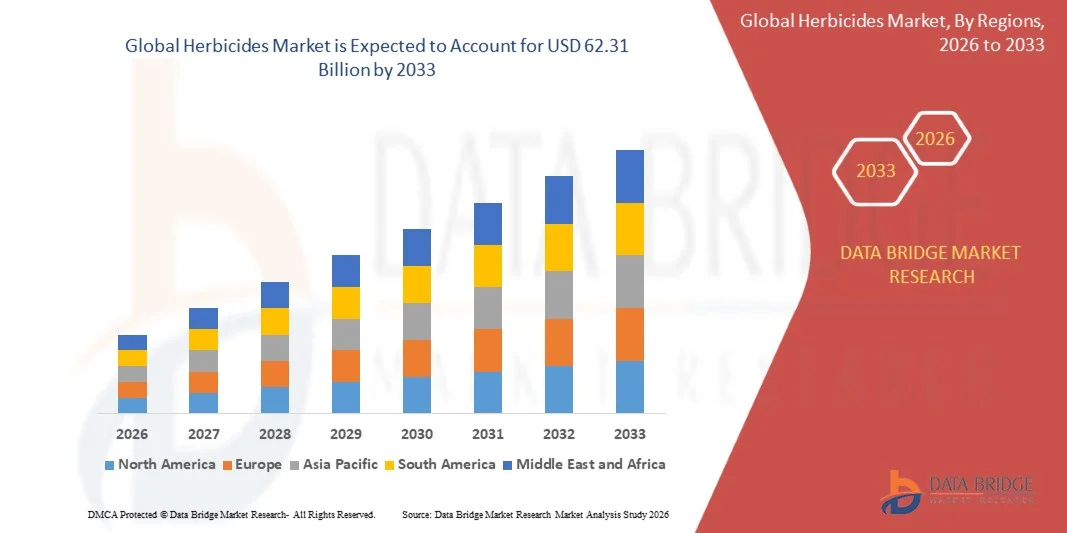
  • The global Herbicides market size was valued at USD 38.80 billion in 2025 and is expected to reach USD 62.31 billion by 2033, at a CAGR of 6.10% during the forecast period.
  • The increasing global demand for food production, combined with shrinking arable land and rising pressure on agricultural productivity, is a major factor driving the growth of the herbicides market. Herbicides play a critical role in ensuring efficient weed control, which directly impacts crop yield and farm profitability.
  • Rapid population growth and changing dietary patterns are increasing the demand for cereals, grains, and oilseeds, thereby boosting the need for crop protection solutions such as herbicides. Farmers are increasingly relying on chemical and biological weed control methods to maximize productivity and reduce crop losses.

Herbicides Market Analysis

  • Herbicides are chemical or biological substances used to eliminate or control unwanted vegetation that competes with crops for nutrients, water, and sunlight. They are widely used in agriculture, horticulture, and non-agricultural sectors such as infrastructure maintenance and industrial weed control.
  • The market is witnessing steady growth due to increasing demand for high agricultural productivity, labor shortages in farming, and the need for cost-effective weed management solutions. Herbicides help reduce manual labor and improve operational efficiency in large-scale farming operations.
  • Asia-Pacific dominated the Herbicides market with the largest revenue share 41.1% in 2025, driven by high agricultural activity, large population base, and increasing adoption of agrochemicals in countries such as China and India.
  • North America is anticipated to show the fastest growth during the forecast period. presents a mature and technologically advanced market, characterized by high adoption of herbicide-tolerant crops and precision agriculture techniques.
  • The Cereals & Grains segment accounted for the largest market share in 38.9% 2025 due to extensive herbicide usage in staple crops such as wheat, rice, and corn.

Herbicides Market

Report Scope and Herbicides Market Segmentation

Attributes

Herbicides Key Market Insights

Segments Covered

  • By Type: Synthetic Herbicides, Bio-Herbicides, Others
  • By Application: Cereals & Grains, Oilseeds & Pulses, Fruits & Vegetables, Turf & Ornamentals, Others
  • By Mode of Action: Selective, Non-Selective
  • By End-Use Industry: Agriculture, Non-Agricultural, Industrial Vegetation Management, Others

Countries Covered

North America

· U.S.

· Canada

· Mexico

Europe

· Germany

· France

· U.K.

· Netherlands

· Switzerland

· Belgium

· Russia

· Italy

· Spain

· Turkey

· Rest of Europe

Asia-Pacific

· China

· Japan

· India

· South Korea

· Singapore

· Malaysia

· Australia

· Thailand

· Indonesia

· Philippines

· Rest of Asia-Pacific

Middle East and Africa

· Saudi Arabia

· U.A.E.

· South Africa

· Egypt

· Israel

· Rest of Middle East and Africa

South America

· Brazil

· Argentina

· Rest of South America

Key Market Players

• Bayer CropScience (Germany)

• Syngenta AG (Switzerland)

• BASF SE (Germany)

• Corteva Agriscience (U.S.)

• FMC Corporation (U.S.)

• UPL Limited (India)

• Nufarm Limited (Australia)

• ADAMA Ltd. (Israel)

• Sumitomo Chemical Co., Ltd. (Japan)

• Albaugh LLC (U.S.)

Market Opportunities

• Increasing demand for bio-herbicides and environmentally sustainable crop protection solutions

• Rising adoption of precision agriculture and smart spraying technologies

Value Added Data Infosets

In addition to the insights on market scenarios such as market value, growth rate, segmentation, geographical coverage, and major players, the market reports curated by the Data Bridge Market Research also include import export analysis, production capacity overview, production consumption analysis, price trend analysis, climate change scenario, supply chain analysis, value chain analysis, raw material/consumables overview, vendor selection criteria, PESTLE Analysis, Porter Analysis, and regulatory framework.

Herbicides Market Trends

“Growing Adoption of Sustainable and Precision Weed Management Solutions”

  • A key trend in the Herbicides market is the increasing shift toward bio-based and environmentally friendly herbicides. Regulatory pressure and growing environmental concerns are encouraging the development of safer alternatives to traditional chemical herbicides.
  • Another major trend is the adoption of herbicide-tolerant crops, which allow selective application of herbicides without damaging crops. This technology improves weed control efficiency and enhances crop productivity.
  • Technological advancements such as nano-formulations, controlled-release herbicides, and digital spraying technologies are improving product performance and reducing environmental impact.
  • Additionally, the integration of artificial intelligence and data analytics in agriculture is enabling precise application of herbicides, minimizing wastage and improving cost efficiency.

Herbicides Market Dynamics

Driver

“Increasing Demand for Food Security and Crop Yield Optimization”

  • The growing global population is significantly increasing the demand for food, which is driving the need for higher agricultural productivity. Herbicides play a crucial role in improving crop yield by controlling weeds that compete for essential resources.
  • The adoption of modern farming practices such as conservation tillage and mechanization is further boosting the demand for herbicides. These practices rely heavily on chemical weed control methods.
  • The expansion of agricultural activities in emerging economies and increasing investments in the agricultural sector are also supporting market growth.
  • Furthermore, the rising demand for export-quality crops is encouraging farmers to adopt advanced crop protection solutions, including herbicides.

Restraint/Challenge

“Environmental Concerns and Regulatory Challenges”

  • The Herbicides market faces challenges related to environmental concerns and stringent regulatory frameworks governing the use of chemical herbicides. Governments are imposing strict regulations to ensure environmental safety and reduce chemical usage.
  • Issues such as soil degradation, water contamination, and biodiversity loss associated with excessive herbicide use are influencing market dynamics.
  • The emergence of herbicide-resistant weeds is another significant challenge, requiring continuous innovation and development of new active ingredients.
  • Additionally, the growing adoption of organic farming practices is limiting the use of synthetic herbicides, impacting market growth. Global Herbicides Market Scope

Global Herbicides Market Scope

The market is segmented on the basis of type, application, mode of action and end user.

By Type:

The market is segmented into synthetic herbicides, bio-herbicides, and others. Synthetic herbicides dominate the market due to their high efficiency, rapid action, and cost-effectiveness in controlling a wide range of weeds across different crop types. Their widespread availability and proven performance make them a preferred choice among farmers globally. However, bio-herbicides are gaining increasing traction as sustainability concerns rise, supported by regulatory pressure and growing demand for environmentally friendly and residue-free agricultural inputs.

By Application:

The market is segmented into cereals & grains, oilseeds & pulses, fruits & vegetables, turf & ornamentals, and others. Cereals & grains hold the largest market share 41.2% in 2025 due to their extensive cultivation across the globe and high susceptibility to weed infestation. Effective weed control is critical for maintaining crop yield and quality in these staple crops. Additionally, the rising demand for food security and increasing agricultural production are further driving herbicide usage in this segment significantly.

 By Mode of Action:

The market is segmented into selective and non-selective herbicides. Selective herbicides hold the largest market share 38.7% in 2025 due to their ability to target specific weeds without damaging crops, making them highly suitable for cereals, grains, oilseeds, and other major agricultural applications. Their widespread adoption in modern farming practices, increasing focus on crop productivity, and growing demand for precision weed management are significantly driving segment growth. Non-selective herbicides are also witnessing steady demand, particularly for land clearing, industrial vegetation management, and pre-planting applications due to their broad-spectrum weed control effectiveness.

By Mode of Action:

The market is segmented into selective and non-selective herbicides. Selective herbicides hold the largest market share 31.7% in 2025 widely used in agriculture as they target specific weed species without harming crops, making them essential for crop-specific weed management. These herbicides are particularly important in large-scale farming operations. Non-selective herbicides, on the other hand, eliminate all types of vegetation and are primarily used in industrial areas, infrastructure maintenance, and land clearing, where complete vegetation control is required.

By End User:

The market is segmented into agriculture, non-agricultural, industrial vegetation management, and others. Agriculture dominates the market share 34.7% in 2025 due to the extensive use of herbicides in crop production to improve yield and reduce labor costs. Farmers rely heavily on herbicides for efficient weed management in large-scale farming. Non-agricultural and industrial segments are also growing steadily, driven by increasing demand for weed control in public infrastructure, railways, and industrial sites.

Herbicides Market Regional Analysis

• Asia-Pacific dominated the Herbicides market with the largest revenue share in 2025, supported by high agricultural activity, increasing population, and rising demand for food production across countries such as China, India, Japan, and South Korea. The region benefits from extensive cultivation of cereals, grains, and oilseeds, along with growing adoption of agrochemicals to improve crop productivity and ensure efficient weed management.

• The Asia-Pacific market is driven by increasing awareness among farmers regarding crop protection, rising adoption of modern farming practices, and government support for agricultural productivity. Additionally, expanding agricultural infrastructure and increasing investments in agrochemical manufacturing are further accelerating demand for herbicides across various crop applications.

Japan Herbicides Market Insight

The Japan Herbicides market is experiencing steady growth due to its advanced agricultural practices and strong focus on efficiency and productivity. The country is known for adopting precision farming and high-quality crop protection solutions. Increasing demand for effective weed control in limited arable land is further supporting the growth of herbicides in Japan.

China Herbicides Market Insight

The China Herbicides market accounted for a significant revenue share in Asia-Pacific in 2025, driven by large-scale agricultural production and strong domestic manufacturing capabilities. The country’s increasing focus on improving crop yields and ensuring food security is boosting herbicide consumption. Additionally, rising adoption of modern farming techniques

Europe Herbicides Market Insight

The Europe Herbicides market is projected to expand at a substantial CAGR throughout the forecast period, driven by a strong focus on sustainable agriculture, regulatory compliance, and integrated weed management practices. The region is witnessing increasing adoption of eco-friendly and low-toxicity herbicides to minimize environmental impact. Additionally, stringent regulations imposed by governing authorities are encouraging manufacturers to develop safer and more sustainable herbicide formulations, supporting long-term market growth.

U.K. Herbicides Market Insight

The U.K. Herbicides market is expected to grow at a noteworthy CAGR during the forecast period, driven by increasing adoption of modern farming practices and rising focus on sustainable crop protection solutions. Demand for efficient weed control in cereals and oilseed crops is contributing to market growth. Moreover, the shift toward environmentally friendly herbicides and integrated weed management strategies is further supporting expansion in the country.

Germany Herbicides Market Insight

The Germany Herbicides market is anticipated to expand at a considerable CAGR, supported by the country’s strong agricultural and chemical manufacturing base. Germany plays a key role in herbicide production and innovation, with increasing focus on sustainable and efficient crop protection solutions. Additionally, rising adoption of precision agriculture and demand for high-performance herbicides are further driving market growth.

North America Herbicides Market Insight

The North America Herbicides market is expected to grow at the fastest CAGR during the forecast period, driven by increasing food demand, expanding agricultural land, and rising adoption of agrochemicals. The region benefits from strong government support, growing farmer awareness, and increasing investments in agricultural technologies.

U.S. Herbicides Market Insight

The U.S. Herbicides market accounted for the largest revenue share within North America in 2025, primarily driven by large-scale commercial farming and high adoption of advanced agricultural technologies. The widespread use of herbicide-tolerant crops and precision farming techniques is significantly boosting market growth. Furthermore, the presence of major agrochemical companies such as Corteva Agriscience and FMC Corporation strengthens the market landscape and supports continuous innovation.

Global Herbicides Market Share

The Herbicides industry is primarily led by well-established companies, including:

• Bayer CropScience (Germany)

• Syngenta AG (Switzerland)

• BASF SE (Germany)

• Corteva Agriscience (U.S.)

• FMC Corporation (U.S.)

• UPL Limited (India)

• Nufarm Limited (Australia)

• ADAMA Ltd. (Israel)

• Sumitomo Chemical Co., Ltd. (Japan)

• Albaugh LLC (U.S.)

Latest Developments in Global Herbicides Market

• In March 2025, BASF SE expanded its herbicide portfolio with new sustainable formulations aimed at improving weed resistance management and environmental safety.

• In April 2025, Syngenta AG introduced advanced herbicide solutions designed to enhance crop protection efficiency and reduce resistance issues.

• In June 2025, Corteva Agriscience launched next-generation herbicide technologies focused on improving crop safety and weed control performance.

• In August 2025, FMC Corporation developed innovative herbicide formulations with improved environmental profiles and application efficiency.

• In September 2025, UPL Limited expanded its bio-herbicide portfolio to support sustainable agriculture and integrated weed management practices.


SKU-

Get online access to the report on the World's First Market Intelligence Cloud

  • Interactive Data Analysis Dashboard
  • Company Analysis Dashboard for high growth potential opportunities
  • Research Analyst Access for customization & queries
  • Competitor Analysis with Interactive dashboard
  • Latest News, Updates & Trend analysis
  • Harness the Power of Benchmark Analysis for Comprehensive Competitor Tracking
Request for Demo

Global Herbicides Market, Supply Chain Analysis and Ecosystem Framework

To support market growth and help clients navigate the impact of geopolitical shifts, DBMR has integrated in-depth supply chain analysis into its Global Herbicides Market research reports. This addition empowers clients to respond effectively to global changes affecting their industries. The supply chain analysis section includes detailed insights such as Global Herbicides Market consumption and production by country, price trend analysis, the impact of tariffs and geopolitical developments, and import and export trends by country and HSN code. It also highlights major suppliers with data on production capacity and company profiles, as well as key importers and exporters. In addition to research, DBMR offers specialized supply chain consulting services backed by over a decade of experience, providing solutions like supplier discovery, supplier risk assessment, price trend analysis, impact evaluation of inflation and trade route changes, and comprehensive market trend analysis.

Research Methodology

Data collection and base year analysis are done using data collection modules with large sample sizes. The stage includes obtaining market information or related data through various sources and strategies. It includes examining and planning all the data acquired from the past in advance. It likewise envelops the examination of information inconsistencies seen across different information sources. The market data is analysed and estimated using market statistical and coherent models. Also, market share analysis and key trend analysis are the major success factors in the market report. To know more, please request an analyst call or drop down your inquiry.

The key research methodology used by DBMR research team is data triangulation which involves data mining, analysis of the impact of data variables on the market and primary (industry expert) validation. Data models include Vendor Positioning Grid, Market Time Line Analysis, Market Overview and Guide, Company Positioning Grid, Patent Analysis, Pricing Analysis, Company Market Share Analysis, Standards of Measurement, Global versus Regional and Vendor Share Analysis. To know more about the research methodology, drop in an inquiry to speak to our industry experts.

Customization Available

Data Bridge Market Research is a leader in advanced formative research. We take pride in servicing our existing and new customers with data and analysis that match and suits their goal. The report can be customized to include price trend analysis of target brands understanding the market for additional countries (ask for the list of countries), clinical trial results data, literature review, refurbished market and product base analysis. Market analysis of target competitors can be analyzed from technology-based analysis to market portfolio strategies. We can add as many competitors that you require data about in the format and data style you are looking for. Our team of analysts can also provide you data in crude raw excel files pivot tables (Fact book) or can assist you in creating presentations from the data sets available in the report.

Frequently Asked Questions

The Herbicides market size was valued at USD 38.80 billion in 2025.
The Herbicides market is expected to grow at a CAGR of 6.10% during the forecast period of 2026 to 2033.
The Herbicides market is segmented into notable segments based on type, application, mode of action, and end-use industry. On the basis of type, the market is segmented into synthetic herbicides, bio-herbicides, and others. On the basis of application, the market is segmented into cereals & grains, oilseeds & pulses, fruits & vegetables, turf & ornamentals, and others. Based on mode of action, the market includes selective and non-selective herbicides. By end-use industry, the market is segmented into agriculture, non-agricultural, industrial vegetation management, and others.
Companies such as BASF SE (Germany), Bayer AG (Germany), Syngenta AG (Switzerland), and Corteva Agriscience (U.S.) are major players in the Herbicides market.

Industry Related Reports

Testimonial