


Global Machine-to-Machine (M2M) Connections Market, By Technology (Wired Technologies, Wireless Technologies), End User (Healthcare, Utilities, Automotive & Transportation, Retail, Consumer Electronics, Security & Security, 기타). 산업 동향 및 예측 2032
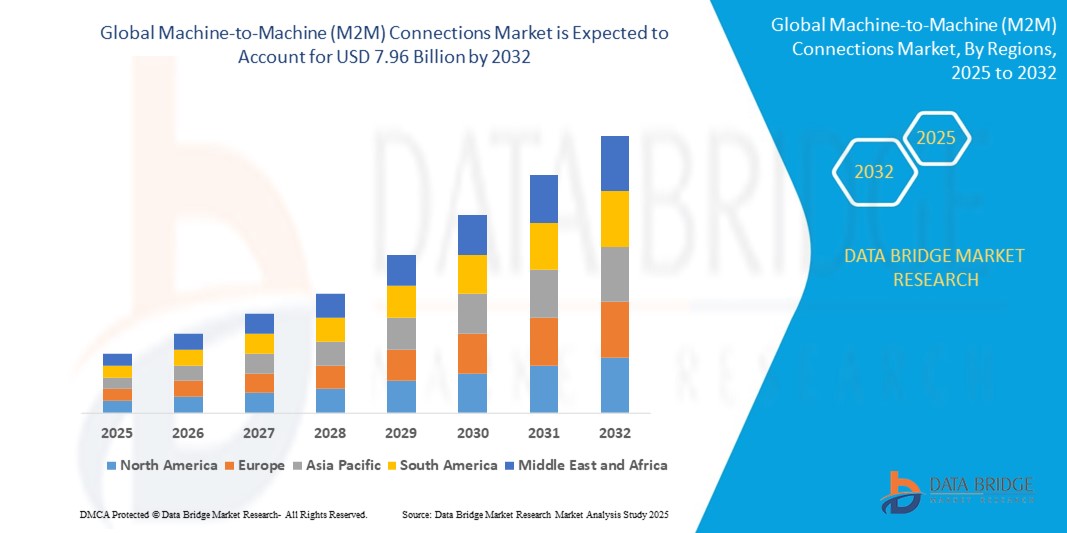
Machine-to-Machine (M2M) Connections Market Size
- The global Machine-to-Machine (M2M) Connections market size was valued atUSD 3.20 billion in 2024and is expected to reachUSD 7.96 billion by 2032, at aCAGR of 11.30%during the forecast period
- Market growth is primarily fueled by the expanding demand for connected devices and real-time data exchange, the advancement of wireless communication technologies such as 5G, NB-IoT, and LPWAN, and the rising implementation of M2M solutions across sectors including automotive, industrial automation, utilities, and smart cities.
Machine-to-Machine (M2M) Connections Market Analysis
- Machine to machine communication refers to direct communication between devices making use of any means of communication including wired or wireless. This system connects machine to mobile- mobile to mobile and mobile to machines. It is highly used in various industries such as manufacturing, logistics, transportation and healthcare.
- The increase in the penetration of the internet and rise in the focus on machine-to-machine connections globally act as the major factors driving the growth of machine-to-machine (M2M) connections market. The initiatives taken by government to support the IT sector through funding and promotional campaigns and the presence of favorable regulatory mandates accelerate the machine-to-machine (M2M) connections market growth.
- North America is expected to dominate the Machine-to-Machine (M2M) Connections market, driven by the high disposable income of enterprises and consumers, early adoption of digital transformation, and the presence of advanced wireless infrastructure and leading M2M solution providers. The region also benefits from robust investments in smart city projects, industrial automation, and connected vehicle ecosystems.
- Asia-Pacific is projected to be the fastest-growing region in the M2M Connections market during the forecast period. Growth is fueled by rapid urbanization, expanding 5G rollout, increasing penetration of smartphones and IoT-enabled devices, and government initiatives supporting digital infrastructure across China, India, Japan, and Southeast Asia.
- The automotive and transportation segment is expected to hold the largest market share—around 25.28% during the forecast period. This dominance is attributed to the rising demand for connected vehicles, fleet management systems, real-time vehicle diagnostics, and the growing implementation of M2M communication for traffic safety, logistics optimization, and telematics solutions.
Report Scope and Machine-to-Machine (M2M) Connections Market Segmentation
|
Attributes |
Machine-to-Machine (M2M) Connections Key Market Insights |
|
Segments Covered |
|
|
Countries Covered |
North America
Europe
Asia-Pacific
Middle East and Africa
South America
|
|
Key Market Players |
|
|
Market Opportunities |
|
|
Value Added Data Infosets |
In addition to the insights on market scenarios such as market value, growth rate, segmentation, geographical coverage, and major players, the market reports curated by the Data Bridge Market Research also include import export analysis, production capacity overview, production consumption analysis, price trend analysis, climate change scenario, supply chain analysis, value chain analysis, raw material/consumables overview, vendor selection criteria, PESTLE Analysis, Porter Analysis, and regulatory framework. |
Machine-to-Machine (M2M) Connections Market Trends
“Rise of Context-Aware Acoustic Networks in Connected Devices”
- M2M connections are increasingly equipped with AI-backed acoustic intelligence, allowing devices to understand their environment and adjust audio output dynamically—whether for home entertainment, automotive systems, or industrial headsets.
- Bluetooth LE Audio, Wi-Fi 6E, and Zigbee are creating robust wireless ecosystems, supporting simultaneous device connections, spatial audio, and seamless handoffs.
- For instance, On February 26, 2023, researchers introduced an adaptive IoT/M2M control system for smart buildings using heterogeneous wireless networks, combining Wireless Sensor Networks (WSNs) and Mobile Cellular Networks (MCNs). This system offers low-latency, accurate data transmission, and remote monitoring via a mobile app, Raniso. It supports smart services like parking, irrigation, security, lighting, and air quality, improving safety, energy efficiency, and resource management.
- This trend is accelerating due to the surge in demand for audio-intelligent devices like smart earbuds, multi-room speakers, and soundbars
Machine-to-Machine (M2M) Connections Market Dynamics
Driver
“Energy Optimization as a Core Product Differentiator”
- Consumers now prioritize devices with enhanced battery efficiency, especially for portable M2M-connected audio systems such as wireless earbuds, fitness trackers, and smart speakers.
- Global environmental regulations are tightening, with organizations like Ecodesign encouraging sustainable innovation and pushing manufacturers to reduce energy consumption across connected products.
- Enhanced power management features, low-energy Bluetooth modules, and optimized audio firmware are fueling the development of greener, more durable devices.
For instance,
- On April 2025, TRAI released recommendations on identifying critical services in the M2M sector and enabling transfer of M2M SIM ownership. It proposed a framework for classifying “critical IoT services” based on reliability and latency needs, helping stakeholders form SLAs with telecom providers to ensure high-performance connectivity for essential sectors like healthcare, safety, and smart cities.
- These innovations are key to mass adoption across mobile and wearables segments, making energy efficiency a top-tier market driver.
Opportunity
“Intelligent Audio Infrastructure for Next-Gen Ecosystems”
- Artificial intelligence is reshaping how machines interact acoustically—enabling functions like adaptive voice enhancement, automatic noise isolation, and usage-based sound optimization.
- The rise of wireless multi-zone systems using UWB, Wi-Fi 6E, and Bluetooth Mesh ensures synchronized, low-latency audio across rooms, devices, and applications.
- AI also brings backend intelligence to manufacturers, allowing devices to offer self-diagnostics, user analytics, and firmware-over-the-air (FOTA) support.
For instance,
- On December 6, 2023, Pod Group predicted key IoT trends for 2024, highlighting advancements in cybersecurity, AI, machine learning, and blockchain. With IoT's integration into critical systems, enhanced security measures for eSIM/iSIM technologies and data integrity are crucial. The SGP.32 standard will improve device accuracy and enable better IoT management, boosting operational efficiency and simplifying global deployment.
- These advancements are unlocking new opportunities in consumer tech, retail intercoms, immersive gaming, and smart vehicle infotainment.
Restraint/Challenge
“Fragmented Connectivity Standards and Price Sensitivity Constraints”
- The lack of universal communication protocols across M2M audio ecosystems remains a significant hurdle—platforms like AirPlay, Chromecast, and AlexaCast often lack cross-compatibility, creating setup friction.
- AI-enhanced M2M solutions are cost-intensive, involving high-end chipsets, custom firmware, and software licensing—all of which raise the barrier to entry for mass-market adoption.
- Interoperability challenges are especially prominent in environments where legacy hardware coexists with newer smart systems, making integration slow and expensive.
For instance,
- On March 22, 2024, a detailed exploration of NarrowBand-Internet of Things (NB-IoT) technology revealed its strengths and limitations. NB-IoT, part of the LPWAN family, offers low power consumption, long-range connectivity, and high penetration through environmental barriers, but is limited by low data transfer rates and lack of voice/video support. It’s ideal for low-data, long-term IoT applications but faces adoption challenges.
- This ecosystem fragmentation, coupled with complex installation requirements, limits scalability in budget-sensitive regions and reduces consumer confidence in upgrading to smart audio infrastructures.
Machine-to-Machine (M2M) Connections Market Scope
The market is segmented on the basis product, technology, application.
|
Segmentation |
Sub-Segmentation |
|
By Technology |
|
|
By end-user |
|
In 2025, the automotive & transportation is projected to dominate the market with a largest share in by end-user segment
The automotive and transportation segment is expected to hold the largest market share—around 25.28% during the forecast period. This dominance is attributed to the rising demand for connected vehicles, fleet management systems, real-time vehicle diagnostics, and the growing implementation of M2M communication for traffic safety, logistics optimization, and telematics solutions.
The wireless technologies is expected to account for the largest share during the forecast period in Machine-to-Machine (M2M) Connections market
In 2025, the Wireless Technologies segment in the Machine-to-Machine (M2M) Connections Market is projected to hold the largest share of approximately 23.76%. This leadership is driven by the rapid adoption of wireless communication protocols such as Bluetooth, Wi-Fi, Zigbee, NB-IoT, and LTE-M, which enable efficient, scalable, and cost-effective M2M communication across industries. Wireless technologies are essential for applications in smart cities, connected vehicles, industrial automation, healthcare monitoring, and utility management, where real-time data exchange and remote access are critical.
Machine-to-Machine (M2M) Connections Market Regional Analysis
“North America Holds the Largest Share in the Machine-to-Machine (M2M) Connections Market”
- North America dominates the Machine-to-Machine (M2M) Connections Market, fueled by the widespread adoption of IoT-enabled technologies, the strong presence of major M2M solution providers, and robust demand across industries such as automotive, utilities, logistics, healthcare, and smart infrastructure.
- The United States contributes significantly to the regional share due to the early adoption of M2M technologies across sectors, particularly in connected vehicles, industrial automation, smart cities, and remote asset monitoring. The integration of M2M in technologies such as telematics, intelligent transportation systems, and real-time monitoring platforms has accelerated deployment across commercial and public domains.
- The region benefits from a mature and well-established digital infrastructure, strong investment in advanced wireless technologies (including 5G and LPWAN), and government support for smart infrastructure development, further cementing its leadership in the M2M market.
- Moreover, leading tech giants and telecom operators based in North America continue to invest heavily in M2M platforms and services, driving innovation and expanding applications in energy management, predictive maintenance, and real-time analytics across the region..
“Asia-Pacific is Projected to Register the Highest CAGR in the Machine-to-Machine (M2M) Connections Market”
- The Asia-Pacific region is expected to witness the highest growth rate in the M2M Connections Market during the forecast period, propelled by rapid urbanization, digital transformation initiatives, and the expansion of smart infrastructure and industrial automation across emerging and developed economies.
- China, India, and Japan are key contributors to regional growth, driven by government-led initiatives for smart cities, the rise of Industry 4.0, and the increased adoption of M2M technologies in areas such as utility monitoring, connected transportation, healthcare, and agriculture.
- Japan, with its advanced technology landscape, continues to lead in the integration of M2M solutions in automotive telematics, robotics, and public infrastructure, enhancing efficiency and connectivity.
- China and India, with rapidly growing digital ecosystems and rising demand for smart solutions in residential and industrial sectors, are witnessing increasing investments in NB-IoT, LoRa, and other M2M-enabling technologies. The presence of major electronics and telecom manufacturers in the region further accelerates the deployment of cost-effective, scalable M2M applications.
Machine-to-Machine (M2M) Connections Market Share
The market competitive landscape provides details by competitor. Details included are company overview, company financials, revenue generated, market potential, investment in research and development, new market initiatives, global presence, production sites and facilities, production capacities, company strengths and weaknesses, product launch, product width and breadth, application dominance. The above data points provided are only related to the companies' focus related to market.
The Major Market Leaders Operating in the Market Are:
- Cisco (U.S.)
- AT&T Intellectual Property (U.S.)
- Huawei Technologies Co., Ltd. (China)
- NXP Semiconductors (Netherlands)
- Texas Instruments Incorporated (U.S.)
- Intel Corporation (U.S.)
- Thales Group (France)
- Vodafone Group (United Kingdom)
- Murata Manufacturing Co., Ltd. (Japan)
- U-blox (Switzerland)
- Fanstel (U.S.)
- CommSolid GmbH (Germany)
- Afero (U.S.)
- Revogi (China)
- Virscient Limited (New Zealand)
- Deutsche Telekom AG (Germany)
- Sierra Wireless (Canada)
- T-Mobile USA, Inc. (U.S.)
Latest Developments in Global Machine-to-Machine (M2M) Connections Market
- On April 2025, TRAI released recommendations on identifying critical services in the M2M sector and enabling transfer of M2M SIM ownership. It proposed a framework for classifying “critical IoT services” based on reliability and latency needs, helping stakeholders form SLAs with telecom providers to ensure high-performance connectivity for essential sectors like healthcare, safety, and smart cities.
- On June 2024, Hitachi Industrial Equipment Systems launched a machine learning-based "Predictive Diagnosis Service" for air compressors. Combining sensor data with technician expertise, the service predicts faults and recommends efficient operations. Initially available for NEXT3 series compressors, it aims to reduce downtime, cut energy use, and address technician shortages through remote maintenance and environmental efficiency.
- On November 25, 2024, the Pentagon announced the deployment of AI-enabled cameras to enhance airspace monitoring in the Washington, D.C. area. The new Enhanced Regional Situational Awareness (ERSA) system offers advanced visual recognition to validate radar data and detect threats. Operated by the National Guard and Army, it strengthens regional air defense through rapid threat assessment and response.
- On June 21, 2024, researchers introduced Dyna-5G, a dynamic, self-organizing 5G New Radio network designed for massive Machine-to-Machine (M2M) applications. Unlike traditional centralized 5G networks, Dyna-5G ensures reliability and adaptability in critical autonomous scenarios, such as autonomous vehicles and drone swarms. It supports rapid failure recovery and decentralized communication, demonstrating its resilience in real-world simulations.
SKU-
세계 최초의 시장 정보 클라우드 보고서에 온라인으로 접속하세요

- 대화형 데이터 분석 대시보드
- 높은 성장 잠재력 기회를 위한 회사 분석 대시보드
- 사용자 정의 및 질의를 위한 리서치 분석가 액세스
- 대화형 대시보드를 통한 경쟁자 분석
- 최신 뉴스, 업데이트 및 추세 분석
- 포괄적인 경쟁자 추적을 위한 벤치마크 분석의 힘 활용
연구 방법론
데이터 수집 및 기준 연도 분석은 대규모 샘플 크기의 데이터 수집 모듈을 사용하여 수행됩니다. 이 단계에는 다양한 소스와 전략을 통해 시장 정보 또는 관련 데이터를 얻는 것이 포함됩니다. 여기에는 과거에 수집한 모든 데이터를 미리 검토하고 계획하는 것이 포함됩니다. 또한 다양한 정보 소스에서 발견되는 정보 불일치를 검토하는 것도 포함됩니다. 시장 데이터는 시장 통계 및 일관된 모델을 사용하여 분석하고 추정합니다. 또한 시장 점유율 분석 및 주요 추세 분석은 시장 보고서의 주요 성공 요인입니다. 자세한 내용은 분석가에게 전화를 요청하거나 문의 사항을 드롭하세요.
DBMR 연구팀에서 사용하는 주요 연구 방법론은 데이터 마이닝, 시장에 대한 데이터 변수의 영향 분석 및 주요(산업 전문가) 검증을 포함하는 데이터 삼각 측량입니다. 데이터 모델에는 공급업체 포지셔닝 그리드, 시장 타임라인 분석, 시장 개요 및 가이드, 회사 포지셔닝 그리드, 특허 분석, 가격 분석, 회사 시장 점유율 분석, 측정 기준, 글로벌 대 지역 및 공급업체 점유율 분석이 포함됩니다. 연구 방법론에 대해 자세히 알아보려면 문의를 통해 업계 전문가에게 문의하세요.
사용자 정의 가능
Data Bridge Market Research는 고급 형성 연구 분야의 선두 주자입니다. 저희는 기존 및 신규 고객에게 목표에 맞는 데이터와 분석을 제공하는 데 자부심을 느낍니다. 보고서는 추가 국가에 대한 시장 이해(국가 목록 요청), 임상 시험 결과 데이터, 문헌 검토, 재생 시장 및 제품 기반 분석을 포함하도록 사용자 정의할 수 있습니다. 기술 기반 분석에서 시장 포트폴리오 전략에 이르기까지 타겟 경쟁업체의 시장 분석을 분석할 수 있습니다. 귀하가 원하는 형식과 데이터 스타일로 필요한 만큼 많은 경쟁자를 추가할 수 있습니다. 저희 분석가 팀은 또한 원시 엑셀 파일 피벗 테이블(팩트북)로 데이터를 제공하거나 보고서에서 사용 가능한 데이터 세트에서 프레젠테이션을 만드는 데 도움을 줄 수 있습니다.











