



Global Neurostimulation for Chronic Pain Management in Cardiology Market Segmentation, By Device Type (Spinal Cord Stimulators (SCS), Deep Brain Stimulators (DBS), Peripheral Nerve Stimulators (PNS), Transcranial Magnetic Stimulation (TMS), Vagus Nerve Stimulators (VNS)), Technology (Rechargeable Devices, Non-Rechargeable Devices), Application (Back and Neck Pain, Migraines and Headaches, Cancer Pain, Neuropathic Pain, Arthritis Pain, Musculoskeletal Pain, Post-surgical Pain, Others), End User (Hospitals, Pain Management Clinics, Ambulatory Surgery Centers (ASCs), Home Care Settings) – Industry Trends and Forecast to 2032
Neurostimulation for Chronic Pain Management in Cardiology Market Analysis
The global neurostimulation for chronic pain management market is driven by the increasing prevalence of chronic pain conditions, which affect a significant portion of the global population. It is estimated that around 20% of adults worldwide suffer from chronic pain, with back pain, neuropathic pain, and arthritis being among the most common types. In the United States alone, approximately 50 million adults are affected by chronic pain, creating a substantial demand for advanced pain management solutions. Neurostimulation therapies, particularly spinal cord stimulators (SCS) and peripheral nerve stimulators (PNS), are increasingly being adopted for their efficacy in treating refractory pain. The rise in the geriatric population, coupled with the growing awareness and acceptance of neurostimulation devices, further fuels the market. Additionally, advancements in technology, such as rechargeable neurostimulation devices, are enhancing the long-term effectiveness and patient comfort, positioning neurostimulation as a leading choice for chronic pain management.
Neurostimulation for Chronic Pain Management in Cardiology Market Size
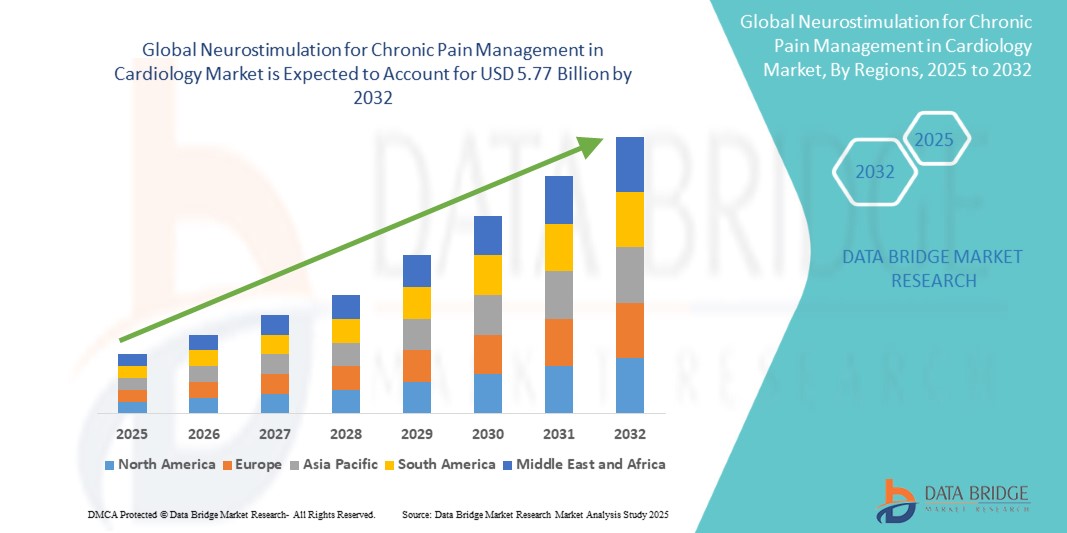
Global neurostimulation for chronic pain management in cardiology market size was valued at USD 3.43 billion in 2024 and is projected to reach USD 5.77 billion by 2032, with a CAGR of 6.70% during the forecast period of 2025 to 2032. In addition to the insights on market scenarios such as market value, growth rate, segmentation, geographical coverage, and major players, the market reports curated by the Data Bridge Market Research also include depth expert analysis, patient epidemiology, pipeline analysis, pricing analysis, and regulatory framework.
Neurostimulation for Chronic Pain Management in Cardiology Market Trends
“Growing Focus on Personalized Pain Management”
A notable trend in the Global Neurostimulation for Chronic Pain Management Market is the growing focus on personalized pain management. This approach involves tailoring neurostimulation therapies to meet the specific needs of individual patients, considering factors such as the type, location, and intensity of pain, as well as the patient's response to previous treatments. By customizing treatment plans, healthcare providers can optimize the effectiveness of neurostimulation, ensuring better pain relief while minimizing potential side effects. Personalized neurostimulation therapies, such as adjusting stimulation parameters or using closed-loop systems that monitor and adapt to real-time feedback, offer a more targeted and efficient solution for managing chronic pain. This trend is contributing to a more patient-centric approach, allowing for better management of complex and varied pain conditions.
Report Scope and Neurostimulation for Chronic Pain Management in Cardiology Market Segmentation
|
Attributes |
Neurostimulation for Chronic Pain Management in Cardiology Key Market Insights |
|
Segments Covered |
|
|
Countries Covered |
U.S., Canada, Mexico, Germany, France, U.K., Netherlands, Switzerland, Belgium, Russia, Italy, Spain, Turkey, Rest of Europe, China, Japan, India, South Korea, Singapore, Malaysia, Australia, Thailand, Indonesia, Philippines, Rest of Asia-Pacific, Saudi Arabia, U.A.E., South Africa, Egypt, Israel, Rest of Middle East and Africa, Brazil, Argentina, Rest of South America |
|
Key Market Players |
Medtronic (Ireland), Boston Scientific Corporation (U.S.), AbbVie Inc. (U.S.), NeuroMetrix, Inc. (U.S.), Stimwave, LLC (U.S.), Nevro Corporation (U.S.), Halsion Ltd. (U.K.), Bioness, Inc. (U.S.), Synapse Biomedical Inc. (U.S.), Nuvectra Corporation (U.S.), ElectroCore, Inc. (U.S.), LivaNova PLC (U.K.), Saluda Medical Pty Ltd. (Australia), Integer Holdings Corporation (U.S.), Cefaly Technology (Belgium), Fisher Wallace Laboratories, Inc. (U.S.), Axon Therapy Inc. (U.S.), Autonomic Technologies, Inc. (U.S.), among others. |
|
Market Opportunities |
|
|
Value Added Data Infosets |
In addition to the insights on market scenarios such as market value, growth rate, segmentation, geographical coverage, and major players, the market reports curated by the Data Bridge Market Research also include depth expert analysis, patient epidemiology, pipeline analysis, pricing analysis, and regulatory framework. |
Neurostimulation for Chronic Pain Management in Cardiology Market Definition
Neurostimulation for Chronic Pain Management refers to the use of electrical stimulation to modulate nerve activity in order to alleviate chronic pain. This therapeutic technique involves the implantation of a neurostimulation device, such as a spinal cord stimulator or peripheral nerve stimulator, which delivers electrical impulses to specific nerves or the spinal cord. The stimulation can block or alter pain signals, providing relief from conditions such as back pain, neuropathic pain, migraines, and other chronic pain disorders. Neurostimulation is typically used when other pain management treatments, such as medications or surgery, have proven ineffective.
Neurostimulation for Chronic Pain Management in Cardiology Market Dynamics
Drivers
- Rising Prevalence of Chronic Pain Conditions
The rising prevalence of chronic pain conditions is a significant driver of the global neurostimulation market. Chronic pain, including conditions such as back pain, neuropathic pain, and arthritis, affects a large portion of the global population, particularly the aging demographic. As the global population ages, the incidence of chronic pain conditions increases, leading to greater demand for effective pain management solutions. Traditional treatments, such as medications and surgeries, often come with side effects, limited effectiveness, or invasive procedures, making them less desirable for long-term relief. Neurostimulation devices, such as spinal cord stimulators and peripheral nerve stimulators, offer a non-invasive alternative that can provide significant pain relief with fewer risks and complications. These devices are increasingly being adopted due to their ability to effectively manage chronic pain without relying heavily on pharmaceuticals.
The growing burden of chronic pain conditions is propelling the demand for neurostimulation therapies, positioning them as a key solution in pain management.
- Advancements in Neurostimulation Technology
Advancements in neurostimulation technology are a major driver of growth in the global market. The development of closed-loop systems, which continuously monitor and adjust electrical stimulation based on real-time feedback, enhances the precision and effectiveness of treatment. Rechargeable devices also play a crucial role, offering patients longer-term usage and reducing the need for frequent device replacements, which is both cost-effective and convenient. Additionally, the trend toward minimally invasive procedures is making neurostimulation more accessible, as these techniques typically involve smaller incisions, shorter recovery times, and fewer complications compared to traditional surgeries. These technological innovations not only improve treatment outcomes but also reduce side effects and enhance patient comfort, making neurostimulation therapies a more appealing option for both healthcare providers and patients.
The continuous improvements in neurostimulation technology are significantly driving market adoption, ensuring better, more efficient pain management solutions.
Opportunities
- Integration of Remote Monitoring and Telemedicine
The integration of remote monitoring and telemedicine with neurostimulation devices presents a significant opportunity in the global chronic pain management market. With advancements in digital health technologies, patients using neurostimulation devices can now be monitored remotely, enabling healthcare providers to track their progress and make real-time adjustments to treatment protocols. This approach enhances patient outcomes by ensuring personalized and timely care while improving the overall convenience for patients, especially those with chronic pain who may face difficulties attending in-person appointments frequently. Telemedicine allows for continuous monitoring, reducing the need for hospital visits, which is especially beneficial for elderly or immobile patients. As telehealth adoption continues to rise, this integration can further improve the accessibility and effectiveness of neurostimulation therapies, ensuring that patients receive optimal pain management.
In conclusion, the synergy of neurostimulation and digital health technologies represents a growing opportunity to enhance patient care and expand the market.
- Partnerships and Collaborations with Healthcare Providers
Partnerships and collaborations between neurostimulation device manufacturers and healthcare providers present a significant opportunity to expand market reach. By forming alliances with hospitals, pain management clinics, and rehabilitation centers, companies can ensure that their devices are integrated more effectively into clinical practices. These collaborations help enhance the understanding and acceptance of neurostimulation therapies among healthcare professionals, improving the adoption rate. Additionally, partnering with healthcare institutions provides an opportunity to conduct clinical trials, gather real-world data, and validate the effectiveness of neurostimulation treatments in chronic pain management. Such partnerships also facilitate the exchange of insights between manufacturers and healthcare providers, leading to better device development and patient outcomes. These collaborations enhance the market visibility of neurostimulation therapies and can drive broader adoption, ultimately benefiting patients who seek more effective, long-term pain relief solutions. In conclusion, strategic partnerships can significantly boost both the reach and credibility of neurostimulation therapies in the market.
Restraints/Challenges
- High Cost of Neurostimulation Devices
The high cost of neurostimulation devices is a significant restraint in the global neurostimulation for chronic pain management market. These devices, coupled with the associated implantation surgeries, can be prohibitively expensive, limiting their accessibility, particularly in low-income and developing regions where healthcare budgets are constrained. The financial burden of these treatments can deter patients from choosing neurostimulation, especially those without adequate insurance coverage or access to specialized healthcare facilities. In addition to the initial device and procedure costs, there are ongoing expenses related to device maintenance, including battery replacements and regular adjustments. These continuous costs further complicate affordability for patients seeking long-term pain management solutions. As a result, the high price point of neurostimulation devices can restrict their widespread adoption and limit the market’s growth potential.
In conclusion, the cost barrier remains a key challenge in expanding the reach of neurostimulation therapies to a broader patient population.
- Regulatory and Approval Issues
Regulatory and approval issues represent a significant challenge for the global neurostimulation for chronic pain management market. Neurostimulation devices must undergo extensive clinical trials and meet stringent regulatory standards to obtain approval for use, which can be a lengthy and costly process. The regulatory requirements differ across regions, creating additional complexity and potential delays for manufacturers seeking to introduce new devices to global markets. These differences in approval timelines and standards can slow down the entry of innovative products and increase uncertainty for companies. Furthermore, the evolving regulatory landscape, particularly regarding device safety and performance, adds another layer of difficulty. The increasing need for compliance with various standards places a financial burden on companies and may divert resources away from research and development.
Regulatory and approval challenges can limit the pace of innovation, slow market expansion, and increase costs for manufacturers in the neurostimulation market.
Neurostimulation for Chronic Pain Management in Cardiology Market Scope
The market is segmented on the basis of device type, technology, application, and end user. The growth amongst these segments will help you analyze meagre growth segments in the industries and provide the users with a valuable market overview and market insights to help them make strategic decisions for identifying core market applications.
Device Type
- Spinal Cord Stimulators (SCS)
- Deep Brain Stimulators (DBS)
- Peripheral Nerve Stimulators (PNS)
- Transcranial Magnetic Stimulation (TMS)
- Vagus Nerve Stimulators (VNS)
Technology
- Rechargeable Devices
- Non-Rechargeable Devices
Application
- Back and Neck Pain
- Migraines and Headaches
- Cancer Pain
- Neuropathic Pain
- Arthritis Pain
- Musculoskeletal Pain
- Post-surgical Pain
- Others
End User
- Hospitals
- Pain Management Clinics
- Ambulatory Surgery Centers (ASCs)
- Home Care Settings
Neurostimulation for Chronic Pain Management in Cardiology Market Regional Analysis
The market is analyzed and market size insights and trends are provided by country, device type, technology, application, and end user as referenced above.
The countries covered in the market are U.S., Canada, Mexico, Germany, France, U.K., Netherlands, Switzerland, Belgium, Russia, Italy, Spain, Turkey, rest of Europe, China, Japan, India, South Korea, Singapore, Malaysia, Australia, Thailand, Indonesia, Philippines, rest of Asia-Pacific, Saudi Arabia, U.A.E., South Africa, Egypt, Israel, rest of Middle East and Africa, Brazil, Argentina, and rest of South America.
North America is expected to dominate the market due to advanced healthcare infrastructure, high healthcare expenditure, a large aging population, and widespread adoption of innovative pain management technologies.
Asia-Pacific is expected to be the fastest growing due to increasing healthcare access, a large patient population, rising prevalence of chronic pain conditions, and growing adoption of advanced medical technologies.
The country section of the report also provides individual market impacting factors and changes in regulation in the market domestically that impacts the current and future trends of the market. Data points like down-stream and upstream value chain analysis, technical trends and porter's five forces analysis, case studies are some of the pointers used to forecast the market scenario for individual countries. Also, the presence and availability of global brands and their challenges faced due to large or scarce competition from local and domestic brands, impact of domestic tariffs and trade routes are considered while providing forecast analysis of the country data.
Neurostimulation for Chronic Pain Management in Cardiology Market Share
The market competitive landscape provides details by competitor. Details included are company overview, company financials, revenue generated, market potential, investment in research and development, new market initiatives, global presence, production sites and facilities, production capacities, company strengths and weaknesses, product launch, product width and breadth, application dominance. The above data points provided are only related to the companies' focus related to market.
Neurostimulation for Chronic Pain Management in Cardiology Market Leaders Operating in the Market Are:
- Medtronic (Ireland)
- Boston Scientific Corporation (U.S.)
- AbbVie Inc. (U.S.)
- NeuroMetrix, Inc. (U.S.)
- Stimwave, LLC (U.S.)
- Nevro Corporation (U.S.)
- Halsion Ltd. (U.K.)
- Bioness, Inc. (U.S.)
- Synapse Biomedical Inc. (U.S.)
- Nuvectra Corporation (U.S.)
- ElectroCore, Inc. (U.S.)
- LivaNova PLC (U.K.)
- Saluda Medical Pty Ltd. (Australia)
- Integer Holdings Corporation (U.S.)
- Cefaly Technology (Belgium)
- Fisher Wallace Laboratories, Inc. (U.S.)
- Axon Therapy Inc. (U.S.)
- Autonomic Technologies, Inc. (U.S.)
Latest Developments in Neurostimulation for Chronic Pain Management in Cardiology Market
- In November 2024, Nevro Corp. announced CE Mark certification in Europe for its HFX iQ spinal cord stimulation (SCS) system, enabling its marketing across countries recognizing this certification. This approval expands Nevro’s market reach and strengthens its presence in the European chronic pain management market
- In October 2024, Nevro Corp. announced new data in the Journal of Pain Research showing that its 10 kHz high-frequency spinal cord stimulation (SCS) therapy provides significant and lasting pain relief, along with clinically meaningful reductions in HbA1c and weight in patients with painful diabetic neuropathy (PDN) and Type 2 diabetes. This breakthrough strengthens Nevro’s position in the chronic pain management market and enhances its reputation for innovative solutions
SKU-
세계 최초의 시장 정보 클라우드 보고서에 온라인으로 접속하세요

- 대화형 데이터 분석 대시보드
- 높은 성장 잠재력 기회를 위한 회사 분석 대시보드
- 사용자 정의 및 질의를 위한 리서치 분석가 액세스
- 대화형 대시보드를 통한 경쟁자 분석
- 최신 뉴스, 업데이트 및 추세 분석
- 포괄적인 경쟁자 추적을 위한 벤치마크 분석의 힘 활용
연구 방법론
데이터 수집 및 기준 연도 분석은 대규모 샘플 크기의 데이터 수집 모듈을 사용하여 수행됩니다. 이 단계에는 다양한 소스와 전략을 통해 시장 정보 또는 관련 데이터를 얻는 것이 포함됩니다. 여기에는 과거에 수집한 모든 데이터를 미리 검토하고 계획하는 것이 포함됩니다. 또한 다양한 정보 소스에서 발견되는 정보 불일치를 검토하는 것도 포함됩니다. 시장 데이터는 시장 통계 및 일관된 모델을 사용하여 분석하고 추정합니다. 또한 시장 점유율 분석 및 주요 추세 분석은 시장 보고서의 주요 성공 요인입니다. 자세한 내용은 분석가에게 전화를 요청하거나 문의 사항을 드롭하세요.
DBMR 연구팀에서 사용하는 주요 연구 방법론은 데이터 마이닝, 시장에 대한 데이터 변수의 영향 분석 및 주요(산업 전문가) 검증을 포함하는 데이터 삼각 측량입니다. 데이터 모델에는 공급업체 포지셔닝 그리드, 시장 타임라인 분석, 시장 개요 및 가이드, 회사 포지셔닝 그리드, 특허 분석, 가격 분석, 회사 시장 점유율 분석, 측정 기준, 글로벌 대 지역 및 공급업체 점유율 분석이 포함됩니다. 연구 방법론에 대해 자세히 알아보려면 문의를 통해 업계 전문가에게 문의하세요.
사용자 정의 가능
Data Bridge Market Research는 고급 형성 연구 분야의 선두 주자입니다. 저희는 기존 및 신규 고객에게 목표에 맞는 데이터와 분석을 제공하는 데 자부심을 느낍니다. 보고서는 추가 국가에 대한 시장 이해(국가 목록 요청), 임상 시험 결과 데이터, 문헌 검토, 재생 시장 및 제품 기반 분석을 포함하도록 사용자 정의할 수 있습니다. 기술 기반 분석에서 시장 포트폴리오 전략에 이르기까지 타겟 경쟁업체의 시장 분석을 분석할 수 있습니다. 귀하가 원하는 형식과 데이터 스타일로 필요한 만큼 많은 경쟁자를 추가할 수 있습니다. 저희 분석가 팀은 또한 원시 엑셀 파일 피벗 테이블(팩트북)로 데이터를 제공하거나 보고서에서 사용 가능한 데이터 세트에서 프레젠테이션을 만드는 데 도움을 줄 수 있습니다.











