



Global Next Generation Biofuels Market, By Biofuel Type (Biodiesels, Biogas, Bio butanol, and Others), Process (Biochemical Process and Thermochemical Process), Raw Material (Lignocellulose, Jatropha, Camelina, Algae, and Others), and Application (Transportation, Power Generation and Others) – Industry Trends and Forecast to 2029
Next Generation Biofuels Market Analysis and Size
Global efforts to replace fossil fuels with biofuels for a more sustainable ecosystem have significantly increased biofuel production. Concerns among environmentalists and policymakers around the world about reducing greenhouse gas pollutant emissions, depletion of fossil resources, and reliance on unstable foreign suppliers are expected to drive up production and consumption of biofuels during the forecast period.
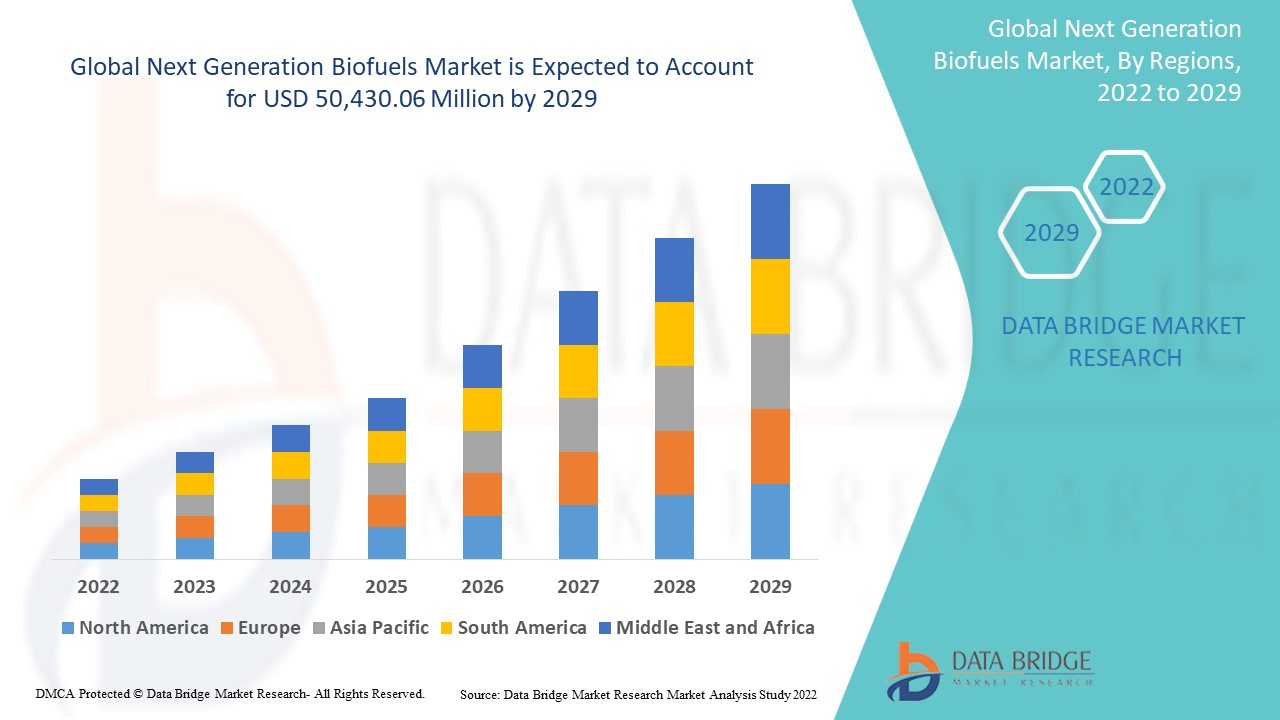
Global next generation biofuels market was valued at USD 7,405 million in 2021 and is expected to reach USD 50,430.06 million by 2029, registering a CAGR of 27.1% during the forecast period of 2022-2029. In addition to the market insights such as market value, growth rate, market segments, geographical coverage, market players, and market scenario, the market report curated by the Data Bridge Market Research team also includes technological advancements, regulatory framework, PESTEL, porter's five forces analysis, industry standards-at a glance, raw material costs/ operational expenditure-overview, supply chain analysis, vendor selection criteria, pricing analysis, production analysis, and climate chain scenario.
Market Definition
Biofuels are created through modern biological processes such as anaerobic digestion, as opposed to geological processes. Second-generation biofuels are made from non-food crops like organic waste, wood, biomass crops, and food crop waste. In contrast, third-generation biofuels are made from improved biomass production and use engineered energy crops like algae as feedstock.
Report Scope and Market Segmentation
|
Report Metric |
Details |
|
Forecast Period |
2022 to 2029 |
|
Base Year |
2021 |
|
Historic Years |
2020 (Customizable to 2014 - 2019) |
|
Quantitative Units |
Revenue in USD Million, Volumes in Units, Pricing in USD |
|
Segments Covered |
Biofuel Type (Biodiesels, Biogas, Bio butanol, and Others), Process (Biochemical Process and Thermochemical Process), Raw Material (Lignocellulose, Jatropha, Camelina, Algae, and Others), and Application (Transportation, Power Generation and Others) |
|
Countries Covered |
U.S., Canada and Mexico in North America, Germany, France, U.K., Netherlands, Switzerland, Belgium, Russia, Italy, Spain, Turkey, Poland, Norway, Finland, Rest of Europe in Europe, China, Japan, India, South Korea, Singapore, Malaysia, Australia, Thailand, Indonesia, Philippines, Rest of Asia-Pacific (APAC) in the Asia-Pacific (APAC), Saudi Arabia, U.A.E, Israel, Egypt, South Africa, Nigeria, Algeria, Angola, Ghana, Rest of Middle East and Africa (MEA) as a part of Middle East and Africa (MEA), Brazil, Argentina and Rest of South America as part of South America |
|
Market Players Covered |
Clean Coal Technologies Inc., (U.S.), General Electric (U.S.), Alstom (France), Siemens (Germany), ExxonMobil Corporation (US), Shell PLC (Netherlands), JaworskiEnergyServices (U.S.), ABB (Switzerland), Tracxn Technologies Limited (Poland), GreatPoint Energy (U.S.), Schneider Electric (France), E3 Clean Technologies (South Africa), LanzaTech (New Zealand), Accelergy (U.S.), Hygen (Sweden), Cortus (Sweden), Gasliner (Latvia) and Ciris Energy (U.S.) |
|
Market Opportunities |
|
Global Next Generation Biofuels Market Dynamics
This section deals with understanding the market drivers, advantages, opportunities, restraints and challenges. All of this is discussed in detail as below:
Drivers
- Mounting Demand for Clean and Reliable Power Generation
The major determinant anticipated to propel the next generation biofuels technology market throughout the forecast period include the tremendously rising need for clean, dependable power production technology and the accelerating rate of industrialization around the world. Various supportive laws and regulations are also in place to increase spending on environmental protection, fuel efficiency, and technical advancement in both new and existing facilities. Consequently, this factor is ultimately projected to boost the market growth.
Furthermore the increasing urbanization in developing countries will drive industry growth. Moreover, the factors such as increase in the power demand and consumption across the globe and the shifting towards the renewable energy also accelerates the market growth. In addition, more people are becoming aware of the advantages of using clean coal gasification technology since they lower air pollution from carbon emissions, accelerating the market growth.
Opportunities
- Surging Developments and Increasing Investments
Furthermore, various developments coupled with introduction of advanced technologies by the market players further extend profitable opportunities to the market players in the forecast period of 2022 to 2029. The manufacturers of next generation biofuels technology are encouraged to invest in research and development efforts for the progress of technology by numerous global government policies, rules, and recommendations, which generates various opportunities for the market.
Restraints/Challenges
- High Capital Costs
The development of next generation biofuels technology largely involves a high upfront cost, and other related costs are predicted to impede the market's expansion. The high upfront cost and other related costs further result in the high capital cost, largely preventing the implementation of Next Generation Biofuels. As a result, the global Next Generation Biofuels market is hampered by this factor over the forecasted period.
- Dearth of Awareness
It is anticipated that a lack of public awareness and insufficient financial and economic capabilities will further create challenges for the market growth over the forecast period. This factor will further pose as a serious challenge to the growth of the next generation biofuels market.
This next generation biofuels market report provides details of new recent developments, trade regulations, import-export analysis, production analysis, value chain optimization, market share, impact of domestic and localized market players, analyses opportunities in terms of emerging revenue pockets, changes in market regulations, strategic market growth analysis, market size, category market growths, application niches and dominance, product approvals, product launches, geographic expansions, technological innovations in the market. To gain more info on the next generation biofuels market contact Data Bridge Market Research for an Analyst Brief, our team will help you take an informed market decision to achieve market growth.
COVID-19 Impact on Next Generation Biofuels Market
The recent outbreak of coronavirus had a negative impact on the next generation biofuels market, as the pandemic has had a significant impact on wind power industry's supply chain. The global coronavirus pandemic epidemic has accelerated the next generation biofuels market transformation. As previously mentioned, the luxury car market's cutting-edge features and technical advancements impact how the next-generation biofuels technology market operates. It is currently a very difficult period, internationally, as a result of the implementation of stringent limitations and changes to business working hours and circumstances. The worldwide market functions are unable to generate in accordance with the anticipated demand due to operational limitations. The amount of luxury car sales in the world's key regions is decreasing due to this, which also creates operating problems and losses.
Recent Development
- In October 2021, Adani Power Limited, one of the major businesses in the APAC area, declared its intention to start up the Godda Ultra Super Critical coal thermal Power Project by the end of March 2022. It is anticipated that the facility, which is situated in Jharkhand, India, will have an installed capacity of 1,600 MW. Thus, it is projected that the number of these future coal power plants will expand during the forecast period.
Global Next Generation Biofuels Market Scope
The next generation biofuels market is segmented on the basis of biofuel type, process, raw material and application. The growth amongst these segments will help you analyze meagre growth segments in the industries and provide the users with a valuable market overview and market insights to help them make strategic decisions for identifying core market applications.
Biofuel Type
- Biodiesels
- Biogas
- Biobutanol
- Others
Process
- Biochemical process
- Thermochemical process
Raw material
- Lignocellulose
- Jatropha
- Camelina
- Algae
- Others
Application
- Transportation
- Power Generation
- Others
Next Generation Biofuels Market Regional Analysis/Insights
The next generation biofuels market is analyzed and market size insights and trends are provided by country, biofuel type, process, raw material and application as referenced above.
The countries covered in the next generation biofuels market report are U.S., Canada and Mexico in North America, Germany, France, U.K., Netherlands, Switzerland, Belgium, Russia, Italy, Spain, Turkey, Poland, Norway, Finland, Rest of Europe in Europe, China, Japan, India, South Korea, Singapore, Malaysia, Australia, Thailand, Indonesia, Philippines, Rest of Asia-Pacific (APAC) in the Asia-Pacific (APAC), Saudi Arabia, U.A.E, Israel, Egypt, South Africa, Nigeria, Algeria, Angola, Ghana, Rest of Middle East and Africa (MEA) as a part of Middle East and Africa (MEA), Brazil, Argentina and Rest of South America as part of South America.
North America dominates the next generation biofuels market in terms of market share and market revenue and will continue to flourish its dominance during the forecast period of 2022-2029. The market growth over this region is attributed to the increase the expenditure on environmental safety coupled with the growing demand for consistent and eco-friendly power generation technology within the region.
North America is expected to gain significant traction in the global next generation biofuels market due to rising demand from countries such as Canada, the United States, and others.
The country section of the report also provides individual market impacting factors and changes in market regulation that impact the current and future trends of the market. Data points like down-stream and upstream value chain analysis, technical trends and porter's five forces analysis, case studies are some of the pointers used to forecast the market scenario for individual countries. Also, the presence and availability of global brands and their challenges faced due to large or scarce competition from local and domestic brands, impact of domestic tariffs and trade routes are considered while providing forecast analysis of the country data.
Competitive Landscape and Next Generation Biofuels Market Share Analysis
The next generation biofuels market competitive landscape provides details by competitor. Details included are company overview, company financials, revenue generated, market potential, investment in research and development, new market initiatives, global presence, production sites and facilities, production capacities, company strengths and weaknesses, product launch, product width and breadth, application dominance. The above data points provided are only related to the companies' focus related to next generation biofuels market.
Some of the major players operating in the next generation biofuels market are
- Clean Coal Technologies Inc., (U.S.)
- General Electric (U.S.)
- Alstom (France)
- Siemens (Germany)
- ExxonMobil Corporation (U.S.)
- Shell PLC (Netherlands)
- JaworskiEnergyServices (U.S.)
- ABB (Switzerland)
- Tracxn Technologies Limited (Poland)
- GreatPoint Energy (U.S.)
- Schneider Electric (France)
- E3 Clean Technologies (South Africa)
- LanzaTech (New Zealand)
- Accelergy (U.S.)
- Hygen (Sweden)
- Cortus (Sweden)
- Gasliner (Latvia)
- Ciris Energy (U.S.)
SKU-
세계 최초의 시장 정보 클라우드 보고서에 온라인으로 접속하세요

- 대화형 데이터 분석 대시보드
- 높은 성장 잠재력 기회를 위한 회사 분석 대시보드
- 사용자 정의 및 질의를 위한 리서치 분석가 액세스
- 대화형 대시보드를 통한 경쟁자 분석
- 최신 뉴스, 업데이트 및 추세 분석
- 포괄적인 경쟁자 추적을 위한 벤치마크 분석의 힘 활용
연구 방법론
데이터 수집 및 기준 연도 분석은 대규모 샘플 크기의 데이터 수집 모듈을 사용하여 수행됩니다. 이 단계에는 다양한 소스와 전략을 통해 시장 정보 또는 관련 데이터를 얻는 것이 포함됩니다. 여기에는 과거에 수집한 모든 데이터를 미리 검토하고 계획하는 것이 포함됩니다. 또한 다양한 정보 소스에서 발견되는 정보 불일치를 검토하는 것도 포함됩니다. 시장 데이터는 시장 통계 및 일관된 모델을 사용하여 분석하고 추정합니다. 또한 시장 점유율 분석 및 주요 추세 분석은 시장 보고서의 주요 성공 요인입니다. 자세한 내용은 분석가에게 전화를 요청하거나 문의 사항을 드롭하세요.
DBMR 연구팀에서 사용하는 주요 연구 방법론은 데이터 마이닝, 시장에 대한 데이터 변수의 영향 분석 및 주요(산업 전문가) 검증을 포함하는 데이터 삼각 측량입니다. 데이터 모델에는 공급업체 포지셔닝 그리드, 시장 타임라인 분석, 시장 개요 및 가이드, 회사 포지셔닝 그리드, 특허 분석, 가격 분석, 회사 시장 점유율 분석, 측정 기준, 글로벌 대 지역 및 공급업체 점유율 분석이 포함됩니다. 연구 방법론에 대해 자세히 알아보려면 문의를 통해 업계 전문가에게 문의하세요.
사용자 정의 가능
Data Bridge Market Research는 고급 형성 연구 분야의 선두 주자입니다. 저희는 기존 및 신규 고객에게 목표에 맞는 데이터와 분석을 제공하는 데 자부심을 느낍니다. 보고서는 추가 국가에 대한 시장 이해(국가 목록 요청), 임상 시험 결과 데이터, 문헌 검토, 재생 시장 및 제품 기반 분석을 포함하도록 사용자 정의할 수 있습니다. 기술 기반 분석에서 시장 포트폴리오 전략에 이르기까지 타겟 경쟁업체의 시장 분석을 분석할 수 있습니다. 귀하가 원하는 형식과 데이터 스타일로 필요한 만큼 많은 경쟁자를 추가할 수 있습니다. 저희 분석가 팀은 또한 원시 엑셀 파일 피벗 테이블(팩트북)로 데이터를 제공하거나 보고서에서 사용 가능한 데이터 세트에서 프레젠테이션을 만드는 데 도움을 줄 수 있습니다.











