



Global Next Generation Cancer Diagnostics Market, By Technology (NGS, LOAC and RT-PCR), Application (CTC, Biomarker), Cancer Type (Lung, Breast) – Industry Trends and Forecast to 2029
Market Analysis and Size
The global next generation cancer diagnostics market is expected to witness significant growth during the forecast period. Next-generation cancer diagnosis helps in the early detection and prevention of cancer. Researchers are constantly working to develop new cancer diagnostic tools and improve existing ones. Many market companies are working together to develop new cancer biomarkers and assays, which are driving market growth. Cancer diagnosis helps early detection of cancer for better treatment options. Next-generation cancer diagnosis helps detect disease with full accuracy and low cost.
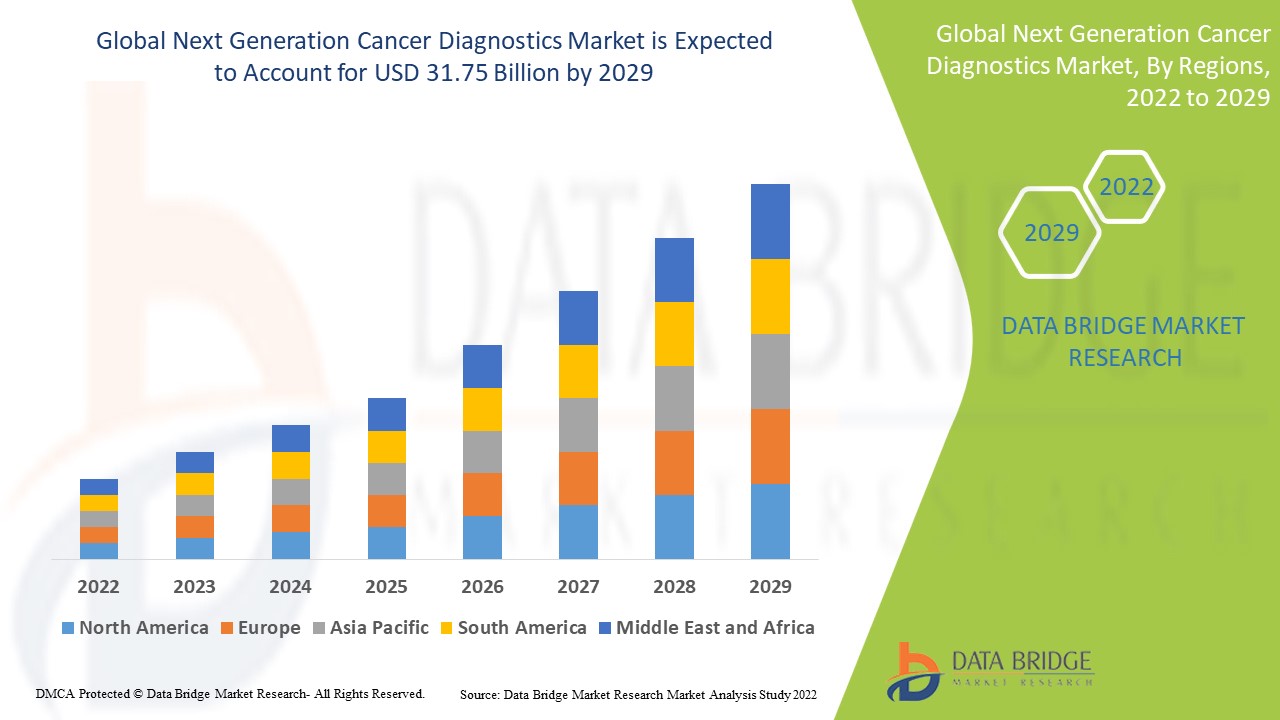
Data Bridge Market Research analyses a growth rate in the global next generation cancer diagnostics market in the forecast period 2022-2029. The expected CAGR of global next generation cancer diagnostics market is tend to be around 18.1% in the mentioned forecast period. The market was valued at USD 8.39 billion in 2021, and it would grow upto USD 31.75 billion by 2029. In addition to the market insights such as market value, growth rate, market segments, geographical coverage, market players, and market scenario, the market report curated by the Data Bridge Market Research team also includes in-depth expert analysis, patient epidemiology, pipeline analysis, pricing analysis, and regulatory framework.
Market Definition
Cancer diagnostics is a kind of process detecting numerous biomarkers, proteins, and certain symptoms that result in the detection of the presence of cancerous tumors in the patients. The process of detecting cancer includes the wide usage of certain technology and devices specifically used in its diagnosis. These tests are meant to facilitate early diagnosis and provide efficient prognosis of different types of cancer, which in turn, is expected to positively influence the progress of this market over the forecast period.
Report Scope and Market Segmentation
|
Report Metric |
Details |
|
Forecast Period |
2022 to 2029 |
|
Base Year |
2021 |
|
Historic Years |
2020 (Customizable to 2014 - 2019) |
|
Quantitative Units |
Revenue in USD Million, Volumes in Units, Pricing in USD |
|
Segments Covered |
By Technology (NGS, LOAC and RT-PCR), Application (CTC, Biomarker), Cancer Type (Lung, Breast) |
|
Countries Covered |
U.S., Canada and Mexico in North America, Germany, France, U.K., Netherlands, Switzerland, Belgium, Russia, Italy, Spain, Turkey, Rest of Europe in Europe, China, Japan, India, South Korea, Singapore, Malaysia, Australia, Thailand, Indonesia, Philippines, Rest of Asia-Pacific (APAC) in the Asia-Pacific (APAC), Saudi Arabia, U.A.E, South Africa, Egypt, Israel, Rest of Middle East and Africa (MEA) as a part of Middle East and Africa (MEA), Brazil, Argentina and Rest of South America as part of South America |
|
Market Players Covered |
Agilent Technologies, Inc. (U.S.), Abbott (U.S.), BD (U.S.), bioMérieux SA (France), NeoGenomics Laboratories, Inc. (U.S.), Telerad Tech (U.S.), F. Hoffmann-La Roche Ltd (Switzerland), GENERAL ELECTRIC COMPANY (U.S.), Hologic Inc. (U.S.), Illumina, Inc. (U.S.), QIAGEN (Germany), BioGenex (China), Siemens Healthcare GmbH (Germany), BioNTech SE (Germany), Thermo Fisher Scientific Inc. (India), Koninklijke Philips N.V. (Netherlands), PerkinElmer Inc (U.S.), OPKO Health, Inc. (U.S.), Cepheid (U.S.) |
|
Market Opportunities |
|
Global Next Generation Cancer Diagnostics Market Dynamics
Drivers
- Increasing Cancer Cases
Cancer is the leading cause of death in many countries, followed by other diseases such as stroke and coronary artery disease. Next-generation cancer diagnostic tests help prevent and detect illness early and, as a result, improve mortality worldwide.
- Advanced Technology
Advances in diagnostic labs and the introduction of integrated and automated lab systems are also expected to drive demand for advanced workflow systems and increase revenue during the forecast period. In addition, the transition from traditional clinical testing to rapid point-of-care testing will support market expansion as it is expected to commercialize a technologically advanced range of products such as diagnostic kits, instruments and reagents.
Opportunities
- Increase in Geriatric Population
The rise in elderly population face varied diseased conditions and increased cancer cases. There are several cancer types that are more prone to elderly population. Hence, these next-generation cancer diagnostics tools is surely going to aid in the further treatment process.
- Prevalence of Software
The advantages, comprising detection of gene duplications or deletions,qPCR technology for tumor profiling in clinical laboratories and melting curve analysis for identification of mutations are the advanced software tools that are prompting the market growth.
Restraints/Challenges
- Lack of skilled professionals
The lack of qualified personnel who are unable to use these diagnostics tests could curb the growth of the global enhanced ambulatory patient grouping software market over a forecast period.
- High Cost
High cost of these screening tests can hinder the growth of the global next generation cancer diagnostics market even though the prevalence of the patients are high.
This global next generation cancer diagnostics market report provides details of new recent developments, trade regulations, import-export analysis, production analysis, value chain optimization, market share, impact of domestic and localized market players, analyses opportunities in terms of emerging revenue pockets, changes in market regulations, strategic market growth analysis, market size, category market growths, application niches and dominance, product approvals, product launches, geographic expansions, technological innovations in the market. To gain more info on the global next generation cancer diagnostics market contact Data Bridge Market Research for an Analyst Brief, our team will help you take an informed market decision to achieve market growth.
COVID-19 Impact on Global Next Generation Cancer Diagnostics Market
Considering the present scenario, COVID-19 has left an unprecedented global public health crisis that has impacted practically every business, and its long-term repercussions are expected to have an influence on industry growth during the forecast period.
With the reopening of the hospitals and research institutes for all the diseased conditions other than COVID-19 patients, the market is slowly seeing a huge growth and is expected to witness a huge rise up in the forecast period.
Global Next Generation Cancer Diagnostics Market Scope
The global next generation cancer diagnostics market is segmented on the basis of technology, application and cancer type. The growth amongst these segments will help you analyze meagre growth segments in the industries and provide the users with a valuable market overview and market insights to help them make strategic decisions for identifying core market applications.
Technology
- NGS
- LOAC
- RT-PCR
Application
- CTC
- Biomarker
Cancer Type
- Lung
- Breast
Next Generation Cancer Diagnostics Market Regional Analysis/Insights
The global next generation cancer diagnostics market is analysed and market size insights and trends are provided by Technology, Application, Cancer type as referenced above.
The major countries covered in the global next generation cancer diagnostics market are the U.S., Canada and Mexico in North America, Germany, France, U.K., Netherlands, Switzerland, Belgium, Russia, Italy, Spain, Turkey, Rest of Europe in Europe, China, Japan, India, South Korea, Singapore, Malaysia, Australia, Thailand, Indonesia, Philippines, Rest of Asia-Pacific (APAC) in the Asia-Pacific (APAC), Saudi Arabia, U.A.E, South Africa, Egypt, Israel, Rest of Middle East and Africa (MEA) as a part of Middle East and Africa (MEA), Brazil, Argentina and Rest of South America as part of South America.
North America dominates the next generation cancer diagnostics market due to increased prevalence of cancer in this region. Asia-Pacific is the expected region in terms of growth in next generation cancer diagnostics market.
The country section of the report also provides individual market impacting factors and changes in regulation in the market domestically that impacts the current and future trends of the market. Also, the presence and availability of global brands and their challenges faced due to large or scarce competition from local and domestic brands, impact of domestic tariffs and trade routes are considered while providing forecast analysis of the country data.
Competitive Landscape and Global Next Generation Cancer Diagnostics Market Share Analysis
The global next generation cancer diagnostics market competitive landscape provides details by competitor. Details included are company overview, company financials, revenue generated, market potential, investment in research and development, new market initiatives, global presence, production sites and facilities, production capacities, company strengths and weaknesses, product launch, product width and breadth, application dominance. The above data points provided are only related to the companies' focus related to global next generation cancer diagnostics market.
Key players operating in the global next generation cancer diagnostics market include:
- Agilent Technologies, Inc. (U.S.)
- Abbott (U.S.)
- BD (U.S.)
- bioMérieux SA (France)
- NeoGenomics Laboratories, Inc. (U.S.)
- Telerad Tech (U.S.)
- F. Hoffmann-La Roche Ltd (Switzerland)
- GENERAL ELECTRIC COMPANY (U.S.)
- Hologic Inc. (U.S.)
- Illumina, Inc. (U.S.)
- QIAGEN (Germany)
- BioGenex (China)
- Siemens Healthcare GmbH (Germany)
- BioNTech SE (Germany)
- Thermo Fisher Scientific Inc. (India)
- Koninklijke Philips N.V. (Netherlands)
- PerkinElmer Inc (U.S.)
- OPKO Health, Inc. (U.S.)
- Cepheid (U.S.)
SKU-
세계 최초의 시장 정보 클라우드 보고서에 온라인으로 접속하세요

- 대화형 데이터 분석 대시보드
- 높은 성장 잠재력 기회를 위한 회사 분석 대시보드
- 사용자 정의 및 질의를 위한 리서치 분석가 액세스
- 대화형 대시보드를 통한 경쟁자 분석
- 최신 뉴스, 업데이트 및 추세 분석
- 포괄적인 경쟁자 추적을 위한 벤치마크 분석의 힘 활용
연구 방법론
데이터 수집 및 기준 연도 분석은 대규모 샘플 크기의 데이터 수집 모듈을 사용하여 수행됩니다. 이 단계에는 다양한 소스와 전략을 통해 시장 정보 또는 관련 데이터를 얻는 것이 포함됩니다. 여기에는 과거에 수집한 모든 데이터를 미리 검토하고 계획하는 것이 포함됩니다. 또한 다양한 정보 소스에서 발견되는 정보 불일치를 검토하는 것도 포함됩니다. 시장 데이터는 시장 통계 및 일관된 모델을 사용하여 분석하고 추정합니다. 또한 시장 점유율 분석 및 주요 추세 분석은 시장 보고서의 주요 성공 요인입니다. 자세한 내용은 분석가에게 전화를 요청하거나 문의 사항을 드롭하세요.
DBMR 연구팀에서 사용하는 주요 연구 방법론은 데이터 마이닝, 시장에 대한 데이터 변수의 영향 분석 및 주요(산업 전문가) 검증을 포함하는 데이터 삼각 측량입니다. 데이터 모델에는 공급업체 포지셔닝 그리드, 시장 타임라인 분석, 시장 개요 및 가이드, 회사 포지셔닝 그리드, 특허 분석, 가격 분석, 회사 시장 점유율 분석, 측정 기준, 글로벌 대 지역 및 공급업체 점유율 분석이 포함됩니다. 연구 방법론에 대해 자세히 알아보려면 문의를 통해 업계 전문가에게 문의하세요.
사용자 정의 가능
Data Bridge Market Research는 고급 형성 연구 분야의 선두 주자입니다. 저희는 기존 및 신규 고객에게 목표에 맞는 데이터와 분석을 제공하는 데 자부심을 느낍니다. 보고서는 추가 국가에 대한 시장 이해(국가 목록 요청), 임상 시험 결과 데이터, 문헌 검토, 재생 시장 및 제품 기반 분석을 포함하도록 사용자 정의할 수 있습니다. 기술 기반 분석에서 시장 포트폴리오 전략에 이르기까지 타겟 경쟁업체의 시장 분석을 분석할 수 있습니다. 귀하가 원하는 형식과 데이터 스타일로 필요한 만큼 많은 경쟁자를 추가할 수 있습니다. 저희 분석가 팀은 또한 원시 엑셀 파일 피벗 테이블(팩트북)로 데이터를 제공하거나 보고서에서 사용 가능한 데이터 세트에서 프레젠테이션을 만드는 데 도움을 줄 수 있습니다.











