Global Nuclear Decommissioning Market
Market Size in USD Billion
CAGR :
%
USD
8.25 Billion
USD
12.20 Billion
2025
2033
| 2026 –2033 | |
| USD 8.25 Billion | |
| USD 12.20 Billion | |
|
|
|
|
Nuclear Decommissioning Market Size
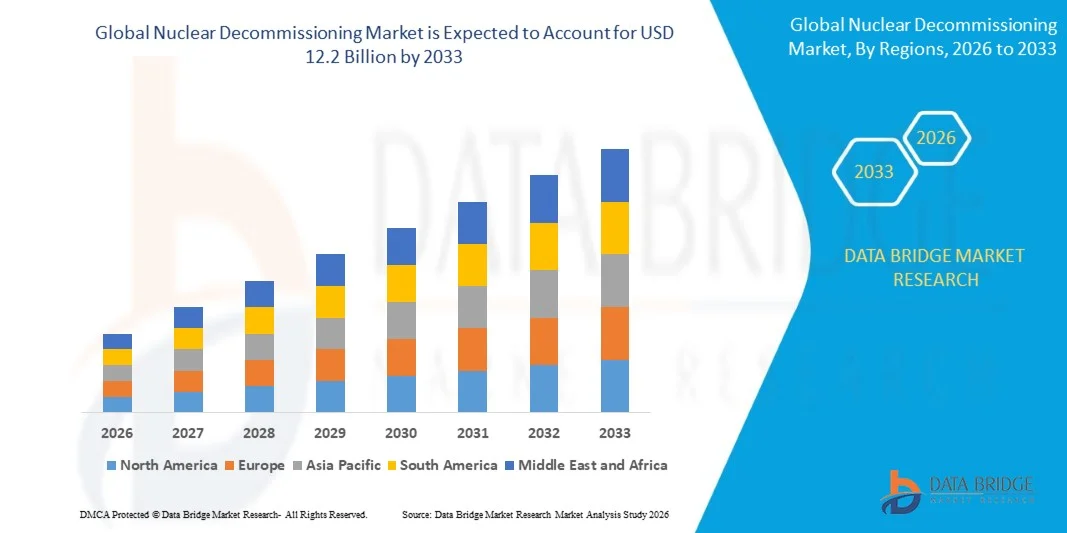
- The global nuclear decommissioning market size was valued at USD 8.25 billion in 2025 and is expected to reach around USD 12.2 billion by 2033, at a CAGR of 5.0% during the forecast period
- The market growth is primarily driven by the increasing number of aging nuclear reactors reaching end-of-life, particularly in North America, Europe, and parts of Asia-Pacific, leading to rising demand for safe dismantling and radioactive waste management services
- In addition, stringent nuclear safety regulations, government-led shutdown policies, and growing environmental concerns are accelerating the decommissioning of obsolete nuclear facilities, thereby supporting long-term market expansion
Nuclear Decommissioning Market Analysis
- Nuclear decommissioning involves the safe shutdown, dismantling, decontamination, and waste management of nuclear power plants and research reactors after their operational life ends
- The increasing focus on nuclear safety, environmental protection, and radioactive waste containment is making decommissioning a critical component of the global nuclear energy lifecycle
- Europe dominates the nuclear decommissioning market, accounting for approximately 34% of the global market share, driven by a large fleet of aging nuclear reactors, early nuclear program development, and strong regulatory frameworks requiring structured shutdown and cleanup activities
- Asia-Pacific is expected to be the fastest-growing region, with a CAGR of 6.5% during the forecast period, driven by Japan’s post-Fukushima reactor shutdowns, increasing nuclear retirement planning in India and South Korea, and rising investments in nuclear cleanup technologies.
- The Pressurized Water Reactor (PWR) segment dominates the nuclear decommissioning market in 2025, as it represents the largest installed base of commercial nuclear power reactors worldwide. A significant number of these reactors, particularly in Europe and North America, are reaching the end of their operational lifespans, resulting in a high volume of decommissioning projects driven by aging infrastructure, regulatory shutdowns, and lifecycle completion of large-scale electricity-generating nuclear plants.
Report Scope and Nuclear Decommissioning Market Segmentation
|
Attributes |
Nuclear Decommissioning Key Market Insights |
|
Segments Covered |
|
|
Countries Covered |
North America · U.S. · Canada · Mexico Europe · Germany · France · U.K. · Netherlands · Switzerland · Belgium · Russia · Italy · Spain · Turkey · Rest of Europe Asia-Pacific · China · Japan · India · South Korea · Singapore · Malaysia · Australia · Thailand · Indonesia · Philippines · Rest of Asia-Pacific Middle East and Africa · Saudi Arabia · U.A.E. · South Africa · Egypt · Israel · Rest of Middle East and Africa South America · Brazil · Argentina · Rest of South America |
|
Key Market Players |
|
|
Market Opportunities |
· Expansion of advanced robotic dismantling and remote decommissioning technologies · Increasing demand for radioactive waste recycling and long-term storage solutions · Growing investments in safe shutdown of aging nuclear reactors in Europe and Japan |
|
Value Added Data Infosets |
In addition to the insights on market scenarios such as market value, growth rate, segmentation, geographical coverage, and major players, the market reports curated by the Data Bridge Market Research also include in-depth expert analysis, geographically represented company-wise production and capacity, network layouts of distributors and partners, detailed and updated price trend analysis and deficit analysis of supply chain and demand. |
Nuclear Decommissioning Market Trends
“Increasing Adoption of Robotics and Remote Decommissioning Technologies”
- A key trend in the global nuclear decommissioning market is the growing use of robotic systems, AI-enabled inspection tools, and remote dismantling technologies to reduce human exposure to radiation
- For instance, advanced robotic arms and autonomous systems are increasingly used in high-radiation reactor zones for cutting, dismantling, and waste retrieval operations
- Digital technologies such as 3D mapping, simulation modeling, and digital twins are improving planning accuracy and reducing project risks
- The shift toward long-term site remediation and environmental restoration is also gaining momentum, particularly in Europe and North America
- Increasing focus on cost optimization and lifecycle efficiency is pushing operators to adopt hybrid decommissioning strategies combining immediate dismantling and safe enclosure
Nuclear Decommissioning Market Dynamics
Driver
“Rising Number of Aging Nuclear Reactors and Government Shutdown Programs”
- The global nuclear reactor fleet is rapidly aging, with over 60% of operational reactors worldwide exceeding 30 years of service life, creating a significant pipeline for decommissioning projects over the next two decades
- Many early-generation reactors in North America and Europe were designed for 30–40 years of operation, and a large proportion are now entering or exceeding their original licensed lifespans, increasing shutdown activity
- Countries such as Germany (nuclear phase-out policy), Japan (post-Fukushima regulatory tightening), and the U.S. (economic retirement of older plants) are actively decommissioning or planning closure of multiple reactors
- Global energy transition policies aimed at net-zero emissions by 2050 are accelerating the shift toward renewable energy sources, reducing long-term reliance on nuclear power in several regions
- Government-backed nuclear decommissioning programs, such as EU decommissioning funds and U.S. Nuclear Regulatory Commission (NRC) oversight frameworks, are ensuring structured funding and compliance-driven dismantling processes
- Rising investment in advanced decommissioning technologies such as remote robotics, AI-based radiation mapping, and automated dismantling systems is improving project feasibility and accelerating timelines
- Increasing focus on brownfield redevelopment of former nuclear sites for industrial or renewable energy use (such as solar farms) is further incentivizing faster reactor retirement and cleanup activities
Restraint/Challenge
“High Cost, Long Timelines, and Complex Radioactive Waste Management”
- Nuclear decommissioning remains one of the most expensive industrial processes globally, with costs ranging from USD 300 million to over USD 5 billion per reactor site, depending on size, contamination level, and strategy adopted
- Large-scale projects such as PWR and BWR dismantling in Europe and the U.S. often require multi-decade funding commitments, creating pressure on utilities, governments, and public funding agencies
- Project timelines are extensive, typically ranging from 10–40 years, particularly when adopting deferred dismantling strategies (SAFSTOR), leading to prolonged asset inactivity and financial burden
- The management of high-level radioactive waste (HLW), intermediate-level waste (ILW), and spent nuclear fuel remains a critical bottleneck due to limited permanent geological disposal facilities globally
- Stringent regulatory requirements from bodies such as the International Atomic Energy Agency (IAEA), U.S. NRC, and European nuclear regulators increase compliance complexity and extend approval timelines
- Workforce constraints are significant, with a shortage of highly specialized nuclear engineers, radiation protection experts, and decommissioning technicians, especially in emerging economies
- High dependency on specialized contractors and limited global decommissioning experience centers (primarily in France, UK, U.S., and Japan) further restrict scalability and increase project costs
- Environmental and public opposition concerns around radioactive contamination risks and long-term site safety can delay approvals and extend project execution schedules
Nuclear decommissioning Market Scope
The market is segmented on the basis of reactor type, decommissioning strategy, reactor capacity, and application.
- By Reactor Type
On the basis of reactor type, the global nuclear decommissioning market is segmented into Pressurized Water Reactor (PWR), Boiling Water Reactor (BWR), Pressurized Heavy Water Reactor (PHWR), Gas Cooled Reactor (GCR), and Others. The Pressurized Water Reactor (PWR) segment dominated the market with the largest revenue share in 2025, accounting for 48% of the global market share, driven by its widespread global deployment in commercial nuclear power generation, particularly across North America and Europe. A significant number of early-generation PWRs are now reaching end-of-life, resulting in a strong pipeline of decommissioning projects. PWRs also represent the highest installed base globally, making them the primary source of nuclear dismantling and site remediation activities. Established regulatory frameworks and standardized reactor designs further support structured and large-scale decommissioning operations for this segment.
The Boiling Water Reactor (BWR) segment is expected to witness notable growth during the forecast period, fueled by accelerated shutdowns of aging units, particularly in Japan and the U.S. following stricter post-Fukushima safety regulations. BWR decommissioning is often more complex due to higher contamination levels in certain components, increasing demand for advanced remote handling and robotic dismantling technologies.
- By Decommissioning Strategy
On the basis of decommissioning strategy, the market is segmented into Immediate Dismantling, Deferred Dismantling, and Entombment. The Deferred Dismantling segment dominated the market in 2025, as many utilities prefer long-term safe enclosure strategies to allow radiation levels to decay naturally, thereby reducing worker exposure and overall decommissioning costs. This approach is widely adopted in Europe and North America due to regulatory acceptance and financial optimization benefits.
The Immediate Dismantling segment is expected to register the fastest growth during the forecast period, driven by increasing regulatory pressure for faster site reuse, especially in Europe where nuclear phase-out policies are active. Immediate dismantling is also gaining momentum due to advancements in robotics, AI-based radiation mapping, and remote dismantling technologies that improve safety and efficiency.
- By Reactor Capacity
On the basis of reactor capacity, the market is segmented into Up to 800 MW, 801–1000 MW, and Above 1000 MW. The 801–1000 MW segment dominated the market in 2025, as many first-generation commercial nuclear reactors globally fall within this capacity range and are currently reaching retirement age. These reactors represent a large portion of ongoing and planned decommissioning projects across developed economies.
The Above 1000 MW segment is expected to witness steady growth during the forecast period, driven by the gradual planning of decommissioning for newer large-capacity reactors, particularly in Europe, the U.S., and Asia-Pacific. These projects are typically more complex due to higher radiation inventories and larger infrastructure scale, requiring advanced dismantling technologies and long-term project management.
- By Application
On the basis of application, the market is segmented into Commercial Nuclear Power Reactors, Prototype Power Reactors, and Research Reactors. The Commercial Nuclear Power Reactors segment dominated the market with the largest revenue share in 2025, as most decommissioning activities originate from large-scale electricity generation facilities that have reached the end of operational life. These reactors represent the majority of global installed nuclear capacity and therefore account for the highest dismantling and remediation workload.
The Prototype Power Reactors segment is witnessing moderate growth, as early-stage experimental reactors built for technology validation are being retired and decommissioned after completing their operational objectives.
Nuclear Decommissioning Market Regional Analysis
- Europe dominated the nuclear decommissioning market with the largest revenue share of approximately 34% in 2025, supported by a large fleet of aging nuclear reactors, early nuclear power program development, and stringent regulatory frameworks mandating structured shutdown and site remediation activities across the region
- Countries such as France, the U.K., Germany, and Russia are actively engaged in large-scale nuclear decommissioning programs, driven by national nuclear phase-out policies, lifecycle completion of early-generation reactors, and strong government oversight for nuclear safety compliance
- The region’s leadership is further strengthened by the presence of well-established nuclear decommissioning expertise, specialized engineering contractors, and dedicated national decommissioning agencies, particularly in the UK and France, which manage long-term cleanup and waste management operations
- European governments and regulatory bodies enforce strict environmental protection standards and radioactive waste management regulations, ensuring structured, long-term decommissioning strategies and sustained project pipelines across multiple sites
U.S. Nuclear Decommissioning Market Insight
The U.S. nuclear decommissioning market is a major contributor to global demand, driven by a large fleet of aging commercial reactors and several permanently shut-down nuclear plants undergoing long-term dismantling. Strong regulatory oversight from the U.S. Nuclear Regulatory Commission (NRC), along with structured funding mechanisms and established decommissioning frameworks such as SAFSTOR and DECON strategies, supports steady market growth. Increasing focus on site cleanup, radioactive waste management, and redevelopment of former nuclear sites is further accelerating decommissioning activities across the country.
Europe Nuclear Decommissioning Market Insight
The Europe nuclear decommissioning market is a leading regional segment, driven by a large number of aging nuclear reactors, early adoption of nuclear power, and several national nuclear phase-out policies across countries such as Germany, the U.K., and France. The region is characterized by strict regulatory frameworks, strong environmental compliance requirements, and well-established decommissioning programs supported by government agencies and specialized contractors. Increasing shutdown of older reactors, along with growing investments in radioactive waste management and site remediation, is steadily accelerating decommissioning activities. Europe’s focus on safety, sustainability, and redevelopment of former nuclear sites further strengthens its position in the global market.
U.K. Nuclear Decommissioning Market Insight
The U.K. nuclear decommissioning market is one of the most advanced globally, driven by a large legacy fleet of Magnox and AGR reactors reaching end-of-life and being systematically retired under the country’s long-term nuclear cleanup program. The market is primarily managed by the Nuclear Decommissioning Authority (NDA), which oversees safe dismantling, radioactive waste management, and site restoration across multiple nuclear facilities. Strong regulatory compliance, high government funding, and decades-long decommissioning timelines support sustained market activity. Increasing focus on environmental restoration and redevelopment of former nuclear sites for alternative energy and industrial use is further contributing to market growth.
Germany Nuclear Decommissioning Market Insight
The Germany nuclear decommissioning market is witnessing strong growth due to the country’s complete nuclear phase-out policy, which mandates the shutdown of all nuclear power plants and systematic dismantling of remaining facilities. Following the government’s energy transition (Energiewende) strategy, several reactors have already been permanently closed, with the remaining units undergoing structured decommissioning and site remediation. The market is supported by strict environmental regulations, high safety standards, and strong regulatory oversight from federal nuclear authorities. Increasing investments in radioactive waste management infrastructure and advanced dismantling technologies, along with redevelopment of former nuclear sites for renewable energy projects, are further driving decommissioning activities across the country.
Asia-Pacific Nuclear Decommissioning Market Insight
The Asia-Pacific nuclear decommissioning market is expected to witness the fastest growth globally, driven by increasing shutdown activities in countries such as Japan, South Korea, and India, along with rising focus on nuclear safety and long-term waste management. Japan remains a key contributor following post-Fukushima reactor closures and ongoing decommissioning of damaged facilities, requiring highly complex, long-term dismantling operations. The region is also experiencing growing investments in nuclear decommissioning technologies, including robotics and remote handling systems, to address high radiation environments safely and efficiently. Rapid urbanization, increasing energy transition policies, and strengthening regulatory frameworks are further supporting market expansion across Asia-Pacific.
Japan Nuclear Decommissioning Market Insight
The Japan nuclear decommissioning market is a key global hotspot, largely driven by the long-term decommissioning of Fukushima Daiichi and other post-Fukushima reactor shutdowns. The country is undertaking some of the most complex and technically challenging decommissioning projects worldwide, involving fuel debris removal, high-radiation environment management, and advanced robotic intervention systems. Strong regulatory oversight from the Nuclear Regulation Authority (NRA) and sustained government funding are supporting multi-decade cleanup efforts. Japan is also heavily investing in cutting-edge technologies such as remote-controlled robotics, AI-based monitoring systems, and containment solutions to ensure safe dismantling. The combination of strict safety requirements and large-scale legacy cleanup programs is making Japan one of the most technologically advanced nuclear decommissioning markets globally.
India Nuclear Decommissioning Market Insight
The India nuclear decommissioning market is still in a nascent but steadily emerging stage, supported by the country’s expanding nuclear energy program and the gradual retirement planning of older research and prototype reactors. Decommissioning activity in India is primarily managed by the Department of Atomic Energy (DAE) and involves specialized units focused on safe dismantling, radioactive waste handling, and long-term site monitoring. The market is driven by increasing emphasis on nuclear safety, regulatory strengthening, and alignment with international best practices set by organizations such as the IAEA. Growing investments in nuclear infrastructure, rising energy demand, and the development of indigenous decommissioning capabilities are expected to gradually accelerate market activity in the coming years.
Nuclear Decommissioning Market Share
The Nuclear decommissioning industry is primarily led by well-established companies, including:
- Westinghouse Electric Company LLC (U.S.)
- Orano (France)
- EDF (Electricité de France) (France)
- Amentum (U.S.)
- Bechtel Corporation (U.S.)
- Fluor Corporation (U.S.)
- SNC-Lavalin / AtkinsRéalis (Canada)
- Jacobs Solutions Inc. (U.S.)
- Babcock International Group (U.K.)
- Studsvik AB (Sweden)
- EnergySolutions (U.S.)
- NWMO (Canada)
- Rosatom State Corporation (Russia)
- GE Hitachi Nuclear Energy (Japan)
- Nuvia (France)
What are the Recent Developments in Global Nuclear Decommissioning Market?
- In April 2026, the Nuclear Decommissioning Authority (NDA) and Nuclear Restoration Services formally took control of the Hunterston B nuclear site from EDF Energy, marking a major transition into full-scale decommissioning and long-term site restoration activities
- In 2025, Orano strengthened its position in European nuclear cleanup by advancing large-scale dismantling programs and radioactive waste treatment solutions, particularly in legacy reactor sites across France and the U.K.
- In 2025, EDF Group progressed its long-term nuclear shutdown strategy, accelerating decommissioning activities across multiple aging reactors while transitioning assets to dedicated cleanup and waste management entities
- In 2025, Holtec International advanced decommissioning work for permanently shut-down nuclear plants, including fuel removal and site stabilization projects under U.S. Nuclear Regulatory Commission (NRC) oversight
SKU-
Get online access to the report on the World's First Market Intelligence Cloud
- Interactive Data Analysis Dashboard
- Company Analysis Dashboard for high growth potential opportunities
- Research Analyst Access for customization & queries
- Competitor Analysis with Interactive dashboard
- Latest News, Updates & Trend analysis
- Harness the Power of Benchmark Analysis for Comprehensive Competitor Tracking
Global Nuclear Decommissioning Market, Supply Chain Analysis and Ecosystem Framework
To support market growth and help clients navigate the impact of geopolitical shifts, DBMR has integrated in-depth supply chain analysis into its Global Nuclear Decommissioning Market research reports. This addition empowers clients to respond effectively to global changes affecting their industries. The supply chain analysis section includes detailed insights such as Global Nuclear Decommissioning Market consumption and production by country, price trend analysis, the impact of tariffs and geopolitical developments, and import and export trends by country and HSN code. It also highlights major suppliers with data on production capacity and company profiles, as well as key importers and exporters. In addition to research, DBMR offers specialized supply chain consulting services backed by over a decade of experience, providing solutions like supplier discovery, supplier risk assessment, price trend analysis, impact evaluation of inflation and trade route changes, and comprehensive market trend analysis.
Research Methodology
Data collection and base year analysis are done using data collection modules with large sample sizes. The stage includes obtaining market information or related data through various sources and strategies. It includes examining and planning all the data acquired from the past in advance. It likewise envelops the examination of information inconsistencies seen across different information sources. The market data is analysed and estimated using market statistical and coherent models. Also, market share analysis and key trend analysis are the major success factors in the market report. To know more, please request an analyst call or drop down your inquiry.
The key research methodology used by DBMR research team is data triangulation which involves data mining, analysis of the impact of data variables on the market and primary (industry expert) validation. Data models include Vendor Positioning Grid, Market Time Line Analysis, Market Overview and Guide, Company Positioning Grid, Patent Analysis, Pricing Analysis, Company Market Share Analysis, Standards of Measurement, Global versus Regional and Vendor Share Analysis. To know more about the research methodology, drop in an inquiry to speak to our industry experts.
Customization Available
Data Bridge Market Research is a leader in advanced formative research. We take pride in servicing our existing and new customers with data and analysis that match and suits their goal. The report can be customized to include price trend analysis of target brands understanding the market for additional countries (ask for the list of countries), clinical trial results data, literature review, refurbished market and product base analysis. Market analysis of target competitors can be analyzed from technology-based analysis to market portfolio strategies. We can add as many competitors that you require data about in the format and data style you are looking for. Our team of analysts can also provide you data in crude raw excel files pivot tables (Fact book) or can assist you in creating presentations from the data sets available in the report.