Global Regenerative Agriculture Inputs Market
Market Size in USD Billion
CAGR :
%
USD
12.50 Billion
USD
26.02 Billion
2025
2033
| 2026 –2033 | |
| USD 12.50 Billion | |
| USD 26.02 Billion | |
|
|
|
|
Regenerative Agriculture Inputs Market Size
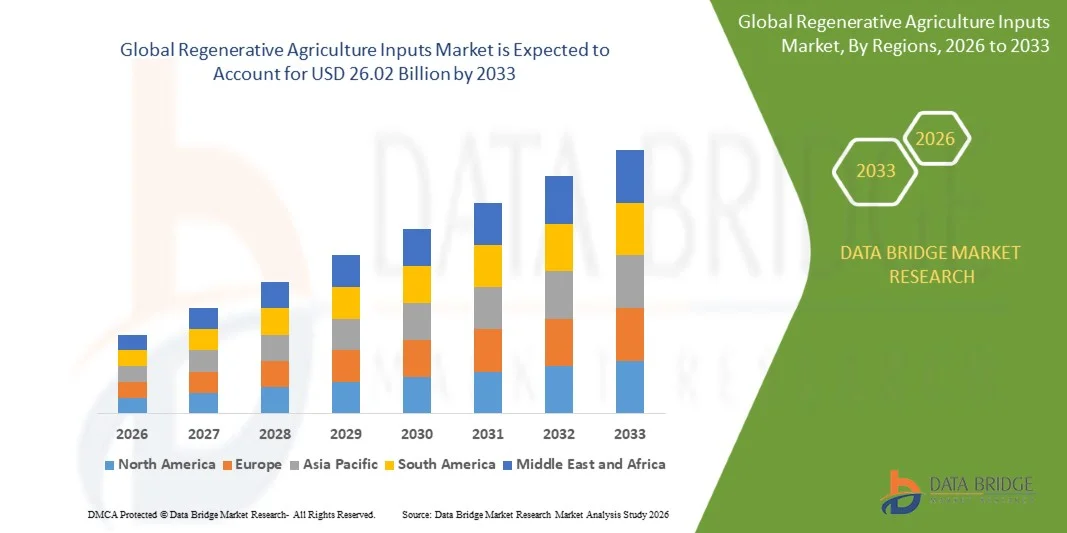
- The global regenerative agriculture inputs market size was valued at USD 12.50 billion in 2025 and is expected to reach USD 26.02 billion by 2033, at a CAGR of 9.60% during the forecast period
- The market growth is largely fuelled by the increasing adoption of sustainable farming practices, rising demand for soil health improvement solutions, and growing focus on reducing chemical fertilizer dependency in agriculture
- Expanding government support for climate-resilient agriculture and incentives for organic and regenerative farming inputs is further accelerating market expansion
Regenerative Agriculture Inputs Market Analysis
- The regenerative agriculture inputs market is witnessing strong growth due to rising awareness about soil regeneration, carbon sequestration, and long-term agricultural sustainability
- Increasing demand for bio-based fertilizers, compost, and microbial inputs is driving the shift away from conventional chemical-based farming solutions, particularly in large-scale commercial agriculture
- North America dominated the regenerative agriculture inputs market with the largest revenue share in 2025, driven by increasing adoption of sustainable farming practices, strong government support for soil health improvement, and rising demand for organic and bio-based agricultural inputs
- Asia-Pacific region is expected to witness the highest growth rate in the global regenerative agriculture inputs market, driven by increasing food demand, rapid agricultural modernization, and growing adoption of biofertilizers, compost, and microbial-based soil enhancement solutions
- The organic fertilizers segment held the largest market revenue share in 2025 driven by increasing demand for soil-enriching and chemical-free farming solutions that enhance long-term agricultural productivity. Organic fertilizers are widely adopted due to their ability to improve soil structure, increase nutrient retention, and support sustainable crop growth across large-scale farming systems
Report Scope and Regenerative Agriculture Inputs Market Segmentation
|
Attributes |
Regenerative Agriculture Inputs Key Market Insights |
|
Segments Covered |
• By Product Type: Organic Fertilizers, Biofertilizers, Biostimulants, Compost, Cover Crop Seeds, and Others • By Input Source: Plant-Based Inputs, Microbial Inputs, Animal-Based Inputs, and Mineral-Based Inputs • By Application: Soil Health Management, Crop Nutrition, Pest and Disease Management, and Carbon Sequestration • By End-User: Farmers, Agricultural Cooperatives, Agribusiness Companies, and Research and Government Institutions |
|
Countries Covered |
North America
Europe
Asia-Pacific
Middle East and Africa
South America
|
|
Key Market Players |
• Bayer AG (Germany) |
|
Market Opportunities |
• Expansion Of Carbon Farming Practices |
|
Value Added Data Infosets |
In addition to the insights on market scenarios such as market value, growth rate, segmentation, geographical coverage, and major players, the market reports curated by the Data Bridge Market Research also include import export analysis, production capacity overview, production consumption analysis, price trend analysis, climate change scenario, supply chain analysis, value chain analysis, raw material/consumables overview, vendor selection criteria, PESTLE Analysis, Porter Analysis, and regulatory framework. |
Regenerative Agriculture Inputs Market Trends
“Rising Adoption Of Sustainable And Soil Regeneration Practices”
• The growing shift toward sustainable farming and soil regeneration is significantly shaping the regenerative agriculture inputs market, as farmers increasingly adopt natural, bio-based, and eco-friendly input solutions. Products such as biofertilizers, compost, and biostimulants are gaining strong traction due to their ability to improve soil fertility, enhance microbial activity, and restore long-term agricultural productivity. These inputs also help in improving water retention capacity and reducing soil erosion, making farmland more resilient to climate variability. This trend is strengthening adoption across large-scale farming and organic cultivation systems, encouraging manufacturers to innovate in sustainable input development and precision agriculture solutions
• Increasing awareness around climate change, soil degradation, and long-term food security is accelerating demand for regenerative agriculture inputs across crop production systems. Farmers and agribusinesses are actively seeking solutions that reduce chemical dependency while improving yield efficiency and environmental outcomes. This has led to rising adoption of microbial inputs, compost-based fertilizers, and cover cropping solutions that help rebuild soil organic matter and improve nutrient cycling. In addition, these practices are supporting biodiversity in agricultural ecosystems and reducing greenhouse gas emissions from conventional farming methods
• Sustainability-driven farming practices are influencing purchasing decisions, with governments and agricultural organizations promoting regenerative techniques through subsidies, training programs, and certification initiatives. These efforts are helping farmers transition from conventional inputs to regenerative alternatives while encouraging transparency and traceability in agricultural supply chains. The increasing integration of digital farming tools is also enabling better monitoring of soil health and input efficiency. As a result, regenerative agriculture inputs are becoming a core part of modern sustainable farming strategies across multiple regions
• For instance, in 2024, companies such as Indigo Ag in the U.S. and Yara International in Norway expanded their regenerative agriculture programs by promoting carbon-smart fertilizers and microbial-based soil inputs. These initiatives were introduced to support climate-resilient farming and were implemented across large-scale agricultural regions, enhancing soil health and productivity outcomes. These companies also partnered with farmers and agritech platforms to track carbon sequestration levels and improve farm-level sustainability reporting. Such initiatives are strengthening the commercial viability of regenerative input solutions in global agriculture markets
• While adoption is increasing, long-term market growth depends on scalability of production, farmer awareness, and consistent performance of bio-based inputs under different soil and climatic conditions. Manufacturers are focusing on improving formulation stability, shelf life, and field effectiveness to ensure reliable results across diverse agricultural environments. Investment in R&D and field trials is also essential to build farmer confidence and demonstrate measurable yield improvements over conventional input systems
Regenerative Agriculture Inputs Market Dynamics
Driver
“Growing Focus On Soil Health And Sustainable Farming Practices”
• Rising concerns over soil degradation and declining agricultural productivity are a major driver for the regenerative agriculture inputs market, as farmers shift toward natural solutions that restore soil health and improve nutrient cycling. Continuous monocropping and excessive chemical fertilizer use have significantly reduced soil fertility, pushing demand for regenerative alternatives. These inputs help rebuild soil structure, enhance microbial diversity, and improve long-term crop productivity. As a result, regenerative agriculture is increasingly seen as a strategic solution for ensuring global food security and sustainable land use
• Expanding use of biofertilizers, compost, and biostimulants is enhancing crop yield efficiency while reducing reliance on synthetic fertilizers, supporting long-term agricultural sustainability. These inputs improve nutrient uptake, stimulate plant growth, and increase resistance to environmental stress conditions such as drought and salinity. In addition, regenerative inputs contribute to reducing input costs over time by improving soil productivity naturally. This makes them particularly attractive for both large-scale commercial farms and smallholder farmers aiming for cost-efficient agriculture
• Government initiatives promoting regenerative agriculture practices and carbon sequestration are further encouraging farmers to adopt eco-friendly input solutions across both developed and emerging markets. Many countries are introducing financial incentives, carbon credit programs, and training initiatives to accelerate adoption. These policies are also aligning agricultural practices with climate goals and sustainability targets. Furthermore, public-private partnerships are playing a key role in scaling regenerative input usage across major agricultural regions
• For instance, in 2023, Corteva Agriscience in the U.S. and Bayer AG in Germany expanded their regenerative agriculture initiatives by introducing microbial-based soil health solutions and carbon-reducing farming programs, supporting large-scale adoption among commercial farmers. These programs included digital soil monitoring tools, farmer advisory services, and sustainability benchmarking systems. Such initiatives are helping farmers transition more effectively toward regenerative practices while improving productivity and environmental performance simultaneously
• Although demand is increasing, growth depends on cost competitiveness, farmer education, and availability of high-quality regenerative input products at scale. Addressing supply chain limitations and ensuring consistent product performance across regions remains critical. Companies are also focusing on improving awareness programs and demonstrating long-term economic benefits to encourage wider adoption among cost-sensitive farming communities
Restraint/Challenge
“High Cost And Limited Farmer Awareness In Emerging Regions”
• The relatively higher cost of regenerative agriculture inputs compared to conventional fertilizers remains a key challenge, particularly for small and medium-scale farmers operating under tight budgets. Production of bio-based inputs often requires specialized raw materials, controlled environments, and advanced processing techniques, which increases overall pricing. This cost gap makes it difficult for farmers in price-sensitive markets to transition from conventional to regenerative systems despite long-term benefits
• Limited awareness and technical knowledge regarding regenerative farming practices restrict adoption in several developing regions, slowing market penetration. Many farmers are still unfamiliar with the long-term soil health and yield benefits provided by regenerative inputs. Lack of training, demonstration farms, and extension services further limits understanding of how to effectively use these products. This results in slower adoption rates compared to traditional agricultural inputs
• Supply chain limitations and dependency on specialized microbial and organic raw materials also impact availability and pricing stability of regenerative inputs. Inadequate distribution networks in rural areas make it difficult for farmers to access quality products consistently. In additiona, storage and handling requirements for biological inputs increase logistical complexity. These factors collectively affect market reliability and scalability in emerging agricultural economies
• For instance, in 2024, agricultural distributors in India and Southeast Asia reported slower adoption of biofertilizers and microbial soil inputs due to cost concerns and limited understanding of long-term yield benefits among farmers, affecting market expansion in rural farming regions. Many small retailers also faced challenges in maintaining cold-chain requirements and ensuring product viability during transportation. This further reduced accessibility in remote agricultural areas
• Overcoming these challenges will require improved farmer training programs, government subsidies, and investment in scalable production technologies for bio-based agricultural inputs, along with stronger distribution networks to ensure wider accessibility. Collaboration between agritech companies, governments, and research institutions will be essential to accelerate knowledge transfer and build trust in regenerative farming solutions across global agricultural markets
Regenerative Agriculture Inputs Market Scope
The regenerative agriculture inputs market is segmented into four notable segments based on product type, input source, application, and end-user.
• By Product Type
On the basis of product type, the regenerative agriculture inputs market is segmented into organic fertilizers, biofertilizers, biostimulants, compost, cover crop seeds, and others. The organic fertilizers segment held the largest market revenue share in 2025 driven by increasing demand for soil-enriching and chemical-free farming solutions that enhance long-term agricultural productivity. Organic fertilizers are widely adopted due to their ability to improve soil structure, increase nutrient retention, and support sustainable crop growth across large-scale farming systems.
The biofertilizers segment is expected to witness the fastest growth rate from 2026 to 2033, driven by rising adoption of microbial-based soil enhancement solutions that improve nutrient availability and reduce dependency on synthetic fertilizers. Biofertilizers are gaining popularity due to their ability to fix atmospheric nitrogen, stimulate plant growth, and enhance soil microbial activity, making them highly suitable for regenerative farming practices and organic agriculture systems.
• By Input Source
On the basis of input source, the market is segmented into plant-based inputs, microbial inputs, animal-based inputs, and mineral-based inputs. The plant-based inputs segment held the largest market revenue share in 2025 driven by strong availability of natural agricultural residues and growing preference for plant-derived soil enhancement materials. These inputs are widely used in composting, mulching, and soil conditioning to improve soil fertility and water retention capacity.
The microbial inputs segment is expected to witness the fastest growth rate from 2026 to 2033, driven by increasing demand for beneficial microorganisms that enhance soil health and crop productivity. Microbial inputs play a key role in nutrient cycling, disease suppression, and improving plant resilience, making them a critical component of regenerative agriculture systems focused on restoring ecosystem balance.
• By Application
On the basis of application, the market is segmented into soil health management, crop nutrition, pest and disease management, and carbon sequestration. The soil health management segment held the largest market revenue share in 2025 driven by increasing focus on restoring degraded soils and improving long-term agricultural sustainability. Farmers are widely adopting regenerative inputs to enhance soil organic matter, microbial diversity, and fertility levels.
The carbon sequestration segment is expected to witness the fastest growth rate from 2026 to 2033, driven by rising global emphasis on climate-smart agriculture and carbon credit programs. Regenerative inputs are increasingly used to capture and store atmospheric carbon in soil, supporting climate change mitigation goals while improving soil productivity and resilience.
• By End-User
On the basis of end-user, the market is segmented into farmers, agricultural cooperatives, agribusiness companies, and research and government institutions. The farmers segment held the largest market revenue share in 2025 driven by increasing adoption of sustainable farming practices and rising awareness of soil regeneration benefits. Farmers are actively integrating regenerative inputs to improve crop yield, reduce chemical usage, and enhance long-term soil fertility.
The agribusiness companies segment is expected to witness the fastest growth rate from 2026 to 2033, driven by large-scale adoption of regenerative agriculture practices within commercial farming operations. These companies are investing in advanced soil health solutions, digital farming tools, and sustainable input supply chains to improve productivity and meet environmental sustainability targets.
Regenerative Agriculture Inputs Market Regional Analysis
• North America dominated the regenerative agriculture inputs market with the largest revenue share in 2025, driven by increasing adoption of sustainable farming practices, strong government support for soil health improvement, and rising demand for organic and bio-based agricultural inputs
• Farmers and agribusinesses in the region highly value improved soil fertility, enhanced crop productivity, and long-term environmental benefits offered by regenerative inputs such as biofertilizers, compost, and biostimulants
• This widespread adoption is further supported by advanced agricultural infrastructure, high awareness of climate-smart farming practices, and strong presence of agritech companies, establishing regenerative inputs as a key component of modern farming systems across both commercial and large-scale agricultural operations
U.S. Regenerative Agriculture Inputs Market Insight
The U.S. regenerative agriculture inputs market captured the largest revenue share in 2025 within North America, fueled by rapid adoption of climate-smart agriculture practices and increasing focus on carbon sequestration in farming. Farmers are increasingly shifting toward microbial inputs, organic fertilizers, and cover cropping solutions to improve soil health and reduce dependency on synthetic chemicals. Growing investment in agritech innovations, carbon credit programs, and sustainable farming initiatives is further driving market expansion. In addition, strong collaboration between agribusiness companies and technology providers is accelerating the adoption of precision-based regenerative input solutions across large farming areas.
Europe Regenerative Agriculture Inputs Market Insight
The Europe regenerative agriculture inputs market is expected to witness the fastest growth rate from 2026 to 2033, primarily driven by strict environmental regulations, strong sustainability targets, and rising demand for organic food production. The region’s focus on reducing chemical fertilizer usage and improving soil biodiversity is encouraging adoption of biofertilizers, compost, and microbial solutions. Increasing support from government policies promoting carbon-neutral agriculture and sustainable land use practices is further accelerating market growth across both small and large farming operations.
U.K. Regenerative Agriculture Inputs Market Insight
The U.K. regenerative agriculture inputs market is expected to witness the fastest growth rate from 2026 to 2033, driven by increasing awareness of soil degradation and growing demand for sustainable farming solutions. Farmers are adopting regenerative inputs to improve soil structure, enhance productivity, and meet sustainability certification requirements. Rising consumer preference for sustainably produced food is also encouraging agricultural producers to shift toward eco-friendly farming inputs and regenerative practices.
Germany Regenerative Agriculture Inputs Market Insight
The Germany regenerative agriculture inputs market is expected to witness the fastest growth rate from 2026 to 2033, fueled by strong emphasis on environmental sustainability, advanced agricultural practices, and government support for organic farming. Increasing adoption of microbial inputs and biostimulants is helping farmers enhance soil health and reduce environmental impact. The country’s focus on innovation and precision agriculture is further supporting the integration of regenerative inputs into modern farming systems.
Asia-Pacific Regenerative Agriculture Inputs Market Insight
The Asia-Pacific regenerative agriculture inputs market is expected to witness the fastest growth rate from 2026 to 2033, driven by rising population, increasing food demand, and growing awareness of sustainable farming practices. Countries such as China, India, and Japan are increasingly adopting biofertilizers, compost, and microbial inputs to improve soil fertility and agricultural productivity. Government initiatives promoting sustainable agriculture and reduced chemical fertilizer usage are further accelerating market adoption across the region.
Japan Regenerative Agriculture Inputs Market Insight
The Japan regenerative agriculture inputs market is expected to witness strong growth from 2026 to 2033 due to increasing focus on soil health, sustainable farming, and high-value crop production. The country’s aging farming population is encouraging adoption of efficient and eco-friendly agricultural inputs. Integration of regenerative practices with precision farming technologies is further enhancing productivity and supporting long-term agricultural sustainability.
China Regenerative Agriculture Inputs Market Insight
The China regenerative agriculture inputs market accounted for the largest market revenue share in Asia Pacific in 2025, attributed to rapid agricultural modernization, strong government support for sustainable farming, and high demand for improved soil productivity. Increasing use of biofertilizers, microbial inputs, and organic soil conditioners is supporting large-scale adoption. The country’s push toward green agriculture and food security is further driving expansion of regenerative agriculture input solutions across rural and commercial farming regions.
Regenerative Agriculture Inputs Market Share
The Regenerative Agriculture Inputs industry is primarily led by well-established companies, including:
• Bayer AG (Germany)
• BASF SE (Germany)
• Syngenta Group (Switzerland)
• Corteva Agriscience (U.S.)
• Yara International (Norway)
• Nutrien Ltd. (Canada)
• Indigo Ag (U.S.)
• UPL Limited (India)
• Novozymes A/S (Denmark)
• Marrone Bio Innovations (U.S.)
• Koppert Biological Systems (Netherlands)
• Valagro (Italy)
• The Scotts Miracle-Gro Company (U.S.)
• Tata Chemicals Limited (India)
• Seipasa S.A. (Spain)
SKU-
Get online access to the report on the World's First Market Intelligence Cloud
- Interactive Data Analysis Dashboard
- Company Analysis Dashboard for high growth potential opportunities
- Research Analyst Access for customization & queries
- Competitor Analysis with Interactive dashboard
- Latest News, Updates & Trend analysis
- Harness the Power of Benchmark Analysis for Comprehensive Competitor Tracking
Research Methodology
Data collection and base year analysis are done using data collection modules with large sample sizes. The stage includes obtaining market information or related data through various sources and strategies. It includes examining and planning all the data acquired from the past in advance. It likewise envelops the examination of information inconsistencies seen across different information sources. The market data is analysed and estimated using market statistical and coherent models. Also, market share analysis and key trend analysis are the major success factors in the market report. To know more, please request an analyst call or drop down your inquiry.
The key research methodology used by DBMR research team is data triangulation which involves data mining, analysis of the impact of data variables on the market and primary (industry expert) validation. Data models include Vendor Positioning Grid, Market Time Line Analysis, Market Overview and Guide, Company Positioning Grid, Patent Analysis, Pricing Analysis, Company Market Share Analysis, Standards of Measurement, Global versus Regional and Vendor Share Analysis. To know more about the research methodology, drop in an inquiry to speak to our industry experts.
Customization Available
Data Bridge Market Research is a leader in advanced formative research. We take pride in servicing our existing and new customers with data and analysis that match and suits their goal. The report can be customized to include price trend analysis of target brands understanding the market for additional countries (ask for the list of countries), clinical trial results data, literature review, refurbished market and product base analysis. Market analysis of target competitors can be analyzed from technology-based analysis to market portfolio strategies. We can add as many competitors that you require data about in the format and data style you are looking for. Our team of analysts can also provide you data in crude raw excel files pivot tables (Fact book) or can assist you in creating presentations from the data sets available in the report.