Global Renewable Energy Market
Market Size in USD Billion
CAGR :
%
USD
1,602.00 Billion
USD
4,860.85 Billion
2025
2033
| 2026 –2033 | |
| USD 1,602.00 Billion | |
| USD 4,860.85 Billion | |
|
|
|
|
Renewable Energy Market Size
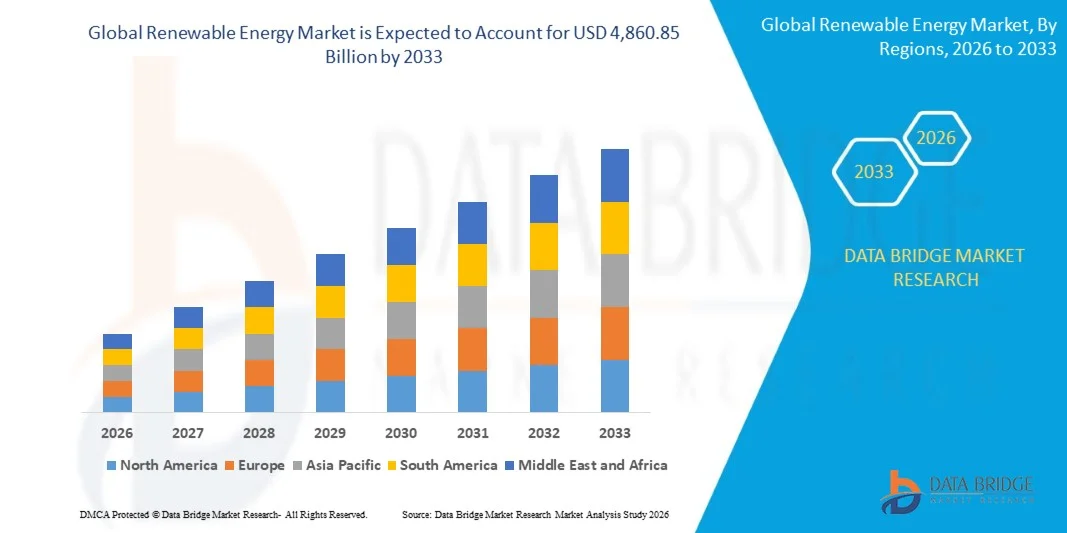
- The global renewable energy market size was valued at USD 1,602 billion in 2025 and is expected to reach USD 4,860.85 billion by 2033, at a CAGR of 14.7% during the forecast period
- Market growth is primarily driven by increasing global focus on decarbonization, rising investments in clean energy infrastructure, and supportive government policies promoting renewable adoption
- Rapid cost reductions in solar and wind technologies, along with advancements in energy storage and grid integration, are accelerating large-scale deployment across both developed and emerging economies
Renewable Energy Market Analysis
- Renewable energy, derived from natural resources such as sunlight, wind, water, and biomass, is becoming a cornerstone of global energy systems due to its sustainability, low carbon emissions, and long-term cost advantages
- The escalating demand is driven by rising energy consumption, climate change concerns, and international commitments toward net-zero emissions targets
- North America accounted for a significant market share of approximately 35% in 2025, supported by strong policy frameworks, technological innovation, and high renewable capacity additions
- Asia-Pacific is expected to be the fastest-growing region, with a CAGR of 15.3% during the forecast period, due to rapid industrialization, increasing electricity demand, and strong government initiatives in countries such as China and India.
- The solar energy segment dominated the market in 2025 due to its declining installation costs, scalability, and widespread adoption across residential, commercial, and utility applications. In addition, strong government incentives and continuous technological advancements in photovoltaic efficiency further strengthened its leading market position globally.
Report Scope and Renewable Energy Market Segmentation
|
Attributes |
Renewable Energy Key Market Insights |
|
Segments Covered |
|
|
Countries Covered |
North America · U.S. · Canada · Mexico Europe · Germany · France · U.K. · Netherlands · Switzerland · Belgium · Russia · Italy · Spain · Turkey · Rest of Europe Asia-Pacific · China · Japan · India · South Korea · Singapore · Malaysia · Australia · Thailand · Indonesia · Philippines · Rest of Asia-Pacific Middle East and Africa · Saudi Arabia · U.A.E. · South Africa · Egypt · Israel · Rest of Middle East and Africa South America · Brazil · Argentina · Rest of South America |
|
Key Market Players |
|
|
Market Opportunities |
· Expansion of energy storage systems to support renewable integration · Increasing adoption of hybrid renewable systems combining solar, wind, and storage · Growth of decentralized and off-grid renewable solutions in emerging markets |
|
Value Added Data Infosets |
In addition to the insights on market scenarios such as market value, growth rate, segmentation, geographical coverage, and major players, the market reports curated by the Data Bridge Market Research also include in-depth expert analysis, geographically represented company-wise production and capacity, network layouts of distributors and partners, detailed and updated price trend analysis and deficit analysis of supply chain and demand. |
Renewable Energy Market Trends
“Transition Toward Integrated, Decentralized, and Smart Energy Systems”
- Increasing shift toward decentralized energy systems such as rooftop solar and microgrids
- Rising adoption of hybrid systems integrating multiple renewable sources with storage solutions
- Growth of smart grids and digital energy management technologies enhancing efficiency and reliability
- Increasing investment in green hydrogen and advanced energy storage technologies
- Expansion of distributed energy resources (DERs) enabling localized power generation and reduced grid dependency
- Integration of AI and IoT-based energy management systems for real-time monitoring and optimization
- Growing focus on grid flexibility and resilience to support intermittent renewable power generation
Renewable Energy Market Dynamics
Driver
“Rising Demand for Clean Energy and Government Support”
- Increasing global energy demand and climate commitments are driving renewable adoption
- Government incentives, subsidies, and renewable targets are accelerating installations
- Corporate sustainability initiatives and ESG investments are boosting renewable projects
- Rapid electrification of transport and industrial sectors is further increasing demand for clean power
- Declining cost of solar PV and wind technologies is improving project viability and scalability
- Strong policy frameworks such as net-zero pledges and carbon pricing mechanisms are supporting long-term market growth
- Increasing foreign direct investment (FDI) in renewable infrastructure is enhancing global capacity expansion
Restraint/Challenge
“Intermittency and High Initial Investment Costs”
- Variability in solar and wind energy generation creates grid stability challenges
- High upfront capital costs for infrastructure and storage systems
- Regulatory and land acquisition challenges in large-scale projects
- Limited grid infrastructure in developing regions restricts efficient renewable integration
- Dependence on weather conditions leads to unpredictability in energy output
- High costs associated with energy storage technologies such as lithium-ion batteries impact project economics
- Complex permitting processes and lengthy approval timelines delay project execution
Renewable Energy Market Scope
The market is segmented on the basis of energy source, installation type, technology integration, and end use.
- By Energy Source
On the basis of energy source, the global renewable energy market is segmented into solar energy, wind energy, hydropower, bioenergy, geothermal energy, and others. The solar energy segment dominated the market with the largest revenue share in 2025, accounting for 42% of the global market share, driven by its declining installation costs, high scalability, and widespread deployment across residential, commercial, and utility-scale applications. Solar photovoltaic (PV) systems are widely adopted due to their modular nature, ease of installation, and continuous technological advancements that improve efficiency. Strong government incentives, net metering policies, and corporate investments in clean energy further reinforce the dominance of this segment.
The wind energy segment is expected to witness the fastest growth during the forecast period, fueled by rising investments in offshore wind farms and large-scale onshore wind installations. Technological improvements in turbine efficiency and increasing grid integration capabilities are enhancing energy output and cost competitiveness. Growing focus on decarbonization and energy diversification is further accelerating wind energy adoption globally.
- By Installation Type
On the basis of installation type, the market is segmented into utility-scale projects, distributed generation, and off-grid systems. The utility-scale projects segment dominated the market in 2025, driven by large renewable energy plants that supply power directly to national and regional grids. These projects benefit from economies of scale, strong policy support, and high investment inflows from governments and independent power producers. Utility-scale solar and wind farms are particularly dominant in developed and emerging economies due to rising electricity demand.
The distributed generation segment is expected to witness the fastest growth during the forecast period, supported by increasing adoption of rooftop solar systems and localized energy production. Rising electricity costs, growing consumer awareness, and supportive net metering policies are encouraging residential and commercial users to generate their own power. Expansion of decentralized energy infrastructure is further driving this segment globally.
- By Technology Integration
On the basis of technology integration, the market is segmented into standalone renewable systems, hybrid systems, and energy storage integrated systems. The standalone renewable systems segment dominated the market in 2025 due to widespread deployment of individual solar and wind installations, particularly in utility-scale projects and rural electrification programs. These systems remain widely used due to their simplicity, lower initial complexity, and established infrastructure.
The energy storage integrated systems segment is expected to witness the fastest growth during the forecast period, driven by increasing need for grid stability and renewable energy reliability. Battery storage solutions are being integrated with solar and wind systems to manage intermittency and ensure continuous power supply. Advancements in lithium-ion and next-generation battery technologies are significantly enhancing system efficiency and adoption.
- By End Use
On the basis of end use, the market is segmented into residential, commercial, industrial, and utilities. The utilities segment dominated the market in 2025, driven by large-scale renewable power generation projects supplying electricity to national grids. Utilities play a central role in renewable energy adoption through long-term power purchase agreements (PPAs) and infrastructure investments.
The residential segment is expected to witness the fastest growth during the forecast period, supported by increasing rooftop solar installations and rising consumer preference for self-generated clean energy. Falling solar panel costs, government subsidies, and increasing environmental awareness are encouraging household-level adoption. Growth in smart home energy systems is further strengthening this segment.
Renewable Energy Market Regional Analysis
- North America dominated the renewable energy market with the largest revenue share of approximately 35% in 2025, supported by strong policy frameworks, advanced grid infrastructure, high renewable energy capacity additions, and significant investments in clean energy technologies
- Governments and private sector players in the region place strong emphasis on decarbonization, energy security, and transition toward net-zero emissions, leading to widespread deployment of solar, wind, and energy storage systems across utility and distributed generation segments
- This strong market position is further supported by high clean energy investments, presence of leading renewable energy companies, and increasing adoption of grid modernization and smart energy solutions, establishing renewable energy as a key component of the region’s long-term energy transition strategy
U.S. Renewable Energy Market Insight
The U.S. renewable energy market is witnessing strong growth driven by rising investments in solar and wind energy, supportive federal and state-level policies, and increasing demand for clean and sustainable power generation. The country benefits from advanced grid infrastructure, large-scale utility renewable projects, and rapid adoption of energy storage systems to support grid stability. Expanding corporate sustainability commitments and tax incentives under clean energy programs are further accelerating deployment across residential, commercial, and utility segments, positioning the U.S. as a key contributor to global renewable energy expansion.
Europe Renewable Energy Market Insight
The Europe renewable energy market is experiencing steady growth, driven by ambitious climate targets, stringent carbon reduction regulations, and strong policy support under the European Green Deal. The region is rapidly expanding its wind and solar capacity, particularly offshore wind projects in countries such as the U.K., Germany, and the Netherlands. Increasing energy security concerns, coupled with efforts to reduce dependence on fossil fuel imports, are further accelerating renewable adoption. In addition, well-established grid infrastructure and rising investments in energy storage and smart grid technologies are supporting the transition toward a low-carbon energy system across Europe.
U.K. Renewable Energy Market Insight
The U.K. renewable energy market is witnessing strong expansion driven by aggressive net-zero targets, large-scale offshore wind development, and supportive government policies such as Contracts for Difference (CfD). The country is one of the global leaders in offshore wind capacity, with continuous investments in new wind farms and grid infrastructure upgrades. Growing emphasis on phasing out coal-based power, increasing adoption of solar energy in residential and commercial sectors, and rising investments in energy storage systems are further supporting market growth. Additionally, corporate decarbonization initiatives and energy security priorities are accelerating the transition toward clean energy solutions in the U.K.
Germany Renewable Energy Market Insight
The Germany renewable energy market is expanding steadily, driven by the country’s strong commitment to the Energiewende (energy transition) policy and ambitious carbon neutrality targets. Germany is a leading adopter of wind and solar energy in Europe, supported by favorable regulatory frameworks, feed-in tariffs, and increasing investments in grid modernization. The phase-out of nuclear and coal power is further accelerating the shift toward renewable sources. In addition, rising deployment of rooftop solar systems, expansion of onshore wind capacity, and growing focus on energy storage integration are strengthening Germany’s position as a key renewable energy market in Europe.
Asia-Pacific Renewable Energy Market Insight
The Asia-Pacific renewable energy market is experiencing the fastest growth globally, driven by rapid industrialization, rising electricity demand, and strong government initiatives promoting clean energy adoption. Countries such as China, India, Japan, and Australia are significantly expanding their solar and wind energy capacities, supported by large-scale investments and favorable policy frameworks. Increasing concerns over air pollution, energy security, and carbon emissions are further accelerating the transition toward renewables. In addition, declining technology costs, expansion of grid infrastructure, and growing adoption of energy storage systems are strengthening the region’s position as a major hub for renewable energy development.
Japan Renewable Energy Market Insight
The Japan renewable energy market is growing steadily, driven by the country’s strong focus on energy security, decarbonization goals, and reduced dependence on imported fossil fuels. Following the post-Fukushima energy transition, Japan has significantly expanded its solar energy capacity and is increasingly investing in offshore wind projects. Limited land availability is encouraging the adoption of floating solar systems and advanced energy-efficient technologies. In addition, government support through feed-in tariffs and green energy incentives, along with rising deployment of energy storage systems, is further supporting the country’s transition toward a more sustainable and diversified energy mix.
India Renewable Energy Market Insight
The India renewable energy market is witnessing rapid expansion, driven by strong government initiatives such as the National Solar Mission, ambitious renewable capacity targets, and increasing focus on energy independence. The country is experiencing large-scale growth in solar and wind installations supported by declining technology costs and favorable policy frameworks. Rising electricity demand from industrialization, urbanization, and population growth, along with concerns over air pollution and energy security, is further accelerating adoption. In addition, increasing investments from both domestic and international players, expansion of rooftop solar projects, and growing deployment of green energy corridors are strengthening India’s position as a key renewable energy market in Asia-Pacific.
Renewable Energy Market Share
The renewable energy industry is primarily led by well-established companies, including:
- NextEra Energy (U.S.)
- Vestas Wind Systems (Denmark)
- Siemens Gamesa Renewable Energy (Spain)
- First Solar (U.S.)
- Canadian Solar (Canada)
- Orsted (Denmark)
- Enel Green Power (Italy)
- Brookfield Renewable Partners (Canada)
- GE Renewable Energy (U.S.)
- JinkoSolar (China)
What are the Recent Developments in Global Renewable Energy Market?
- In April 2026, NextEra Energy Resources and Graphic Packaging Holding announced a partnership to develop a 250 MW solar power project in Texas, aimed at expanding clean electricity supply and supporting rising industrial demand for renewable energy integration.
- In April 2026, TotalEnergies approved a $1.2 billion investment in the 1 GW Mirny wind project in Kazakhstan, paired with large-scale battery storage, strengthening its global shift toward utility-scale renewable energy expansion despite regional investment disputes.
- In April 2026, Meta (Facebook parent company) signed a deal with Overview Energy to deploy up to 1 GW of orbit-to-grid solar energy infrastructure, marking a breakthrough move toward space-based renewable power generation for data centers and AI infrastructure.
- In 2025, ReNew Energy Global advanced its India clean energy pipeline by investing in a $2.57 billion hybrid renewable energy project in Andhra Pradesh, combining solar and wind (2.8 GW total capacity) to strengthen grid reliability and peak power supply.
SKU-
Get online access to the report on the World's First Market Intelligence Cloud
- Interactive Data Analysis Dashboard
- Company Analysis Dashboard for high growth potential opportunities
- Research Analyst Access for customization & queries
- Competitor Analysis with Interactive dashboard
- Latest News, Updates & Trend analysis
- Harness the Power of Benchmark Analysis for Comprehensive Competitor Tracking
Global Renewable Energy Market, Supply Chain Analysis and Ecosystem Framework
To support market growth and help clients navigate the impact of geopolitical shifts, DBMR has integrated in-depth supply chain analysis into its Global Renewable Energy Market research reports. This addition empowers clients to respond effectively to global changes affecting their industries. The supply chain analysis section includes detailed insights such as Global Renewable Energy Market consumption and production by country, price trend analysis, the impact of tariffs and geopolitical developments, and import and export trends by country and HSN code. It also highlights major suppliers with data on production capacity and company profiles, as well as key importers and exporters. In addition to research, DBMR offers specialized supply chain consulting services backed by over a decade of experience, providing solutions like supplier discovery, supplier risk assessment, price trend analysis, impact evaluation of inflation and trade route changes, and comprehensive market trend analysis.
Research Methodology
Data collection and base year analysis are done using data collection modules with large sample sizes. The stage includes obtaining market information or related data through various sources and strategies. It includes examining and planning all the data acquired from the past in advance. It likewise envelops the examination of information inconsistencies seen across different information sources. The market data is analysed and estimated using market statistical and coherent models. Also, market share analysis and key trend analysis are the major success factors in the market report. To know more, please request an analyst call or drop down your inquiry.
The key research methodology used by DBMR research team is data triangulation which involves data mining, analysis of the impact of data variables on the market and primary (industry expert) validation. Data models include Vendor Positioning Grid, Market Time Line Analysis, Market Overview and Guide, Company Positioning Grid, Patent Analysis, Pricing Analysis, Company Market Share Analysis, Standards of Measurement, Global versus Regional and Vendor Share Analysis. To know more about the research methodology, drop in an inquiry to speak to our industry experts.
Customization Available
Data Bridge Market Research is a leader in advanced formative research. We take pride in servicing our existing and new customers with data and analysis that match and suits their goal. The report can be customized to include price trend analysis of target brands understanding the market for additional countries (ask for the list of countries), clinical trial results data, literature review, refurbished market and product base analysis. Market analysis of target competitors can be analyzed from technology-based analysis to market portfolio strategies. We can add as many competitors that you require data about in the format and data style you are looking for. Our team of analysts can also provide you data in crude raw excel files pivot tables (Fact book) or can assist you in creating presentations from the data sets available in the report.