



솔루션(빌딩 인프라 관리(BIM), 보안 및 비상 관리, 에너지 관리, 네트워크 관리, 인력 관리), 서비스(컨설팅, 통합 및 배포, 지원 및 유지 관리), 건물 유형(주거용, 상업용, 산업용)별 글로벌 스마트 빌딩 시장 세분화 - 산업 동향 및 2032년까지의 전망
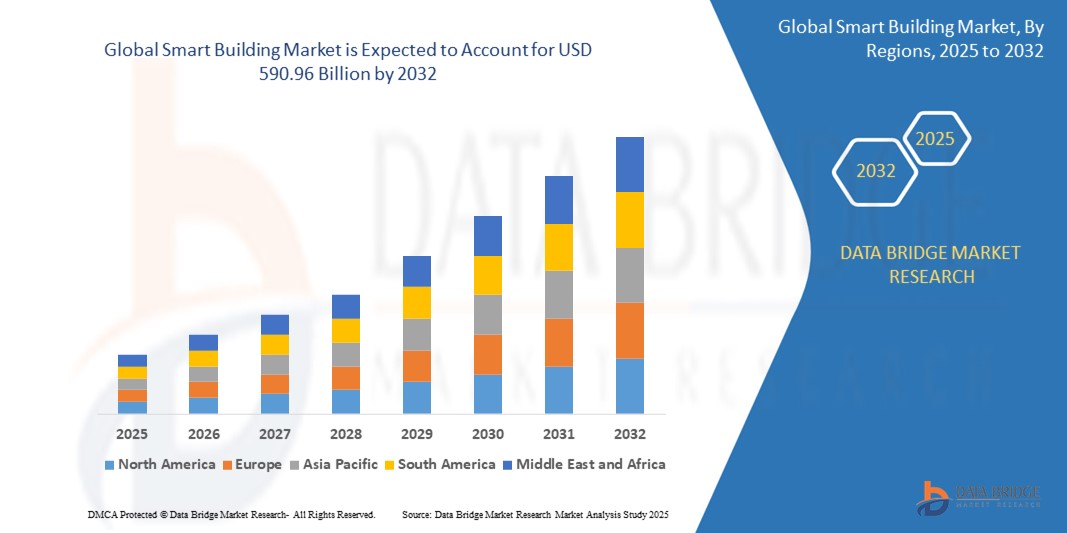
스마트 빌딩 시장 규모
- 글로벌 스마트 빌딩 시장 규모는 2024년에 1,286억 1천만 달러 로 평가되었으며, 예측 기간 동안 21.00%의 CAGR 로 2032년까지 5,909억 6천만 달러에 도달할 것으로 예상됩니다 .
- 이러한 성장은 사물인터넷(IoT)과 AI 기술 도입 증가, 에너지 효율 시스템에 대한 수요 증가, 스마트 인프라에 대한 정부 지원 이니셔티브, 지속 가능성과 거주자 안전에 대한 인식 증가 등의 요인에 의해 촉진되었습니다.
스마트 빌딩 시장 분석
- 현재 스마트 빌딩 시장은 에너지 사용, 유지 관리 및 전반적인 빌딩 성능을 간소화하는 지능형 시스템 통합에 대한 관심이 커지면서 꾸준히 발전하고 있습니다.
- 이러한 추세는 실시간 데이터와 자동화 도구(예: 스마트 센서 및 중앙 플랫폼)가 현대 인프라에서 점점 더 표준이 되어가는 시장 역학의 변화를 강조합니다.
- 북미는 잘 구축된 기술 인프라와 스마트 빌딩 솔루션의 조기 도입으로 인해 시장 점유율 35.07%로 스마트 빌딩 시장을 주도할 것으로 예상됩니다.
- 아시아 태평양 지역은 도시화와 경제 확장의 가속화로 인해 예측 기간 동안 스마트 빌딩 시장에서 가장 빠르게 성장하는 지역이 될 것으로 예상됩니다.
- 사무실 단지, 쇼핑몰, 병원, 공항 등에서 지능형 시스템이 널리 도입되어 운영 효율성이 향상되고, 에너지 비용이 절감되며, 자동화 및 중앙 집중식 관리를 통해 입주자 경험이 개선됨에 따라 상업 부문이 2025년에 53.11%의 가장 큰 점유율을 차지하며 스마트 빌딩 시장을 장악할 것으로 예상됩니다.
보고서 범위 및 스마트 빌딩 시장 세분화
|
속성 |
스마트 빌딩 주요 시장 통찰력 |
|
다루는 세그먼트 |
|
|
포함 국가 |
북아메리카
유럽
아시아 태평양
중동 및 아프리카
남아메리카
|
|
주요 시장 참여자 |
|
|
시장 기회 |
|
|
부가가치 데이터 정보 세트 |
Data Bridge Market Research 팀이 큐레이팅한 시장 보고서에는 시장 가치, 성장률, 시장 부문, 지리적 범위, 시장 참여자, 시장 시나리오와 같은 시장 통찰력 외에도 심층적인 전문가 분석, 수입/수출 분석, 가격 분석, 생산 소비 분석, 유봉 분석이 포함되어 있습니다. |
스마트 빌딩 시장 동향
"스마트 빌딩 효율성을 촉진하는 지능형 유지 관리"
- 빌딩 관리 시스템은 센서 데이터를 분석하고 장비 고장이 발생하기 전에 이를 예측하기 위해 인공 지능 알고리즘을 점점 더 많이 활용하고 있습니다.
- 이러한 사전 예방적 접근 방식을 통해 시설 관리자는 유지 관리 활동을 효율적으로 일정에 맞춰 계획할 수 있어 예상치 못한 가동 중지 시간을 줄이고 건물 시스템의 수명을 연장할 수 있습니다.
- 예측 유지 관리 도입은 운영 효율성을 향상시킬 뿐만 아니라 긴급 수리를 최소화하여 상당한 비용 절감에도 기여합니다.
- 결론적으로 스마트 빌딩 시장이 계속해서 발전함에 따라 인공 지능 기반 예측 유지 관리에 대한 강조가 빌딩 성능과 지속 가능성을 최적화하는 데 중추적인 역할을 할 것으로 예상됩니다.
스마트 빌딩 시장 동향
운전사
“건물 에너지 최적화에 대한 강조 증가”
- 건물이 여전히 세계 최대 전기 소비자 중 하나이고 비용과 배출량을 줄이기 위한 효율적인 시스템이 필요하기 때문에 에너지 최적화를 위한 노력으로 스마트 빌딩 도입이 가속화되고 있습니다.
- 자동 조명 및 기후 제어와 같은 스마트 기술은 점유 및 사용 패턴을 기반으로 실시간 조정을 가능하게 하여 에너지 낭비를 방지하고 자원 사용을 최적화하는 데 도움이 됩니다.
- 예를 들어, Siemens의 Enlighted 또는 Honeywell의 Building Management Solutions와 같은 시스템을 사용하면 시설에서 조명 및 HVAC를 실시간으로 모니터링하여 에너지 비용을 절감하고 편안함을 향상시킬 수 있습니다.
- Green certifications such as Leadership in Energy and Environmental Design and energy codes such as ASHRAE are driving both residential and commercial developers to integrate efficiency-focused infrastructure
- In conclusion, as governments offer tax incentives and rebates for smart energy systems and businesses aim for net-zero goals this makes energy optimization through intelligent technologies not just a sustainable choice but a necessary evolution
Opportunity
“Integration of Digital Twins to Enhance Building Intelligence”
- Digital twin technology offers a major opportunity by enabling virtual replicas of buildings that support real-time simulation monitoring and control for better management
- For instance, Microsoft’s Redmond campus uses digital twins to manage energy systems and maintenance proactively leading to improved efficiency and occupant comfort
- These models can replicate electrical mechanical and structural systems allowing operators to detect inefficiencies simulate emergency scenarios and plan predictive maintenance
- Integration of Internet of Things and artificial intelligence makes it feasible to gather vast data streams from sensors and devices supporting real-time decision-making and automation
- As buildings grow more complex digital twins help optimize space usage reduce costs and assess environmental impact making them vital tools for future-ready infrastructure
- In conclusion, with increasing adoption digital twins are set to become a standard in smart building design offering enhanced operational visibility and innovation potential
Restraint/Challenge
“High Initial Investment and Implementation Complexity”
- High upfront investment remains a key obstacle as smart building implementation demands costly hardware software systems and skilled labor for installation and maintenance
- Retrofitting older buildings with intelligent infrastructure requires structural changes integration with legacy systems and extended timelines which raise both cost and complexity
- For instance, installing sensor networks and control units in traditional commercial facilities can disrupt operations and delay project timelines creating reluctance among owners
- Lack of standardized protocols among different vendors' solutions leads to interoperability issues complicating integration and increasing the risk of security or performance failures
- Continuous investment in cybersecurity updates and technical training adds to the operational load especially for small businesses with limited budgets or technical resources
- In conclusion, while smart buildings promise long-term savings and operational benefits the high initial cost and technical hurdles continue to restrict adoption across many markets
Smart Building Market Scope
The market is segmented on the basis of solution, service, and building type.
|
Segmentation |
Sub-Segmentation |
|
By Solution |
|
|
By Service |
|
|
By Building Type
|
|
In 2025, the commercial segment is projected to dominate the market with a largest share in building type segment
The commercial segment is expected to dominate the Smart Building market with the largest share of 53.11% in 2025 due to the widespread adoption of intelligent systems in office complexes, shopping malls, hospitals, and airports to enhance operational efficiency, reduce energy costs, and improve occupant experience through automation and centralized management
The support and maintenance segment is expected to account for the largest share during the forecast period in service segment
In 2025, the support and maintenance segment is expected to dominate the market with the largest market share of 38.14% due to the rising need for continuous system monitoring, timely software updates, and technical assistance to ensure optimal performance and security of integrated smart building solutions
Smart Building Market Regional Analysis
“North America Holds the Largest Share in the Smart Building Market”
- North America holds the largest share of the global smart building market with market share of 35.07% due to its well-established technological infrastructure and early adoption of smart building solutions
- The U.S. leads with a strong commercial building sector and a growing focus on energy-efficient systems
- High internet connectivity and the presence of leading industry players contribute to the region’s dominance
- Government policies and incentives support the implementation of advanced building automation and energy management
- Demand for integrated security systems and smart controls is particularly high among commercial and institutional buildings
“Asia-Pacific is Projected to Register the Highest CAGR in the Smart Building Market”
- Asia Pacific is experiencing rapid growth in the smart building market due to accelerating urbanization and economic expansion
- Countries such as China, India, and Singapore are investing heavily in smart infrastructure to support increasing urban populations
- The rise of connected devices and artificial intelligence technologies is speeding up smart building adoption
- Government programs promoting sustainability and energy efficiency further boost market growth
- The region sees significant activity both in new construction and retrofitting existing buildings with smart systems
Smart Building Market Share
The market competitive landscape provides details by competitor. Details included are company overview, company financials, revenue generated, market potential, investment in research and development, new market initiatives, global presence, production sites and facilities, production capacities, company strengths and weaknesses, product launch, product width and breadth, application dominance. The above data points provided are only related to the companies' focus related to market.
The Major Market Leaders Operating in the Market Are:
- Honeywell International Inc. (U.S.)
- Johnson Controls Inc. (U.S.)
- Cisco Systems Inc. (U.S.)
- Siemens (Germany)
- IBM (U.S.)
- Schneider Electric (France)
- Intel Corporation (U.S.)
- Huawei Technologies Co. Ltd. (China)
- ABB (Switzerland)
- L&T Technology Services Limited (India)
- 75F (U.S.)
- Telit Cinterion (U.K.)
- PointGrab (Israel)
- Spacewell International (Belgium)
- PTC (U.S.)
- Avnet Inc. (U.S.)
- Softdel (India)
- HCL Technologies Limited (India)
Latest Developments in Global Smart Building Market
- In May 2024, ABB Ltd. entered into a partnership with Powrmatic to deliver advanced electrical distribution solutions in Canada. This collaboration combines ABB’s cutting-edge electrical products with Powrmatic’s wide-reaching distribution network, aiming to meet the rising demand for reliable and efficient electrical systems in residential, commercial, and industrial sectors across the region
- In March 2023, Siemens Smart Infrastructure launched the Connect Box, an intuitive IoT solution designed for small- to medium-sized buildings. This new addition to the Siemens Xcelerator portfolio enables efficient monitoring of building performance, offering the potential to enhance energy efficiency by up to 30% and significantly improve indoor air quality in spaces such as schools, retail stores, and small offices
- In May 2023, Delta, a leader in power and thermal management, introduced a smart community hub powered by its IoT-based Smart Green Solutions. The "Intelligent Sustainable Connecting Hub" integrates an Operation Center with a multifunctional management platform, carbon emissions inventory, renewable power matching, and energy-efficient solutions, demonstrating how Delta’s technologies contribute to sustainable development across various sectors
- In September 2023, Johnson Controls formed a strategic partnership with BT to combine Johnson Controls' building automation and energy management expertise with BT's digital connectivity services. The aim of this partnership is to provide smart building solutions that improve energy efficiency, reduce carbon footprints, and support businesses in their transition to net zero carbon emissions
- 2023년 7월, 지멘스는 그리스에서 스마트하고 지속 가능한 빌딩 개발을 위해 프로데아 인베스트먼트(Prodea Investments)와 파트너십을 체결했습니다. 이번 협력은 지멘스의 첨단 빌딩 기술을 통합하여 프로데아 부동산 프로젝트의 에너지 효율, 편의성, 연결성을 개선하는 데 중점을 두고 있으며, 그리스 시장에서 지속 가능성과 스마트 빌딩 솔루션에 대한 새로운 기준을 제시합니다.
SKU-
세계 최초의 시장 정보 클라우드 보고서에 온라인으로 접속하세요

- 대화형 데이터 분석 대시보드
- 높은 성장 잠재력 기회를 위한 회사 분석 대시보드
- 사용자 정의 및 질의를 위한 리서치 분석가 액세스
- 대화형 대시보드를 통한 경쟁자 분석
- 최신 뉴스, 업데이트 및 추세 분석
- 포괄적인 경쟁자 추적을 위한 벤치마크 분석의 힘 활용
연구 방법론
데이터 수집 및 기준 연도 분석은 대규모 샘플 크기의 데이터 수집 모듈을 사용하여 수행됩니다. 이 단계에는 다양한 소스와 전략을 통해 시장 정보 또는 관련 데이터를 얻는 것이 포함됩니다. 여기에는 과거에 수집한 모든 데이터를 미리 검토하고 계획하는 것이 포함됩니다. 또한 다양한 정보 소스에서 발견되는 정보 불일치를 검토하는 것도 포함됩니다. 시장 데이터는 시장 통계 및 일관된 모델을 사용하여 분석하고 추정합니다. 또한 시장 점유율 분석 및 주요 추세 분석은 시장 보고서의 주요 성공 요인입니다. 자세한 내용은 분석가에게 전화를 요청하거나 문의 사항을 드롭하세요.
DBMR 연구팀에서 사용하는 주요 연구 방법론은 데이터 마이닝, 시장에 대한 데이터 변수의 영향 분석 및 주요(산업 전문가) 검증을 포함하는 데이터 삼각 측량입니다. 데이터 모델에는 공급업체 포지셔닝 그리드, 시장 타임라인 분석, 시장 개요 및 가이드, 회사 포지셔닝 그리드, 특허 분석, 가격 분석, 회사 시장 점유율 분석, 측정 기준, 글로벌 대 지역 및 공급업체 점유율 분석이 포함됩니다. 연구 방법론에 대해 자세히 알아보려면 문의를 통해 업계 전문가에게 문의하세요.
사용자 정의 가능
Data Bridge Market Research는 고급 형성 연구 분야의 선두 주자입니다. 저희는 기존 및 신규 고객에게 목표에 맞는 데이터와 분석을 제공하는 데 자부심을 느낍니다. 보고서는 추가 국가에 대한 시장 이해(국가 목록 요청), 임상 시험 결과 데이터, 문헌 검토, 재생 시장 및 제품 기반 분석을 포함하도록 사용자 정의할 수 있습니다. 기술 기반 분석에서 시장 포트폴리오 전략에 이르기까지 타겟 경쟁업체의 시장 분석을 분석할 수 있습니다. 귀하가 원하는 형식과 데이터 스타일로 필요한 만큼 많은 경쟁자를 추가할 수 있습니다. 저희 분석가 팀은 또한 원시 엑셀 파일 피벗 테이블(팩트북)로 데이터를 제공하거나 보고서에서 사용 가능한 데이터 세트에서 프레젠테이션을 만드는 데 도움을 줄 수 있습니다.











