



Global Smart Governments Market, By Solution (Government Resource Planning System, Security, Analytics, Open Data Platform, Network Management, and Remote Monitoring), Service (Professional and Managed) – Industry Trends and Forecast to 2029
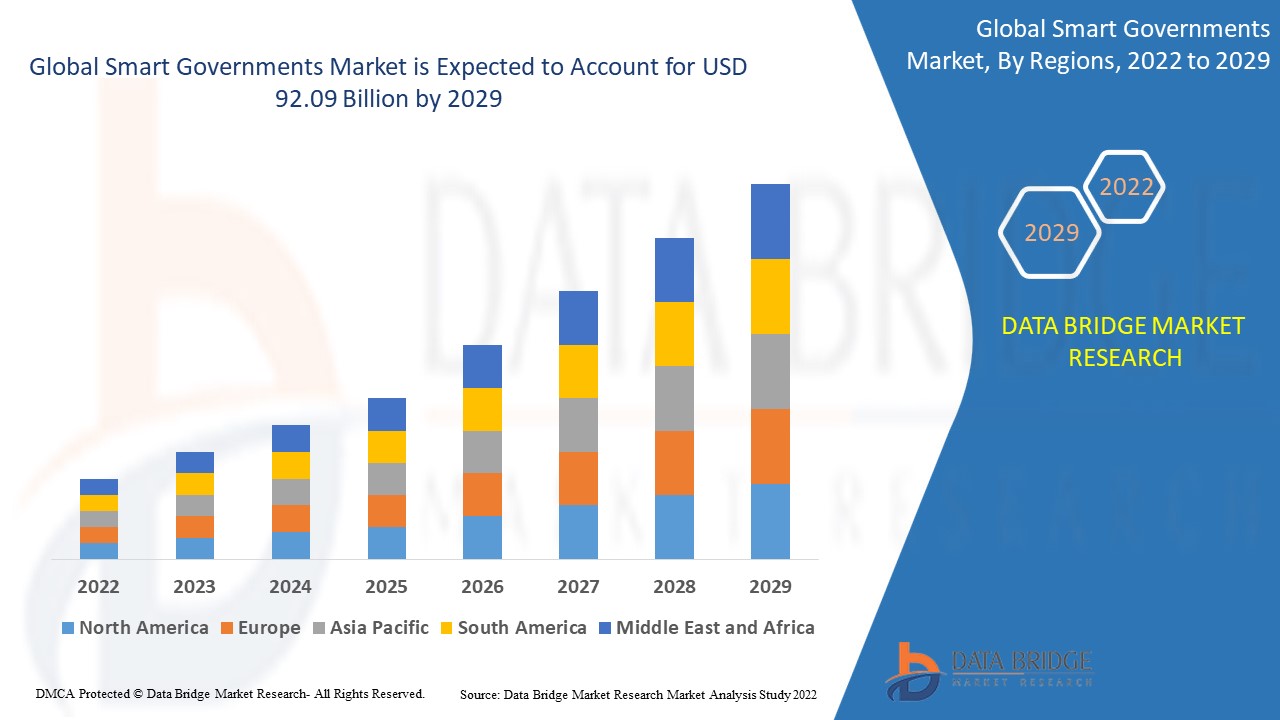
Smart Governments Market Analysis and Size
Globally, there has been a rapid increase in the systematic release of government data. Cloud is responsible for government data transparency, which promotes the government's accountability and reduces corruption. It also aids in the empowerment of citizens and the resolution of complex public problems by bringing a broader range of expertise and knowledge to bear on public issues.
Data Bridge Market Research analyses that the smart governments market which was growing at a value of 21.85 billion in 2021 and is expected to reach the value of USD 92.09 billion by 2029, at a CAGR of 19.70% during the forecast period of 2022-2029. In addition to the market insights such as market value, growth rate, market segments, geographical coverage, market players, and market scenario, the market report curated by the Data Bridge Market Research team includes in-depth expert analysis, import/export analysis, pricing analysis, production consumption analysis, and pestle analysis.
Report Scope and Market Segmentation
|
Report Metric |
Details |
|
Forecast Period |
2022 to 2029 |
|
Base Year |
2021 |
|
Historic Years |
2020 (Customizable to 2014 - 2019) |
|
Quantitative Units |
Revenue in USD billion, Volumes in Units, Pricing in USD |
|
Segments Covered |
Component (Solutions, Services), Technology (Computer Vision, Machine Learning, Natural Language Processing, Others), Function (Training, Inference) Deployment Type (On-Premises, Cloud, Hybrid), Vertical (BFSI, Healthcare and Life Sciences, Government and Defence, Media and Entertainment, Telecom, Retail, Automotive, Others) |
|
Countries Covered |
U.S., Canada and Mexico in North America, Germany, France, U.K., Netherlands, Switzerland, Belgium, Russia, Italy, Spain, Turkey, Rest of Europe in Europe, China, Japan, India, South Korea, Singapore, Malaysia, Australia, Thailand, Indonesia, Philippines, Rest of Asia-Pacific (APAC) in the Asia-Pacific (APAC), Saudi Arabia, U.A.E, South Africa, Egypt, Israel, Rest of Middle East and Africa (MEA) as a part of Middle East and Africa (MEA), Brazil, Argentina and Rest of South America as part of South America |
|
Market Players Covered |
IBM Corporation (U.S.), Microsoft (U.S.), Siemens AG (Germany), ANSYS, Inc (U.S.), SAP SE (Germany), Oracle (U.S.), Robert Bosch GmbH (Germany), Swim.ai, Inc. (U.S.)., Atos S.E. (France), ABB (Switzerland), KELLTON TECH (India), AVEVA Group plc (U.K.), DXC Technology Company (U.S.), Altair Engineering, Inc (U.S.), Hexaware Technologies Limited (India), Tata Consultancy Services Limited (India), Infosys Limited (India), NTT DATA, Inc. (Japan), TIBCO Software Inc. (U.S.) |
|
Opportunities |
|
Market Definition
Smart government is defined as the use of intelligently networked information and communication (ICT) technology to manage government and administrative business activities. This portfolio includes initiatives in e-government and open government, as well as big data and open data. It is entirely concerned with long-term government and administrative activity in the age of the internet of things and the internet of services, both of which are based on the internet of systems, the internet of people, and the internet of data.
Global Smart Governments Market Dynamics
Drivers
- high data volume is shifting technologies towards a digital transformations
Demand for digital mediums and smart technologies has resulted in a surge in investments for smart government technologies around the world, which is expected to fuel market growth. Furthermore, as a result of increasing census data, collaboration with other regions, and the implementation of new policies/initiatives, government data generation has increased exponentially. In contrast, legacy systems based on physical hardware may run out of space due to inefficiency. As a result, demand for smart governance is increasing, further boosting market growth. Furthermore, increased data volume from various sources enables governments to be better prepared for digital transformation, which leads to the deployment of smart technology.
- Ease of communication and a widespread of advanced technologies
Mobile apps, big data analytics, and social media technologies enabled citizens to communicate with the government, accelerating market growth even further. Rising consumer widespread use of digital technology and the need to secure data from various sources process data for digitalisation, rising adoption of cloud services, big data, and Internet of Things (IoT), and progress toward digital revolution are major factors driving the smart governments market, among others.
Opportunity
Increased compliance with technology regulations will boost market growth. Furthermore, the use of artificial intelligence to reduce gender bias and discrimination will increase the beneficial opportunities for the growth of the smart governments market.
Restraints
However, the establishment of comprehensive ethical principles for artificial intelligence and the high cost of investment will impede the growth of the smart governments market growth. In addition, a lack of intelligence expertise and skills will impede the growth of the smart governments market.
This smart governments market report provides details of new recent developments, trade regulations, import-export analysis, production analysis, value chain optimization, market share, impact of domestic and localized market players, analyses opportunities in terms of emerging revenue pockets, changes in market regulations, strategic market growth analysis, market size, category market growths, application niches and dominance, product approvals, product launches, geographic expansions, technological innovations in the market. To gain more info on the smart governments market contact Data Bridge Market Research for an Analyst Brief, our team will help you take an informed market decision to achieve market growth.
COVID-19 Impact on Smart Governments Market
The COVID-19 outbreak positively impacted the smart government market because it created new needs for smart government services while also increasing demand for existing ones. Government developers were mobilised and engaged in producing new digital applications and services to aid in the fight against COVID-19, resulting in a digital revolution in the government sector in various regions.
Recent Development
- In February 2022 Meta AI (formerly Facebook A.I.) announced that it had open-sourced data2vec, a unified framework for self-supervised deep learning on text, images, and speech audio data.
- In February 2022 Virtana, a California-based technology company, announced in February 2022 that it had developed a hybrid cloud management solutions platform that would allow its customers to plan, execute, and manage their hybrid cloud implementations. In addition, the company stated that it used a combination of A.I., machine learning, and data analytics to provide observability for managing app workloads across public, private, hybrid, and multi-cloud environments.
- In April 2020, OpenGov Financials will be available, a new financial management solution that expands its cloud-based software offerings and unveils the industry's first fully-integrated cloud ERP designed exclusively for local government. The solution will enable governments to run their mission-critical processes on a daily basis, as well as report, forecast, and budget using a single online platform.
Global Smart Governments Market Scope
The smart governments market is segmented on the basis of solution and services. The growth amongst these segments will help you analyse meagre growth segments in the industries and provide the users with a valuable market overview and market insights to help them make strategic decisions for identifying core market applications.
Solution
- Government Resource Planning System
- Security
- Analytics
- Open Data Platform
- Network Management
- Remote Monitoring
Services
- Professional
- Managed
Smart Governments Market Regional Analysis/Insights
The smart governments market is analysed and market size insights and trends are provided by country, solution and services as referenced above.
The countries covered in the smart governments market report are U.S., Canada and Mexico in North America, Germany, France, U.K., Netherlands, Switzerland, Belgium, Russia, Italy, Spain, Turkey, Rest of Europe in Europe, China, Japan, India, South Korea, Singapore, Malaysia, Australia, Thailand, Indonesia, Philippines, Rest of Asia-Pacific (APAC) in the Asia-Pacific (APAC), Saudi Arabia, U.A.E, South Africa, Egypt, Israel, Rest of Middle East and Africa (MEA) as a part of Middle East and Africa (MEA), Brazil, Argentina and Rest of South America as part of South America.
Asia-Pacific is expected to hold the largest market share during the forecast period due to the increasing penetration of smartphones and connected devices, prompting organisations to establish cloud data centres in the region. Cloud services are seen as an opportunity by governments across the region to improve government service delivery by lowering unemployment, increasing responsiveness, and delivering information and communication technology services at a lower cost.
North America is expected to have the highest growth rate during the forecast period due to increased spending on smart solution deployment across various government levels and rising penetration of smart technologies such as big data, Internet of Things (IoT), analytics, and cloud computing.
The country section of the report also provides individual market impacting factors and changes in market regulation that impact the current and future trends of the market. Data points like down-stream and upstream value chain analysis, technical trends and porter's five forces analysis, case studies are some of the pointers used to forecast the market scenario for individual countries. Also, the presence and availability of Global brands and their challenges faced due to large or scarce competition from local and domestic brands, impact of domestic tariffs and trade routes are considered while providing forecast analysis of the country data.
Competitive Landscape and Smart Governments Market Share Analysis
The smart governments market competitive landscape provides details by competitor. Details included are company overview, company financials, revenue generated, market potential, investment in research and development, new market initiatives, Global presence, production sites and facilities, production capacities, company strengths and weaknesses, product launch, product width and breadth, application dominance. The above data points provided are only related to the companies' focus related to smart governments market.
Some of the major players operating in the smart governments market are:
- IBM Corporation (U.S.)
- Microsoft (U.S.)
- Siemens AG (Germany)
- ANSYS, Inc (U.S.)
- SAP SE (Germany)
- Oracle (U.S.)
- Robert Bosch GmbH (Germany)
- Swim.ai, Inc. (U.S.)
- Atos S.E. (France)
- ABB (Switzerland)
- KELLTON TECH (India)
- AVEVA Group plc (U.K.)
- DXC Technology Company (U.S.)
- Altair Engineering, Inc (U.S.)
- Hexaware Technologies Limited (India)
- Tata Consultancy Services Limited (India)
- Infosys Limited (India)
- NTT DATA, Inc. (Japan)
- TIBCO Software Inc. (U.S.)
SKU-
세계 최초의 시장 정보 클라우드 보고서에 온라인으로 접속하세요

- 대화형 데이터 분석 대시보드
- 높은 성장 잠재력 기회를 위한 회사 분석 대시보드
- 사용자 정의 및 질의를 위한 리서치 분석가 액세스
- 대화형 대시보드를 통한 경쟁자 분석
- 최신 뉴스, 업데이트 및 추세 분석
- 포괄적인 경쟁자 추적을 위한 벤치마크 분석의 힘 활용
연구 방법론
데이터 수집 및 기준 연도 분석은 대규모 샘플 크기의 데이터 수집 모듈을 사용하여 수행됩니다. 이 단계에는 다양한 소스와 전략을 통해 시장 정보 또는 관련 데이터를 얻는 것이 포함됩니다. 여기에는 과거에 수집한 모든 데이터를 미리 검토하고 계획하는 것이 포함됩니다. 또한 다양한 정보 소스에서 발견되는 정보 불일치를 검토하는 것도 포함됩니다. 시장 데이터는 시장 통계 및 일관된 모델을 사용하여 분석하고 추정합니다. 또한 시장 점유율 분석 및 주요 추세 분석은 시장 보고서의 주요 성공 요인입니다. 자세한 내용은 분석가에게 전화를 요청하거나 문의 사항을 드롭하세요.
DBMR 연구팀에서 사용하는 주요 연구 방법론은 데이터 마이닝, 시장에 대한 데이터 변수의 영향 분석 및 주요(산업 전문가) 검증을 포함하는 데이터 삼각 측량입니다. 데이터 모델에는 공급업체 포지셔닝 그리드, 시장 타임라인 분석, 시장 개요 및 가이드, 회사 포지셔닝 그리드, 특허 분석, 가격 분석, 회사 시장 점유율 분석, 측정 기준, 글로벌 대 지역 및 공급업체 점유율 분석이 포함됩니다. 연구 방법론에 대해 자세히 알아보려면 문의를 통해 업계 전문가에게 문의하세요.
사용자 정의 가능
Data Bridge Market Research는 고급 형성 연구 분야의 선두 주자입니다. 저희는 기존 및 신규 고객에게 목표에 맞는 데이터와 분석을 제공하는 데 자부심을 느낍니다. 보고서는 추가 국가에 대한 시장 이해(국가 목록 요청), 임상 시험 결과 데이터, 문헌 검토, 재생 시장 및 제품 기반 분석을 포함하도록 사용자 정의할 수 있습니다. 기술 기반 분석에서 시장 포트폴리오 전략에 이르기까지 타겟 경쟁업체의 시장 분석을 분석할 수 있습니다. 귀하가 원하는 형식과 데이터 스타일로 필요한 만큼 많은 경쟁자를 추가할 수 있습니다. 저희 분석가 팀은 또한 원시 엑셀 파일 피벗 테이블(팩트북)로 데이터를 제공하거나 보고서에서 사용 가능한 데이터 세트에서 프레젠테이션을 만드는 데 도움을 줄 수 있습니다.











