Global Sustainable Crop Nutrition Market Size, Share, and Trends Analysis Report – Industry Overview and Forecast to 2033

Request for TOC Request for TOC Speak to Analyst Speak to Analyst Free Sample Report Free Sample Report Inquire Before Buying Inquire Before Buy Now Buy Now

Global Sustainable Crop Nutrition Market Size, Share, and Trends Analysis Report – Industry Overview and Forecast to 2033

Global Sustainable Crop Nutrition Market Segmentation, By Nutrient Type (Macro, Micro, Specialty, and Others), Product Type (Fertilizers, Bio-stimulants, Soil Conditioners, and Others), Formulation (Liquid, Granular, Controlled Release, and Others), Application (Soil, Foliar, Fertigation, and Others), Crop Type (Cereals & Grains, Fruits & Vegetables, Oilseeds & Pulses, and Others) - Industry Trends and Forecast to 2033

  • Agriculture And Animal Feed
  • May 2026
  • Global
  • 350 Pages
  • No of Tables: 220
  • No of Figures: 60

Global Sustainable Crop Nutrition Market

Market Size in USD Billion

CAGR :  % Diagram

Bar chart comparing the Global Sustainable Crop Nutrition Market size in 2025 - 143.20 and 2033 - 283.24, highlighting the projected market growth. USD 143.20 Billion USD 283.24 Billion 2025 2033
Diagram Forecast Period
2026 –2033
Diagram Market Size (Base Year)
USD 143.20 Billion
Diagram Market Size (Forecast Year)
USD 283.24 Billion
Diagram CAGR
%
Diagram Major Markets Players
  • Yara International (Norway)
  • Nutrien Ltd. (Canada)
  • The Mosaic Company (U.S.)
  • CF Industries Holdings Inc. (U.S.)
  • K+S AG (Germany)

Sustainable Crop Nutrition Market Size

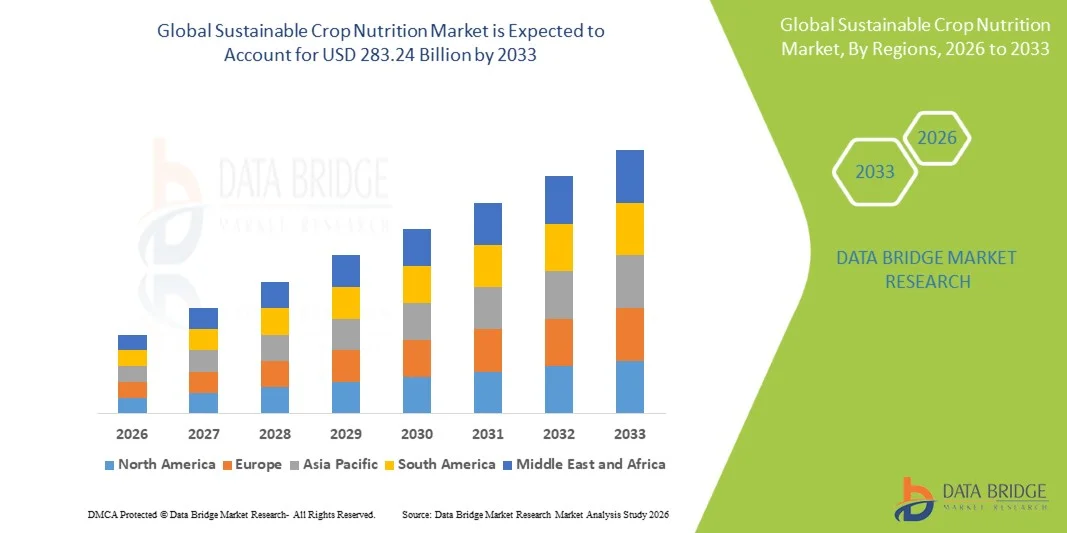
  • The global sustainable crop nutrition market size was valued at USD 143.2 billion in 2025 and is expected to reach USD 283.24 billion by 2033, at a CAGR of 8.90% during the forecast period
  • The market growth is largely fueled by the increasing adoption of sustainable agricultural practices and the shift toward improving soil health and nutrient efficiency, leading to reduced environmental impact and optimized crop productivity across farming systems
  • Furthermore, rising demand for high-quality agricultural output and growing awareness regarding balanced fertilization and precision nutrient management is establishing sustainable crop nutrition solutions as essential inputs in modern agriculture. These converging factors are accelerating the uptake of eco-friendly fertilizers, bio-stimulants, and advanced nutrient technologies, thereby significantly boosting the industry's growth

Sustainable Crop Nutrition Market Analysis

  • Sustainable crop nutrition solutions, including advanced fertilizers, bio-stimulants, and soil conditioners, are increasingly vital components of modern agriculture due to their ability to enhance nutrient uptake efficiency, improve soil fertility, and support long-term agricultural sustainability across diverse crop systems
  • The escalating demand for these solutions is primarily fueled by rising global food demand, increasing pressure on arable land, and growing regulatory emphasis on reducing the environmental footprint of conventional farming practices, driving the transition toward efficient and sustainable nutrient management approaches
  • Asia-Pacific dominated the sustainable crop nutrition market with a share of around 60% in 2025, due to extensive agricultural activities, large arable land area, and rising demand for improved crop productivity
  • North America is expected to be the fastest growing region in the sustainable crop nutrition market during the forecast period due to increasing adoption of precision agriculture and sustainable farming techniques
  • Fertilizers segment dominated the market with a market share of 60.5% in 2025, due to their widespread use as the primary source of essential nutrients for crop growth. Sustainable fertilizers, including organic and enhanced-efficiency variants, are increasingly adopted to improve soil health and reduce nutrient losses

Sustainable Crop Nutrition Market

Report Scope and Sustainable Crop Nutrition Market Segmentation

Attributes

Sustainable Crop Nutrition Key Market Insights

Segments Covered

  • By Nutrient Type: Macro, Micro, Specialty, and Others
  • By Product Type: Fertilizers, Bio-stimulants, Soil Conditioners, and Others
  • By Formulation: Liquid, Granular, Controlled Release, and Others
  • By Application: Soil, Foliar, Fertigation, and Others
  • By Crop Type: Cereals & Grains, Fruits & Vegetables, Oilseeds & Pulses, and Others

Countries Covered

North America

· U.S.

· Canada

· Mexico

Europe

· Germany

· France

· U.K.

· Netherlands

· Switzerland

· Belgium

· Russia

· Italy

· Spain

· Turkey

· Rest of Europe

Asia-Pacific

· China

· Japan

· India

· South Korea

· Singapore

· Malaysia

· Australia

· Thailand

· Indonesia

· Philippines

· Rest of Asia-Pacific

Middle East and Africa

· Saudi Arabia

· U.A.E.

· South Africa

· Egypt

· Israel

· Rest of Middle East and Africa

South America

· Brazil

· Argentina

· Rest of South America

Key Market Players

· Yara International (Norway)

· Nutrien Ltd. (Canada)

· The Mosaic Company (U.S.)

· CF Industries Holdings, Inc. (U.S.)

· K+S AG (Germany)

· ICL Group (Israel)

· EuroChem Group (Switzerland)

· Coromandel International Limited (India)

· Haifa Group (Israel)

· COMPO EXPERT GmbH (Germany)

· Bayer AG (Germany)

· Bio Huma Netics, Inc. (U.S.)

· AgroLiquid (U.S.)

· Acadian Seaplants Limited (Canada)

· Aries Agro Limited (India)

Market Opportunities

· Growing Expansion of Precision Agriculture Technologies

· Increasing Demand for Sustainable Crop Nutrition in Emerging Economies

Value Added Data Infosets

In addition to the insights on market scenarios such as market value, growth rate, segmentation, geographical coverage, and major players, the market reports curated by the Data Bridge Market Research also include import export analysis, production capacity overview, production consumption analysis, price trend analysis, climate change scenario, supply chain analysis, value chain analysis, raw material/consumables overview, vendor selection criteria, PESTLE Analysis, Porter Analysis, and regulatory framework.

Sustainable Crop Nutrition Market Trends

“Increasing Adoption of Bio-based and Organic Crop Nutrition Solutions”

  • A significant trend in the sustainable crop nutrition market is the increasing adoption of bio-based and organic nutrient solutions, driven by the rising need to improve soil health and reduce environmental impact across agricultural systems. This shift is positioning sustainable inputs as essential components in modern farming practices focused on long-term productivity and ecological balance
  • For instance, Yara International and Syngenta are expanding their biological and organic product portfolios to support sustainable agriculture and improve nutrient efficiency. These initiatives are strengthening the availability of eco-friendly solutions and encouraging farmers to transition away from conventional chemical-intensive inputs
  • The integration of bio-stimulants and microbial-based products is gaining momentum as these solutions enhance nutrient uptake and improve plant resilience under stress conditions. This is increasing their adoption across high-value crops and intensive farming systems
  • The demand for residue-free and high-quality agricultural produce is encouraging farmers to adopt organic and sustainable nutrition practices. This trend is further supported by regulatory frameworks promoting reduced chemical usage in agriculture
  • Advancements in formulation technologies are enabling the development of efficient and targeted nutrient delivery systems that align with sustainable farming goals. This is improving product performance and expanding their applicability across diverse crop types
  • The market is witnessing continuous growth in environmentally responsible farming inputs where bio-based solutions are playing a critical role in improving soil fertility and crop productivity. This increasing adoption is reinforcing the transition toward sustainable agriculture and driving long-term market expansion

Sustainable Crop Nutrition Market Dynamics

Driver

“Rising Demand for Higher Agricultural Productivity and Soil Health Improvement”

  • The rising demand for higher agricultural productivity and improved soil health is driving the adoption of sustainable crop nutrition solutions across global farming systems. Increasing pressure on agricultural land and the need to enhance crop yield are encouraging the use of efficient nutrient management practices
  • For instance, Nutrien Ltd. and ICL Group are investing in advanced fertilizers and precision nutrient solutions that improve crop output while maintaining soil fertility. These developments are enabling farmers to achieve better productivity with optimized input usage
  • The growing emphasis on balanced fertilization is increasing the adoption of products that enhance nutrient uptake efficiency and minimize losses. This is supporting sustainable yield improvement and reducing environmental impact
  • Farmers are increasingly adopting integrated nutrient management practices that combine organic and inorganic inputs to maintain soil health. This approach is strengthening long-term agricultural sustainability and productivity
  • The continuous need to ensure food security while maintaining soil quality is reinforcing the importance of sustainable crop nutrition solutions. This driver is expected to remain a key factor influencing market growth and innovation

Restraint/Challenge

“High Cost and Limited Awareness of Advanced Sustainable Inputs”

  • The sustainable crop nutrition market faces challenges due to the high cost associated with advanced bio-based and specialty nutrient products, which can limit adoption among small and medium-scale farmers. These cost constraints create barriers to widespread implementation despite long-term benefits
  • For instance, Bayer AG and K+S AG offer advanced specialty fertilizers and sustainable solutions that often involve higher production and development costs. These pricing challenges can restrict accessibility for cost-sensitive farming communities and slow down adoption rates
  • Limited awareness regarding the benefits of sustainable crop nutrition products further impacts market penetration, particularly in developing regions. Farmers may continue relying on conventional fertilizers due to familiarity and lower upfront costs
  • The lack of technical knowledge and training in precision nutrient management reduces the effective utilization of advanced solutions. This creates inefficiencies and limits the perceived value of sustainable inputs
  • The market continues to face pressure in balancing cost efficiency with performance and sustainability benefits. Addressing these challenges is essential to improve adoption rates and ensure long-term growth of sustainable crop nutrition solutions

Sustainable Crop Nutrition Market Scope

The market is segmented on the basis of nutrient type, product type, formulation, application, and crop type.

  • By Nutrient Type

On the basis of nutrient type, the sustainable crop nutrition market is segmented into macro, micro, specialty, and others. The macro nutrients segment dominated the market with the largest market revenue share in 2025, driven by their essential role in plant growth and high-volume requirement across all crop types. Farmers widely depend on nitrogen, phosphorus, and potassium-based solutions to ensure optimal yield and soil fertility, making macro nutrients a foundational component of crop nutrition programs. The increasing focus on balanced fertilization practices and precision agriculture further strengthens the demand for macro nutrients, as they directly influence crop productivity and quality. The segment also benefits from continuous innovations in sustainable formulations that improve nutrient use efficiency and reduce environmental impact.

The specialty nutrients segment is anticipated to witness the fastest growth rate from 2026 to 2033, fueled by rising demand for targeted and high-efficiency nutrient solutions. Specialty nutrients, including chelated and slow-release variants, help address specific soil deficiencies and enhance nutrient uptake efficiency. Their adoption is increasing among farmers aiming to improve crop quality while minimizing input wastage and environmental concerns. The growing emphasis on sustainable farming practices and precision nutrient management is accelerating the use of specialty nutrients, particularly in high-value crops.

  • By Product Type

On the basis of product type, the sustainable crop nutrition market is segmented into fertilizers, bio-stimulants, soil conditioners, and others. The fertilizers segment dominated the market with the largest market revenue share of 60.5% in 2025, driven by their widespread use as the primary source of essential nutrients for crop growth. Sustainable fertilizers, including organic and enhanced-efficiency variants, are increasingly adopted to improve soil health and reduce nutrient losses. Farmers rely heavily on fertilizers due to their immediate impact on crop yield and productivity, making them a critical input in modern agriculture. The segment also benefits from supportive government initiatives promoting eco-friendly fertilizer usage and sustainable farming practices.

The bio-stimulants segment is anticipated to witness the fastest growth rate from 2026 to 2033, fueled by increasing awareness regarding plant health and stress tolerance. Bio-stimulants enhance nutrient uptake, improve plant metabolism, and support resilience against environmental stress conditions. Their rising adoption is driven by the shift toward organic and regenerative agriculture practices, where chemical input reduction is prioritized. The demand for residue-free and high-quality produce further accelerates the use of bio-stimulants across various crop categories.

  • By Formulation

On the basis of formulation, the sustainable crop nutrition market is segmented into liquid, granular, controlled release, and others. The granular segment dominated the market with the largest market revenue share in 2025, driven by its ease of handling, storage stability, and suitability for large-scale agricultural operations. Granular formulations are widely preferred for soil application due to their uniform distribution and cost-effectiveness. Farmers favor this formulation for its compatibility with conventional farming equipment and its ability to deliver nutrients over a sustained period. The segment continues to maintain strong demand due to its practicality and widespread availability across global markets.

The controlled release segment is anticipated to witness the fastest growth rate from 2026 to 2033, fueled by increasing demand for efficient nutrient management solutions. Controlled release formulations minimize nutrient losses and provide a steady supply of nutrients over time, improving crop uptake efficiency. Their adoption is growing in precision agriculture systems where optimizing input use and reducing environmental impact are critical priorities. The rising focus on sustainable intensification of agriculture is further driving the demand for controlled release products.

  • By Application

On the basis of application, the sustainable crop nutrition market is segmented into soil, foliar, fertigation, and others. The soil segment dominated the market with the largest market revenue share in 2025, driven by its traditional and widespread use as the primary method of nutrient delivery. Soil application ensures direct nutrient availability to plant roots, supporting consistent crop growth and development. Farmers continue to rely on this method due to its simplicity, effectiveness, and compatibility with a wide range of crops and farming systems. The segment also benefits from advancements in soil health management practices aimed at improving nutrient retention and utilization.

The fertigation segment is anticipated to witness the fastest growth rate from 2026 to 2033, fueled by increasing adoption of precision irrigation systems. Fertigation enables the simultaneous application of water and nutrients, improving efficiency and reducing wastage. Its growing use in greenhouse farming and high-value crop cultivation supports optimal nutrient delivery and better yield outcomes. The integration of fertigation with modern irrigation technologies is accelerating its adoption across regions focusing on water and resource conservation.

  • By Crop Type

On the basis of crop type, the sustainable crop nutrition market is segmented into cereals and grains, fruits and vegetables, oilseeds and pulses, and others. The cereals and grains segment dominated the market with the largest market revenue share in 2025, driven by their large cultivation area and high global demand as staple food crops. Sustainable crop nutrition solutions are extensively applied in cereal production to maintain soil fertility and ensure consistent yield. Governments and agricultural bodies emphasize nutrient management in cereals to support food security and sustainable farming practices. The segment continues to benefit from large-scale farming and continuous demand across both developed and developing regions.

The fruits and vegetables segment is anticipated to witness the fastest growth rate from 2026 to 2033, fueled by increasing consumer demand for high-quality and nutrient-rich produce. These crops require precise and balanced nutrient management to enhance quality, appearance, and shelf life. The rising trend of organic farming and protected cultivation further supports the adoption of sustainable nutrition solutions in this segment. Farmers are increasingly investing in advanced nutrient products to meet market standards and maximize profitability in high-value crop production.

Sustainable Crop Nutrition Market Regional Analysis

  • Asia-Pacific dominated the sustainable crop nutrition market with the largest revenue share of around 60% in 2025, driven by extensive agricultural activities, large arable land area, and rising demand for improved crop productivity
  • The region benefits from increasing adoption of sustainable farming practices, government support for balanced fertilization, and growing awareness regarding soil health management
  • Rapid population growth, rising food demand, and expansion of precision agriculture technologies are accelerating market expansion

China Sustainable Crop Nutrition Market Insight

China held the largest share in the Asia-Pacific sustainable crop nutrition market in 2025, supported by its vast agricultural production and strong focus on improving crop yields. The country has been actively promoting efficient fertilizer usage and sustainable farming practices to address soil degradation and environmental concerns. Strong government initiatives and subsidies are encouraging the adoption of advanced nutrient solutions. In addition, increasing investments in agricultural modernization and technology integration are strengthening China’s leadership in sustainable crop nutrition.

India Sustainable Crop Nutrition Market Insight

India is witnessing the fastest growth in the Asia-Pacific region, driven by increasing adoption of sustainable agriculture practices and rising demand for high crop productivity. Government programs promoting soil health cards and balanced nutrient application are significantly boosting market growth. The country’s large farming population and increasing awareness regarding efficient nutrient management are supporting adoption. In addition, expansion of irrigation infrastructure and precision farming techniques is accelerating long-term market development.

Europe Sustainable Crop Nutrition Market Insight

The Europe sustainable crop nutrition market is expanding steadily, supported by strong emphasis on environmentally friendly agricultural practices and strict regulatory frameworks. The region promotes the use of organic fertilizers, bio-stimulants, and controlled release nutrients to minimize environmental impact. Increasing focus on soil conservation and sustainable yield improvement is driving demand for advanced nutrient solutions. In addition, continuous innovation in agricultural inputs and eco-friendly technologies is enhancing market growth.

Germany Sustainable Crop Nutrition Market Insight

Germany accounted for the largest share in the Europe sustainable crop nutrition market in 2025, driven by its advanced agricultural practices and strong focus on sustainability. The country emphasizes efficient nutrient management and adoption of precision farming technologies to improve productivity. Strong regulatory standards and environmental policies are encouraging the use of eco-friendly crop nutrition products. In addition, continuous research and development in agricultural technologies are supporting market expansion.

U.K. Sustainable Crop Nutrition Market Insight

The U.K. market is supported by increasing demand for sustainable and organic farming solutions. Rising focus on reducing chemical fertilizer usage and improving soil quality is driving adoption of advanced crop nutrition products. The country’s strong research ecosystem supports innovation in bio-based and specialty nutrient solutions. In addition, growing emphasis on sustainable food production systems is further supporting market growth.

North America Sustainable Crop Nutrition Market Insight

North America is projected to grow at the fastest CAGR from 2026 to 2033, driven by increasing adoption of precision agriculture and sustainable farming techniques. Strong demand for high-efficiency fertilizers and bio-stimulants is supporting improved crop yield and soil health. Continuous advancements in agricultural technology are enhancing nutrient management practices. In addition, increasing focus on environmental sustainability and regulatory compliance is accelerating regional market growth.

U.S. Sustainable Crop Nutrition Market Insight

The U.S. accounted for the largest share in the North America sustainable crop nutrition market in 2025, supported by widespread adoption of advanced farming technologies and strong demand for high-quality agricultural output. The country benefits from a well-established agricultural infrastructure and strong presence of leading agrochemical companies. Increasing use of precision nutrient application and soil health management practices is driving market growth. In addition, continuous innovation in sustainable crop inputs is reinforcing the U.S. leadership position in the regional market.

Sustainable Crop Nutrition Market Share

The sustainable crop nutrition industry is primarily led by well-established companies, including:

  • Yara International (Norway)
  • Nutrien Ltd. (Canada)
  • The Mosaic Company (U.S.)
  • CF Industries Holdings, Inc. (U.S.)
  • K+S AG (Germany)
  • ICL Group (Israel)
  • EuroChem Group (Switzerland)
  • Coromandel International Limited (India)
  • Haifa Group (Israel)
  • COMPO EXPERT GmbH (Germany)
  • Bayer AG (Germany)
  • Bio Huma Netics, Inc. (U.S.)
  • AgroLiquid (U.S.)
  • Acadian Seaplants Limited (Canada)
  • Aries Agro Limited (India)

Latest Developments in Global Sustainable Crop Nutrition Market

  • In December 2025, Ginkgo Bioworks partnered with Agricen to enhance the manufacturing efficiency of biological soil amendments and next-generation crop nutrition solutions, which is strengthening the scalability of sustainable inputs and accelerating commercialization across global markets. This collaboration enables improved production processes for microbial and bio-based products, reducing costs and increasing availability for farmers. As demand for sustainable and residue-free farming inputs rises, this partnership is contributing to faster adoption of biological nutrition solutions and expanding the competitive landscape of the market
  • In November 2025, Sustainable Agro Solutions (SAS Group) acquired a majority stake in Agroquímica Codiagro, which is expanding its product portfolio in biostimulants and specialty fertilizers and reinforcing its competitive position in the sustainable crop nutrition market. The acquisition enhances SAS Group’s access to advanced formulation technologies and strengthens its presence in key agricultural regions. This strategic move supports the development of high-efficiency nutrient products and improves distribution capabilities, enabling the company to address evolving farmer requirements and sustainability goals
  • In January 2025, Nutrien Ag Solutions launched the N-FINITY nitrogen management solution, which is improving nutrient use efficiency and supporting farmers in optimizing fertilizer application. The solution integrates advanced agronomic insights and application strategies to minimize nitrogen losses and enhance crop uptake. This development is contributing to reduced environmental impact and cost savings for farmers while promoting precision agriculture practices. As regulatory pressure on fertilizer usage increases, such innovations are playing a key role in driving the shift toward sustainable crop nutrition
  • In December 2024, Syngenta acquired Intrinsyx Bio, which is enhancing its capabilities in biological crop nutrition and enabling the development of innovative nutrient efficiency solutions. The acquisition strengthens Syngenta’s biologicals portfolio by incorporating microbial technologies that improve plant nutrient uptake and resilience. This move supports the company’s long-term strategy to expand in sustainable agriculture and reduce dependence on synthetic inputs. It also intensifies competition in the biological crop nutrition segment, encouraging further innovation and investment
  • In October 2024, AgroLiquid acquired Monty’s Plant Food, which is broadening its sustainable fertilizer portfolio, particularly in organic and humic-based products. The acquisition allows AgroLiquid to integrate complementary technologies and expand its offerings in soil health enhancement solutions. This development supports growing farmer demand for eco-friendly and performance-driven inputs that improve crop yield and soil fertility. It also strengthens the company’s market positioning by enabling access to new customer segments and enhancing product innovation capabilities


SKU-

Get online access to the report on the World's First Market Intelligence Cloud

  • Interactive Data Analysis Dashboard
  • Company Analysis Dashboard for high growth potential opportunities
  • Research Analyst Access for customization & queries
  • Competitor Analysis with Interactive dashboard
  • Latest News, Updates & Trend analysis
  • Harness the Power of Benchmark Analysis for Comprehensive Competitor Tracking
Request for Demo

Research Methodology

Data collection and base year analysis are done using data collection modules with large sample sizes. The stage includes obtaining market information or related data through various sources and strategies. It includes examining and planning all the data acquired from the past in advance. It likewise envelops the examination of information inconsistencies seen across different information sources. The market data is analysed and estimated using market statistical and coherent models. Also, market share analysis and key trend analysis are the major success factors in the market report. To know more, please request an analyst call or drop down your inquiry.

The key research methodology used by DBMR research team is data triangulation which involves data mining, analysis of the impact of data variables on the market and primary (industry expert) validation. Data models include Vendor Positioning Grid, Market Time Line Analysis, Market Overview and Guide, Company Positioning Grid, Patent Analysis, Pricing Analysis, Company Market Share Analysis, Standards of Measurement, Global versus Regional and Vendor Share Analysis. To know more about the research methodology, drop in an inquiry to speak to our industry experts.

Customization Available

Data Bridge Market Research is a leader in advanced formative research. We take pride in servicing our existing and new customers with data and analysis that match and suits their goal. The report can be customized to include price trend analysis of target brands understanding the market for additional countries (ask for the list of countries), clinical trial results data, literature review, refurbished market and product base analysis. Market analysis of target competitors can be analyzed from technology-based analysis to market portfolio strategies. We can add as many competitors that you require data about in the format and data style you are looking for. Our team of analysts can also provide you data in crude raw excel files pivot tables (Fact book) or can assist you in creating presentations from the data sets available in the report.

Frequently Asked Questions

The sustainable crop nutrition market size was valued at USD 143.2 billion in 2025.
The sustainable crop nutrition market is to grow at a CAGR of 8.90% during the forecast period of 2026 to 2033.
The sustainable crop nutrition market is segmented into five notable segments based on nutrient type, product type, formulation, application, and crop type. On the basis of nutrient type, the market is segmented into macro, micro, specialty, and others. On the basis of product type, the market is segmented into fertilizers, bio-stimulants, soil conditioners, and others. On the basis of formulation, the market is segmented into liquid, granular, controlled release, and others. On the basis of application, the market is segmented into soil, foliar, fertigation, and others. On the basis of crop type, the market is segmented into cereals and grains, fruits and vegetables, oilseeds and pulses, and others.
Companies such as Yara International (Norway), Nutrien Ltd. (Canada), The Mosaic Company (U.S.), CF Industries Holdings, Inc. (U.S.), and K+S AG (Germany) are the major companies in the sustainable crop nutrition market.

Industry Related Reports

Testimonial