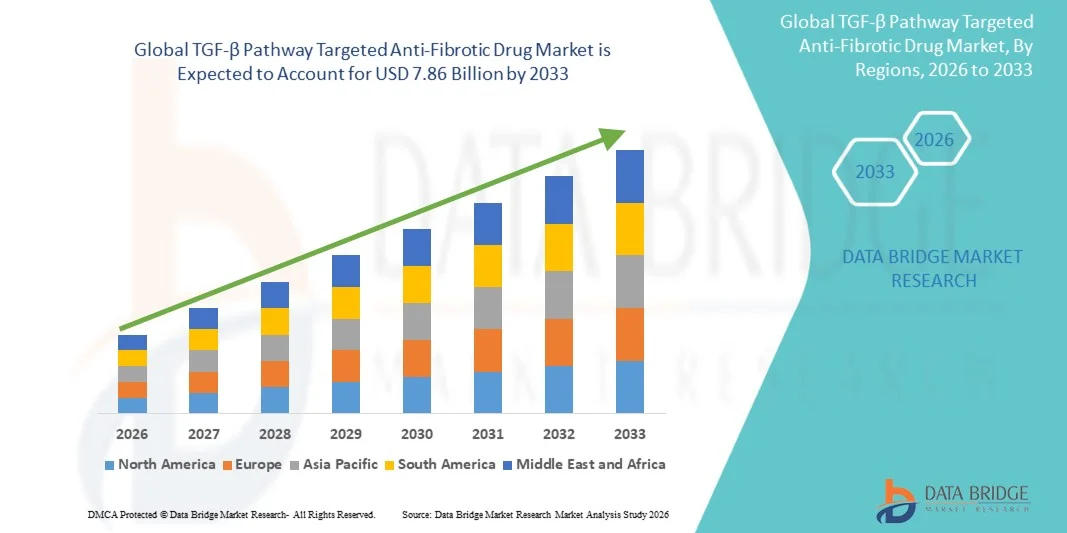
Global TGF-β Pathway Targeted Anti-Fibrotic Drug Market Segmentation, 약 클래스 (TGF-β Receptor Kinase Inhibitors, Monoclonal Antibodies, Ligand Traps 및 기타), 응용 프로그램 (Pulmonary Fibrosis, Liver Fibrosis, Kidney Fibrosis, Cardiac Fibrosis 및 기타) - 산업 동향 및 2033에 대한 예측
TGF-β 통로는 반대로 피로 약을 표했습니다시장 크기
- 글로벌 TGF-β 통로 대상 안티-Fibrotic 약 시장 규모가 평가되었습니다.25억 달러견적 요청2033년 USD 7.86 억, 에 a17.40%년예측 기간
- 시장 성장은 폐섬유증, 간섬유증, 신장섬유증 등 만성 섬유질 질환의 상승률에 의해 크게 연료를 공급하고 있으며, TGF-β 신호의 역할에 대한 이해와 함께 표적화성 치료의 채택을 선도하고 있습니다.
- 또한, 정밀 의학의 발전, TGF-β 통로 변조에 중점을 둔 임상 시험 증가, 소설 생물 공학 및 소형 molecule 억제제의 성장 투자는 진보적인 섬유질 질환을 치료하는 중요한 접근으로 TGF-β 통로 표적 치료법을 수립하고 있습니다. 이러한 융합 요인은 TGF-β Pathway Targeted Anti-Fibrotic Drug solution의 uptake를 가속화하고 업계의 성장을 크게 향상시켜 왔습니다.
TGF-β 통로는 반대로 피로 약을 표했습니다시장 분석
- TGF-β Pathway는 작은 molecule 억제물, monoclonal 항체 및 수용체 kinase 변조기를 포함하여, 반대로 뇌하수체 약을, 점점 중요한 성분이어, 조직 scarring와 염증에서 관여된 중요한 신호 통로를 표적으로해서 섬유질 질병의 느린 또는 halt 진도에 그들의 능력 때문에 현대 치료 발달의 중요한 성분입니다
- TGF-β 통로 표적 치료를 위한 에스컬레이션 수요는 주로 idiopathic pulmonary fibrosis, 간 경련 및 만성 신장병과 같은 만성 섬유질 조건의 상승 전세에 의해, 그리고 symptomatic 배려 보다는 오히려 질병 대우에 초점 증가와 더불어 만성 신장 질병에 의해 연료를 공급됩니다
- 북미는 TGF-β Pathway가 2025 년 가장 큰 수익 점유율을 가진 항암제 시장을 대상으로 한 TGF-β Pathway는 고급 생명 공학 연구 인프라, 강력한 임상 시험 활동 및 미국과의 초기 채택으로 TGF-β에서 실질적으로 성장하는 TGF-β에서 상당한 성장과 제약 및 생명 공학 회사에서 투자 증가로 구동되는 사용량 증가
- 아시아 태평양은 TGF-β Pathway에서 가장 빠르게 성장하는 지역이 될 것으로 예상되며, 의료 지출 상승으로 인한 예측 기간 동안 안티 - 섬유 약물 시장은 만성 섬유질 질환의 부담을 증가시키고, 생명 공학 연구 및 약물 개발 투자 증가
- 폐섬유 세그먼트는 2025년에 45.6%의 가장 큰 시장 수익 점유율을 지배하고, 이디오병 폐섬유증의 높은 전분에 의해 몰고 진보적인 폐병의 인식을 증가시킨
보고서 범위 및TGF-β 통로는 반대로 피로 약 시장 세그먼트를 표했습니다
|
관련 기사 |
TGF-β 통로는 반대로 피로 약 열쇠를 표적했습니다시장 통찰력 |
|
Segments 적용 |
|
|
국가 덮음 |
북아메리카 · 미국 · 캐나다 · 멕시코 · · 독일 · 프랑스 · 미국 · 네덜란드 · 스위스 · 벨기에 · 러시아 · 이탈리아 · 스페인 · 터키 · 유럽의 나머지 아시아 태평양 · 중국 · 일본 · 인도 · 대한민국 · 싱가포르 · 말레이시아 · 호주 · 태국 · 인도네시아 · 필리핀 · 아시아 태평양의 휴식 중동 및 아프리카 · 사우디 아라비아 · 미국 · 남아프리카 공화국 · 이집트 · 이스라엘 · 중동 및 아프리카의 나머지 대한민국 · 브라질 · 아르헨티나 · 남미의 휴식 |
|
핵심 시장 선수 |
·로치 홀딩 AG(스위스) ·Novartis AG, 이탈리아(스위스) ·회사 소개. (미국) ·브리스톨 마이어스 Squibb 회사(미국) ·엘리 릴리와 회사(미국) · Merck & Co., Inc. (미국) · Gilead Sciences, Inc. (미국) · AbbVie (미국) · Amgen Inc. (미국) · AstraZeneca plc (미국) · GlaxoSmithKline plc (미국) · Boehringer Ingelheim International GmbH (독일) · 바이어 AG (독일) · Sanofi S.A. (프랑스) · Teva 제약 산업 (Israel) · Sun Pharmaceutical Industries Ltd. (인도) · Reddy의 Laboratories Ltd. (인도) 박사 · Biogen Inc. (미국) · FibroGen Inc. (미국) · Galapagos NV (벨기에) |
|
시장 기회 |
· idiopathic pulmonary fibrosis와 같은 만성 섬유질 질병의 상승 전임 · 생명 공학 연구에 투자 증가 |
|
Value 추가 데이터 Infosets |
시장 가치, 성장률, 세그먼트, 지리적 범위 및 주요 플레이어와 같은 시장 시나리오에 대한 통찰력 외에도 데이터 브리지 시장 연구에 의해 큐레이터 시장 보고서는 심층적 인 전문가 분석, 환자 분석, 파이프라인 분석, 가격 분석 및 규제 프레임 워크를 포함합니다. |
TGF-β Pathway는 반대로 피로 약 시장 동향을 표적으로 했습니다
"Targeted TGF-β Inhibition 및 Precision Anti-Fibrotic Therapies의 발전·
- 전 세계 TGF-β Pathway Targeted Anti-Fibrotic Drug 시장의 중요한 추세는 성장 인자 beta (TGF-β) 신호 통로를 개조하는 표적 치료의 성장 발달입니다, 다수 기관에 걸쳐 섬유증 진도에 있는 중앙 역할을 하는 표적 치료의 성장 발전입니다.
- 제약 회사는 선택적 TGF-β 억제제와 통로 변조기와 같은 조건에서 과도한 extracellular matrix 증착 및 느린 질병 진전을 감소시키기 위하여 디자인된 선택적 TGF-β 억제제 및 통로 변조기에 점점 집중하고 idiopathic pulmonary fibrosis (IPF), 간 fibrosis, 신장 fibrosis 및 체계적인 sclerosis
- Biomarker 기반 환자의 stratification 및 분자 프로파일링을 포함한 정밀 의학 접근의 상승 응용 프로그램은 더 많은 표적 치료 개발 및 임상 시험 성공률 개선을 가능하게합니다.
- 또한, monoclonal 항체, 작은 분자 억제제 및 RNA 기반 치료제의 발전은 향상된 효능 및 안전 프로파일을 가진 항균 약물 후보의 파이프라인을 확장하고 있습니다.
- 항염증제 또는 immunomodulatory 약을 가진 항염증제를 통합하는 조합 치료 접근은, 또한 복잡한 섬유질 질병에 있는 처리 결과를 강화하는 견인을 얻는
- 이 추세는 고도로 타겟팅, 메커니즘 기반 및 정밀 구동 약물 개발은 크게 전 세계적으로 섬유 질환에 대한 치료 풍경을 재구성합니다.
TGF-β Pathway는 반대로 피로 약 시장 동적인 표적을 했습니다
관련 기사
"Chronic Fibrotic Diseases와 Unmet Therapeutic Needs의 약속"
- 만성 섬유질 질환의 증가 된 글로벌 부담은 TGF-β Pathway의 성장을 추진하는 주요 요인입니다. Anti-Fibrotic 약 시장
- 예를 들어, idiopathic pulmonary fibrosis, 간 cirrhosis, 만성 신장 질환 및 체계적인 sclerosis는 노후화 인구, 환경 노출, 대사 장애 및 라이프 스타일 관련 위험 요인 때문에 더 많은 동등이되고 있습니다.
- 많은 섬유 조건을 위한 현재 처리 선택권은, 효과적으로 halt 또는 반전 섬유질 진전을 할 수 있는 치료를 위한 뜻깊은 unmet 임상 필요와 더불어, 제한된 남아 있습니다
- 또한, 섬유질병의 조기 진단 및 개입에 관한 클리닉에 대한 인식은 symptom 기반 치료보다 오히려 질병 퇴치 치료에 대한 수요 증가
- Respiratory, hepatology 및 nephrology 약 개발 파이프라인에 있는 성장 투자는 또한 anti-fibrotic therapeutics 시장의 확장을 지원합니다
- 또한 임상 시험 활동과 정부 지원 드문 질병 연구 이니셔티브는 전 세계적으로 TGF-β pathway-targeted therapies의 혁신을 가속화하고 있습니다.
스트레인트/Challenge
"복합 질병 생물학 및 고약 개발 실패율·
- TGF-β 신호 통로의 섬유 병리학 및 다발성 역할의 복잡성은 효과적인 약 개발을 위한 중요한 도전을 선물합니다
- 예를 들어, TGF-β는 면역 조절 및 조직 수리를 포함한 여러 물리 공정과 관련이 있으며, 오프타겟 효과 또는 안전 문제 발생 없이 선택적 타겟팅이 어렵습니다.
- 또한 항염증제에 대한 늦은 단계 임상 시험의 높은 실패율은 일관된 인간 치료 결과로 preclinical 성공 번역과 관련된 문제를 반영합니다.
- 섬유질병의 느린 진도는 또한 임상 endpoint 측정을 어렵게 만들고, 머리말을 붙이고 costly 임상 시험 적시에 지도합니다
- 또한, 만성 질환 징후의 안전 및 효능에 대한 엄격한 규제 요구 사항은 제약 회사에 대한 개발 비용과 시간 시장 증가
- 향상된 바이오마커 식별, 고급 평가 설계, 조합 치료 전략을 통해 이러한 도전을 해결하고, 섬유 메커니즘의 깊은 이해는 글로벌 TGF-β에서 장기적인 성장을 지속하기 위해 중요합니다. Pathway Targeted Anti-Fibrotic 약 시장
TGF-β Pathway는 반대로 피로 약 시장 범위 표적을 했습니다
시장은 약 종류와 응용 프로그램의 기초에 구분됩니다.
- 약 종류
약 종류의 기초에, TGF-β 통로에 의하여 표적된 반대로 뇌하수성 약 시장은 TGF-β 수용체 키아제 억제물, monoclonal 항체, ligand 함정 및 다른 사람으로 구분됩니다. TGF-β 수용체 키아제 억제제 세그먼트는 섬유 진도에 책임있는 intracellular 신호 통로를 막는 즉시에 있는 활동의 그들의 강한 기계장치에 의해 모는 2025년에 42.8%의 가장 큰 시장 수익 몫을 지배했습니다. 이 억제물은 섬유질 발달에 있는 중요한 요인인 과도한 extracellular matrix 증착을 감소시키는 그들의 능력 때문에 널리 이용됩니다. 폐와 간 섬유질과 같은 만성 섬유질 질환의 전임 증가는 세그먼트 성장에 크게 기여했습니다. 또한 강력한 임상 파이프라인 활동 및 지속적인 약 개발 프로그램은 시장 확장을 지원합니다. 약제 회사는 작은 분자 키아제 억제제에서 그들의 구두 bioavailability 및 표적으로 한 활동 때문에 크게 투자하고 있습니다. 초기 임상 시험의 상승 채택은 세그먼트 침투를 강화하는 것입니다. 섬유질 치료에 있는 정밀도 약 접근에 있는 성장 초점은 수요를 강화하고 있습니다. 또한 분자 생물학 및 신호 통로 연구의 발전은 혁신을 가속화하고 있습니다. Biotech 기업과 연구 기관 간의 협력을 증가시키는 것은 약물 개발 효율성을 높입니다. 새로운 kinase 억제물에 대한 규제 승인 확장은 더 많은 시장 성장을 지원합니다. 전반적으로, 강한 치료 잠재력 및 임상 전진은 예측 기간 도중 세그먼트 지배를 강화하고 있습니다.
단일 클론 항체 세그먼트는 2026에서 2033까지 23.2%의 가장 빠른 CAGR를 목격할 것으로 예상되며, TGF-β 신호 통로를 타겟팅하는 매우 특정 생물적 치료법에 대한 수요 증가로 구동됩니다. 이 항체는 선택성을 개선하고 기존 치료에 비해 off-target 효과를 감소시킵니다. 가혹하고 진보적인 섬유질 조건에 있는 성장 채택은 세그먼트 성장을 두드러지게 지원합니다. 또한 Biologics 개발 및 항체 공학 기술에 대한 급속한 발전은 치료 효능을 강화하고 있습니다. immunotherapy 근거한 섬유질 처리 연구에 있는 상승 투자는 더 accelerating 채택입니다. Anti-TGF-β monoclonal 항체를 증발하는 임상 시험 확장은 미래 시장 잠재력을 밀어줍니다.
- 회사연혁
신청의 기초에, TGF-β Pathway 표적된 반대로 뇌하수성 약 시장은 폐섬유증, 간섬유증, 신장섬유증, 심장섬유증 및 다른 사람으로 구분됩니다. 폐섬유 세그먼트는 2025년에 45.6%의 가장 큰 시장 수익 점유율을 차지하고, 이디오병 폐병의 높은 전분에 의해 구동되고 진보적인 폐병의 인식을 증가시켰습니다. 폐 섬유질은 표적 치료를 위한 뜻깊은 수요에 지도하는 가장 가혹하고 생활 threatening 섬유질 조건의 한 남아 있습니다. 흡연 전세, 환경 오염 및 노후화 인구는 질병 부담에 기여하는 주요 요인입니다. 또한, 향상된 이미징 및 폐 기능 테스트로 인한 진단률이 증가합니다. 제약 회사는 폐 조직 재건축을 대상으로 한 새로운 항균 치료법을 적극적으로 개발하고 있습니다. Respiratory fibrosis에 있는 임상 연구 활동은 세그먼트 성장을 강화하고 있습니다. 고급 의료 시설에 대한 확장 접근은 조기 탐지 및 치료 개시를 개선하고 있습니다. 또한, 드문 질병 치료 개발에 대한 정부 지원 증가 시장 침투를 밀어. 폐섬유증의 TGF-β 신호를 나타내는 강한 파이프라인 약은 미래 성장 잠재력을 강화할 것으로 예상됩니다.
간 fibrosis 세그먼트는 간염, 지방 간 질환 및 알코올 관련 간 손상과 같은 만성 간 질환의 임신에 의해 구동 2026에서 2033 %의 가장 빠른 CAGR를 목격하는 것으로 예상됩니다. 비 알콜 steatohepatitis (NASH)의 증가 사례는 세그먼트 성장에 크게 기여합니다. 초기 섬유 진단 및 치료에 대한 인식은 더 가속 채택이다. 또한, 표적 분자 치료를 통해 간 fibrosis를 반전하는 강한 연구 초점은 임상 발달 활동을 밀어줍니다. 새로운 항동제에 대한 임상 시험 및 규제 지원 확장은 세그먼트 확장을 더욱 강화하고 있습니다.
TGF-β Pathway Targeted Anti-Fibrotic Drug Market 지역 분석
- 북미는 TGF-β Pathway가 2025 년 가장 큰 수익 점유율을 가진 항암제 시장을 대상으로 한 TGF-β Pathway를 지배했으며 고급 생명 공학 연구 인프라, 강력한 임상 시험 활동 및 새로운 생물 공학의 초기 채택으로 특징으로합니다.
- 높은 개발 제약 생태계의 지역 혜택, 번역 연구에 대한 강력한 자금, 및 학술 기관과 생명 공학 회사 간의 강력한 협력
- 또한, TGF-β 통로 억제제의 파이프라인을 확장하고, 정밀 의학에 중점을 두는 것은 북미 전역의 시장 성장을 크게 추진하고 있습니다.
U.S. TGF-β Pathway는 항암제 시장 통찰력을 표적으로 했습니다
미국 TGF-β 통로 대상 안티-Fibrotic 약 시장은 2025년 북미에서 가장 큰 수익 점유율을 차지했으며, 제약 및 생명 공학 회사로부터 실질적인 투자를 진행했습니다. 이 국가는 고급 연구 인프라 및 규제 프레임 워크에 의해 지원 섬유 관련 질병에 초점을 맞춘 임상 시험에서 강력한 성장을 목격하고 있습니다. 또한, 만성 섬유질 조건의 전세 증가 및 차세대 생물학 치료의 상승 채택은 미국에 있는 시장 확장에 기여하고 있습니다.
유럽 TGF-β 통로는 반대로 피로 약 시장 통찰력을 표화했습니다
유럽 TGF-β 통로 대상 안티-Fibrotic 약 시장은 예측 기간 동안 실질적인 CAGR로 확장하여 주로 강력한 생물 의학 연구 기능으로 구동되고 희귀하고 만성 섬유질 질환에 중점을 둡니다. 임상시험망 및 혁신적인 바이오매틱 치료의 채택을 잘 수립한 지역 혜택. 또한, 지원 규제 프레임 워크, 성장 제약 R & D 투자, 그리고 Biotech 기업과 학술 기관 간의 협력 증가 유럽 전역의 꾸준한 시장 성장에 기여.
U.K. TGF-β 통로는 반대로 뇌하수체 약 시장 통찰력을 표적했습니다
영국 TGF-β 통로는 반대로 뇌관을 표했습니다 약물 시장은 예측 기간 동안 주목할만한 CAGR에서 성장할 것으로 예상되며, 강력한 임상 연구 활동으로 구동되며 고급 바이오 논리 치료에 중점을 둡니다. 전국의 잘 발달 된 생명 과학 분야 및 글로벌 임상 시험의 적극적인 참여는 섬유 관련 징후의 약 개발을 지원하는 것입니다. 또한, 생물 의학 혁신을위한 정부 및 민간 자금은 미국 시장에서 시장 성장을 더욱 강화하고 있습니다.
독일 TGF-β 통로는 반대로 피로 약 시장 통찰력을 표적으로 했습니다
독일 TGF-β 통로는 반대로 뇌관을 표했습니다 약 시장은 예측 기간 동안 상당한 CAGR를 확장 할 것으로 예상되며 강력한 제약 제조 능력과 고급 생명 공학 연구 인프라로 연료를 공급합니다. 독일은 혁신 중심의 의료 및 강력한 투자에 중점을두고 약 발견 프로그램에 대한 강력한 투자는 표적 안티 - fibrotic 치료의 개발을 지원합니다. 또한, multicenter 임상 시험에 참여 증가는 국가의 시장 확장에 기여하고 있습니다.
Asia-Pacific TGF-β Pathway는 항암제 시장 통찰력을 표적으로 했습니다
아시아 태평양은 TGF-β Pathway에서 가장 빠르게 성장하는 지역이 될 것으로 예상되며, 의료 지출으로 인한 예측 기간 동안 안티 - 섬유 약물 시장은 만성 섬유질 질환의 부담을 높일 수 있으며, 생명 공학 연구 및 약물 개발의 투자를 증가시킵니다. Biopharmaceutical 기능의 급속한 확장을 목격하고, 생명 과학 혁신을 위한 정부 지원을 증가시키고, 임상 연구 활동을 성장합니다. 또한, 의료 인프라 개선 및 고급 치료 옵션의 인식은 신흥 경제를 통해 시장 성장을 가속화하고 있습니다.
일본 TGF-β 통로는 반대로 피로 약 시장 통찰력을 표적으로 했습니다
일본 TGF-β Pathway Targeted Anti-Fibrotic Drug 시장은 강력한 생명 공학 연구 기능, 고급 의료 인프라, 혁신적인 바이오 논리 치료에 초점을 맞추고 있습니다. 세계 임상 연구 프로그램에 대한 정밀 의학 및 활성 참여에 중점을 둔 국가는 표적 항염증제의 개발을 지원합니다. 또한, 만성 질환 및 고급 치료를위한 강력한 규제 지원의 상승은 시장 성장에 기여하고 있습니다.
중국 TGF-β 통로 대상 안티 - 뇌 약 시장 통찰력
중국 TGF-β Pathway는 2025년에 아시아 태평양에서 가장 큰 시장 수익 점유율을 차지한 항섬유약시장을 대상으로 바이오 기술 연구의 급속한 확장에 따라 제약 R&D 투자를 증가시키고, 혁신적인 약 개발에 중점을 둡니다. 국가는 임상 연구 활동에 강한 성장을 목격하고 국내 및 글로벌 바이오 기술 회사 간의 협력을 가속화합니다. 또한, 만성 섬유 질환의 부담 증가 및 생명 과학 혁신에 대한 지원 정부 이니셔티브는 중국의 주요 요인 추진 시장 성장.
TGF-β Pathway는 항섬유약시장 공유를 목표로
TGF-β 통로는 반대로 피로를 표화했습니다 제약 산업은 주로 잘 설립 된 회사에 의해 주도된다 :
- Roche Holding AG (스위스)
- Novartis AG (스위스)
- Pfizer Inc. (미국)
- 브리스톨 마이어스 Squibb 회사 (미국)
- Eli Lilly 및 회사 (미국)
- 주식회사 머크 & (미국)
- Gilead Sciences, Inc. (미국)
- AbbVie Inc. (미국)
- (주)암젠
- AstraZeneca plc (미국)
- GlaxoSmithKline plc (미국)
- Boehringer Ingelheim International GmbH (독일)
- Bayer AG (독일)
- Sanofi S.A. (프랑스)
- Teva 제약 산업 (Israel)
- Sun Pharmaceutical Industries Ltd. (인도)
- Reddy의 Laboratories Ltd. (인도)
- Biogen Inc. (미국)
- FibroGen Inc. (미국)
- Galapagos NV (벨기에)
글로벌 TGF-β Pathway의 최신 개발은 Anti-Fibrotic Drug Market을 목표로
- 2021년 5월에서는, 임상 연구 간행물은 다수 TGF-β 통로 억제물 (monoclonal antibodies, 수용체 kinase 억제물 및 ligand 함)가 idiopathic pulmonary fibrosis (IPF)와 myelofibrosis와 같은 섬유질 질병을 위한 활동적인 단계 I-III 예심에서, TGF-β를 반대로 fibrotic 약 발달에 있는 중앙 치료 표적으로 강화하는
- 2021년 12월에서는, integrin-mediated TGF-β 활성화 (αvβ6/αvβ1 억제제)가 IPF를 위한 임상 평가로 진행된 IPF를 대상으로 한 초기 항체 치료의 안전 한계 때문에 상류 통로 변조를 향해 직접적인 TGF-β 차단에서 전략적인 교대를 반영하는, 초기 단계 발달 프로그램
- 9 월 2022에서 Signal Transduction 및 Targeted Therapy의 주요 피어 리뷰는 pirfenidone 및 nintedanib가 TGF-β 신호에 대해 간접적으로 영향을 미치는 유일한 승인 안티 세동 약물을 유지하고 TGF-β 수용체를 대상으로 조사 에이전트의 수십, SMAD 신호 및 integrins는 Phase I-III 임상 시험에있었습니다.
- 3 월 2024에서 고급 섬유 파이프 라인 분석은 TGF-β ligand 트랩과 단일 클론 항체 (NIS793, ABBV-151, AVID200 및 bintrafusp alfa와 같은)의 지속적인 확장을보고했습니다. 췌장암 관련 섬유증 및 myelofibrosis를 포함한 종양 및 섬유 표시에 대한 종양 및 섬유 표시에 여러 가지 프로그램 직면 해 있습니다.
- 3 월 2025에서, BEACON-IPF 단계 2b/3 임상 시험 evaluating bexotegrast (αvβ6 / αvβ1 integrin 억제제) IPF에 대한 IPF에 대한 αvβ6 / αvβ1 integrin 억제제)는 TGF-β 활성화 통로를 대상으로하는 폐 기능 안정화의 초기 신호에도 불구하고 안전 및 관용 문제에 따라 중단되었습니다.
- 5월 2025일, 수력증제 (F351)의 피벗 단계 III 연구는 만성 간염 B-associated 간 섬유질에 있는 statistically 뜻깊은 섬유질 회귀를 설명했습니다, 간 질병 표시에 있는 TGF-β-modulating antifibrotic 전략의 지속적인 발달을 지원했습니다
SKU-
세계 최초의 시장 정보 클라우드 보고서에 온라인으로 접속하세요
- 대화형 데이터 분석 대시보드
- 높은 성장 잠재력 기회를 위한 회사 분석 대시보드
- 사용자 정의 및 질의를 위한 리서치 분석가 액세스
- 대화형 대시보드를 통한 경쟁자 분석
- 최신 뉴스, 업데이트 및 추세 분석
- 포괄적인 경쟁자 추적을 위한 벤치마크 분석의 힘 활용
연구 방법론
데이터 수집 및 기준 연도 분석은 대규모 샘플 크기의 데이터 수집 모듈을 사용하여 수행됩니다. 이 단계에는 다양한 소스와 전략을 통해 시장 정보 또는 관련 데이터를 얻는 것이 포함됩니다. 여기에는 과거에 수집한 모든 데이터를 미리 검토하고 계획하는 것이 포함됩니다. 또한 다양한 정보 소스에서 발견되는 정보 불일치를 검토하는 것도 포함됩니다. 시장 데이터는 시장 통계 및 일관된 모델을 사용하여 분석하고 추정합니다. 또한 시장 점유율 분석 및 주요 추세 분석은 시장 보고서의 주요 성공 요인입니다. 자세한 내용은 분석가에게 전화를 요청하거나 문의 사항을 드롭하세요.
DBMR 연구팀에서 사용하는 주요 연구 방법론은 데이터 마이닝, 시장에 대한 데이터 변수의 영향 분석 및 주요(산업 전문가) 검증을 포함하는 데이터 삼각 측량입니다. 데이터 모델에는 공급업체 포지셔닝 그리드, 시장 타임라인 분석, 시장 개요 및 가이드, 회사 포지셔닝 그리드, 특허 분석, 가격 분석, 회사 시장 점유율 분석, 측정 기준, 글로벌 대 지역 및 공급업체 점유율 분석이 포함됩니다. 연구 방법론에 대해 자세히 알아보려면 문의를 통해 업계 전문가에게 문의하세요.
사용자 정의 가능
Data Bridge Market Research는 고급 형성 연구 분야의 선두 주자입니다. 저희는 기존 및 신규 고객에게 목표에 맞는 데이터와 분석을 제공하는 데 자부심을 느낍니다. 보고서는 추가 국가에 대한 시장 이해(국가 목록 요청), 임상 시험 결과 데이터, 문헌 검토, 재생 시장 및 제품 기반 분석을 포함하도록 사용자 정의할 수 있습니다. 기술 기반 분석에서 시장 포트폴리오 전략에 이르기까지 타겟 경쟁업체의 시장 분석을 분석할 수 있습니다. 귀하가 원하는 형식과 데이터 스타일로 필요한 만큼 많은 경쟁자를 추가할 수 있습니다. 저희 분석가 팀은 또한 원시 엑셀 파일 피벗 테이블(팩트북)로 데이터를 제공하거나 보고서에서 사용 가능한 데이터 세트에서 프레젠테이션을 만드는 데 도움을 줄 수 있습니다.