Global X Linked Hypophosphatemia (XLH) Treatment Market, By Type (Form of Hypophosphatemia Rickets), Treatment (Standard Hormone Therapies, Surgery, Phosphate Supplements), End-Users (Hospitals, Specialty Clinics, Others), Distribution Channel (Hospital Pharmacy, Retail Pharmacy, Others) – Industry Trends and Forecast to 2030.
X Linked Hypophosphatemia (XLH) Treatment Market Analysis and Size
According to the statistics published in 2017 by the FDA, XLH affected approximately 3,000 children and 12,000 adults in the U.S. The disorder is generally diagnosed in children with symptoms such as bent or bowed legs, severe dental and bone pain, and short stature. This is because of the mutation in the PHEX gene on the X chromosome. Furthermore, as per the study published in May 2016 by NIHR Horizon Scanning Research & Intelligence Centre, XLH affected more than 500 children in the U.K.
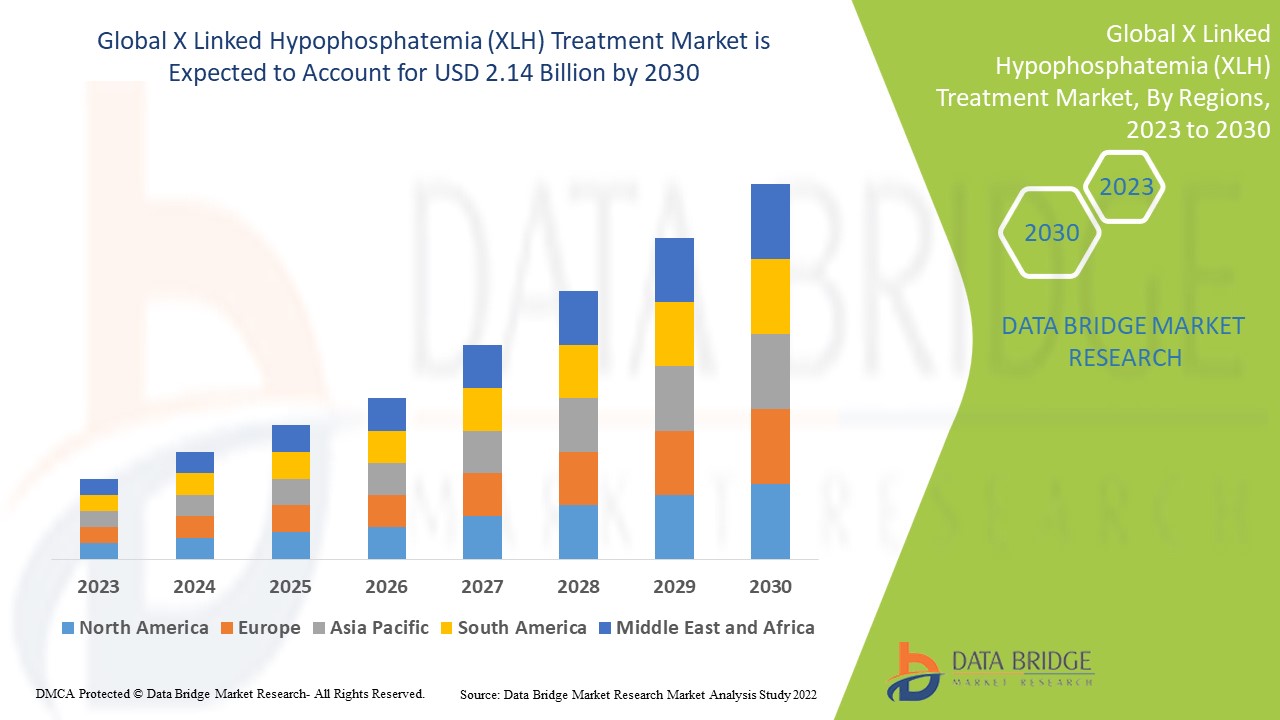
Data Bridge Market Research analyses a growth rate in the X linked hypophosphatemia (XLH) treatment market in the forecast period 2023-2030. The expected CAGR of X linked hypophosphatemia (XLH) treatment market tend to be around 10% in the mentioned forecast period. The market was valued at USD 1 billion in 2022, and it would grow upto USD 2.14 billion by 2030. In addition to the market insights such as market value, growth rate, market segments, geographical coverage, market players, and market scenario, the market report curated by the Data Bridge Market Research team also includes in-depth expert analysis, patient epidemiology, pipeline analysis, pricing analysis, and regulatory framework.
X Linked Hypophosphatemia (XLH) Treatment Market Scope and Segmentation
|
Report Metric |
Details |
|
Forecast Period |
2023 to 2030 |
|
Base Year |
2022 |
|
Historic Years |
2021 (Customizable to 2015 - 2020) |
|
Quantitative Units |
Revenue in USD Billion, Volumes in Units, Pricing in USD |
|
Segments Covered |
Type (Form of Hypophosphatemia Rickets), Treatment (Standard Hormone Therapies, Surgery, Phosphate Supplements), End-Users (Hospitals, Specialty Clinics, Others), Distribution Channel (Hospital Pharmacy, Retail Pharmacy, Others) |
|
Countries Covered |
U.S., Canada and Mexico in North America, Germany, France, U.K., Netherlands, Switzerland, Belgium, Russia, Italy, Spain, Turkey, Rest of Europe in Europe, China, Japan, India, South Korea, Singapore, Malaysia, Australia, Thailand, Indonesia, Philippines, Rest of Asia-Pacific (APAC) in the Asia-Pacific (APAC), Saudi Arabia, U.A.E, South Africa, Egypt, Israel, Rest of Middle East and Africa (MEA) as a part of Middle East and Africa (MEA), Brazil, Argentina and Rest of South America as part of South America |
|
Market Players Covered |
Kyowa Kirin Co., Ltd (Japan), Smith+Nephew (U.K.), Nestle (Switzerland), Pfizer, Inc. (U.S.), Koninklijke Philips N.V. (Netherlands), ADM Animal Nutrition (U.S.), Ultragenyx Pharmaceutical (U.S.), Nanjing Jianyou Biochemical Pharmaceutical Co., Ltd. (China), Lilly (U.S.), F. Hoffmann-La Roche Ltd (Switzerland) |
|
Market Opportunities |
|
Market Definition
X-linked hypophosphatemia (XLH) is an inherited condition typically characterized by low blood phosphate levels. Phosphate levels tend to be low in these patients because phosphate is stored abnormally in the kidneys, causing the urine to lose phosphate and leading to poor, weak bones (rickets). Usually X-linked hypophosphatemia (XLH) is diagnosed in children. The disorder is inherited in X-linked dominant manner as the gene responsible for the condition is located on the X chromosome. Furthermore, women with X-linked hypophosphatemia (XLH) have 50% of chance to pass the disorder to her children.
Global X Linked Hypophosphatemia (XLH) Treatment Market Dynamics
Drivers
- High Prevalence of X-linked hypophosphatemia (XLH)
As per the European Journal of Endocrinology statistics published in 2016, the occurrence of XLH has been estimated to be 3.9 per 100,000 live births and has an incidence of 4.8 per 100,000 people. As per the report published in 2017 by the National Institute for Health and Care Excellence, there were around 250 children and young people with XLH in England, and up to 2,500 adults, till date.
- Rising Healthcare Expenditure
The increasing research funding towards several rare diseases such as XLH and the high healthcare expenditure is also projected to increase the growth of the market during the forecast period. For instance, Genome Canada and the Canadian Institutes for Health Research entered into a partnership to study rare genetic diseases by using Next-Generation Sequencing (NGS) technology. Thus, this factor has impacted in a huge growth of the market.
Opportunities
- Increase in Elderly Population
The market is estimated to witness a heavy growth rate in the forecast period driven by the factor of an aging population. The increasing demand in the market is the replication of increasing elderly population, as people aged over 60 years often develop low immunity conditions and in turn it affects the normal functioning. This boost the market growth.
- Rising Drug Approvals of XLH
Numerous recent approval of drugs for X-linked hypophosphatemia (XLH) by regulatory authorities globally is expected to boost the growth of the market during the forecast period. For instance, in December, 2018, Ultragenyx Pharmaceutical Inc. and Kyowa Kirin Co., Ltd announced approval for Crysvita, burosumab injection by Heath Canada for the better treatment of X-linked hypophosphatemia (XLH) in adult as well as pediatric patients.
Restraints/Challenges
- Lack of skilled professionals
The lack of qualified healthcare professional unable to perform the treatments could reduce the growth of the global X linked hypophosphatemia (XLH) treatment market during the forecast period.
- Side-Effects of X Linked Hypophosphatemia (XLH) Treatment
The adverse side effects associated with the treatment process hinder the market growth. Effects such as hearing loss, infections and also some drugs can lead to autoimmune reactions.
This X linked hypophosphatemia (XLH) treatment market report provides details of new recent developments, trade regulations, import-export analysis, production analysis, value chain optimization, market share, impact of domestic and localized market players, analyses opportunities in terms of emerging revenue pockets, changes in market regulations, strategic market growth analysis, market size, category market growths, application niches and dominance, product approvals, product launches, geographic expansions, technological innovations in the market. To gain more info on the X linked hypophosphatemia (XLH) treatment market contact Data Bridge Market Research for an Analyst Brief, our team will help you take an informed market decision to achieve market growth.
Global X Linked Hypophosphatemia (XLH) Treatment Market Scope
The X linked hypophosphatemia (XLH) treatment market is segmented on the basis of type, treatment, end-user and distribution channel. The growth amongst these segments will help you analyze meagre growth segments in the industries and provide the users with a valuable market overview and market insights to help them make strategic decisions for identifying core market applications.
Type
- Form of Hypophosphatemia Rickets
Treatment
- Standard Hormone Therapies
- Surgery
- Phosphate Supplements
End-Users
- Hospitals
- Specialty Clinics
- Others
Distribution Channel
- Hospital Pharmacy
- Retail Pharmacy
- Others
Global X Linked Hypophosphatemia (XLH) Treatment Market Regional Analysis/Insights
The X linked hypophosphatemia (XLH) treatment market is analyzed and market size insights and trends are provided by type, treatment, end-user and distribution channel as referenced above.
The major countries covered in the X linked hypophosphatemia (XLH) treatment market report are the U.S., Canada and Mexico in North America, Germany, France, U.K., Netherlands, Switzerland, Belgium, Russia, Italy, Spain, Turkey, Rest of Europe in Europe, China, Japan, India, South Korea, Singapore, Malaysia, Australia, Thailand, Indonesia, Philippines, Rest of Asia-Pacific (APAC) in the Asia-Pacific (APAC), Saudi Arabia, U.A.E, South Africa, Egypt, Israel, Rest of Middle East and Africa (MEA) as a part of Middle East and Africa (MEA), Brazil, Argentina and Rest of South America as part of South America.
North America dominates the market due to the growing prevalence of X linked hypophosphatemia (XLH) treatment in the U.S. and Canada and the presence of a well-established healthcare sector.
Asia-Pacific is expected to account for the largest market due to increased prevalence of hypertension, kidney and liver diseases and number of generic disorders.
The country section of the report also provides individual market impacting factors and changes in regulation in the market domestically that impacts the current and future trends of the market. Also, the presence and availability of global brands and their challenges faced due to large or scarce competition from local and domestic brands, impact of domestic tariffs and trade routes are considered while providing forecast analysis of the country data.
Competitive Landscape and Global X Linked Hypophosphatemia (XLH) Treatment Market Share Analysis
The X linked hypophosphatemia (XLH) treatment market competitive landscape provides details by competitor. Details included are company overview, company financials, revenue generated, market potential, investment in research and development, new market initiatives, global presence, production sites and facilities, production capacities, company strengths and weaknesses, product launch, product width and breadth, application dominance. The above data points provided are only related to the companies' focus related to X linked hypophosphatemia (XLH) treatment market
Key players operating in the X linked hypophosphatemia (XLH) treatment market include:
- Kyowa Kirin Co., Ltd (Japan
- Smith+Nephew (U.K.)
- Nestle (Switzerland)
- Pfizer, Inc. (U.S.)
- Koninklijke Philips N.V. (Netherlands)
- ADM Animal Nutrition (U.S.)
- Ultragenyx Pharmaceutical (U.S.)
- Nanjing Jianyou Biochemical Pharmaceutical Co., Ltd. (China)
- Lilly (U.S.)
- F. Hoffmann-La Roche Ltd (Switzerland)
SKU-
세계 최초의 시장 정보 클라우드 보고서에 온라인으로 접속하세요
- 대화형 데이터 분석 대시보드
- 높은 성장 잠재력 기회를 위한 회사 분석 대시보드
- 사용자 정의 및 질의를 위한 리서치 분석가 액세스
- 대화형 대시보드를 통한 경쟁자 분석
- 최신 뉴스, 업데이트 및 추세 분석
- 포괄적인 경쟁자 추적을 위한 벤치마크 분석의 힘 활용
연구 방법론
데이터 수집 및 기준 연도 분석은 대규모 샘플 크기의 데이터 수집 모듈을 사용하여 수행됩니다. 이 단계에는 다양한 소스와 전략을 통해 시장 정보 또는 관련 데이터를 얻는 것이 포함됩니다. 여기에는 과거에 수집한 모든 데이터를 미리 검토하고 계획하는 것이 포함됩니다. 또한 다양한 정보 소스에서 발견되는 정보 불일치를 검토하는 것도 포함됩니다. 시장 데이터는 시장 통계 및 일관된 모델을 사용하여 분석하고 추정합니다. 또한 시장 점유율 분석 및 주요 추세 분석은 시장 보고서의 주요 성공 요인입니다. 자세한 내용은 분석가에게 전화를 요청하거나 문의 사항을 드롭하세요.
DBMR 연구팀에서 사용하는 주요 연구 방법론은 데이터 마이닝, 시장에 대한 데이터 변수의 영향 분석 및 주요(산업 전문가) 검증을 포함하는 데이터 삼각 측량입니다. 데이터 모델에는 공급업체 포지셔닝 그리드, 시장 타임라인 분석, 시장 개요 및 가이드, 회사 포지셔닝 그리드, 특허 분석, 가격 분석, 회사 시장 점유율 분석, 측정 기준, 글로벌 대 지역 및 공급업체 점유율 분석이 포함됩니다. 연구 방법론에 대해 자세히 알아보려면 문의를 통해 업계 전문가에게 문의하세요.
사용자 정의 가능
Data Bridge Market Research는 고급 형성 연구 분야의 선두 주자입니다. 저희는 기존 및 신규 고객에게 목표에 맞는 데이터와 분석을 제공하는 데 자부심을 느낍니다. 보고서는 추가 국가에 대한 시장 이해(국가 목록 요청), 임상 시험 결과 데이터, 문헌 검토, 재생 시장 및 제품 기반 분석을 포함하도록 사용자 정의할 수 있습니다. 기술 기반 분석에서 시장 포트폴리오 전략에 이르기까지 타겟 경쟁업체의 시장 분석을 분석할 수 있습니다. 귀하가 원하는 형식과 데이터 스타일로 필요한 만큼 많은 경쟁자를 추가할 수 있습니다. 저희 분석가 팀은 또한 원시 엑셀 파일 피벗 테이블(팩트북)로 데이터를 제공하거나 보고서에서 사용 가능한 데이터 세트에서 프레젠테이션을 만드는 데 도움을 줄 수 있습니다.