


Middle East and Africa Sensor Cleaning System Market Segmentation, Sensor Type (Camera Cleaning Systems, Lidar Cleaning Systems, and Radar Cleaning Systems), Cleaning System (Automated Sensor Cleaning Systems, Manual Sensor Cleaning Systems, and Semi-Automated Sensor Cleaning Systems), End User (Automotive, Aerospace & Defense, Industrial, Healthcare & Medical Devices, Consumer Electronics, Oil & Gas, and Others), Sales Channel (Original Equipment and Aftermarket) – Industry Trends and Forecast to 2032
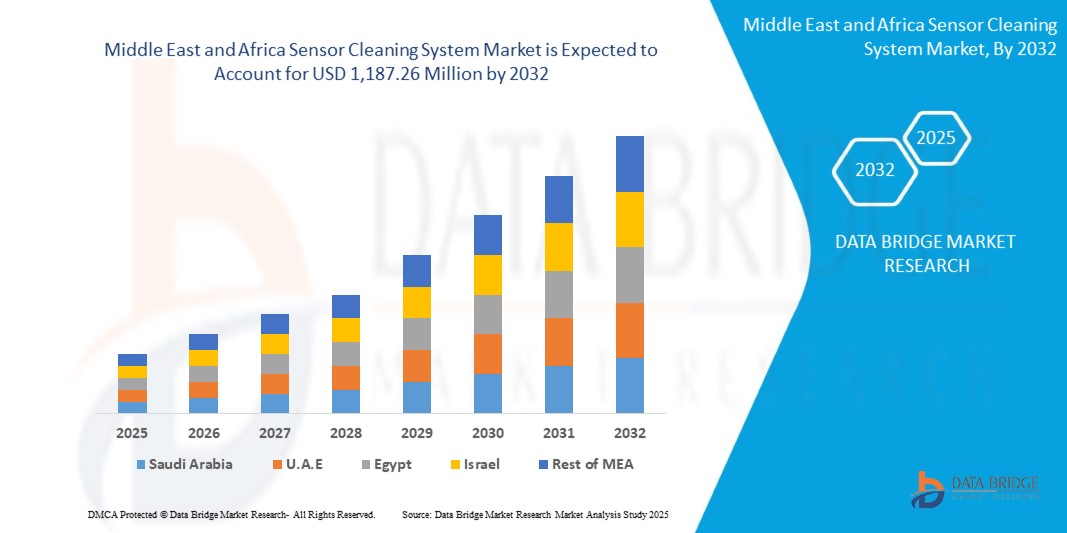
Sensor Cleaning System Market Analysis
The Middle East and Africa sensor cleaning system market is experiencing steady growth, driven by the increasing reliance on sensors in various industries such as automotive, aerospace, manufacturing, and healthcare. With the rising demand for autonomous vehicles, industrial automation, and advanced monitoring systems, maintaining sensor accuracy and performance through regular cleaning is becoming critical. Environmental factors like dust, moisture, and pollutants further contribute to the need for efficient sensor cleaning solutions. Technological advancements in cleaning systems, including automated, contactless, and self-cleaning sensors, are driving market innovation. The growing emphasis on safety, operational efficiency, and reducing maintenance costs in critical applications also fuels demand. As industries continue to integrate sensors into everyday operations, the market for sensor cleaning systems is expected to expand.
Sensor Cleaning System Market Size
Middle East and Africa sensor cleaning system market size was valued at USD 512.04 million in 2024 and is projected to reach USD 1,187.26 million by 2032, with a CAGR of 11.2% during the forecast period of 2025 to 2032. In addition to the insights on market scenarios such as market value, growth rate, segmentation, geographical coverage, and major players, the market reports curated by the Data Bridge Market Research also include depth expert analysis, patient epidemiology, pipeline analysis, pricing analysis, and regulatory framework.
Sensor Cleaning System Market Trends
“The Expansion of Smart Factories and Industry 4.0”
The growth in industrial automation is significantly impacting the sensor cleaning system market as smart factories and Industry 4.0 initiatives become more prevalent. The increasing reliance on high-precision sensors for automation, robotics, and real-time data collection has led to a surge in demand for sensor cleaning solutions. These systems ensure sensors maintain accuracy and reliability, even in challenging environments. As industries automate further, the need for continuous sensor performance and minimal downtime drives innovation in cleaning technologies. The trend also encourages the development of automated, self-cleaning sensor systems. Additionally, the push for increased efficiency and reduced maintenance costs in manufacturing operations boosts the adoption of sensor cleaning systems. These trends are expected to continue as industrial sectors move toward more advanced automation processes.
Report Scope and Sensor Cleaning System Market Segmentation
|
Attributes |
Sensor Cleaning System Key Market Insights |
|
Segments Covered |
|
|
Countries Covered |
U.A.E., Saudi Arabia, South Africa, Egypt, Israel, and Rest of Middle East and Africa |
|
Key Market Players |
SOLERO TECHNOLOGIES, LLC.( U.S.), Continental AG(Germany), Ficosa International SA (Spain), Valeo Service (Valeo SA) (France), Actasys Inc. (U.S.), Araymond (France), Röchling SE & Co. KG (Germany), Kautex (Textron GmbH & Co. KG) (Germany ), Process Instruments UK Ltd (U.K.), Mettler Toledo (Germany), Vitesco Technologies (Schaeffler AG) (U.S), Endress+Hauser Group Services AG (Switzerland), Jet Clean gmbh (Australia), Rapa (Germany ), and entegris inc. (U.S.) |
|
Market Opportunities |
|
|
Value Added Data Infosets |
In addition to the insights on market scenarios such as market value, growth rate, segmentation, geographical coverage, and major players, the market reports curated by the Data Bridge Market Research also include depth expert analysis, patient epidemiology, pipeline analysis, pricing analysis, and regulatory framework. |
Sensor Cleaning System Market Definition
The Middle East and Africa sensor cleaning system market is concerned with technologies and solutions for cleaning and maintaining sensors used in a wide range of applications, including manufacturing, automotive, aerospace, and healthcare. These systems are necessary for guaranteeing the best performance and longevity of sensors, which are essential components in contemporary equipment and machinery. Increased use of automation and smart devices, as well as rising demand for precise data in industries such as automotive and industrial manufacturing, are driving market expansion. Furthermore, advances in sensor technologies, such as those used in self-driving cars and robotics, are driving the industry. The market comprises both standalone cleaning systems and integrated solutions for sensor maintenance. Key market trends include efficiency, cost-effectiveness, and the drive for sustainability.
Sensor Cleaning System Market Dynamics
Drivers
- Increasing Demand of Sensor Accuracy in Automotive Industries
As automation continues to shape the future of the automotive industry, sensors play an increasingly important role in assuring the precision, efficiency, and safety of production processes and robotic operations. Sensors are utilized in a variety of automobile manufacturing applications, including assembly lines, robotic arms, and car safety systems. As these technologies grow and become more complex, sensors must remain clean and functional in order to preserve operating efficiency and reduce the possibility of costly errors or malfunctions.
For Instance:
As per the Newelectronics, as the number of sensors in automotive like Ultrasonic Sensors, Infrared Sensors, Capacitive Sensors continues to rise, driven by advancements in safety, efficiency, and autonomous driving technologies, the demand for automotive sensor cleaning solutions will also increase. Sensors, such as LiDAR, infrared, and radar, require regular maintenance to ensure optimal performance. This will create a growing market for specialized cleaning products and services tailored to these high-tech automotive sensors. Consequently, sensor cleaning will become a crucial aspect of vehicle maintenance, supporting the broader automotive sensor market's expansion.
- Rising Regulatory Standards for Cleanliness and Sensor Accuracy
Environmental concerns are increasingly influencing Middle East and Africa industrial plans and operations. As sustainability becomes a top issue, firms face increasing pressure to reduce their environmental impact while maintaining efficient and productive manufacturing processes. In sectors that rely on sensor technologies, preserving sensor operation while adhering to environmental requirements has become a top priority. This has resulted in the use of modern sensor cleaning systems that are intended not just to ensure performance but also to reduce environmental effect.
For instance,
According to the Springer Nature, World Health Organization Baseline Country Survey on Medical Devices (World Health Organization,2014), only 65 percent of the 145 responding countries have a national authority responsible for implementing and enforcing medical device regulations. This shows the need for proper maintenance for the use of the medical equipment. Because of this, the need for the sensor cleaning increases.
Opportunities
- Collaborating With IoT and Smart Sensor Manufacturers
Strategic alliances in the sensor cleaning systems market are proven to be effective growth drivers, particularly with makers of IoT devices, smart sensors, and original equipment manufacturers (OEMs). As the need for linked devices and advanced sensor technology grows, firms offering sensor cleaning solutions are increasingly seeing the value of creating alliances to provide integrated, bespoke solutions. These collaborations enable the development of more efficient, compatible, and customized cleaning methods, hence boosting the overall expansion of sensor technology across industries.
For instance,
As per the fraunhofer article, IoT-enabled sensor cleaning systems offer up to 75% energy savings and a 50% reduction in cleaning time. These systems enhance equipment capacity, reduce cleaning agent use, and lower wastewater disposal costs. Customizable cleaning processes meet specific requirements with minimal investment. The adaptability of IoT-enabled sensor cleaning systems across multiple industries opens new revenue streams and increases market penetration potential. Collaborative partnerships with smart sensor manufacturers can drive innovation, creating a broader customer base and accelerating market growth.
- Integrating Sensor Cleaning Systems with Predictive Maintenance Frameworks
As organizations embrace predictive maintenance to improve operational efficiency and reduce downtime, incorporating sensor cleaning systems into these frameworks presents enormous opportunities. Predictive maintenance uses real-time sensor data to predict equipment breakdowns before they occur, and introducing sensor cleaning methods into these systems can improve sensor performance and durability. This integration not only keeps sensors in top condition, but it also improves the whole value proposition of predictive maintenance programs, especially in businesses that rely on complex machinery and automated systems.For instance,
As per the MDPI article, by using vibration signals from cleaning robots, predictive maintenance frameworks can identify performance degradation and potential safety issues early. This allows for proactive intervention, preventing operational failures in autonomous mobile cleaning systems. The integration of predictive maintenance into sensor cleaning technologies offers a significant opportunity for growth, as it enhances system reliability and reduces downtime. As the demand for autonomous driving increases, sensor cleaning solutions with advanced monitoring capabilities will be essential to maintaining optimal sensor performance. This opens a new avenue for innovation and growth in the sensor cleaning market.
Restraints/Challenges
- Integrating Sensor Cleaning Systems with Existing Infrastructure
As companies rely more on advanced sensor technology, integrating sensor cleaning systems into existing infrastructure has become a key task. While the demand for effective cleaning solutions grows, integrating new systems with older facilities or legacy gear can be challenging. This is especially true in businesses where outdated technology are still in use, posing further challenges to the adoption of sophisticated sensor cleaning solutions.
As companies rely on more advanced sensor technology, integrating sensor cleaning systems into existing infrastructure has become a key task. While the demand for effective cleaning solutions grows, integrating new systems with older facilities or legacy gear can be challenging. This is especially true in businesses where outdated technology are still in use, posing further challenges to the adoption of sophisticated sensor cleaning solutions.
For instance,
As per the SEA international, designing cleaning mechanisms compatible with various sensor shapes and placements often requires significant reconfiguration by manufacturers, such as adjusting liquid-jet sprays or adapting ultrasonic systems. These adjustments complicate integration efforts. Older facilities and equipment often require significant modifications to accommodate new sensor cleaning technologies, which can be costly and time-consuming. Because of this, the sensor cleaning systems cause restraint.
- The Rise of Self-Cleaning Sensors and Alternative Maintenance Technologies
As sensor technologies continue to evolve, the rise of alternative solutions such as self-cleaning sensors and innovative maintenance methods poses a potential challenge to traditional sensor cleaning systems. These advancements aim to reduce or eliminate the need for external cleaning systems, offering a more streamlined approach to maintaining sensor performance. While traditional sensor cleaning systems have proven effective, the development of these alternatives presents competition in the market, prompting companies to reassess their strategies and innovations.
Self-cleaning sensors, for example, use sophisticated materials or built-in systems to automatically remove pollutants without requiring external intervention. This approach can greatly minimize the maintenance load by providing continuous sensor performance in tough or distant situations where manual cleaning is unfeasible. Similarly, alternative maintenance approaches, like as cleaning with UV light or nanotechnology, may enable more sustainable and effective ways to keep sensors operating in the absence of standard cleaning systems. As these technologies evolve, they may gain acceptance, particularly in industries where lowering operational costs and maintenance time is critical. While traditional sensor cleaning systems remain functional, these developing alternatives may provide a more cost-effective and low-maintenance solution for certain applications, introducing competition into the market.
For instance,
As per the Royal Society of Chemistry research paper publication, materials like titanium dioxide (TiO2) are used in photocatalytic self-cleaning systems that break down pollutants under UV light, which can be applied to sensor surfaces for self-maintenance in harsh environments. The continuous evolution of self-cleaning technologies, along with the development of alternative maintenance methods such as nanocoatings and automated cleaning solutions, poses a significant challenge to traditional sensor cleaning systems. As these technologies become more efficient and cost-effective, they could reduce the demand for conventional cleaning methods, forcing the market to adapt to a new landscape where manual or sensor-based cleaning processes may become obsolete. This shift could disrupt existing business models and require companies to invest in new, advanced solutions to stay competitive.
This market report provides details of new recent developments, trade regulations, import-export analysis, production analysis, value chain optimization, market share, impact of domestic and localized market players, analyses opportunities in terms of emerging revenue pockets, changes in market regulations, strategic market growth analysis, market size, category market growths, application niches and dominance, product approvals, product launches, geographic expansions, technological innovations in the market. To gain more info on the market contact Data Bridge Market Research for an Analyst Brief, our team will help you take an informed market decision to achieve market growth.
Sensor Cleaning System Market Scope
The market is segmented on the basis of sensor type, cleaning system, end user and sales channel. The growth amongst these segments will help you analyze meagre growth segments in the industries and provide the users with a valuable market overview and market insights to help them make strategic decisions for identifying core market applications.
Sensor Type
- Camera cleaning systems
- Lidar cleaning systems
- Radar cleaning system
- Others
Cleaning System
- Automated Sensor Cleaning Systems
- Manual Sensor Cleaning Systems
- Semi-Automated Sensor Cleaning Systems
End-User
- Automotive
- Commercial vehicle
- Passenger cars
- Compact Cars
- Luxury Cars
- Mid Sized Cars
- Suvs
- Aerospace & Defence
- Industrial
- Healthcare & Medical Devices
- Consumer Electronics
- Oil & Gas
- Others
Sales Channel
- Aftermarket
- Original Equipment Manufacturer
Sensor Cleaning System Market Regional Analysis
The market is analyzed and market size insights and trends are provided by sensor type, cleaning system, end user and sales channel as referenced above.
The countries covered in the market are U.A.E., Saudi Arabia, South Africa, Egypt, Israel, and rest of Middle East and Africa.
In the Middle East, Saudi Arabia dominates the sensor cleaning system market due to its robust industrial growth and expanding automotive and manufacturing sectors. The government's Vision to initiative fosters industrial innovation and adoption of advanced technologies, driving market growth. High investments in infrastructure and increasing automation further boost demand for sensor cleaning systems. This makes Saudi Arabia the fastest-growing and leading region in the Middle East for this market.
The country section of the report also provides individual market impacting factors and changes in regulation in the market domestically that impacts the current and future trends of the market. Data points like down-stream and upstream value chain analysis, technical trends and porter's five forces analysis, case studies are some of the pointers used to forecast the market scenario for individual countries. Also, the presence and availability of Middle East and Africa brands and their challenges faced due to large or scarce competition from local and domestic brands, impact of domestic tariffs and trade routes are considered while providing forecast analysis of the country data.
Sensor Cleaning System Market Share
The market competitive landscape provides details by competitor. Details included are company overview, company financials, revenue generated, market potential, investment in research and development, new market initiatives, Middle East and Africa presence, production sites and facilities, production capacities, company strengths and weaknesses, product launch, product width and breadth, application dominance. The above data points provided are only related to the companies' focus related to market.
Sensor Cleaning System Market Leaders Operating in the Market Are:
- SOLERO TECHNOLOGIES, LLC.( U.S.)
- Continental AG(Germany)
- Ficosa International SA (Spain)
- Valeo Service (Valeo SA) (France)
- Actasys Inc. (U.S.)
- Araymond (France)
- Röchling SE & Co. KG (Germany)
- Kautex (Textron GmbH & Co. KG) (Germany )
- Process Instruments UK Ltd (U.K.)
- Mettler Toledo (Germany)
- Vitesco Technologies (Schaeffler AG) (U.S)
- Endress+Hauser Group Services AG (Switzerland)
- Jet Clean gmbh (Australia)
- Rapa (Germany )
- entegris inc. (U.S.)
Latest Developments in Middle East and Africa Sensor Cleaning System Market
- In September 2024, Entegris, a leading electronics materials company, is investing $600 million in a new facility in Colorado Springs to manufacture FOUPS and advanced liquid filters, supporting the reshoring of semiconductor supply chain components. This expansion strengthens Entegris' expertise in sensor cleaning systems by improving defect control in wafer handling. The facility will utilize advanced processes to produce highly precise FOUPS, boosting production yields for semiconductor manufacturers
- In August 2024, SICK and Endress+Hauser have formed a strategic partnership, with Endress+Hauser assuming Middle East and Africa sales and service responsibilities for SICK's process analyzers and gas flowmeters, alongside a joint venture for their production and development. This partnership enhances Endress+Hauser's portfolio by incorporating advanced analyzers and flowmeter technologies, bolstering its sensor cleaning systems to improve contamination control and support more efficient industrial processes
- In May 2021, The Fluid Control Unit (FCU), developed by dlhBOWLES and RAPA Automotive, is now commercially available, enhancing sensor and camera cleaning technology for advanced driving systems and autonomous vehicles. This development allows RAPA Group to leverage its valve design expertise, improving the performance and reliability of sensor cleaning systems, thereby supporting the functionality of advanced driving and autonomous vehicle technologies
- In April 2024, Solero Technologies, backed by Atar Capital, has announced the acquisition of Kendrion’s automotive business. This strategic move enhances Solero's capabilities in electrification and sustainability, expanding its Middle East and Africa presence with additional plants in Europe and the U.S., doubling its annual revenue
- In January 2024, Ficosa and indie Semiconductor have partnered to develop AI-based automotive camera solutions aimed at enhancing safety. This collaboration will combine Ficosa’s vision expertise with indie’s AI processing technology to provide advanced object detection and imaging for improved external element protection. The first smart camera solutions are set to be tested in 2024, with full-scale production expected by 2025. The partnership aligns with increasing automotive safety regulations focused on protecting vulnerable road users, like pedestrians and cyclists, through intelligent sensing in ADAS systems
SKU-
세계 최초의 시장 정보 클라우드 보고서에 온라인으로 접속하세요

- 대화형 데이터 분석 대시보드
- 높은 성장 잠재력 기회를 위한 회사 분석 대시보드
- 사용자 정의 및 질의를 위한 리서치 분석가 액세스
- 대화형 대시보드를 통한 경쟁자 분석
- 최신 뉴스, 업데이트 및 추세 분석
- 포괄적인 경쟁자 추적을 위한 벤치마크 분석의 힘 활용
목차
1 서론
1.1 연구 목적
1.2 시장 정의
1.3 중동 및 아프리카 센서 세척 시스템 시장 개요
1.4 통화 및 가격
1.5 제한 사항
1.6 대상 시장
2 시장 세분화
2.1 대상 시장
2.2 지리적 범위
연구에 2.3년이 고려됨
2.4 DBMR TRIPOD 데이터 검증 모델
2.5 주요 여론 리더와의 1차 인터뷰
2.6 DBMR 시장 위치 그리드
2.7 공급업체 점유율 분석
2.8 다변량 모델링
2.9 유형 타임라인 곡선
2.1 시장 최종 사용자 범위 그리드
2.11 2차 소스
2.12 가정
3 요약
4가지 프리미엄 인사이트
5 시장 개요
5.1 드라이버
5.1.1 자동차 산업에서 센서 정확도에 대한 수요 증가
5.1.2 정확도와 성능 유지를 위한 센서 세척 시스템의 중요성 증가
5.1.3 제조 및 로봇 산업의 자동화 성장
5.1.4 청결성 및 센서 정확도에 대한 규제 기준의 상승
5.1.5 반도체 및 전자 산업에서 깨끗한 환경에 대한 수요 증가
5.2 제약
5.2.1 기존 인프라와 센서 세척 시스템 통합
5.2.2 센서 세척 시스템 구현을 위한 높은 사전 비용
5.3 기회
5.3.1 IoT 및 스마트 센서 제조업체와의 협력
5.3.2 센서 세척 시스템을 예측 유지 관리 프레임워크와 통합
5.3.3 효율성 개선을 위한 센서 세척 시스템에 AI 및 ML 구현
5.4 과제
5.4.1 자체 세척 센서 및 대체 유지 관리 기술의 증가
5.4.2 광산 및 중공업 분야에서 센서 세척 시스템 도입의 어려움
6 중동 및 아프리카 센서 세척 시스템 시장, 센서 유형별
6.1 개요
6.2 카메라 세척 시스템
6.3 LIDAR 세척 시스템
6.4 레이더 청소 시스템
6.5 기타
7 중동 및 아프리카 센서 세척 시스템 시장, 세척 시스템별
7.1 개요
7.2 자동 센서 세척 시스템
7.3 반자동 센서 세척 시스템
7.4 수동 센서 세척 시스템
8 중동 및 아프리카 센서 세척 시스템 시장, 최종 사용자별
8.1 개요
8.2 자동차
8.2.1 자동차, 유형별
8.2.1.1 승용차
8.2.1.1.1 승용차, 유형별
8.2.1.1.1.1 SUV
8.2.1.1.1.2 중형차
8.2.1.1.1.3 소형차
8.2.1.1.1.4 고급차
8.2.1.2 상용차
8.3 산업
8.4 의료 및 의료 기기
8.5 항공우주 및 방위
8.6 가전제품
8.7 기타
9 중동 및 아프리카 센서 세척 시스템 시장, 판매 채널별
9.1 개요
9.2 원래 장비
9.3 사후 시장
10 중동 및 아프리카 센서 세척 시스템 시장, 지역별
10.1 중동 및 아프리카
10.1.1 사우디 아라비아
10.1.2 아랍에미리트
10.1.3 남아프리카 공화국
10.1.4 이집트
10.1.5 이스라엘
10.1.6 오만
10.1.7 바레인
10.1.8 쿠웨이트
10.1.9 카타르
10.1.10 중동 및 아프리카의 나머지 지역
11 중동 및 아프리카 센서 세척 시스템 시장, 회사 환경
11.1 회사 점유율 분석: 중동 및 아프리카
12 SWOT 분석
13 회사 프로필
13.1 VALEO 서비스
13.1.1 회사 스냅샷
13.1.2 수익 분석
13.1.3 회사 점유율 분석
13.1.4 제품 포트폴리오
13.1.5 최근 개발
13.2 콘티넨탈 AG
13.2.1 회사 스냅샷
13.2.2 수익 분석
13.2.3 회사 점유율 분석
13.2.4 제품 포트폴리오
13.2.5 최근 개발
13.3 아레이몬드 에 시에
13.3.1 회사 스냅샷
13.3.2 회사 점유율 분석
13.3.3 제품 포트폴리오
13.3.4 최근 개발
13.4 로클링 SE 앤 코. KG
13.4.1 회사 스냅샷
13.4.2 회사 점유율 분석
13.4.3 제품 포트폴리오
13.4.4 최근 개발
13.5 메틀러 톨레도
13.5.1 회사 스냅샷
13.5.2 수익 분석
13.5.3 회사 점유율 분석
13.5.4 제품 포트폴리오
13.5.5 최근 개발
13.6 액타시스 주식회사
13.6.1 회사 스냅샷
13.6.2 제품 포트폴리오
13.6.3 최근 개발
13.7 엔드레스하우저 그룹 서비스 AG
13.7.1 회사 스냅샷
13.7.2 제품 포트폴리오
13.7.3 최근 개발 사항
13.8 엔테그리스
13.8.1 회사 스냅샷
13.8.2 수익 분석
13.8.3 제품 포트폴리오
13.8.4 최근 개발 사항
13.9 피코사 인터내셔널 SA
13.9.1 회사 스냅샷
13.9.2 제품 포트폴리오
13.9.3 최근 개발
13.1 제트클린 GMBH
13.10.1 회사 스냅샷
13.10.2 제품 포트폴리오
13.10.3 최근 개발 사항
13.11 카우텍스
13.11.1 회사 스냅샷
13.11.2 제품 포트폴리오
13.11.3 최근 개발
13.12 프로세스 인스트루먼트 UK 유한회사
13.12.1 회사 스냅샷
13.12.2 제품 포트폴리오
13.12.3 최근 개발
13.13 라파 그룹
13.13.1 회사 스냅샷
13.13.2 제품 포트폴리오
13.13.3 최근 개발 사항
13.14 솔레로 테크놀로지스, 유한회사
13.14.1 회사 스냅샷
13.14.2 제품 포트폴리오
13.14.3 최근 개발
13.15 비테스코 테크놀로지스 유한회사
13.15.1 회사 스냅샷
13.15.2 수익 분석
13.15.3 제품 포트폴리오
13.15.4 최근 개발
14 설문지
15 관련 보고서
표 목록
표 1 다양한 센서 세척 시스템의 가격 범위
표 2 중동 및 아프리카 센서 세척 시스템 시장, 센서 유형별, 2020-2032 (USD 천 달러)
표 3 중동 및 아프리카 카메라 세척 시스템 센서 세척 시스템 시장, 지역별, 2020-2032 (USD 천 달러)
표 4 중동 및 아프리카 센서 세척 시스템 시장에서의 LIDAR 세척 시스템, 지역별, 2020-2032 (USD 천 달러)
표 5 중동 및 아프리카 레이더 세척 시스템 센서 세척 시스템 시장, 지역별, 2020-2032 (USD 천 달러)
표 6 중동 및 아프리카 기타 지역별 센서 세척 시스템 시장, 2020-2032년(USD 천 달러)
표 7 중동 및 아프리카 센서 세척 시스템 시장, 세척 시스템별, 2020-2032 (USD 천 달러)
표 8 중동 및 아프리카 자동 센서 세척 시스템 시장, 지역별 센서 세척 시스템, 2020-2032 (USD 천 달러)
표 9 중동 및 아프리카 지역별 센서 세척 시스템 시장에서의 반자동 센서 세척 시스템, 2020-2032년 (USD 천 달러)
표 10 중동 및 아프리카 수동 센서 세척 시스템 중동 및 아프리카 센서 세척 시스템 시장, 지역별, 2020-2032 (USD 천)
표 11 중동 및 아프리카 센서 세척 시스템 시장, 최종 사용자별, 2020-2032(USD 천 달러)
표 12 중동 및 아프리카 자동차 센서 세척 시스템 시장, 지역별, 2020-2032 (USD 천)
표 13 중동 및 아프리카 자동차 센서 세척 시스템 시장, 유형별, 2020-2032 (USD 천 달러)
표 14 중동 및 아프리카 승용차 센서 세척 시스템 시장, 유형별, 2020-2032 (USD 천 달러)
표 15 중동 및 아프리카 센서 세척 시스템 시장 산업, 지역별, 2020-2032 (USD 천)
표 16 중동 및 아프리카 센서 세척 시스템 시장의 의료 및 의료 기기, 지역별, 2020-2032 (USD 천 달러)
표 17 중동 및 아프리카 항공우주 및 방위 장비 센서 세척 시스템 시장, 지역별, 2020-2032 (USD 천)
표 18 중동 및 아프리카 소비자 전자 제품 센서 세척 시스템 시장, 지역별, 2020-2032 (USD 천 달러)
표 19 중동 및 아프리카 기타 지역별 센서 세척 시스템 시장, 2020-2032년(USD 천 달러)
표 20 중동 및 아프리카 센서 세척 시스템 시장, 판매 채널별, 2020-2032 (USD 천)
표 21 중동 및 아프리카 센서 세척 시스템 시장의 OEM(Original Equipment), 지역별, 2020-2032 (USD 천 달러)
표 22 중동 및 아프리카 센서 세척 시스템 시장의 애프터마켓, 지역별, 2020-2032 (USD 천)
표 23 중동 및 아프리카 센서 세척 시스템 시장, 국가별, 2020-2032 (USD 천 달러)
표 24 중동 및 아프리카 센서 세척 시스템 시장, 센서 유형별, 2020-2032 (USD 천 달러)
표 25 중동 및 아프리카 센서 세척 시스템 시장, 세척 시스템별, 2020-2032 (USD 천 달러)
표 26 중동 및 아프리카 센서 세척 시스템 시장, 최종 사용자별, 2020-2032(USD 천 달러)
표 27 중동 및 아프리카 자동차 센서 세척 시스템 시장, 유형별, 2020-2032 (USD 천 달러)
표 28 중동 및 아프리카 승용차 센서 세척 시스템 시장, 유형별, 2020-2032 (USD 천 달러)
표 29 중동 및 아프리카 센서 세척 시스템 시장, 판매 채널별, 2020-2032 (USD 천 달러)
표 30 사우디 아라비아 센서 세척 시스템 시장, 센서 유형별, 2020-2032 (USD 천 달러)
표 31 사우디 아라비아 센서 세척 시스템 시장, 세척 시스템별, 2020-2032 (USD 천)
표 32 사우디 아라비아 센서 세척 시스템 시장, 최종 사용자별, 2020-2032 (USD 천)
표 33 사우디 아라비아 자동차 센서 세척 시스템 시장, 유형별, 2020-2032 (USD 천 달러)
표 34 사우디 아라비아 승용차 센서 세척 시스템 시장, 유형별, 2020-2032 (USD 천 달러)
표 35 사우디 아라비아 센서 세척 시스템 시장, 판매 채널별, 2020-2032 (USD 천)
표 36 센서 유형별 UAE 센서 세척 시스템 시장, 2020-2032년(USD 천 달러)
표 37 세척 시스템별 UAE 센서 세척 시스템 시장, 2020-2032년(USD 천 달러)
표 38 최종 사용자별 UAE 센서 세척 시스템 시장, 2020-2032년(USD 천 달러)
표 39 UAE 자동차 센서 세척 시스템 시장, 유형별, 2020-2032(USD 천 달러)
표 40 센서 세척 시스템 시장에서의 UAE 승용차, 유형별, 2020-2032 (USD 천 달러)
표 41 UAE 센서 세척 시스템 시장, 판매 채널별, 2020-2032 (USD 천 달러)
표 42 남아프리카 센서 세척 시스템 시장, 센서 유형별, 2020-2032 (USD 천 달러)
표 43 남아프리카 센서 세척 시스템 시장, 세척 시스템별, 2020-2032 (USD 천)
표 44 남아프리카 센서 세척 시스템 시장, 최종 사용자별, 2020-2032 (USD 천)
표 45 남아프리카 자동차 센서 세척 시스템 시장, 유형별, 2020-2032 (USD 천 달러)
표 46 남아프리카 승용차 센서 세척 시스템 시장, 유형별, 2020-2032 (USD 천 달러)
표 47 남아프리카 센서 세척 시스템 시장, 판매 채널별, 2020-2032 (USD 천 달러)
표 48 이집트 센서 세척 시스템 시장, 센서 유형별, 2020-2032 (USD 천 달러)
표 49 이집트 센서 세척 시스템 시장, 세척 시스템별, 2020-2032 (USD 천)
표 50 이집트 센서 세척 시스템 시장, 최종 사용자별, 2020-2032 (USD 천)
표 51 이집트 자동차 센서 세척 시스템 시장, 유형별, 2020-2032 (USD 천)
표 52 이집트 승용차 센서 세척 시스템 시장, 유형별, 2020-2032 (USD 천 달러)
표 53 이집트 센서 세척 시스템 시장, 판매 채널별, 2020-2032 (USD 천)
표 54 이스라엘 센서 세척 시스템 시장, 센서 유형별, 2020-2032 (USD 천 달러)
표 55 이스라엘 센서 세척 시스템 시장, 세척 시스템별, 2020-2032 (USD 천)
표 56 이스라엘 센서 세척 시스템 시장, 최종 사용자별, 2020-2032 (USD 천)
표 57 이스라엘 자동차 센서 세척 시스템 시장, 유형별, 2020-2032 (USD 천)
표 58 이스라엘 승용차 센서 세척 시스템 시장, 유형별, 2020-2032 (USD 천)
표 59 이스라엘 센서 세척 시스템 시장, 판매 채널별, 2020-2032 (USD 천)
표 60 오만 센서 세척 시스템 시장, 센서 유형별, 2020-2032 (USD 천 달러)
표 61 오만 센서 세척 시스템 시장, 세척 시스템별, 2020-2032 (USD 천)
표 62 오만 센서 세척 시스템 시장, 최종 사용자별, 2020-2032(USD 천)
표 63 오만 자동차 센서 세척 시스템 시장, 유형별, 2020-2032 (USD 천 달러)
표 64 센서 세척 시스템 시장에서 오만 승용차의 유형별 시장, 2020-2032 (USD 천 달러)
표 65 오만 센서 세척 시스템 시장, 판매 채널별, 2020-2032 (USD 천)
표 66 바레인 센서 세척 시스템 시장, 센서 유형별, 2020-2032 (USD 천 달러)
표 67 바레인 센서 세척 시스템 시장, 세척 시스템별, 2020-2032 (USD 천)
표 68 바레인 센서 세척 시스템 시장, 최종 사용자별, 2020-2032 (USD 천)
표 69 바레인 자동차 센서 세척 시스템 시장, 유형별, 2020-2032 (USD 천 달러)
표 70 바레인 승용차 센서 세척 시스템 시장, 유형별, 2020-2032 (USD 천 달러)
표 71 바레인 센서 세척 시스템 시장, 판매 채널별, 2020-2032 (USD 천 달러)
표 72 쿠웨이트 센서 세척 시스템 시장, 센서 유형별, 2020-2032 (USD 천 달러)
표 73 쿠웨이트 센서 세척 시스템 시장, 세척 시스템별, 2020-2032 (USD 천)
표 74 쿠웨이트 센서 세척 시스템 시장, 최종 사용자별, 2020-2032 (USD 천)
표 75 쿠웨이트 자동차 센서 세척 시스템 시장, 유형별, 2020-2032 (USD 천)
표 76 센서 세척 시스템 시장에서 쿠웨이트 승용차의 유형별 시장, 2020-2032 (USD 천 달러)
표 77 쿠웨이트 센서 세척 시스템 시장, 판매 채널별, 2020-2032 (USD 천)
표 78 카타르 센서 세척 시스템 시장, 센서 유형별, 2020-2032 (USD 천 달러)
표 79 카타르 센서 세척 시스템 시장, 세척 시스템별, 2020-2032 (USD 천)
표 80 카타르 센서 세척 시스템 시장, 최종 사용자별, 2020-2032 (USD 천)
표 81 카타르 자동차 센서 세척 시스템 시장, 유형별, 2020-2032 (USD 천 달러)
표 82 센서 세척 시스템 시장의 카타르 승용차, 유형별, 2020-2032 (USD 천)
표 83 카타르 센서 세척 시스템 시장, 판매 채널별, 2020-2032 (USD 천)
표 84 중동 및 아프리카 나머지 지역 센서 세척 시스템 시장, 센서 유형별, 2020-2032년(USD 천 달러)
그림 목록
그림 1 중동 및 아프리카 센서 세척 시스템 시장: 세분화
그림 2 중동 및 아프리카 센서 세척 시스템 시장: 데이터 삼각 측량
그림 3 중동 및 아프리카 센서 세척 시스템 시장: DROC 분석
그림 4 중동 및 아프리카 센서 세척 시스템 시장: 중동 및 아프리카 대 지역 시장 분석
그림 5 중동 및 아프리카 센서 세척 시스템 시장: 회사 연구 분석
그림 6 중동 및 아프리카 센서 세척 시스템 시장: 인터뷰 인구 통계
그림 7 중동 및 아프리카 센서 세척 시스템 시장: DBMR 시장 위치 그리드
그림 8 중동 및 아프리카 센서 세척 시스템 시장: 공급업체 점유율 분석
그림 9 중동 및 아프리카 센서 세척 시스템 시장: 다변량 모델링
그림 10 중동 및 아프리카 센서 세척 시스템 시장: 센서 유형 타임라인 곡선
그림 11 중동 및 아프리카 센서 세척 시스템 시장: 시장 최종 사용자 범위 그리드
그림 12 중동 및 아프리카 센서 세척 시스템 시장: 세분화
그림 13 요약
그림 14 4개 세그먼트는 센서 유형별 중동 및 아프리카 센서 세척 시스템 시장을 구성합니다(2024년)
그림 15 전략적 결정
그림 16 자동차 산업에서 센서 정확도에 대한 수요 증가는 2025년에서 2032년 예측 기간 동안 중동 및 아프리카 센서 세척 시스템 시장을 주도할 것으로 예상됩니다.
그림 17 카메라 세척 시스템 부문은 2025년 및 2032년 중동 및 아프리카 센서 세척 시스템 시장에서 가장 큰 점유율을 차지할 것으로 예상됩니다.
그림 18 중동 및 아프리카 센서 세척 시스템 시장의 동인, 제약, 기회 및 과제
그림 19 상업용 로봇 시장 규모
그림 20 중동 및 아프리카 센서 세척 시스템 시장: 센서 유형별, 2024년
그림 21 중동 및 아프리카 센서 세척 시스템 시장: 세척 시스템별, 2024
그림 22 중동 및 아프리카 센서 세척 시스템 시장: 최종 사용자별 2024년
그림 23 중동 및 아프리카 센서 세척 시스템 시장: 판매 채널별, 2024년
그림 24 중동 및 아프리카 센서 세척 시스템 시장: 스냅샷(2024)
그림 25 중동 및 아프리카 센서 세척 시스템 시장: 회사 점유율 2024(%)

연구 방법론
데이터 수집 및 기준 연도 분석은 대규모 샘플 크기의 데이터 수집 모듈을 사용하여 수행됩니다. 이 단계에는 다양한 소스와 전략을 통해 시장 정보 또는 관련 데이터를 얻는 것이 포함됩니다. 여기에는 과거에 수집한 모든 데이터를 미리 검토하고 계획하는 것이 포함됩니다. 또한 다양한 정보 소스에서 발견되는 정보 불일치를 검토하는 것도 포함됩니다. 시장 데이터는 시장 통계 및 일관된 모델을 사용하여 분석하고 추정합니다. 또한 시장 점유율 분석 및 주요 추세 분석은 시장 보고서의 주요 성공 요인입니다. 자세한 내용은 분석가에게 전화를 요청하거나 문의 사항을 드롭하세요.
DBMR 연구팀에서 사용하는 주요 연구 방법론은 데이터 마이닝, 시장에 대한 데이터 변수의 영향 분석 및 주요(산업 전문가) 검증을 포함하는 데이터 삼각 측량입니다. 데이터 모델에는 공급업체 포지셔닝 그리드, 시장 타임라인 분석, 시장 개요 및 가이드, 회사 포지셔닝 그리드, 특허 분석, 가격 분석, 회사 시장 점유율 분석, 측정 기준, 글로벌 대 지역 및 공급업체 점유율 분석이 포함됩니다. 연구 방법론에 대해 자세히 알아보려면 문의를 통해 업계 전문가에게 문의하세요.
사용자 정의 가능
Data Bridge Market Research는 고급 형성 연구 분야의 선두 주자입니다. 저희는 기존 및 신규 고객에게 목표에 맞는 데이터와 분석을 제공하는 데 자부심을 느낍니다. 보고서는 추가 국가에 대한 시장 이해(국가 목록 요청), 임상 시험 결과 데이터, 문헌 검토, 재생 시장 및 제품 기반 분석을 포함하도록 사용자 정의할 수 있습니다. 기술 기반 분석에서 시장 포트폴리오 전략에 이르기까지 타겟 경쟁업체의 시장 분석을 분석할 수 있습니다. 귀하가 원하는 형식과 데이터 스타일로 필요한 만큼 많은 경쟁자를 추가할 수 있습니다. 저희 분석가 팀은 또한 원시 엑셀 파일 피벗 테이블(팩트북)로 데이터를 제공하거나 보고서에서 사용 가능한 데이터 세트에서 프레젠테이션을 만드는 데 도움을 줄 수 있습니다.











