


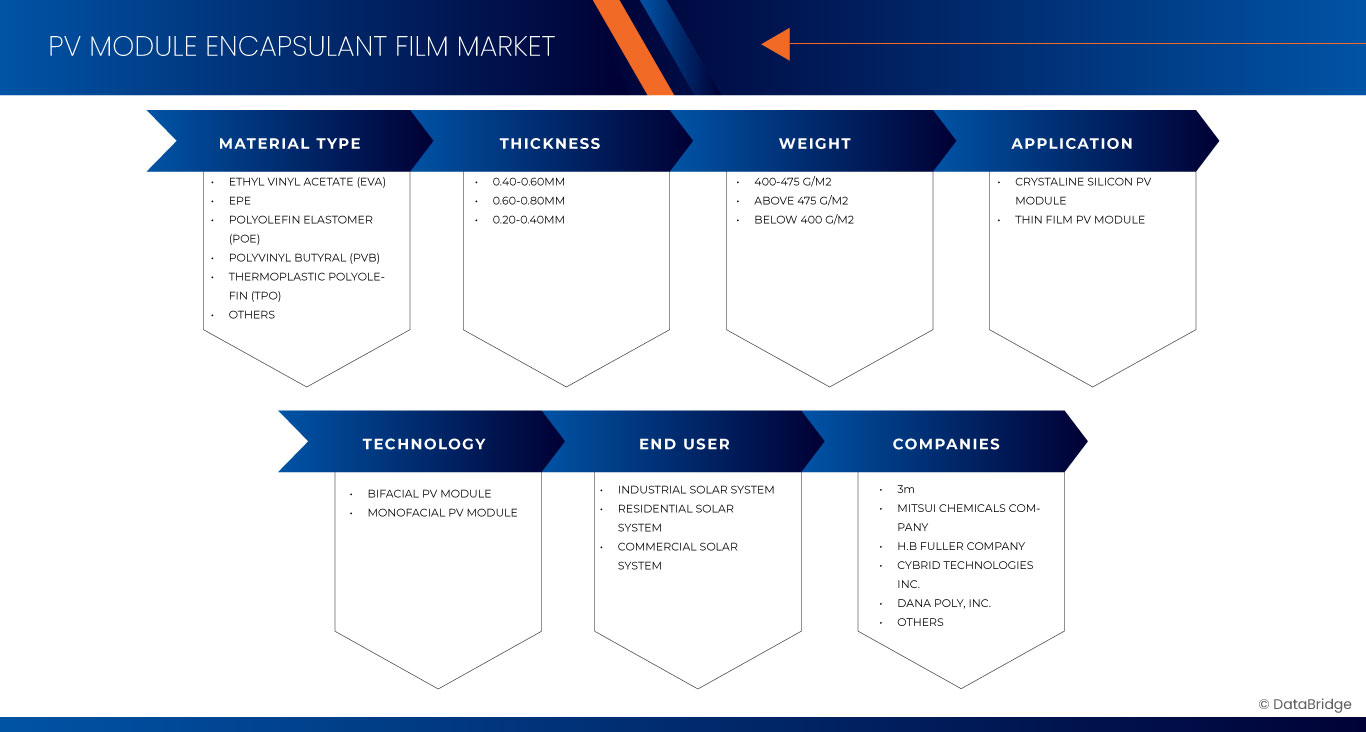
North America PV Module Encapsulant Film Market Segmentation, By Material Type (Ethyl Vinyl Acetate (EVA), EPE, Polyolefin Elastomer (POE), Polyvinyl Butyral (PVB), Thermoplastic Polyolefin (TPO), and others), Thickness (0.40-0.60MM, 0.60-0.80MM, and 0.20-0.40MM), Weight (400-475 G/M2, Above 475 G/M2, and Below 400 G/M2), Application (Crystaline Silicon PV Module, and Thin Film PV Module), Technology (Bifacial PV Module and Monofacial PV Module), End Use (Industrial Solar System, Residential Solar System, and Commercial Solar System) – Industry Trends and Forecast to 2032
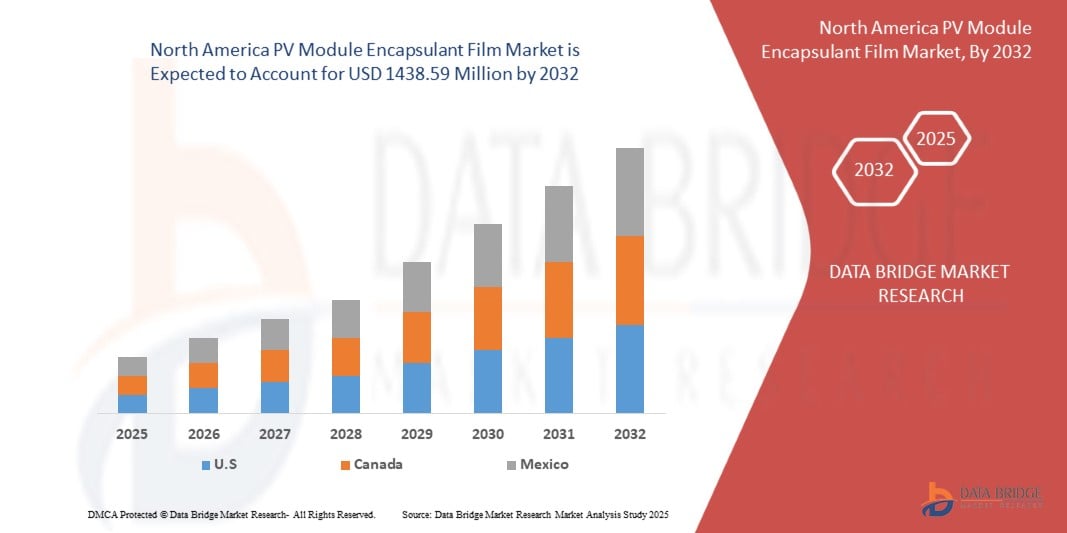
North America PV Module Encapsulant Film Market Analysis
A PV module encapsulant film is a crucial component in solar panels, designed to protect and enhance the performance of photovoltaic (PV) cells. These films, typically made from materials like ethylene-vinyl acetate (EVA), act as a protective layer that insulates the solar cells from environmental factors such as moisture, dust, and UV radiation. This encapsulation ensures the durability and longevity of the solar panels, making them more reliable and efficient.
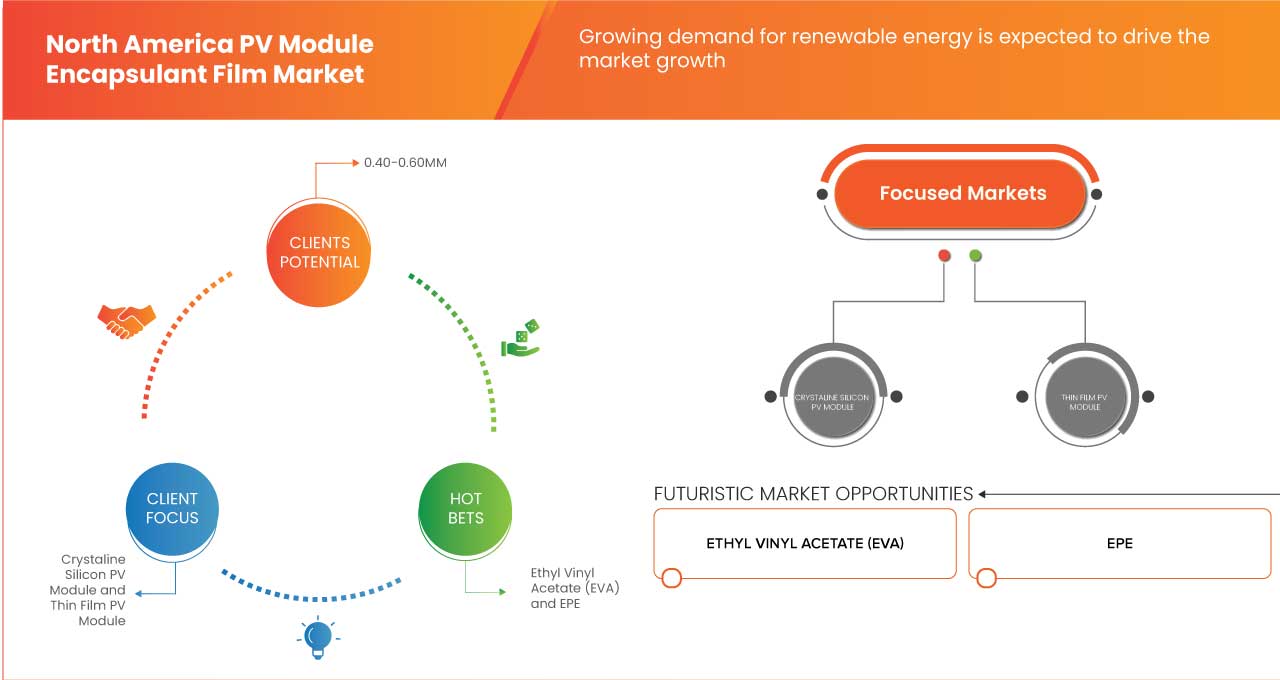
The market for PV module encapsulant films is growing in North America due to several factors. The increasing demand for renewable energy sources, driven by government initiatives and policies promoting solar energy, is a significant driver. Additionally, advancements in encapsulation materials and technologies have improved the efficiency and cost-effectiveness of solar panels, further boosting their adoption. The growing awareness of climate change and the need for sustainable energy solutions also contribute to the rising demand for PV module encapsulant films in the region.
North America PV Module Encapsulant Film Market Size
The North America PV module encapsulant film market is expected to reach USD 1438.59 million by 2032 from USD 386.62 million in 2024, growing with a substantial CAGR of 18.2% in the forecast period of 2025 to 2032.
North America PV module encapsulant film market Trends
“Increasing Installation of Rooftop Solar by Commercial and Residential Sectors”
The rising installation of rooftop solar systems in both the commercial and residential sectors is one of the most significant drivers for the growth of the North America PV Module Encapsulant Film Market. This shift toward solar energy is largely driven by the increasing demand for clean, renewable energy, government incentives, and the falling cost of solar technology. As more commercial buildings and homes adopt solar panels, the need for high-quality, durable encapsulant films has surged.
In the commercial sector, many businesses are turning to rooftop solar installations to reduce energy costs and meet sustainability targets. Companies, from large retailers to manufacturing facilities, are increasingly using solar panels to lower electricity expenses and minimize their carbon footprint. These large-scale installations require high-performance encapsulant films to ensure the solar modules' longevity and performance over time. Encapsulant films provide essential protection against environmental factors such as moisture, UV radiation, and mechanical stress, ensuring that solar panels operate at optimal efficiency.
Report Scope and Market Segmentation
|
Attributes |
North America PV module encapsulant film market Insights |
|
Segments Covered |
By Material Type: Ethyl Vinyl Acetate (EVA), EPE, Polyolefin Elastomer (POE), Polyvinyl Butyral (PVB), Thermoplastic Polyolefin (TPO), and others By Thickness: 0.40-0.60MM, 0.60-0.80MM, and 0.20-0.40MM By Weight: 400-475 G/M2, Above 475 G/M2, and Below 400 G/M2 By Application: (Crystaline Silicon PV Module, Thin Film PV Module), and Technology (Bifacial PV Module and Monofacial PV Module) By Technology: Bifacial PV Module and Monofacial PV Module By End Use: Industrial Solar System, Residential Solar System, and Commercial Solar System |
|
Countries Covered |
U.S., Canada, and Mexico |
|
Key Market Players |
3M (U.S.), Mitsui Chemicals Company (Japan), H.B Fuller Company (U.S.), Cybrid Technologies Inc. (China), Dana Poly, Inc. (U.S.), and JA Solar Technology Co.,Ltd. (China) |
|
Market Opportunities |
|
|
Value Added Data Infosets |
In addition to the insights on market scenarios such as market value, growth rate, segmentation, geographical coverage, and major players, the market reports curated by the Data Bridge Market Research also include import export analysis, production capacity overview, production consumption analysis, price trend analysis, climate change scenario, supply chain analysis, value chain analysis, raw material/consumables overview, vendor selection criteria, PESTLE Analysis, Porter Analysis, and regulatory framework. |
North America PV Module Encapsulant Film Market Definition
A PV encapsulant film is a protective layer used in Photovoltaic (PV) modules to safeguard solar cells from environmental factors such as moisture, dust, and mechanical damage, ensuring their long-term performance and durability. These films are typically made from materials like ethylene vinyl acetate (EVA), polyolefins (POE), or other advanced polymers.
North America PV Module Encapsulant Film Market Dynamics
Drivers
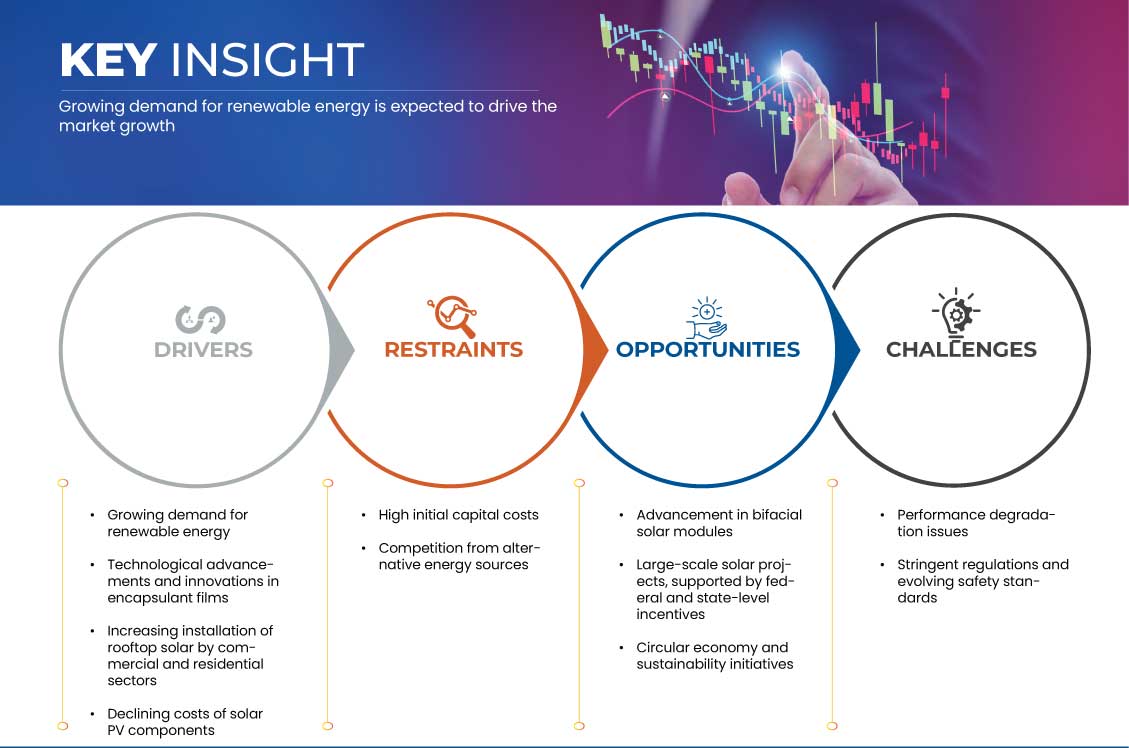
- Growing Demand for Renewable Energy
The North America Photovoltaic (PV) module encapsulant film market is witnessing significant growth, driven largely by the increasing demand for renewable energy sources, particularly solar power. The shift towards cleaner, more sustainable energy solutions has been a dominant trend, as governments and businesses prioritize the reduction of carbon footprints and the adoption of green energy alternatives. As a result, the demand for solar photovoltaic systems has risen sharply, which in turn, drives the growth of the PV module encapsulant film market.
Encapsulant films are crucial components in solar panels, as they provide structural support, protect the cells from environmental damage, and enhance the overall performance and longevity of photovoltaic modules. These films, typically made from materials like Ethylene Vinyl Acetate (EVA), are vital for ensuring the durability of solar modules, which is essential given the long-term nature of solar investments. With the expansion of solar installations, the demand for high-quality encapsulant films is increasing to ensure the reliability and efficiency of solar panels over time.
For instance,
- In 2023, according to an article by REN21, rising renewable energy demand, with North America seeing significant solar adoption. This growth drives the PV Module Encapsulant Film Market, as encapsulant films protect solar panels, ensuring durability. Expanding solar capacity highlights the region's commitment to meeting energy needs sustainably and reducing fossil fuel reliance
- In September 2024, according to an article by IRENA, growth in renewable power, with costs for solar and wind reaching historic lows. In North America, this surge fuels the PV Module Encapsulant Film Market as solar installations expand rapidly, driven by affordability, sustainability goals, and policies supporting renewable energy adoption across residential and commercial sectors
Technological Advancements and Innovations in Encapsulant Films
The North America Photovoltaic (PV) module encapsulant film Market is experiencing robust growth, driven significantly by technological advancements and innovations in encapsulant film materials and manufacturing processes. Encapsulant films are critical components of photovoltaic (PV) modules, as they protect solar cells from moisture, UV radiation, and mechanical stresses, while ensuring efficient light transmission and electrical insulation.
Innovations in encapsulant film technology focus on enhancing performance, durability, and environmental sustainability. the development of advanced materials such as ethylene-vinyl acetate (EVA) with improved crosslinking properties, thermoplastic polyolefins (TPO), and polyvinyl butyral (PVB) has led to encapsulants with superior thermal stability and resistance to delamination. These innovations are critical as solar panels are exposed to harsh environmental conditions for 20 to 30 years.
For instance,
- In February 2024, according to an article by Royal Society of Chemistry, innovations in encapsulant materials like thermoplastic polyolefins (TPO) and advanced transparent conductive films. These materials enhance solar panel durability, efficiency, and adaptability to bifacial technologies. Such advancements drive North America's PV Module Encapsulant Film Market, aligning with the growing adoption of high-performance solar energy systems
- In January 2023, according to an article by John Wiley & Sons, Inc, innovations in encapsulant films, including thermoplastic materials and UV-stabilized polymers, that improve solar panel efficiency and lifespan. These advancements cater to the increasing adoption of bifacial and tandem PV technologies, driving North America's PV Module Encapsulant Film Market in response to the region's accelerating renewable energy expansion
Opportunities
- Advancement in Bifacial Solar Modules
The North American Photovoltaic (PV) module encapsulant film market is witnessing significant opportunities, primarily driven by advancements in bifacial solar modules. Bifacial solar modules, which capture sunlight from both the front and rear sides of the panel, offer higher energy efficiency and performance compared to traditional monofacial solar panels. As the adoption of bifacial modules grows, the demand for advanced encapsulant films, a key component of these modules, is expected to rise.
Encapsulant films play a critical role in PV modules, providing structural integrity, durability, and protection against environmental factors such as moisture, temperature fluctuations, and UV radiation. The evolution of bifacial solar technology has brought forward the need for encapsulant films that can support the unique design and performance characteristics of these modules. Unlike traditional monofacial panels, bifacial modules are often installed in environments where they can harness reflected light, and as such, encapsulant films must be optimized for this double-sided energy collection.
One of the primary advancements in encapsulant technology for bifacial modules is the development of transparent, highly durable, and efficient materials that allow more light to pass through to the rear side of the solar cells. This transparency, combined with improved moisture resistance and UV stability, enhances the overall energy yield and longevity of the panels.
For instance,
- In October 2023, according to an article by Mibet Energy, Advancements in bifacial solar modules have significantly enhanced their efficiency by capturing sunlight from both the front and rear sides of the panel. These innovations include improved durability, with tempered glass that resists UV damage and extreme weather conditions. Bifacial panels also offer better performance in diffused light, reduced degradation over time, and longer warranties compared to monofacial panels, making them ideal for commercial and utility-scale applications
The rise of bifacial solar modules presents significant opportunities for the North American PV module encapsulant film market. Advancements in encapsulant technology, offering improved transparency, durability, and performance, align with growing demand for higher efficiency in solar energy. This trend will drive innovation and position North America as a key player in the renewable energy transition.
Restraint/Challenge
- High Initial Capital Costs
The high initial capital costs associated with solar Photovoltaic (PV) systems remain a major restraint. Solar energy adoption requires substantial upfront investment, including the cost of solar panels, inverters, installation, and encapsulant films, which impacts the decision-making process for both commercial and residential sectors.
For commercial and residential customers, the initial capital outlay for a solar PV system can be daunting. While solar energy promises long-term savings, the upfront cost of purchasing and installing the system remains high. Encapsulant films, which protect solar cells and enhance the longevity of PV modules, are a critical component of the overall solar system cost. While these films are essential for ensuring high performance, their cost contributes to the overall financial burden. For residential customers, even with incentives like tax credits and rebates, the total upfront expenditure is often seen as prohibitive, especially for those with limited access to financing or capital.
North America PV Module Encapsulant Film Market Scope
The market is segmented on the basis of by material type, thickness, weight, application, technology, and end use. The growth amongst these segments will help you analyze meagre growth segments in the industries and provide the users with a valuable market overview and market insights to help them make strategic decisions for identifying core market applications.
By Material Type
- Ethyl Vinyl Acetate (EVA)
- Ethyl Vinyl Acetate (EVA), BY MATERIAL TYPE
- Transparent EVA
- White EVA
- Anti-PID EVA
- Ethyl Vinyl Acetate (EVA), BY MATERIAL TYPE
- EPE
- Polyolefin Elastomer (POE)
- Polyvinyl Butyral (PVB)
- Thermoplastic Polyolefin (TPO)
- Others
By Thickness
- 0.40-0.60MM
- 0.60-0.80MM
- 0.20-0.40MM
By Weight
- 400-475 G/M2
- ABOVE 475 G/M2
- BELOW 400 G/M2
By Application
- Crystaline Silicon PV Module
- Crystaline Silicon PV Module, BY TYPE
- Polycrystaline Modlue
- Monocrystaline Modlue
- Crystaline Silicon PV Module, BY TYPE
- Thin Film PV Module
By Technology
- Bifacial PV Module
- Monofacial PV Module
By End Use
- Industrial Solar System
- Residential Solar System
- Commercial Solar System
North America PV Module Encapsulant Film Market Regional Analysis
The market is analyzed and market size insights and trends are provided by The market is segmented on the basis of by material type, thickness, weight, application, technology, and end use.
The countries covered in the market are U.S., Canada, Mexico.
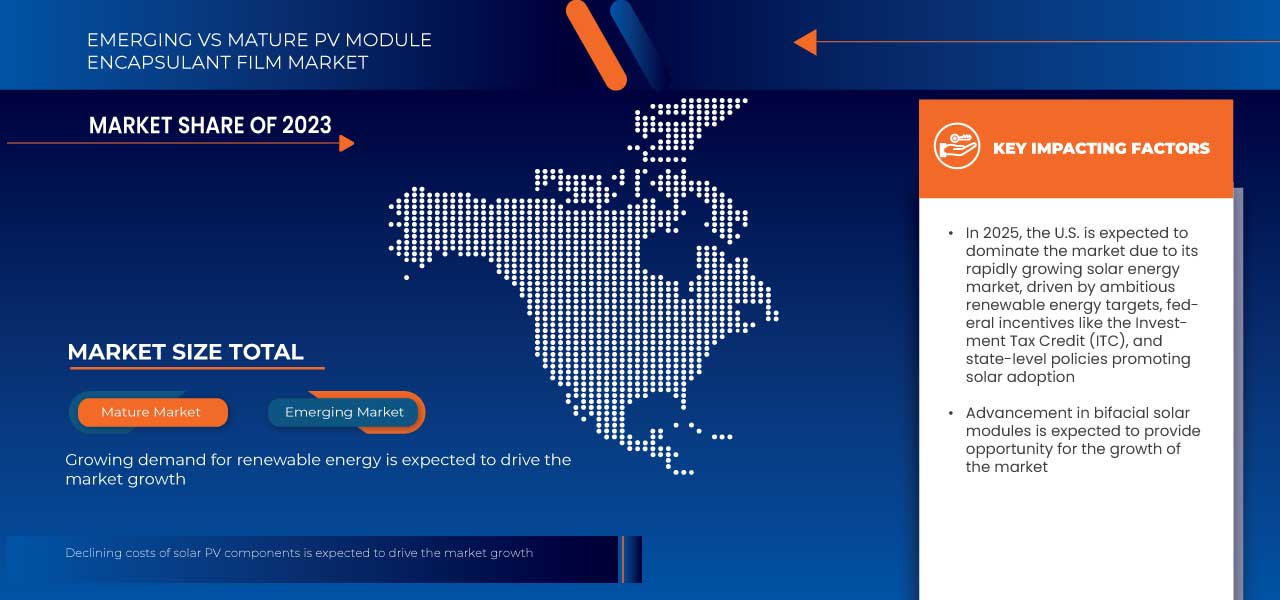
U.S. is expected to dominate and fastest growing country in the market due to technological advancements and innovations in encapsulant films.
The country section of the report also provides individual market impacting factors and changes in regulation in the market domestically that impacts the current and future trends of the market. Data points like down-stream and upstream value chain analysis, technical trends and porter's five forces analysis, case studies are some of the pointers used to forecast the market scenario for individual countries.
Also, the presence and availability of North America brands and their challenges faced due to large or scarce competition from local and domestic brands, impact of domestic tariffs and trade routes are considered while providing forecast analysis of the country data.
North America PV Module Encapsulant Film Market Share
The market competitive landscape provides details by competitors. Details included are company overview, company financials, revenue generated, market potential, investment in research and development, new market initiatives, North America presence, production sites and facilities, production capacities, company strengths and weaknesses, product launch, product width and breadth, application dominance. The above data points provided are only related to the companies' focus related to market.
North America PV Module Encapsulant Film Market Leaders Operating in the Market Are:
- 3M (U.S.)
- Mitsui Chemicals Company (Japan)
- H.B Fuller Company (U.S.)
- Cybrid Technologies Inc. (China)
- Dana Poly, Inc. (U.S.)
- JA Solar Technology Co.,Ltd. (China)
Latest Developments in North America PV Module Encapsulant Film Market
- In September 2024, H.B. Fuller has acquired HS Butyl Limited, the UK’s leading manufacturer of high-quality butyl tapes. This acquisition strengthens H.B. Fuller's position in the global waterproofing tape market and expands its reach in Europe, where the market is significantly larger than North America. It also offers growth opportunities in engineering adhesives
- In May 2024, H.B. Fuller has acquired ND Industries, a leader in fastener locking and sealing solutions. This acquisition expands H.B. Fuller's offerings in high-growth sectors such as automotive, electronics, and aerospace. ND Industries' Vibra-Tite brand and expertise in pre-applied coatings enhance H.B. Fuller's engineering adhesives capabilities, creating new opportunities for innovation and customer solutions
SKU-
세계 최초의 시장 정보 클라우드 보고서에 온라인으로 접속하세요

- 대화형 데이터 분석 대시보드
- 높은 성장 잠재력 기회를 위한 회사 분석 대시보드
- 사용자 정의 및 질의를 위한 리서치 분석가 액세스
- 대화형 대시보드를 통한 경쟁자 분석
- 최신 뉴스, 업데이트 및 추세 분석
- 포괄적인 경쟁자 추적을 위한 벤치마크 분석의 힘 활용
목차
1 서론
1.1 연구 목적
1.2 시장 정의
1.3 개요
1.4 제한 사항
1.5 대상 시장
2 시장 세분화
2.1 대상 시장
2.2 지리적 범위
연구에 2.3년이 고려됨
2.4 통화 및 가격
2.5 DBMR TRIPOD 데이터 검증 모델
2.6 다변량 모델링
2.7 주요 여론 선도자와의 1차 인터뷰
2.8 DBMR 시장 위치 그리드
2.9 DBMR 공급업체 점유율 분석
2.1 시장 적용 범위 그리드
2.11 2차 소스
2.12 가정
3 요약
4가지 프리미엄 인사이트
4.1 PESTEL 분석
4.1.1 정치적 요인
4.1.2 경제적 요인
4.1.3 사회적 요인
4.1.4 기술적 요인
4.1.5 환경 요인
4.1.6 법적 요소
4.1.7 결론
4.2 포터의 5가지 힘
4.2.1 신규 진입자의 위협
4.2.2 대체품의 위협
4.2.3 공급업체의 협상력
4.2.4 구매자의 협상력
4.2.5 경쟁적 경쟁
4.3 수입 수출 시나리오
4.4 가격 분석
4.5 생산 소비 분석
4.6 공급업체 선택 기준
4.6.1 품질 및 일관성
4.6.2 가격 및 비용 경쟁력
4.6.3 공급망 신뢰성 및 리드 타임
4.6.4 기술 역량 및 전문성
4.6.5 지속 가능성 및 규정 준수
4.6.6 평판 및 실적
4.6.7 혁신 및 장기적 파트너십
4.6.8 위험 완화 및 재정 안정성
4.7 기후 변화 시나리오
4.7.1 환경 문제
4.7.2 업계의 대응
4.7.3 정부의 역할
4.7.4 분석가 권장 사항
4.8 생산 능력 개요
4.8.1 태양열 에너지에 대한 시장 수요
4.8.2 캡슐화 필름 재료의 기술적 발전
4.8.3 원자재 가용성 및 공급망 역학
4.8.4 규제 및 정책 영향
4.8.5 경쟁 환경 및 주요 참여자
4.9 원자재 적용 범위
4.9.1 에틸렌 비닐 아세테이트(EVA)
4.9.1.1 투명한 EVA
4.9.1.2 화이트 에바
4.9.1.3 안티 PID EVA
4.9.2 폴리비닐 부티랄(PVB)
4.9.3 폴리올레핀 엘라스토머(POE)
4.9.4 열가소성 폴리올레핀(TPO)
4.9.5 기술 혁신
4.9.6 기타(이오노머 및 실리콘)
4.9.7 결론
4.1 공급망 분석
4.10.1 개요
4.10.2 물류 비용 시나리오
4.10.3 물류 서비스 제공자의 중요성
4.11 제조업체의 기술 발전
4.11.1 고급 재료 화학 및 제형
4.11.2 향상된 광학적 특성 및 효율성
4.11.3 캡슐화 필름용 신소재 개발
4.11.4 수축 저항 필름용 고급 제조 기계
4.11.5 결론
5 규정 적용 범위
6 시장 개요
6.1 드라이버
6.1.1 재생 에너지에 대한 수요 증가
6.1.2 캡슐화 필름의 기술적 진보 및 혁신
6.1.3 상업 및 주거 부문의 옥상 태양광 설치 증가
6.1.4 태양광 PV 구성 요소의 비용 감소
6.2 제약
6.2.1 높은 초기 자본 비용
6.2.2 대체 에너지원으로부터의 경쟁
6.3 기회
6.3.1 양면 태양열 모듈의 발전
6.3.2 연방 및 주 차원의 인센티브로 지원되는 대규모 태양열 프로젝트
6.3.3 순환 경제 및 지속 가능성 이니셔티브
6.4 과제
6.4.1 성능 저하 문제
6.4.2 엄격한 규정 및 진화하는 안전 표준
7 북미 PV 모듈 캡슐화 필름 시장, 재료 유형별
7.1 개요
7.2 에틸 비닐 아세테이트(EVA)
7.2.1 재료 유형별 에틸 비닐 아세테이트(EVA)
7.3 EPE
7.4 폴리올레핀 엘라스토머(POE)
7.5 폴리비닐부티랄(PVB)
7.6 열가소성 폴리올레핀(TPO)
7.7 기타
8 북미 PV 모듈 캡슐화 필름 시장, 두께별
8.1 2.1 개요
8.2 0.40-0.60mm
8.3 0.60-0.80mm
8.4 0.20-0.40mm
9 북미 PV 모듈 캡슐화 필름 시장, 중량 기준
9.1 개요
9.2 400-475 G/M2
9.3 475G/M2 이상
9.4 400G/M2 이하
10 북미 PV 모듈 캡슐화 필름 시장, 응용 분야별
10.1 개요
10.2 결정질 실리콘 PV 모듈
10.2.1 결정질 실리콘 PV 모듈, 유형별
10.3 박막 PV 모듈
11 북미 PV 모듈 캡슐화 필름 시장, 기술별
11.1 개요
11.2 양면 PV 모듈
11.3 단일면 PV 모듈
12 북미 PV 모듈 캡슐화 필름 시장, 최종 용도별
12.1 개요
12.2 산업용 태양열 시스템
12.3 주거용 태양열 시스템
12.4 상업용 태양계
13 북미 PV 모듈 캡슐화 필름 시장, 국가별
13.1 북미
13.1.1 미국
13.1.2 캐나다
13.1.3 멕시코
14 북미 PV 모듈 캡슐화 필름 시장: 회사 환경
14.1 회사 점유율 분석
15 SWOT 분석
16개 회사 프로필
16.1 3M
16.1.1 회사 스냅샷
16.1.2 수익 분석
16.1.3 제품 포트폴리오
16.1.4 최근 개발
16.2 미쓰이 케미컬스 ICT MATERIA, INC
16.2.1 회사 스냅샷
16.2.2 제품 포트폴리오
16.2.3 최근 개발
16.3 HB 풀러 회사
16.3.1 회사 스냅샷
16.3.2 수익 분석
16.3.3 제품 포트폴리오
16.3.4 최근 개발
16.4 사이브리드 테크놀로지 주식회사
16.4.1 회사 스냅샷
16.4.2 수익 분석
16.4.3 제품 포트폴리오
16.4.4 최근 개발
16.5 다나폴리 주식회사
16.5.1 회사 스냅샷
16.5.2 제품 포트폴리오
16.5.3 최근 개발
16.6 JA솔라테크놀로지 주식회사
16.6.1 회사 스냅샷
16.6.2 제품 포트폴리오
16.6.3 최근 개발
17 설문지
18 관련 보고서
표 목록
표 1 규정 적용 범위
표 2 북미 PV 모듈 캡슐화 필름 시장, 재료 유형별, 2018-2032 (USD 천 달러)
표 3 북미 PV 모듈 캡슐화 필름 시장, 재료 유형별, 2018-2032(톤)
표 4 북미 에틸 비닐 아세테이트(EVA) PV 모듈 캡슐화 필름 시장, 재료 유형별, 2018-2032(USD 천)
표 5 북미 PV 모듈 캡슐화 필름 시장, 두께별, 2018-2032 (USD 천)
표 6 북미 PV 모듈 캡슐화 필름 시장, 무게별, 2018-2032 (USD 천)
표 7 북미 PV 모듈 캡슐화 필름 시장, 응용 분야별, 2018-2032 (USD 천 달러)
표 8 북미 결정질 실리콘 PV 모듈 PV 모듈 캡슐화 필름 시장, 유형별, 2018-2032 (USD 천)
표 9 북미 PV 모듈 캡슐화 필름 시장, 기술별, 2018-2032 (USD 천)
표 10 북미 PV 모듈 캡슐화 필름 시장, 최종 용도별, 2018-2032 (USD 천 달러)
표 11 북미 PV 모듈 캡슐화 필름 시장, 국가별, 2018-2032 (USD 천 달러)
표 12 북미 PV 모듈 캡슐화 필름 시장, 국가별, 2018-2032(톤)
표 13 미국 PV 모듈 캡슐화 필름 시장, 재료 유형별, 2018-2032 (USD 천 달러)
표 14 미국 PV 모듈 캡슐화 필름 시장, 재료 유형별, 2018-2032(톤)
표 15 미국 PV 모듈 캡슐화 필름 시장에서의 에틸 비닐 아세테이트(EVA), 재료 유형별, 2018-2032 (USD 천 달러)
표 16 미국 PV 모듈 캡슐화 필름 시장, 두께별, 2018-2032 (USD 천)
표 17 미국 PV 모듈 캡슐화 필름 시장, 무게별, 2018-2032 (USD 천)
표 18 미국 PV 모듈 캡슐화 필름 시장, 응용 분야별, 2018-2032 (USD 천 달러)
표 19 미국 결정질 실리콘 PV 모듈 PV 모듈 캡슐화 필름 시장, 유형별, 2018-2032 (USD 천)
표 20 미국 PV 모듈 캡슐화 필름 시장, 기술별, 2018-2032 (USD 천)
표 21 미국 PV 모듈 캡슐화 필름 시장, 최종 용도별, 2018-2032 (USD 천 달러)
표 22 캐나다 PV 모듈 캡슐화 필름 시장, 재료 유형별, 2018-2032 (USD 천 달러)
표 23 캐나다 PV 모듈 캡슐화 필름 시장, 재료 유형별, 2018-2032(톤)
표 24 캐나다 에틸 비닐 아세테이트(EVA) PV 모듈 캡슐화 필름 시장, 재료 유형별, 2018-2032(USD 천)
표 25 캐나다 PV 모듈 캡슐화 필름 시장, 두께별, 2018-2032 (USD 천)
표 26 캐나다 PV 모듈 캡슐화 필름 시장, 중량 기준, 2018-2032 (USD 천)
표 27 캐나다 PV 모듈 캡슐화 필름 시장, 응용 분야별, 2018-2032 (USD 천)
표 28 캐나다 결정질 실리콘 PV 모듈 PV 모듈 캡슐화 필름 시장, 유형별, 2018-2032 (USD 천)
표 29 캐나다 PV 모듈 캡슐화 필름 시장, 기술별, 2018-2032 (USD 천)
표 30 캐나다 PV 모듈 캡슐화 필름 시장, 최종 용도별, 2018-2032 (USD 천)
표 31 멕시코 PV 모듈 캡슐화 필름 시장, 재료 유형별, 2018-2032 (USD 천)
표 32 멕시코 PV 모듈 캡슐화 필름 시장, 재료 유형별, 2018-2032(톤)
표 33 멕시코 에틸 비닐 아세테이트(EVA) PV 모듈 캡슐화 필름 시장, 재료 유형별, 2018-2032(USD 천)
표 34 멕시코 PV 모듈 캡슐화 필름 시장, 두께별, 2018-2032 (USD 천)
표 35 멕시코 PV 모듈 캡슐화 필름 시장, 무게별, 2018-2032 (USD 천)
표 36 멕시코 PV 모듈 캡슐화 필름 시장, 응용 분야별, 2018-2032 (USD 천 달러)
표 37 멕시코 PV 모듈 캡슐화 필름 시장에서의 결정질 실리콘 PV 모듈, 유형별, 2018-2032 (USD 천 달러)
표 38 멕시코 PV 모듈 캡슐화 필름 시장, 기술별, 2018-2032 (USD 천)
표 39 멕시코 PV 모듈 캡슐화 필름 시장, 최종 용도별, 2018-2032 (USD 천 달러)
그림 목록
그림 1 북미 PV 모듈 캡슐화 필름 시장
그림 2 북미 PV 모듈 캡슐화 필름 시장: 데이터 삼각 측량
그림 3 북미 PV 모듈 캡슐화 필름 시장: DROC 분석
그림 4 북미 PV 모듈 캡슐화 필름 시장: 지역 대 국가 시장 분석
그림 5 북미 PV 모듈 캡슐화 필름 시장: 회사 연구 분석
그림 6 북미 PV 모듈 캡슐화 필름 시장: 다변량 모델링
그림 7 북미 PV 모듈 캡슐화 필름 시장: 인터뷰 인구 통계
그림 8 북미 PV 모듈 캡슐화 필름 시장: DBMR 시장 위치 그리드
그림 9 북미 PV 모듈 캡슐화 필름 시장: 공급업체 점유율 분석
그림 10 북미 PV 모듈 캡슐화 필름 시장: 적용 범위 그리드
그림 11 북미 PV 모듈 캡슐화 필름 시장: 세분화
그림 12 6개 세그먼트로 구성된 북미 PV 모듈 캡슐화 필름 시장(재료별)(2024년)
그림 13 요약
그림 14 전략적 결정
그림 15 재생 에너지에 대한 수요 증가가 예측 기간 동안 북미 PV 모듈 캡슐화 필름 시장을 주도할 것으로 예상됨
그림 16 에틸 비닐 아세테이트(EVA) 세그먼트는 2025년과 2032년에 북미 PV 모듈 캡슐화 필름 시장에서 가장 큰 점유율을 차지할 것으로 예상됩니다.
그림 17 PESTEL 분석
그림 18 포터의 5가지 힘
그림 19 수입 수출 시나리오 (USD 천)
그림 20 북미 PV 모듈 캡슐화 필름 시장, 2023-2032, 평균 판매 가격(USD/KG)
그림 21 생산 소비 분석
그림 22 공급업체 선택 기준
그림 23 글로벌 LIDAR 시장의 동인, 제약, 기회 및 과제
그림 24 북미 PV 모듈 캡슐화 필름 시장: 재료 유형별, 2024
그림 25 북미 PV 모듈 캡슐화 필름 시장: 두께별, 2024년
그림 26 북미 PV 모듈 캡슐화 필름 시장: 무게별, 2024
그림 27 북미 PV 모듈 캡슐화 필름 시장: 응용 분야별, 2024년
그림 28 북미 PV 모듈 캡슐화 필름 시장: 기술별, 2024
그림 29 북미 PV 모듈 캡슐화 필름 시장: 최종 사용 기준, 2024
그림 30 북미 PV 모듈 캡슐화 필름 시장: 스냅샷(2024)
그림 31 북미 PV 모듈 캡슐화 필름 시장: 회사 점유율 2024(%)

연구 방법론
데이터 수집 및 기준 연도 분석은 대규모 샘플 크기의 데이터 수집 모듈을 사용하여 수행됩니다. 이 단계에는 다양한 소스와 전략을 통해 시장 정보 또는 관련 데이터를 얻는 것이 포함됩니다. 여기에는 과거에 수집한 모든 데이터를 미리 검토하고 계획하는 것이 포함됩니다. 또한 다양한 정보 소스에서 발견되는 정보 불일치를 검토하는 것도 포함됩니다. 시장 데이터는 시장 통계 및 일관된 모델을 사용하여 분석하고 추정합니다. 또한 시장 점유율 분석 및 주요 추세 분석은 시장 보고서의 주요 성공 요인입니다. 자세한 내용은 분석가에게 전화를 요청하거나 문의 사항을 드롭하세요.
DBMR 연구팀에서 사용하는 주요 연구 방법론은 데이터 마이닝, 시장에 대한 데이터 변수의 영향 분석 및 주요(산업 전문가) 검증을 포함하는 데이터 삼각 측량입니다. 데이터 모델에는 공급업체 포지셔닝 그리드, 시장 타임라인 분석, 시장 개요 및 가이드, 회사 포지셔닝 그리드, 특허 분석, 가격 분석, 회사 시장 점유율 분석, 측정 기준, 글로벌 대 지역 및 공급업체 점유율 분석이 포함됩니다. 연구 방법론에 대해 자세히 알아보려면 문의를 통해 업계 전문가에게 문의하세요.
사용자 정의 가능
Data Bridge Market Research는 고급 형성 연구 분야의 선두 주자입니다. 저희는 기존 및 신규 고객에게 목표에 맞는 데이터와 분석을 제공하는 데 자부심을 느낍니다. 보고서는 추가 국가에 대한 시장 이해(국가 목록 요청), 임상 시험 결과 데이터, 문헌 검토, 재생 시장 및 제품 기반 분석을 포함하도록 사용자 정의할 수 있습니다. 기술 기반 분석에서 시장 포트폴리오 전략에 이르기까지 타겟 경쟁업체의 시장 분석을 분석할 수 있습니다. 귀하가 원하는 형식과 데이터 스타일로 필요한 만큼 많은 경쟁자를 추가할 수 있습니다. 저희 분석가 팀은 또한 원시 엑셀 파일 피벗 테이블(팩트북)로 데이터를 제공하거나 보고서에서 사용 가능한 데이터 세트에서 프레젠테이션을 만드는 데 도움을 줄 수 있습니다.











