



Asia-Pacific Advanced Wound Care Dressings Market Segmentation, By Type (Foam Dressings, Hydrocolloid Dressings, Hydrofiber Dressings, Film Dressings, Alginate Dressings, Collagen Dressings, Hydrogel Dressings, Wound Contact Dressings, Superabsorbent Dressings, and Other Advanced Dressings), Wound Type (Surgical and Traumatic Wounds, Diabetic Foot Ulcers, Pressure Ulcers, Venous Leg Ulcers, Burns and Other Wounds), End User (Hospitals, ASCs, and Clinics, Home Care Settings, and Other End Users)- Industry Trends and Forecast to 2033
Asia-Pacific Advanced Wound Care Dressings Market Size
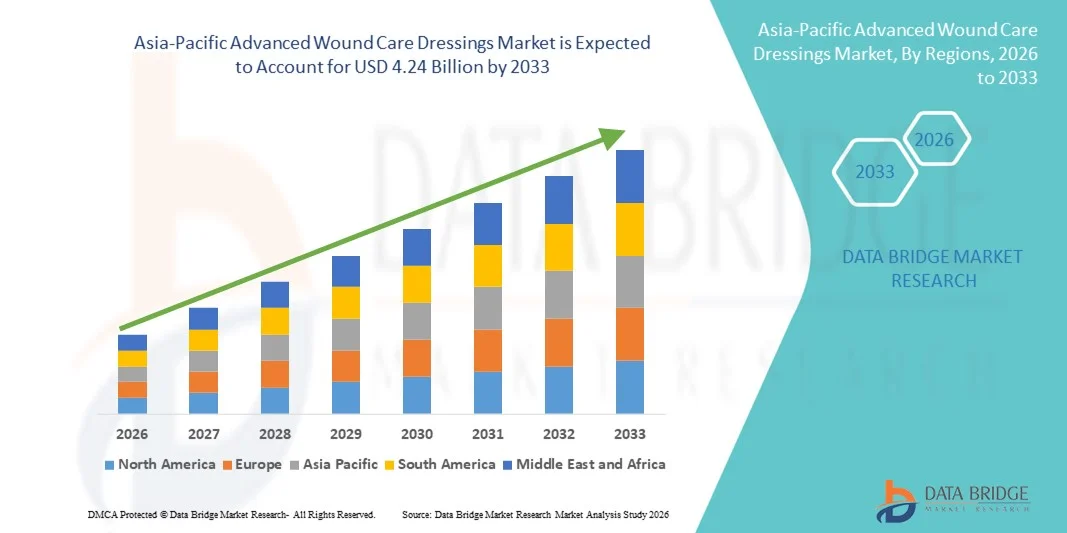
- The Asia-Pacific advanced wound care dressings market size was valued at USD 1.34 billion in 2025 and is expected to reach USD 4.24 billion by 2033, at a CAGR of 15.50% during the forecast period
- The market growth is largely fueled by the rising prevalence of chronic wounds such as diabetic foot ulcers, pressure ulcers, and venous leg ulcers, along with the increasing number of surgical procedures and traumatic injuries worldwide. These factors are driving the demand for advanced wound care solutions that promote faster healing and reduce the risk of infections across hospitals and healthcare facilities
- Furthermore, increasing awareness regarding effective wound management, along with continuous technological advancements in wound care materials such as hydrocolloids, foams, alginates, and antimicrobial dressings, is establishing advanced wound care dressings as a preferred solution for treating complex wounds. These converging factors are accelerating the uptake of Advanced Wound Care Dressings solutions, thereby significantly boosting the industry's growth
Asia-Pacific Advanced Wound Care Dressings Market Analysis
- Advanced wound care dressings, designed to promote faster healing and prevent infection in chronic and acute wounds, are becoming increasingly vital components of modern healthcare systems across hospitals, clinics, and home care settings due to their ability to maintain optimal moisture balance, reduce healing time, and improve patient outcomes
- The escalating demand for advanced wound care dressings is primarily fueled by the rising prevalence of chronic wounds such as diabetic foot ulcers, pressure ulcers, and venous leg ulcers, along with the increasing number of surgical procedures and traumatic injuries worldwide. In addition, the growing geriatric population and rising incidence of diabetes are further driving the adoption of advanced wound care solutions
- China dominated the advanced wound care dressings market with the largest revenue share of approximately 38.5% in 2025, supported by rapidly improving healthcare infrastructure, increasing prevalence of chronic wounds, and the strong presence of both domestic and international wound care product manufacturers. The country accounts for a major share due to rising adoption of technologically advanced wound care solutions across hospitals, clinics, and home healthcare services
- India is expected to be the fastest-growing region in the advanced wound care dressings market during the forecast period due to improving healthcare infrastructure, rising healthcare expenditure, increasing awareness regarding effective wound management, and the growing geriatric population, which is driving demand for advanced wound care solutions across hospitals, clinics, and home care settings
- The diabetic foot ulcers segment held the largest market revenue share of around 29.8% in 2025, primarily due to the rapidly increasing prevalence of diabetes worldwide
Report Scope and Advanced Wound Care Dressings Market Segmentation
|
Attributes |
Advanced Wound Care Dressings Key Market Insights |
|
Segments Covered |
|
|
Countries Covered |
Asia-Pacific
|
|
Key Market Players |
|
|
Market Opportunities |
|
|
Value Added Data Infosets |
In addition to the insights on market scenarios such as market value, growth rate, segmentation, geographical coverage, and major players, the market reports curated by the Data Bridge Market Research also include in-depth expert analysis, patient epidemiology, pipeline analysis, pricing analysis, and regulatory framework. |
Asia-Pacific Advanced Wound Care Dressings Market Trends
Increasing Adoption of Innovative and Bioactive Wound Dressings
- A significant and accelerating trend in the advanced wound care dressings market is the growing adoption of innovative and bioactive wound dressing technologies designed to promote faster healing and improve patient outcomes. Healthcare providers are increasingly utilizing advanced wound care products such as hydrocolloid, alginate, foam, and antimicrobial dressings to manage complex wounds more effectively
- For instance, hospitals and specialized wound care centers are adopting advanced dressings that help maintain optimal moisture levels at the wound site, reduce infection risk, and support faster tissue regeneration compared to traditional wound care products
- Technological advancements in wound care materials, including the use of bioactive compounds, antimicrobial agents, and highly absorbent materials, are improving the effectiveness of wound management solutions. These innovations are helping healthcare professionals treat chronic wounds such as diabetic foot ulcers, pressure ulcers, and venous leg ulcers more efficiently
- Furthermore, the growing use of advanced wound care dressings in surgical wound management and post-operative care is expanding the scope of these products in healthcare settings. The ability of these dressings to minimize infection risks and promote faster recovery is encouraging their wider adoption
- Increasing awareness regarding effective wound management, along with the expansion of specialized wound care clinics and treatment centers, is further supporting the demand for advanced wound care dressings globally
- As a result, manufacturers are focusing on developing innovative wound dressing materials with enhanced healing properties and improved patient comfort to meet the growing demand for effective wound care solutions
Asia-Pacific Advanced Wound Care Dressings Market Dynamics
Driver
Rising Prevalence of Chronic Wounds and Increasing Number of Surgical Procedures
- The increasing prevalence of chronic wounds, including diabetic foot ulcers, pressure ulcers, and venous leg ulcers, is a major factor driving the demand for advanced wound care dressings worldwide. Chronic wounds require specialized treatment and continuous care, making advanced wound dressings essential for effective healing
- For instance, the growing global burden of diabetes is contributing significantly to the rising incidence of diabetic foot ulcers, which often require advanced wound management solutions to prevent complications and improve healing outcomes
- In addition, the increasing number of surgical procedures performed globally is creating a strong demand for advanced wound dressings used in post-operative wound management. These dressings help protect surgical sites, prevent infections, and support faster recovery
- The rapidly growing aging population is also contributing to market growth, as elderly individuals are more susceptible to chronic wounds and slower wound healing
- Furthermore, increasing healthcare expenditure, improvements in healthcare infrastructure, and the growing availability of specialized wound care treatments are encouraging healthcare providers to adopt advanced wound care products
- These factors collectively are expected to significantly drive the growth of the global advanced wound care dressings market during the forecast period
Restraint/Challenge
High Cost of Advanced Wound Care Products and Limited Accessibility in Some Regions
- The high cost associated with advanced wound care dressings compared to traditional wound care products remains a significant challenge for market growth. Many advanced dressings incorporate specialized materials and technologies, which can increase their overall cost
- For instance, In several developing regions, limited access to advanced wound care products and inadequate healthcare infrastructure can restrict the adoption of these solutions. Smaller healthcare facilities may face budget constraints that limit their ability to procure advanced wound management products
- In addition, limited awareness regarding modern wound care practices in certain regions may result in continued reliance on conventional wound care methods rather than advanced treatment solutions
- Reimbursement limitations in some healthcare systems can also affect the adoption of advanced wound care products, particularly for patients requiring long-term wound management
- Addressing these challenges through improved healthcare infrastructure, greater awareness regarding advanced wound care technologies, and the development of cost-effective dressing solutions will be essential to support the sustained growth of the advanced wound care dressings market
Asia-Pacific Advanced Wound Care Dressings Market Scope
The Advanced Wound Care Dressings market is segmented on the basis of type, wound type, and end user.
- By Type
On the basis of type, the Advanced Wound Care Dressings market is segmented into foam dressings, hydrocolloid dressings, hydrofiber dressings, film dressings, alginate dressings, collagen dressings, hydrogel dressings, wound contact dressings, superabsorbent dressings, and other advanced dressings. The foam dressings segment dominated the largest market revenue share of approximately 24.6% in 2025, driven by their high absorbency, flexibility, and effectiveness in managing moderate to heavily exuding wounds. Foam dressings are widely used in clinical settings due to their ability to maintain a moist wound environment, which supports faster healing and reduces the risk of infection. These dressings are commonly used for treating chronic wounds such as pressure ulcers, diabetic foot ulcers, and venous leg ulcers. Healthcare professionals prefer foam dressings because they provide cushioning and protection for sensitive wound areas while allowing proper airflow. The increasing prevalence of chronic wounds among aging populations and diabetic patients is significantly boosting demand for advanced foam-based wound care solutions. In addition, technological advancements have led to the development of antimicrobial foam dressings that further enhance wound healing outcomes. Hospitals and wound care clinics frequently utilize foam dressings due to their ease of application and longer wear time. The growing awareness regarding advanced wound care management and infection prevention also contributes to the segment’s dominance. As healthcare systems continue to emphasize improved wound healing outcomes, foam dressings remain a widely preferred solution in advanced wound care treatment.
The collagen dressings segment is expected to witness the fastest CAGR of 8.5% from 2026 to 2033, driven by increasing adoption in the treatment of complex and chronic wounds. Collagen dressings promote wound healing by stimulating new tissue growth and supporting the natural repair process of the body. These dressings are particularly effective for managing wounds that have difficulty healing, such as diabetic foot ulcers and surgical wounds. The rising prevalence of diabetes worldwide has significantly increased the demand for advanced collagen-based wound care products. In addition, ongoing innovations in biomaterials and regenerative medicine are enhancing the effectiveness of collagen dressings in promoting tissue regeneration. Healthcare providers are increasingly incorporating collagen dressings into advanced wound care protocols due to their ability to accelerate healing and reduce healing time. The growing number of specialized wound care centers also supports the adoption of these products. Furthermore, increasing investments in research and development are leading to the introduction of improved collagen formulations with enhanced antimicrobial and healing properties. As healthcare providers focus on advanced regenerative therapies, collagen dressings are expected to experience strong growth during the forecast period.
- By Wound Type
On the basis of wound type, the Advanced Wound Care Dressings market is segmented into surgical and traumatic wounds, diabetic foot ulcers, pressure ulcers, venous leg ulcers, burns, and other wounds. The diabetic foot ulcers segment held the largest market revenue share of around 29.8% in 2025, primarily due to the rapidly increasing prevalence of diabetes worldwide. Diabetic patients are highly susceptible to foot ulcers due to poor blood circulation and nerve damage, which can lead to severe complications if not properly managed. Advanced wound care dressings play a critical role in preventing infections and promoting faster healing in diabetic foot ulcers. Healthcare providers widely recommend specialized dressings such as foam, hydrocolloid, and collagen-based products to manage these wounds effectively. The rising number of diabetic patients globally has significantly increased the demand for advanced wound care solutions. In addition, increasing awareness regarding early diagnosis and treatment of diabetic foot complications is encouraging patients to seek medical care earlier. Hospitals and wound care clinics are increasingly adopting advanced dressings to improve treatment outcomes and reduce the risk of amputations. Government initiatives aimed at diabetes management and preventive care further support the demand for advanced wound treatment products. As the global burden of diabetes continues to rise, the diabetic foot ulcers segment remains the leading application in the advanced wound care dressings market.
The burns segment is expected to witness the fastest CAGR of 8.1% from 2026 to 2033, driven by the increasing demand for specialized wound care products designed to treat burn injuries. Burn wounds require advanced dressings that can maintain moisture, prevent infection, and promote faster tissue regeneration. Modern advanced wound dressings such as hydrogel, alginate, and collagen-based products are widely used in burn treatment due to their ability to soothe pain and accelerate healing. The growing incidence of burn injuries caused by industrial accidents, household incidents, and natural disasters is significantly contributing to segment growth. In addition, advancements in wound care technologies are improving the effectiveness of burn treatment solutions. Healthcare professionals increasingly rely on advanced dressings that provide antimicrobial protection and reduce scarring during the healing process. The expansion of specialized burn care centers and trauma units further supports the adoption of advanced wound care products. Increasing healthcare awareness regarding proper burn management is also encouraging early treatment and the use of advanced wound care dressings. As healthcare systems continue to improve trauma and emergency care services, the burns segment is expected to grow rapidly during the forecast period.
- By End User
On the basis of end user, the Advanced Wound Care Dressings market is segmented into hospitals, ASCs and clinics, home care settings, and other end users. The hospitals segment dominated the market with the largest revenue share of approximately 45.2% in 2025, primarily due to the high volume of surgical procedures and trauma cases treated in hospital settings. Hospitals are the primary healthcare facilities for managing complex and chronic wounds that require advanced medical supervision. Patients with severe wounds, infections, or post-surgical complications often require specialized wound care treatments available in hospitals. In addition, hospitals are equipped with advanced wound management technologies and skilled healthcare professionals capable of delivering comprehensive wound care services. The increasing number of surgical procedures worldwide significantly contributes to the demand for advanced wound dressings in hospital environments. Furthermore, hospitals often handle emergency and trauma cases, which require immediate and effective wound treatment solutions. The presence of dedicated wound care units in many hospitals further supports the use of advanced dressings for faster healing and improved patient outcomes. Rising healthcare investments and improvements in hospital infrastructure also strengthen the dominance of this segment. As healthcare providers continue to focus on improving postoperative care and infection prevention, hospitals remain the leading end-user segment.
The home care settings segment is expected to witness the fastest CAGR of 8.4% from 2026 to 2033, driven by the growing preference for home-based healthcare services and long-term wound management. Many patients suffering from chronic wounds such as diabetic ulcers and pressure ulcers require continuous wound care, which can often be managed effectively at home. Advanced wound care dressings designed for easy application and extended wear time are increasingly supporting the growth of home-based treatment solutions. The rising aging population and increasing prevalence of chronic diseases are encouraging the adoption of home healthcare services. In addition, healthcare systems are promoting home care treatment to reduce hospital readmissions and lower healthcare costs. Portable wound care products and telehealth support are further enabling patients and caregivers to manage wound treatment at home. The availability of trained home healthcare professionals also contributes to the expansion of this segment. Increasing patient awareness regarding self-care and wound management further supports the adoption of advanced wound care dressings in home settings. As healthcare delivery models continue shifting toward patient-centered care, home care settings are expected to experience significant growth in the advanced wound care dressings market.
Asia-Pacific Advanced Wound Care Dressings Market Regional Analysis
- The Asia-Pacific advanced wound care dressings market is projected to grow significantly during the forecast period, supported by improving healthcare infrastructure, rising healthcare expenditure, and increasing awareness regarding effective wound management
- The region benefits from well-established hospital networks, specialized wound care centers, and growing adoption of technologically advanced wound care solutions across hospitals, clinics, and home healthcare services
- The rising prevalence of chronic conditions such as diabetes, obesity, and pressure ulcers is significantly driving the demand for advanced wound care dressings across the region. In addition, increasing surgical procedures, aging population, and expanding access to modern wound treatment technologies are further supporting market growth in APAC
China Advanced Wound Care Dressings Market Insight
China advanced wound care dressings market dominated the APAC Advanced Wound Care Dressings market with the largest revenue share of approximately 38.5% in 2025, supported by rapid healthcare infrastructure development, increasing prevalence of chronic wounds, and the strong presence of both domestic and international wound care product manufacturers. Rising adoption of advanced wound care solutions across hospitals, clinics, and home healthcare services is driving market dominance.
India Advanced Wound Care Dressings Market Insight
India advanced wound care dressings market is expected to be the fastest-growing market in APAC during the forecast period due to improving healthcare infrastructure, rising healthcare expenditure, growing awareness regarding effective wound management, and the expanding geriatric population. Increasing prevalence of chronic wounds, adoption of modern wound treatment technologies, and broader access to healthcare services across hospitals, clinics, and home care settings are fueling strong growth in the country.
Asia-Pacific Advanced Wound Care Dressings Market Share
The Advanced Wound Care Dressings industry is primarily led by well-established companies, including:
- 3M Company (U.S.)
- Smith & Nephew plc (U.K.)
- Mölnlycke Health Care AB (Sweden)
- ConvaTec Group plc (U.K.)
- Coloplast A/S (Denmark)
- Integra LifeSciences Holdings Corporation (U.S.)
- Medtronic plc (Ireland)
- Cardinal Health (U.S.)
- B. Braun SE (Germany)
- Paul Hartmann AG (Germany)
- Derma Sciences Inc. (U.S.)
- Acelity L.P. Inc. (U.S.)
- Hollister Incorporated (U.S.)
- Urgo Medical (France)
- Advanced Medical Solutions Group plc (U.K.)
- Medline Industries, LP (U.S.)
- Lohmann & Rauscher (Germany)
- Nitto Denko Corporation (Japan)
- Winner Medical Co., Ltd. (China)
- Essity AB (Sweden)
Latest Developments in Asia-Pacific Advanced Wound Care Dressings Market
- In November 2021, ConvaTec Group PLC announced the extension of its partnership with Vizient, Inc., a leading healthcare performance improvement company, to supply advanced wound care treatment products and technologies to Vizient member hospitals through 2025. The extended agreement strengthened ConvaTec’s distribution network and expanded access to advanced wound care dressings and related technologies across healthcare providers in the United States
- In June 2022, Smith+Nephew announced the establishment of a new research and manufacturing facility in the United Kingdom dedicated to its advanced wound management business. The facility was designed to support the development and production of next-generation wound care technologies, including advanced dressings and negative pressure wound therapy systems, reinforcing the company’s long-term commitment to innovation in wound healing solutions
- In January 2023, ConvaTec Group Plc introduced AQUACEL Ag+ Extra, an advanced antimicrobial dressing developed using the company’s Hydrofiber technology to address biofilm-related infections in chronic wounds such as diabetic foot ulcers, venous leg ulcers, and pressure injuries. The product was designed to improve infection control and enhance wound healing outcomes in complex clinical settings
- In February 2023, Smith+Nephew launched the PICO 7Y Single-Use Negative Pressure Wound Therapy System with AIRLOCK Technology, a portable wound therapy solution designed for surgical incisions and chronic wounds. The system improves fluid management and helps reduce surgical site complications while enabling clinicians to provide advanced wound care treatment in both hospital and outpatient environments
- In June 2023, JeNaCell, an Evonik company, announced the launch of the epicite balance wound dressing in Germany. The dressing is made from biosynthetic cellulose and is designed to maintain an optimal moist wound environment for treating chronic wounds such as venous leg ulcers, diabetic foot ulcers, and pressure ulcers
- In September 2024, 3M introduced the V.A.C. Peel and Place Dressing, an integrated dressing and drape system designed for use with negative pressure wound therapy. The product offers extended wear time and simplified application, enabling clinicians to manage wounds more efficiently while improving patient comfort and treatment outcomes
- In March 2025, Mölnlycke Health Care launched Mepilex Border Flex, a multi-layer silicone foam dressing designed to enhance conformability, manage wound exudate effectively, and reduce complications associated with chronic wound care. The product aims to improve healing outcomes while enhancing patient comfort during treatment
- In September 2025, Advamedica Inc. received U.S. FDA 510(k) clearance for MaxioCel, an advanced wound care dressing made from 100% chitosan and designed to manage moderate to heavily exuding wounds. The approval expanded the availability of the dressing in the United States and reinforced the adoption of innovative biomaterial-based wound care solutions
SKU-
Obtenha acesso online ao relatório sobre a primeira nuvem de inteligência de mercado do mundo

- Painel interativo de análise de dados
- Painel de análise da empresa para oportunidades de elevado potencial de crescimento
- Acesso de analista de pesquisa para personalização e customização. consultas
- Análise da concorrência com painel interativo
- Últimas notícias, atualizações e atualizações Análise de tendências
- Aproveite o poder da análise de benchmark para um rastreio abrangente da concorrência
Metodologia de Investigação
A recolha de dados e a análise do ano base são feitas através de módulos de recolha de dados com amostras grandes. A etapa inclui a obtenção de informações de mercado ou dados relacionados através de diversas fontes e estratégias. Inclui examinar e planear antecipadamente todos os dados adquiridos no passado. Da mesma forma, envolve o exame de inconsistências de informação observadas em diferentes fontes de informação. Os dados de mercado são analisados e estimados utilizando modelos estatísticos e coerentes de mercado. Além disso, a análise da quota de mercado e a análise das principais tendências são os principais fatores de sucesso no relatório de mercado. Para saber mais, solicite uma chamada de analista ou abra a sua consulta.
A principal metodologia de investigação utilizada pela equipa de investigação do DBMR é a triangulação de dados que envolve a mineração de dados, a análise do impacto das variáveis de dados no mercado e a validação primária (especialista do setor). Os modelos de dados incluem grelha de posicionamento de fornecedores, análise da linha de tempo do mercado, visão geral e guia de mercado, grelha de posicionamento da empresa, análise de patentes, análise de preços, análise da quota de mercado da empresa, normas de medição, análise global versus regional e de participação dos fornecedores. Para saber mais sobre a metodologia de investigação, faça uma consulta para falar com os nossos especialistas do setor.
Personalização disponível
A Data Bridge Market Research é líder em investigação formativa avançada. Orgulhamo-nos de servir os nossos clientes novos e existentes com dados e análises que correspondem e atendem aos seus objetivos. O relatório pode ser personalizado para incluir análise de tendências de preços de marcas-alvo, compreensão do mercado para países adicionais (solicite a lista de países), dados de resultados de ensaios clínicos, revisão de literatura, mercado remodelado e análise de base de produtos . A análise de mercado dos concorrentes-alvo pode ser analisada desde análises baseadas em tecnologia até estratégias de carteira de mercado. Podemos adicionar quantos concorrentes necessitar de dados no formato e estilo de dados que procura. A nossa equipa de analistas também pode fornecer dados em tabelas dinâmicas de ficheiros Excel em bruto (livro de factos) ou pode ajudá-lo a criar apresentações a partir dos conjuntos de dados disponíveis no relatório.











