



Asia-Pacific Espresso Coffee Market, By Type (Pure Espresso, Double Espresso, Ristretto, Cappuccino, Latte, Mocha, Macchiato, Americano, and Others), Beans (Coffee Arabica, Coffee Robusta, and Coffee Liberica), Roast (Medium, Dark, Light, and Others), Distribution Channel (Specialty Stores, Super Markets/Hyper Markets, Convenience Stores, E-Commerce, and Others), End User (Cafes and Restaurants, Offices, Airports, Homes, Hotels and Bars, Educational Institutes, Hospitals, and Others) – Industry Trends and Forecast to 2030.
Asia-Pacific Espresso Coffee Market Analysis and Size
Numerous industries hold significant commercial potential for espresso coffee. It forms the basis for a broad menu of beverages in the coffee shop and café industry, luring customers and generating revenue. Additionally, espresso coffee is used in the workplace to increase employee happiness and productivity by offering practical and superior coffee options. It also benefits the food service sector by being used as a stand-alone item and an ingredient in specialty desserts. Espresso coffee presents businesses with a flexible and lucrative opportunity to meet the rising demand for high-quality coffee experiences thanks to its robust flavor and cultural significance.
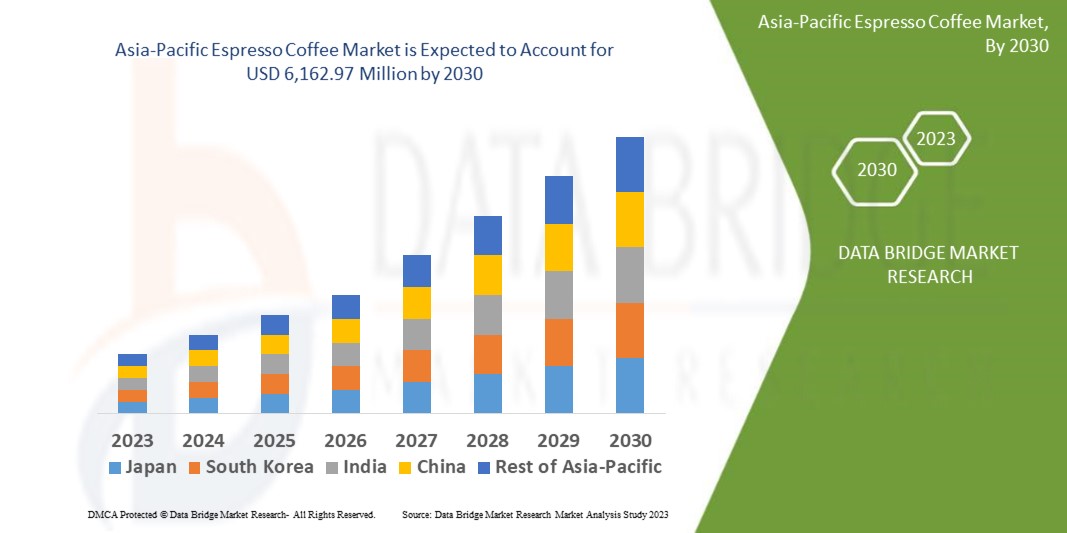
Data Bridge Market Research analyzes that the Asia-Pacific espresso coffee market, which was USD 4,274.34 million in 2022, would rocket up to USD 6,162.97 million by 2030, and is expected to undergo a CAGR of 4.7% during the forecast period. “Cappuccino” dominates the type segment of the market owing to the wider consumer adoption of cream and milk-based coffee products on a wider range.
In addition to the insights on market scenarios such as market value, growth rate, segmentation, geographical coverage, and major players, the market reports curated by the Data Bridge Market Research also include in-depth expert analysis, geographically represented company-wise production and capacity, network layouts of distributors and partners, detailed and updated price trend analysis and deficit analysis of supply chain and demand.
Asia-Pacific Espresso Coffee Market Scope and Segmentation
|
Report Metric |
Details |
|
Forecast Period |
2023 to 2030 |
|
Base Year |
2022 |
|
Historic Year |
2021 (Customizable to 2015-2020) |
|
Quantitative Units |
Revenue in USD Million |
|
Segments Covered |
By Type (Pure Espresso, Double Espresso, Ristretto, Cappuccino, Latte, Mocha, Macchiato, Americano, and Others), Beans (Coffee Arabica, Coffee Robusta, and Coffee Liberica), Roast (Medium, Dark, Light, and Others), Distribution Channel (Specialty Stores, Super Markets/Hyper Markets, Convenience Stores, E-Commerce, and Others), End User (Cafes and Restaurants, Offices, Airports, Homes, Hotels and Bars, Educational Institutes, Hospitals, and Others) |
|
Countries Covered |
Japan Indonesia, Philippines, South Korea, Australia, India, China, Singapore, Thailand, New Zealand, Taiwan, Malaysia, Hong Kong, and Rest of Asia-Pacific |
|
Market Players Covered |
LUIGI LAVAZZA SPA (Italy), illycaffè S.p.A. (Italy), Nestlé (Switzerland), Starbucks Coffee Company (U.S.), Massimo Zanetti Beverage Group (Italy), McDonald's (U.S.), The J.M. Smucker Company (U.S.), The Kraft Heinz Company (U.S.), and Cafe Coffee Day (India) among others |
|
Market Opportunities |
|
Market Definition
Espresso is a concentrated form of coffee served in small, strong shots and is the base for several coffee drinks. Espresso coffee is made from various types of coffee beans such as Arabica and Robusta among others. Arabica coffee contains a high concentration of caffeine. However, because espresso is typically served in smaller servings than coffee, it has less caffeine per serving. Various types of espresso coffee is available in the market such as ristretto, cappuccino, latte, and mocha among others. This coffee is widely preferred by consumers due to its unique taste and flavor.
Espresso coffee beans are ground to a finer consistency and firmly packed before hot water is forced through using an espresso machine. It has various health benefits, such as it boosts the immune system, helps in weight loss, and reduces stress, so widely preferred by consumers.
Asia-Pacific Espresso Coffee Market Dynamics
Drivers
- Antioxidant contents in espresso aid in the enhancement of health
The mineral composition of the coffee is changed depending upon its brewing method. Adult with the age above age of 25 will require to intake 750 mg/day for women and 950 mg/day for men. Therefore, it is estimated that, on average, consumption of two cups of coffee per day can provide 10% - 20% of the average mineral requirement in a human body which will also boost the body immune system. Magnesium acts as a cofactor for boosting the body metabolism. The daily human requirement for Mg is 400 mg, so consuming two cups of coffee provides about 7% - 10% of the required Mg amount in the human body. In nutritional terms, coffee can be regarded as a significant source of that mineral and other calcium in the human body which can help boost the body immune system on a wider range. The wide presence of nutrition in coffee boosts the body immune system and keeps it fit, which is a major factor driving market growth.
- Increasing workload and stress among consumers
According to the research conducted by World Health Organization, in developing countries, particularly in Latin America, various employees are dealing with work-related stress on a wider range which can lead to several psychological and sociological problems, and it is necessary for the employees to know the measure to cope up with it and how to reduce it.
Consumers are widely adopting coffee to reduce the stress levels in the body due to work-related stress. The caffeine present in the coffee injects adrenaline in the human body, which boosts the body immune system and also reduces the stress level from the body. Thus, the growing consumption of coffee among employees to reduce work-related stress and to refresh their mood during working time is a major factor driving market growth.
- The increasing number of local and franchised coffee shops
The wider consumer adoption of a lifestyle involving visiting coffee shops and coffee houses very often with family and friends to reduce their overall stress and to chill out and get quality time has induced many international and local players to expand their global footprint in the market by opening new coffee outlets in various areas, which is expected to drive market growth.
Opportunities
- Growing focus of manufacturers on the development of advanced coffee products
To sustain in the growing market and to fulfill the need of the consumers, various manufacturers are engaged in launching new and advanced coffee products with a pinch of different flavors by investing in the new product or by acquiring or with the merger with different coffee brands to sustain in the market, therefore providing opportunities for market growth.
-
Espresso infused with flavors
Coffee flavors can be natural, artificial, or a combination of both. Some coffee flavors are a combination of two or more existing flavors. An appropriate lab tasting took place by following all the guidelines to add the exact quantity of flavors to the coffee to ensure that the added flavor would not suppress the original taste of the coffee.
The infusion of different flavors in the coffee enhances its original taste. Due to the increasing consumer demand for flavored coffee, many manufacturers are adopting new flavor in their regular coffee products, providing opportunities for the manufacturers to grow in the future.
Restraint/Challenge
- Increasing risk of cardiovascular disease due to consumption of high amounts of caffeine
According to the study conducted by Regulatory Toxicology and Pharmacology, the consumption of more than 600 mg/day of caffeine can lead to cardiovascular diseases. Consumption of high amounts of coffee can lead to severe cardiovascular diseases, but limited consumption of coffee can be beneficial for health. Various consumers are switching to adopt other alternatives due to the high risk of cardiovascular diseases on the consumption of coffee, which is expected to restrain market growth.
The Asia-Pacific espresso coffee market report provides details of new recent developments, trade regulations, import-export analysis, production analysis, value chain optimization, market share, impact of domestic and localized market players, analyses opportunities in terms of emerging revenue pockets, changes in market regulations, strategic market growth analysis, market size, category market growths, application niches and dominance, product approvals, product launches, geographic expansions, technological innovations in the market. To gain more info on this market, contact Data Bridge Market Research for an Analyst Brief. Our team will help you make an informed market decision to achieve market growth.
Recent Developments
- In February 2019, Nestlé announced the launch of a new range of coffee products under the partnership with Starbucks. The new range consists of 24 products, including whole bean and roast and ground, and the first-ever Starbucks capsules developed using Nespresso and Nescafé Dolce Gusto proprietary coffee and system technologies. All these products are made with 100% high-quality arabica coffee. With this, the company will enhance its offering in the market.
- In December 2019, The J.M. Smucker Company announced the launch of a new cinematic ad campaign for 1850 Coffee, featuring creative as bold as the 'contraband caffeine' itself. Through this launch, the company expanded its product portfolio in the market.
Asia-Pacific Espresso Coffee Market Scope
The Asia-Pacific espresso coffee market is segmented into five notable segments based on type, beans, roast, distribution channel, and end user. The growth amongst these segments will help you analyze meager growth segments in the industries and provide the users with a valuable market overview and market insights to help them make strategic decisions for identifying core market applications.
Type
- Pure Espresso
- Double Espresso
- Ristretto
- Cappuccino
- Latte
- Mocha
- Macchiato
- Short Macchiato
- Long Macchiato
- Americano
- Others
Beans
- Coffee Arabica
- Coffee Robusta
- Kopi Luwak
- Kapéng Alamid
- Kahawa Kubing
- Coffee Liberica
Distribution Channel
- E-commerce
- Super Markets/Hyper Markets
- Convenience Stores
- Specialty Stores
- Others
Roast
- Light
- Medium
- Dark
- Others
End User
- Hotels and Bars
- Double Espresso
- Macchiato
- Ristretto
- Cappuccino
- Americano
- Latte
- Pure Espresso
- Mocha
- Others
- Offices
- Double Espresso
- Macchiato
- Ristretto
- Cappuccino
- Americano
- Latte
- Pure espresso
- Mocha
- Others
- Cafes and Resturants
- Double Espresso
- Macchiato
- Ristretto
- Cappuccino
- Americano
- Latte
- Pure Espresso
- Mocha
- Others
- Homes
- Double Espresso
- Macchiato
- Ristretto
- Cappuccino
- Americano
- Latte
- Pure Espresso
- Mocha
- Others
- Educational institutes
- Double Espresso
- Macchiato
- Ristretto
- Cappuccino
- Americano
- Latte
- Pure Espresso
- Mocha
- Others
- Hospitals
- Double Espresso
- Macchiato
- Ristretto
- Cappuccino
- Americano
- Latte
- Pure Espresso
- Mocha
- Others
- Airports
- Double Espresso
- Macchiato
- Ristretto
- Cappuccino
- Americano
- Latte
- Pure Espresso
- Mocha
- Others
- Others
- Double Espresso
- Macchiato
- Ristretto
- Cappuccino
- Americano
- Latte
- Pure Espresso
- Mocha
- Others
Asia-Pacific Espresso Coffee Market Regional Analysis/Insights
The Asia-Pacific espresso coffee market is analyzed and market size insights and trends are provided by country, type, beans, roast, distribution channel, and end user as referenced above.
The countries covered in this market report are Japan Indonesia, Philippines, South Korea, Australia, India, China, Singapore, Thailand, New Zealand, Taiwan, Malaysia, Hong Kong, and rest of Asia-Pacific.
Japan is expected to dominate the market due to the high preference for coffee among office employees to reduce their work stress on a wider range.
The country section of the report also provides individual market-impacting factors and changes in regulation in the market domestically that impact the current and future trends of the market. Data points like downstream and upstream value chain analysis, technical trends, Porter's five forces analysis, and case studies are some of the pointers used to forecast the market scenario for individual countries. Also, the presence and availability of regional brands and their challenges faced due to large or scarce competition from local and domestic brands, and the impact of domestic tariffs and trade routes are considered while providing forecast analysis of the country data.
Competitive Landscape and Asia-Pacific Espresso Coffee Market Share Analysis
The espresso coffee market competitive landscape provides details of competitors. Details included are company overview, company financials, revenue generated, market potential, investment in research and development, new market initiatives, regional presence, production sites and facilities, production capacities, company strengths and weaknesses, product launch, product width and breadth, and application dominance. The above data points provided are only related to the companies' focus related to the market.
Some of the major players operating in the Asia-Pacific espresso coffee market are:
- LUIGI LAVAZZA SPA (Italy)
- illycaffè S.p.A. (Italy)
- Nestlé (Switzerland)
- Starbucks Coffee Company (U.S.)
- Massimo Zanetti Beverage Group (Italy)
- McDonald's (U.S.)
- The J.M. Smucker Company (U.S.)
- The Kraft Heinz Company (U.S.)
- Cafe Coffee Day (India)
- Barista Coffee Company Limited (India)
SKU-
Obtenha acesso online ao relatório sobre a primeira nuvem de inteligência de mercado do mundo

- Painel interativo de análise de dados
- Painel de análise da empresa para oportunidades de elevado potencial de crescimento
- Acesso de analista de pesquisa para personalização e customização. consultas
- Análise da concorrência com painel interativo
- Últimas notícias, atualizações e atualizações Análise de tendências
- Aproveite o poder da análise de benchmark para um rastreio abrangente da concorrência
Metodologia de Investigação
A recolha de dados e a análise do ano base são feitas através de módulos de recolha de dados com amostras grandes. A etapa inclui a obtenção de informações de mercado ou dados relacionados através de diversas fontes e estratégias. Inclui examinar e planear antecipadamente todos os dados adquiridos no passado. Da mesma forma, envolve o exame de inconsistências de informação observadas em diferentes fontes de informação. Os dados de mercado são analisados e estimados utilizando modelos estatísticos e coerentes de mercado. Além disso, a análise da quota de mercado e a análise das principais tendências são os principais fatores de sucesso no relatório de mercado. Para saber mais, solicite uma chamada de analista ou abra a sua consulta.
A principal metodologia de investigação utilizada pela equipa de investigação do DBMR é a triangulação de dados que envolve a mineração de dados, a análise do impacto das variáveis de dados no mercado e a validação primária (especialista do setor). Os modelos de dados incluem grelha de posicionamento de fornecedores, análise da linha de tempo do mercado, visão geral e guia de mercado, grelha de posicionamento da empresa, análise de patentes, análise de preços, análise da quota de mercado da empresa, normas de medição, análise global versus regional e de participação dos fornecedores. Para saber mais sobre a metodologia de investigação, faça uma consulta para falar com os nossos especialistas do setor.
Personalização disponível
A Data Bridge Market Research é líder em investigação formativa avançada. Orgulhamo-nos de servir os nossos clientes novos e existentes com dados e análises que correspondem e atendem aos seus objetivos. O relatório pode ser personalizado para incluir análise de tendências de preços de marcas-alvo, compreensão do mercado para países adicionais (solicite a lista de países), dados de resultados de ensaios clínicos, revisão de literatura, mercado remodelado e análise de base de produtos . A análise de mercado dos concorrentes-alvo pode ser analisada desde análises baseadas em tecnologia até estratégias de carteira de mercado. Podemos adicionar quantos concorrentes necessitar de dados no formato e estilo de dados que procura. A nossa equipa de analistas também pode fornecer dados em tabelas dinâmicas de ficheiros Excel em bruto (livro de factos) ou pode ajudá-lo a criar apresentações a partir dos conjuntos de dados disponíveis no relatório.











