



Asia-Pacific Food Pathogen Testing Market, By Testing Type (System, Test Kits, Consumables and Others), Type Of Pathogen Testing (Salmonella SPP, E. Coli, Listeria SPP, Listeria, Vibrio SPP, Campylobacter and Others), Site (In-house/Internal Lab and Outsourcing Facility), Application (Meat and Poultry Products, Dairy Products, Processed Food, Plant-Based Meat and Meat Alternatives, Confectionary, Baby Food, Herbal Extracts and Herbs, Edible Oils, CBD Products, Honey and Spices) -Industry Trends and Forecast to 2029.
Asia-Pacific Food Pathogen Testing Market Analysis and Insights
Food pathogen testing is widely adopted by food and beverage manufacturers to ensure food safety as well as to fulfil the standards of food safety laid out by the governmental authorities. An increase in the prevalence of foodborne diseases and rising concern regarding food safety will increase the demand for food pathogen testing. Moreover, the increasing number of food recalls and stringent regulations laid by governmental bodies for pathogen testing are anticipated to propel the growth of the Asia-Pacific food pathogen testing market. However, small enterprises' lack of technical expertise may hamper the market's growth.
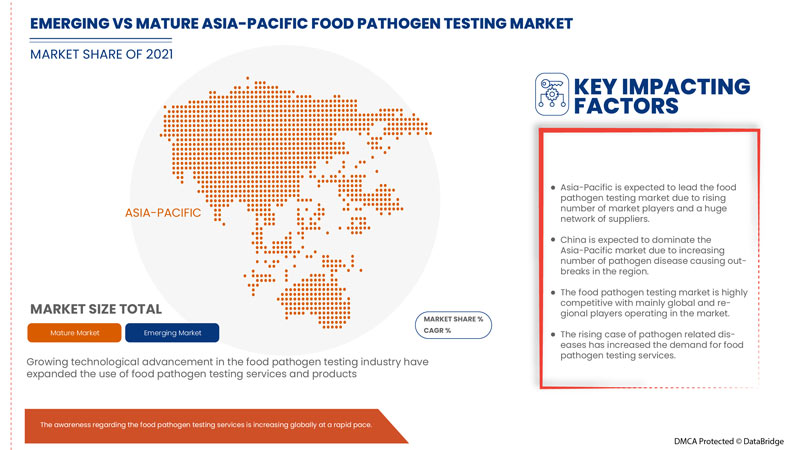
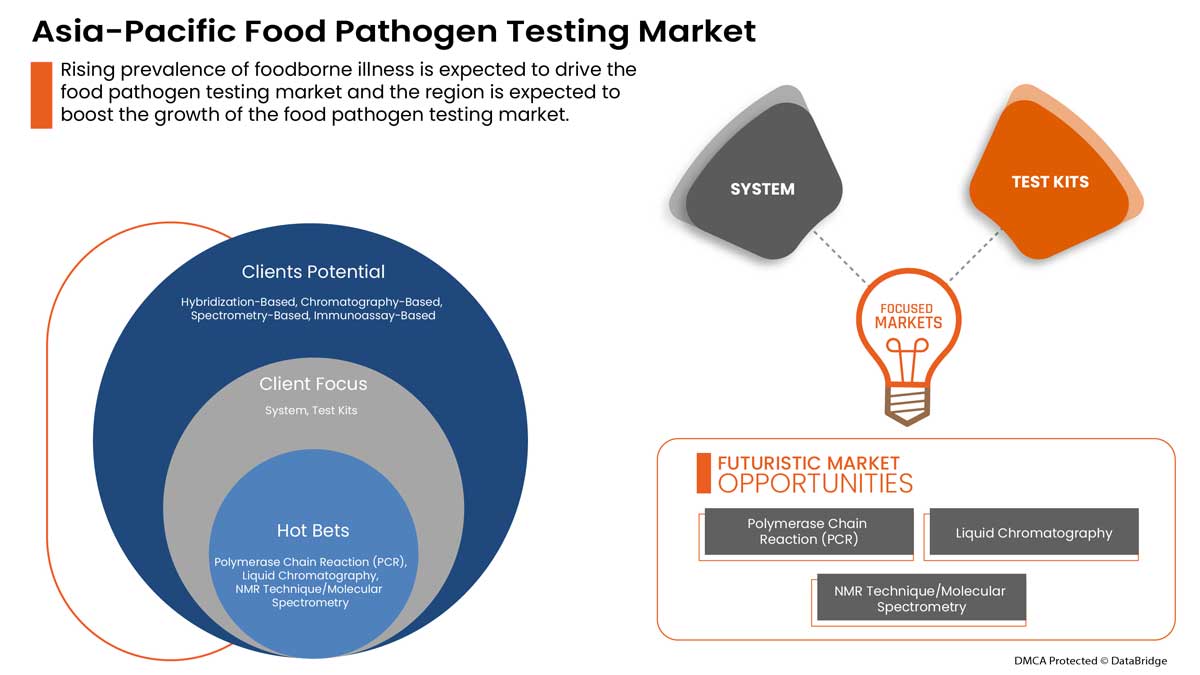
The increase in the technological advancement of food pathogen testing and the rising demand for rapid and sensitive technologies for food and beverage products is expected to create immense opportunities for manufacturers of food pathogen testing. On the other hand, the lack of uniform food safety standards may challenge the market's growth.
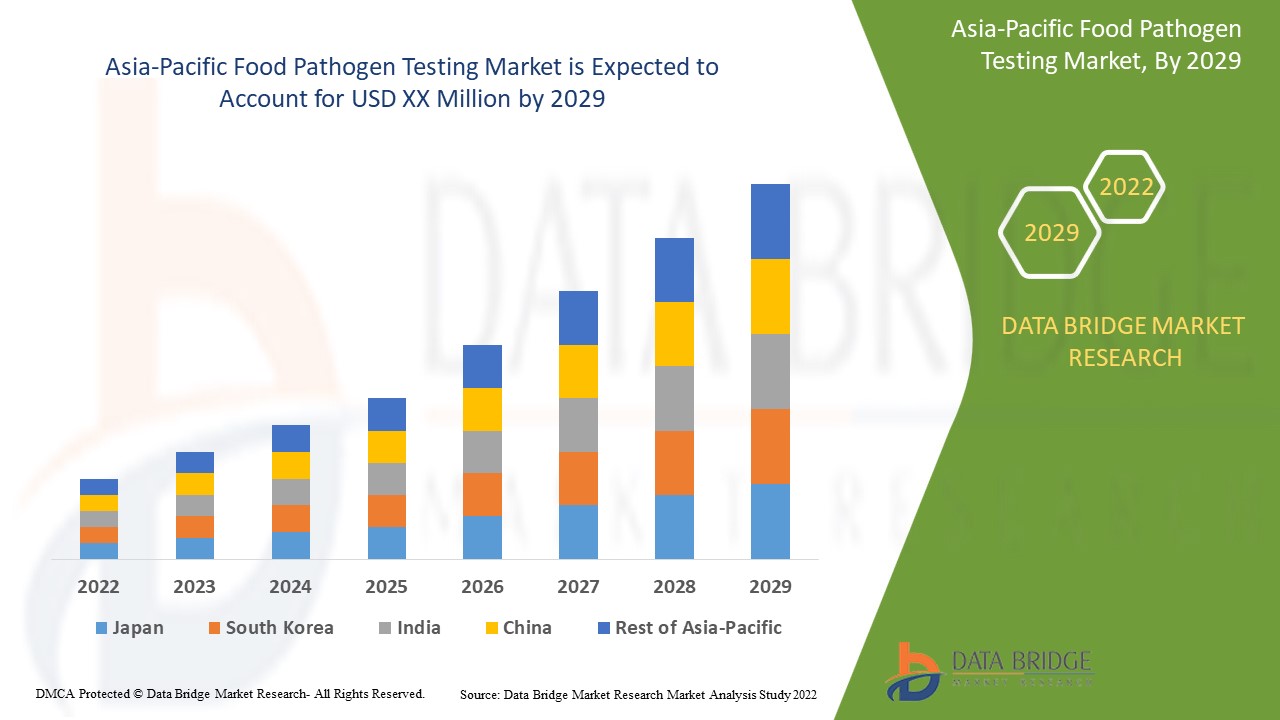
Data Bridge Market Research analyses that the Asia-Pacific food pathogen testing market will grow at a CAGR of 8.5% from 2022 to 2029 and is expected to reach USD 1,621.72 million by 2029.
|
Report Metric |
Details |
|
Forecast Period |
2022 to 2029 |
|
Base Year |
2021 |
|
Historic Years |
2020 (Customizable to 2019 - 2015) |
|
Quantitative Units |
Revenue in USD Million, Pricing in USD, Volumes in Units |
|
Segments Covered |
By Testing Type (System, Test Kits, Consumables and Others), Type Of Pathogen Testing (Salmonella SPP, E. Coli, Listeria SPP, Listeria, Vibrio SPP, Campylobacter and Others), Site (In-house/Internal Lab and Outsourcing Facility), Application (Meat and Poultry Products, Dairy Products, Processed Food, Plant-Based Meat and Meat Alternatives, Confectionary, Baby Food, Herbal Extracts and Herbs, Edible Oils, CBD Products, Honey and Spices) |
|
Countries Covered |
Japan, China, South Korea, India, Australia, Singapore, Malaysia, Indonesia, Thailand, Philippines and Rest of Asia-Pacific |
|
Market Players Covered |
3M, PerkinElmer Inc., Thermo Fisher Scientific Inc., bioMérieux SA, Agilent Technologies, Inc., Shimadzu Corporation, Neogen Corporation, Randox Food Diagnostics, FOSS, Ring Biotechnology Co Ltd., Omega Diagnostics Group PLC, Romer Labs Division Holding GmbH |
Market Definition
Food pathogen testing is important to reduce and ultimately eliminate foodborne illnesses caused by foodborne pathogens, including bacteria, viruses and others. Almost 31 known bacteria and viruses and more unidentified agents cause foodborne illness. Pathogen testing is a process that is implemented in every step of food production to food packaging to ensure food safety and sanitation. The most common foodborne illness is caused by salmonella, listeria and E. coli. Food pathogen testing can be done either by conventional cell culture standard method or using advanced technologies or methodologies such as polymerase chain reaction (PCR), enzyme-linked immunosorbent assay (ELISA) and others. The elimination of foodborne pathogens is desired for the entire food industry to decrease the cases of foodborne illness.
Asia-Pacific Food Pathogen Testing Market Dynamics
This section deals with understanding the market drivers, advantages, opportunities, restraints and challenges. All of this is discussed in detail below:
Drivers
- Rise in prevalence of foodborne illnesses
Foodborne illnesses are caused by consuming spoiled or contaminated food with pathogenic bacteria, viruses, parasites and others, leading to infection. The rising instances of foodborne disease among consumers globally create massive demand for food pathogen testing equipment. The main reason behind the increased foodborne illness in the food industry is the unaware workforce, food handlers and manufacturers, as they lack knowledge of modern technologies, good manufacturing practices (GMP), hazard analysis and critical control points (HACCP) systems, quality control. The lack of knowledge among workers leads to an increase in the prevalence of foodborne diseases. The rising instances of foodborne illness globally increase the demand for food pathogen testing to improve food safety.
Hence, the increasing number of foodborne illnesses and rising deaths due to contaminated food will aid in the growth of the food pathogen testing market.
- Growing concern regarding food safety
The demand for high-quality and safe food has increased recently due to greater awareness of the food quality issue in response to market pressure and reaction to other factors such as health concerns, which have been seen in the increased number of foodborne illnesses. The increasing incidences of foodborne diseases have prompted consumers to bring about vital changes in their diet and lifestyle, making them more concerned regarding food safety. Food safety is important not only for 'consumers' health but also for the entire food industry and regulatory authorities. The government is promoting safe food with rising concern about food safety among consumers.
Therefore, the rising demand for food safety and the need for food pathogen testing for food products to ensure that the product is safe for consumption is expected to boost the growth of the Asia-Pacific food pathogen testing market.
Opportunity
-
Technological advancements in food pathogen testing
The demand for effective and technologically advanced food pathogen testing methods is increasing owing to rising concerns related to food safety and an increasing prevalence of foodborne illness. Foodborne pathogens such as bacteria, fungi, viruses and others can cause harm to consumers if they remain unchecked in food products. Traditional food pathogen testing methods are time-consuming and the need for the technologically advanced process is increasing. New technologies are developed to check the presence of food pathogens in food products efficiently.
Thus, technological advancements play a significant role in food pathogen testing as they help ensure that the food is safe to consume and helps reduce the case of foodborne illness, which is expected to create a good opportunity for the food pathogen testing market.
Restraint/Challenge
- Lack of technical expertise in small enterprises
Small enterprise food manufacturers do not know enough about food pathogen testing methods, services, or programs. They will not be able to meet the food safety requirements. Therefore, a lack of skills and knowledge, especially in developing countries, will affect the effective evaluation and inspection of food operations. Technical expertise and knowledge are essential to implement any such procedures. Thus, the government should conduct certain programs to educate workers so that maximum food safety and pathogen testing and, therefore, safety can be achieved. Lack of experience and technical knowledge, especially in small enterprises, will lead to serious contamination in food products, resulting in foodborne disease and can cause severe problems. The lack of expertise and technical knowledge could harm the food and pathogen testing industries.
Such a lack of knowledge and technical expertise in small enterprises will restrict the growth of the Asia-Pacific pathogen testing market.
Post COVID-19 Impact on Asia-Pacific Food Pathogen Testing Market
COVID-19 has affected the market to some extent. Due to the lockdown, the manufacturing and production of many small and large companies were halted and the demand for food pathogen testing also increased, influencing the market. Post-pandemic, the need for food pathogen testing has increased due to the increasing demand for fermented beverages, soft drinks and many others. Due to the change in many mandates and regulations, manufacturers can design and launch new products in the market, which will help the market's growth.
Recent Development
- In April 2017, According to the United Nations' Food and Agriculture Organization, food availability in Asia and the developed world is now, on average, above 75 percent (as measured by daily calories) of that accessible in the developed world. Insufficient cereals, sugar, vegetable oils, meat and dairy products are gradually being replaced by increasingly processed grains, sugar, vegetable oils and meat. Food processors will provide more food as this trend continues, increasing testing. This shift indicates that the Asian food processing sector and thus the Asian food testing market, has great growth potential
Asia-Pacific Food Pathogen Testing Market Scope
Asia-Pacific food pathogen testing market is segmented based on testing type, type of pathogen testing, site and application. The growth amongst these segments will help you analyze major growth segments in the industries and provide the users with a valuable market overview and market insights to make strategic decisions to identify core market applications.
Testing type
- System
- Test kits
- Consumables
- Others
Based on testing type, Asia-Pacific food pathogen testing market is segmented into system, test kits, consumables and others.
Type of pathogen testing
- Salmonella SPP
- E.Coli
- Listeria SPP
- Listeria
- Vibrio SPP
- Campylobacter
- Others
Based on pathogen testing, Asia-Pacific food pathogen testing market is segmented into Salmonella SPP, E.Coli, Listeria SPP, Listeria, Vibrio SPP, Campylobacter and others.
Site
- In-house/internal lab
- Outsourcing facility
Based on site, Asia-Pacific food pathogen testing market is segmented into in-house/internal lab and outsourcing facility.
Application
- Meat and Poultry Products
- Dairy Products
- Processed Food
- Plant-Based Meat and Meat Alternatives
- Confectionary
- Baby Food
- Herbal Extracts and Herbs
- Edible Oil
- CBD Products
- Honey
- Spices
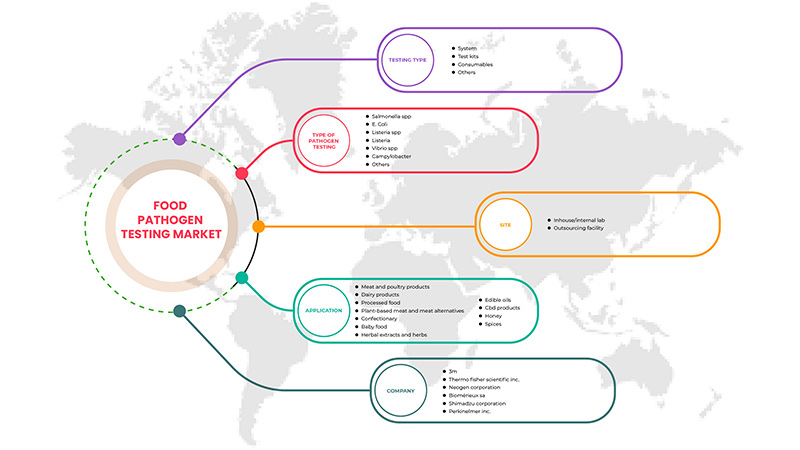
Based on application, Asia-Pacific food pathogen testing market is segmented into meat and poultry products, dairy products, processed food, plant-based meat and meat alternatives, confectionary, baby food, herbal extracts and herbs, edible oils, CBD products, honey and spices.
Asia-Pacific Food Pathogen Testing Market Regional Analysis/Insights
Asia-Pacific food pathogen testing market is analyzed and market size insights and trends are provided as referenced above.
The countries covered in the Asia-Pacific food pathogen testing market report are Japan, China, South Korea, India, Australia, Singapore, Malaysia, Indonesia, Thailand, Philippines and Rest of Asia-Pacific.
Australia is expected to dominate the Asia-Pacific food pathogen testing market in terms of market share and market revenue and is estimated to maintain its dominance during the forecast period due to the growing surge for food pathogen testing in various types of industries for testing their food products and growing consumer demand from the end users.
The region section of the report also provides individual market-impacting factors and changes in regulations that impact the market's current and future trends. Data points, such as new and replacement sales, country demographics, disease epidemiology and import-export tariffs, are some of the major pointers used to forecast the market scenario for individual countries. In addition, the presence and availability of Asia-Pacific brands, the challenges faced due to high competition from local and domestic brands and the impact of sales channels are considered while providing a forecast analysis of the country data.
Competitive Landscape and Asia-Pacific Food Pathogen Testing Market Share Analysis
The Asia-Pacific food pathogen testing market competitive landscape provides details on the competitors. Components included are company overview, company financials, revenue generated, market potential, investment in research and development, new market initiatives, Asia-Pacific presence, production sites and facilities, production capacities, company strengths and weaknesses, product launch, product width and breadth and application dominance. The above data points are only related to the companies focus on the Asia-Pacific food pathogen testing market.
Some of the major players operating in Asia-Pacific food pathogen testing market are 3M, PerkinElmer Inc., Thermo Fisher Scientific Inc., bioMérieux SA, Agilent Technologies, Inc., Shimadzu Corporation, Neogen Corporation, Randox Food Diagnostics, FOSS, Ring Biotechnology Co Ltd., Omega Diagnostics Group PLC and Romer Labs Division Holding GmbH among others.
Research Methodology
Data collection and base year analysis are done using data collection modules with large sample sizes. The market data is analyzed and estimated using market statistical and coherent models. In addition, market share analysis and key trend analysis are the major success factors in the market report. The key research methodology used by the DBMR research team is data triangulation which involves data mining, analysis of the impact of data variables on the market and primary (industry expert) validation. Data models include Vendor Positioning Grid, Market Time Line Analysis, Market Overview and Guide, Company Positioning Grid, Company Market Share Analysis, Standards of Measurement, Asia-Pacific Vs Regional and Vendor Share Analysis. Please request an analyst call in case of further inquiry.
SKU-
Obtenha acesso online ao relatório sobre a primeira nuvem de inteligência de mercado do mundo

- Painel interativo de análise de dados
- Painel de análise da empresa para oportunidades de elevado potencial de crescimento
- Acesso de analista de pesquisa para personalização e customização. consultas
- Análise da concorrência com painel interativo
- Últimas notícias, atualizações e atualizações Análise de tendências
- Aproveite o poder da análise de benchmark para um rastreio abrangente da concorrência
Metodologia de Investigação
A recolha de dados e a análise do ano base são feitas através de módulos de recolha de dados com amostras grandes. A etapa inclui a obtenção de informações de mercado ou dados relacionados através de diversas fontes e estratégias. Inclui examinar e planear antecipadamente todos os dados adquiridos no passado. Da mesma forma, envolve o exame de inconsistências de informação observadas em diferentes fontes de informação. Os dados de mercado são analisados e estimados utilizando modelos estatísticos e coerentes de mercado. Além disso, a análise da quota de mercado e a análise das principais tendências são os principais fatores de sucesso no relatório de mercado. Para saber mais, solicite uma chamada de analista ou abra a sua consulta.
A principal metodologia de investigação utilizada pela equipa de investigação do DBMR é a triangulação de dados que envolve a mineração de dados, a análise do impacto das variáveis de dados no mercado e a validação primária (especialista do setor). Os modelos de dados incluem grelha de posicionamento de fornecedores, análise da linha de tempo do mercado, visão geral e guia de mercado, grelha de posicionamento da empresa, análise de patentes, análise de preços, análise da quota de mercado da empresa, normas de medição, análise global versus regional e de participação dos fornecedores. Para saber mais sobre a metodologia de investigação, faça uma consulta para falar com os nossos especialistas do setor.
Personalização disponível
A Data Bridge Market Research é líder em investigação formativa avançada. Orgulhamo-nos de servir os nossos clientes novos e existentes com dados e análises que correspondem e atendem aos seus objetivos. O relatório pode ser personalizado para incluir análise de tendências de preços de marcas-alvo, compreensão do mercado para países adicionais (solicite a lista de países), dados de resultados de ensaios clínicos, revisão de literatura, mercado remodelado e análise de base de produtos . A análise de mercado dos concorrentes-alvo pode ser analisada desde análises baseadas em tecnologia até estratégias de carteira de mercado. Podemos adicionar quantos concorrentes necessitar de dados no formato e estilo de dados que procura. A nossa equipa de analistas também pode fornecer dados em tabelas dinâmicas de ficheiros Excel em bruto (livro de factos) ou pode ajudá-lo a criar apresentações a partir dos conjuntos de dados disponíveis no relatório.











