


Europe Acrylic Monomers Market, By Product (Acrylamide and Methacrylamide, Acrylate, Acrylic Acids and Salts, Acrylonitrile, Bisphenol Acrylics, Carbohydrate monomers, Fluorinated Acrylics, Malemide, Polyfunctional Acrylics, and Others), Application (Plastic, Adhesives and Sealants, Synthetic Resins, Acrylic Fibers, Building materials, Fabrics, Acrylic Rubber, and Others), End-Use (Paints and Coatings, Building and Construction, Automotive, Consumer Goods, Packaging, Water Treatment, Marine, Aerospace, and Others) - Industry Trends and Forecast to 2030.
Europe Acrylic Monomers Market Analysis and Size
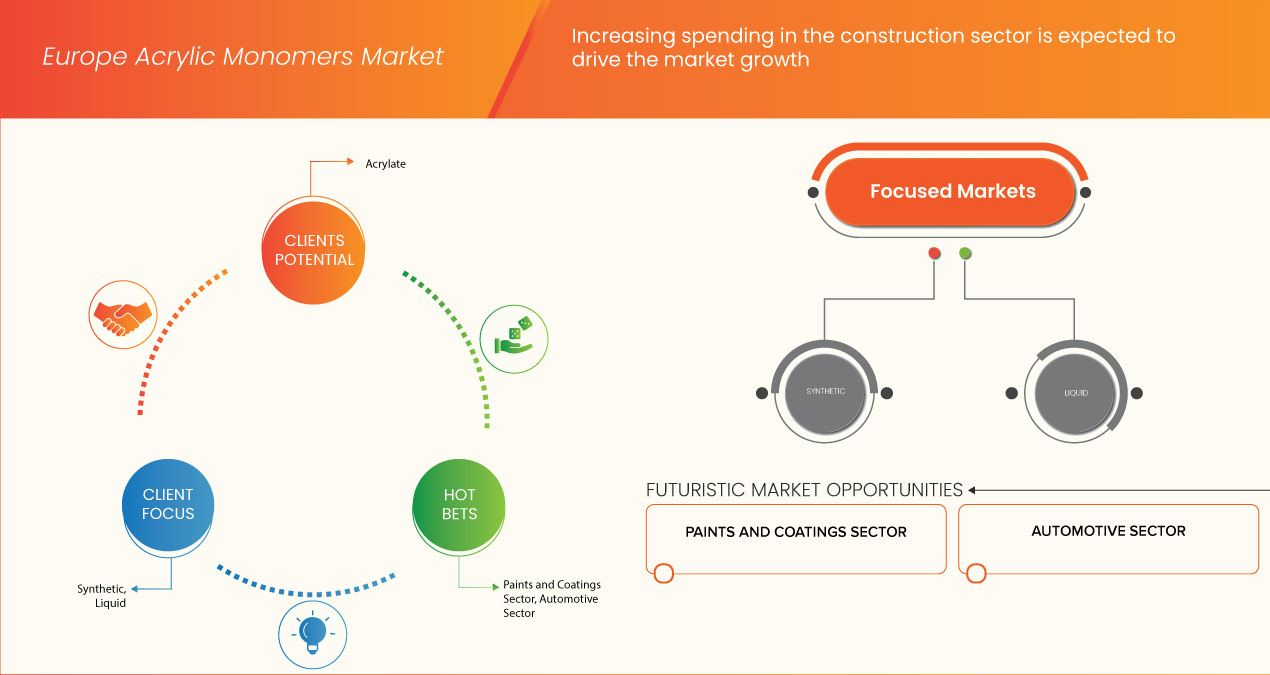
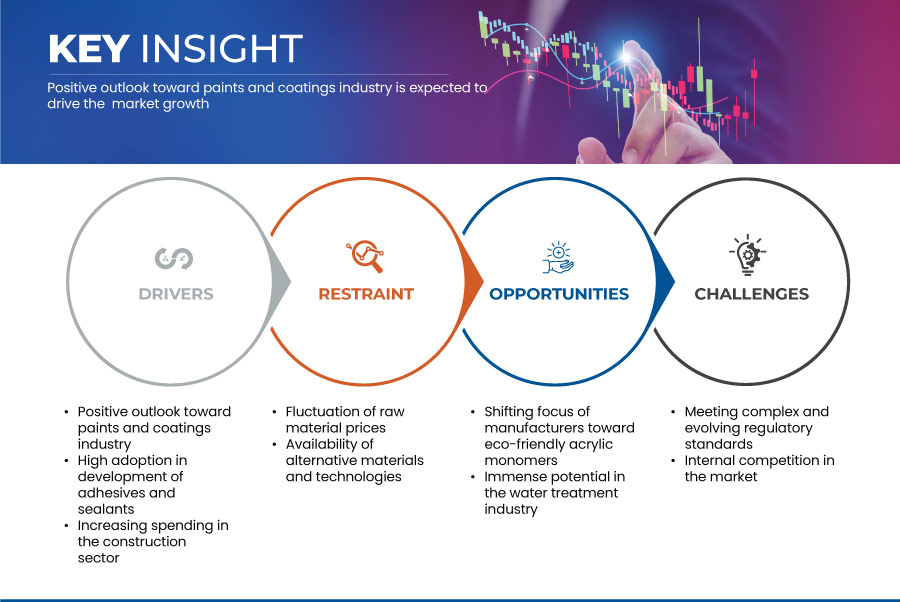
The Europe acrylic monomers market is driven by increasing spending in the construction sector. In addition, a positive outlook toward the paints and coating industry is an important driver for the market. Moreover, the shifting focus of manufacturers toward eco-friendly acrylic monomers is expected to boost market growth. However, meeting complex and evolving regulatory standards is expected to restrain market growth.
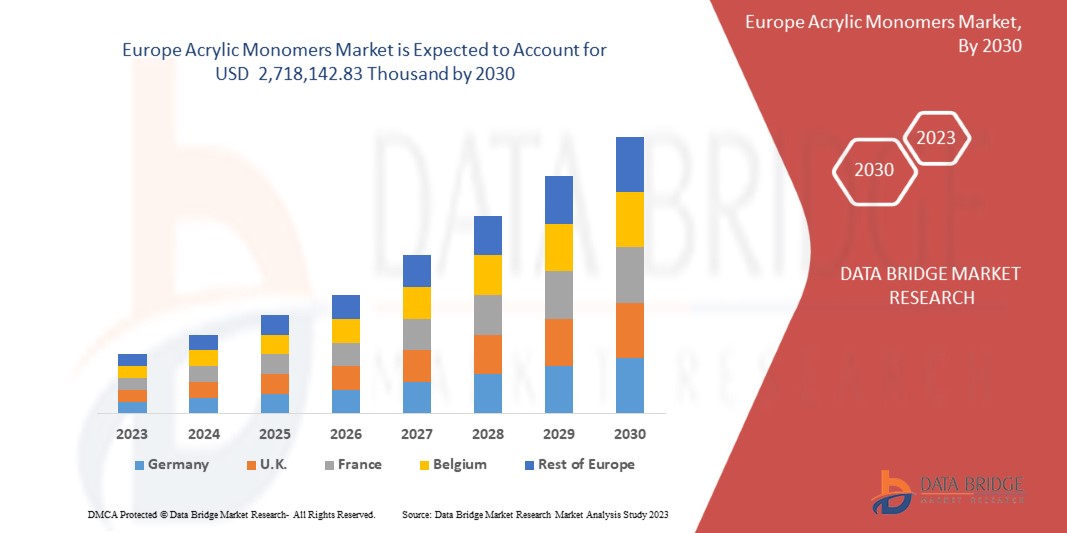
Data Bridge Market Research analyses that the Europe acrylic monomers market is expected to reach the value of USD 2,718,142.83 thousand by 2030 from USD 1,901,459.57 thousand in 2022, at a CAGR of 4.7% during the forecast period.
|
Report Metric |
Details |
|
Forecast Period |
2023 to 2030 |
|
Base Year |
2022 |
|
Historic Year |
2021 (Customizable 2015-2020) |
|
Quantitative Units |
Revenue in USD Thousand |
|
Segments Covered |
Product (Acrylamide and Methacrylamide, Acrylate, Acrylic Acids and Salts, Acrylonitrile, Bisphenol Acrylics, Carbohydrate monomers, Fluorinated Acrylics, Malemide, Polyfunctional Acrylics, and Others), Application (Plastic, Adhesives and Sealants, Synthetic Resins, Acrylic Fibers, Building materials, Fabrics, Acrylic Rubber, and Others), End-Use (Paints and Coatings, Building and Construction, Automotive, Consumer Goods, Packaging, Water Treatment, Marine, Aerospace, and Others) |
|
Countries Covered |
Germany, U.K., Italy, France, Spain, Switzerland, Russia, Turkey, Belgium, Netherlands, and Rest of Europe |
|
Market Players Covered |
BASF SE, Arkema, Mitsubishi Chemical Group Corporation, DOW, LG Chem, Evonik Industries AG, NIPPON SHOKUBAI CO., LTD, LobaChemie Pv.t Ltd., Solventis, Tokyo Chemical Industries CO., Ltd. and among others |
Europe Acrylic Monomers Market Definition
Acrylic monomers are those compounds that contain acrylic acid, and the related compound called acrylates. The compound which is named acrylic is mainly an acrylate or acrylic acid or polymer. Acrylic monomers are highly reactive chemicals. Acrylic monomer liquids are generally used with polymer powder to produce long-lasting acrylic nails. Acrylic monomers contain Ethyl Methacrylate (EMA), owing to their maximum strength, rapid implementation, and superior adhesion properties.
Europe Acrylic Monomers Market Dynamics
This section deals with understanding the market drivers, advantages, opportunities, restraints, and challenges. All of these are discussed in detail below:
Drivers
- Positive Outlook toward the Paints and Coating Industry
The paints and coatings industry holds a positive outlook concerning the market, driven by various factors and applications that contribute to its growth. One of the primary drivers behind the positive outlook for the paints and coatings industry is the extensive use of acrylic monomers, specifically N-butyl acrylate. These monomers serve as essential building blocks for copolymers used in the formulation of paints and coatings. These properties include the ability to form hydrophobic polymers, which are crucial for creating coatings that provide protection and durability. This property makes them particularly valuable in the formulation of coatings, where water resistance and durability are essential. Methacrylate, another essential acrylic monomer derived from methacrylic acid, enjoys widespread usage in diverse applications, including computer screens and paints.
The demand for high-performance coatings with exceptional durability, weather resistance, and clarity has been on the rise. Acrylic monomers, with their hydrophobic nature and ability to form tough polymers, meet these demands effectively. Manufacturers in the paints and coatings industry increasingly turn to acrylic copolymers to enhance the quality and longevity of their products. The expansion of construction and infrastructure projects worldwide has generated significant demand for paints and coatings, which is expected to drive market growth.
- Increasing Spending in the Construction Sector
The construction sector stands as a vital pillar of economic development, shaping the skylines of cities and laying the foundation for infrastructure growth. The surge in construction spending is primarily attributed to the growing urbanization and population expansion. With more people moving to cities, there is an escalating demand for residential, commercial, and infrastructure development. Governments and private investors are pouring substantial funds into construction projects to meet these demands. This surge in construction activity catalyzes the market.
Acrylic monomers, with their ability to fortify concrete, are the ideal solution. They reinforce the concrete matrix, reducing the risk of cracks and fractures. This increased durability ensures that structures can withstand the test of time, aligning perfectly with the long-term goals of construction projects. Acrylic monomers play a pivotal role in this endeavor by improving the workability and flowability of concrete. With optimized water-cement ratios and enhanced fluidity, construction teams can efficiently pour and consolidate concrete, enabling the realization of intricate and daring designs. This not only saves time but also reduces labor costs, making it an economically attractive choice for construction projects. Acrylic monomers provide the required adhesion, water resistance, and durability, making them an indispensable component in the construction of these monumental structures, which is expected to drive market growth.
Opportunities
- Shifting the Focus of Manufacturers toward Eco-friendly Acrylic Monomers
The acrylic monomer market is currently witnessing a significant shift in focus, with manufacturers increasingly turning their attention towards eco-friendly acrylic monomers. One key driver behind this shift is the increasing concern for the environment. In recent years, there has been a growing awareness of the environmental impact of traditional acrylic monomers, which are often derived from fossil fuels and can release harmful emissions during their production. This has led to a heightened demand for more environmentally friendly alternatives. Manufacturers are now investing in research and development to create acrylic monomers that are derived from renewable resources and have a reduced environmental impact.
Furthermore, stringent government regulations and policies aimed at reducing greenhouse gas emissions are pushing manufacturers to adopt more sustainable practices. This regulatory pressure is driving the development and adoption of eco-friendly acrylic monomers as a means to comply with environmental standards. As a result, manufacturers who embrace this shift in focus are likely to gain a competitive edge in the market. The shift towards eco-friendly acrylic monomers also aligns with changing consumer preferences. Today's consumers are more environmentally conscious and are increasingly seeking products that are produced using sustainable and eco-friendly processes thus providing the opportunity for the growth of the market.
- Immense Potential in the Water Treatment Industry
The water treatment industry is currently witnessing immense potential, creating a promising opportunity for the acrylic monomer market. In recent years, concerns about water pollution and scarcity have grown significantly, driving the need for effective water treatment solutions. Acrylic monomers, particularly glacial acrylic acid, play a crucial role in this industry as they are used as flocculent polymers. These polymers aid in the removal of impurities and contaminants from water, making it safer and more suitable for various applications.
One of the key applications of acrylic monomers, such as glacial acrylic acid, is their role as flocculent polymers. In water treatment processes, flocculants are substances that help in the agglomeration and precipitation of suspended particles. Glacial acrylic acid can serve as a monomer for the production of these flocculent polymers. When added to water, these polymers bind to impurities and contaminants, causing them to form agglomerated flakes. This process is critical in the removal of pollutants, including organic matter, chemicals, and heavy metals, from water sources. The agglomerated flakes formed with the help of acrylic monomers can be easily filtered out, resulting in cleaner water. This is particularly valuable in industries where the quality of water is of utmost importance, such as municipal water treatment plants, industrial processes, and even in the production of drinking water. The ability of acrylic monomers to enhance the efficiency of water treatment processes by facilitating the removal of impurities is a significant factor contributing to their relevance in the water treatment industry.
Restraints/ Challenges
- Fluctuations in the Prices of Raw Materials
Fluctuations in raw material prices can act as a restraint in the market. Similarly, acrylic monomers are made using ingredients such as propylene and isobutylene, and their prices can be like a rollercoaster. When these raw material prices suddenly rise, it can make producing acrylic monomers more expensive. Manufacturers might have to charge more for their products or see their profits shrink.
Now, think of businesses that use acrylic monomers to make paints, adhesives, or coatings. They rely on a stable supply and cost of these monomers to plan their budgets and prices. When raw material prices jump, it can disrupt these plans, causing uncertainty in the market.
In addition, these price fluctuations can affect smaller companies and start-ups more, as they might not have the resources to handle sudden cost increases. It can make it harder for them to compete in the market.
Moreover, industries that use acrylic monomers, such as construction or automotive and paint & coatings, also feel the impact. Unpredictable costs can affect their projects and budgets, potentially leading to delays or increased expenses.
- Meeting Complex and Evolving Regulatory Standards
The complex and ever-changing rules and regulations can be a major challenge in the market. In the acrylic monomers industry, there are rules set by governments and environmental agencies around the globe. These rules are there to ensure the safety of workers, consumers, and the environment. They might include limits on the use of certain chemicals or guidelines on how waste should be managed.
Complying with these regulations often requires significant investments in R&D. Companies may need to reformulate their products, change their production processes, or invest in new equipment to meet these standards. The paperwork and documentation required for compliance can also be overwhelming. This can slow down product development and increase costs.
Moreover, non-compliance can lead to fines, legal troubles, and damage to a company's reputation, which is expected to challenge market growth.
Recent Development
- In September 2023, Arkema announced it will implement a new patented purification technology by 2026 at its production site in Carling, France, to improve the site’s operational efficiency and environmental footprint toward the highest standard. This investment will enable to reduce the site’s CO2 emissions by 20 %, thus contributing to the Group’s ambitious climate plan validated by SBTi on a 1.5°C trajectory by 2030
- In January 2023, Mitsubishi Chemical Group and Mitsui Chemicals have initiated collaborative research to standardize and optimize chemical logistics, which underlie both society and industry. The corporations want to gradually roll out activities across a variety of key subjects, with those that can be immediately executed expected to begin this fiscal year. Mitsubishi Chemical Group and Mitsui Chemicals will work together to develop stronger, more sustainable chemical logistics
Europe Acrylic Monomers Market Scope
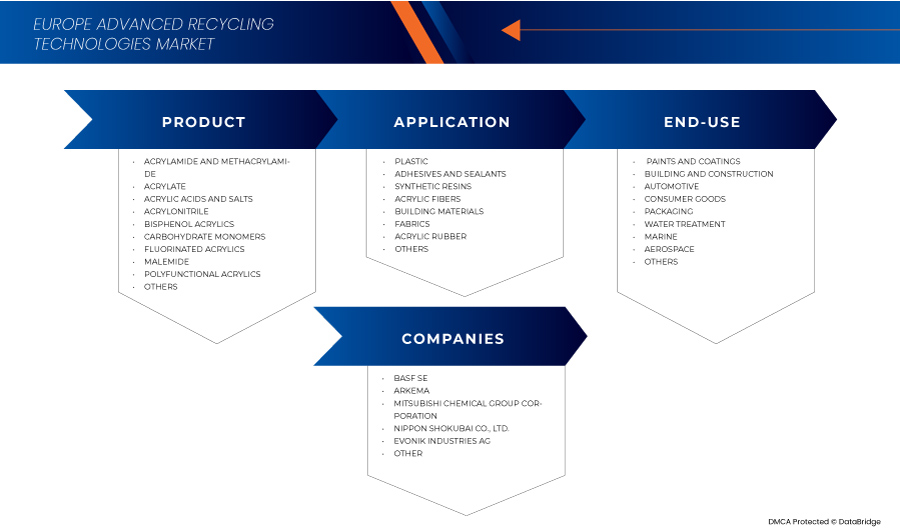
Europe acrylic monomers market is categorized into three segments based on product, application, and end-use. The growth amongst these segments will help you analyze major growth segments in the industries and provide the users with a valuable market overview and market insights to help them make strategic decisions for identifying core market applications.
Product
- Acrylamide and Methacrylamide
- Acrylate
- Acrylic Acids and Salts
- Acrylonitrile
- Bisphenol Acrylics
- Carbohydrate monomers
- Fluorinated Acrylics
- Malemide
- Polyfunctional Acrylics
- Others
On the basis of product, the market is segmented into acrylamide and methacrylamide, acrylate, acrylic acids and salts, acrylonitrile, bisphenol acrylics, carbohydrate monomers, fluorinated acrylics, malemide, polyfunctional acrylics, and others.
Application
- Plastic
- Adhesives and Sealants
- Synthetic Resins
- Acrylic Fibers
- Building materials
- Fabrics
- Acrylic Rubber
- Others
On the basis of application, the market is segmented into plastic, adhesives and sealants, synthetic resins, acrylic fibers, building materials, fabrics, acrylic rubber, and others.
End-Use
- Paints and Coatings
- Building and Construction
- Automotive
- Consumer Goods
- Packaging
- Water Treatment
- Marine
- Aerospace
- Others
On the basis of end-use, the market is segmented into paints and coatings, building and construction, automotive, consumer goods, packaging, water treatment, marine, aerospace, and others.
Regional Analysis/Insights: Europe Acrylic Monomers Market
Europe acrylic monomers market is analyzed, and market size insights and trends are provided by product, application, and end-use as referenced above.
The countries covered in the Europe acrylic monomers market report are Germany, U.K., Italy, France, Spain, Switzerland, Russia, Turkey, Belgium, Netherlands, and Rest of Europe.
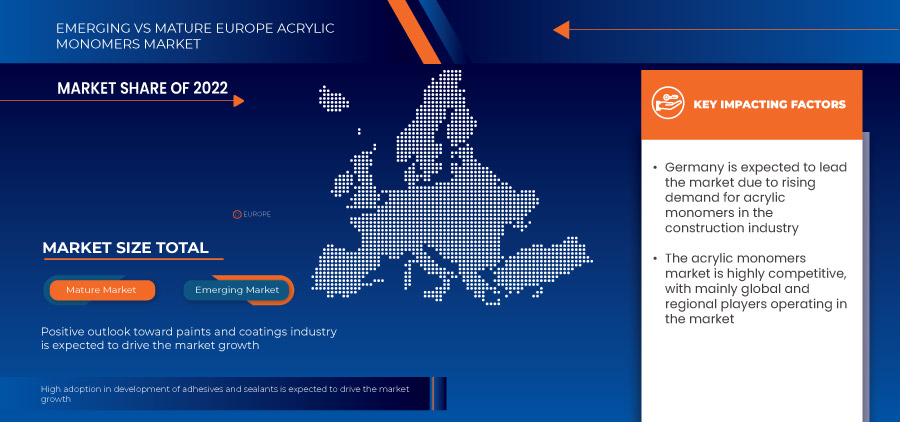
Germany is expected to dominate the market in terms of market share due to the extensive use of acrylic monomers, specifically N-butyl acrylate. These monomers serve as essential building blocks for copolymers used in the formulation of paints and coatings.
The country section of the report also provides individual market impacting factors and changes in market regulation that impact the current and future trends of the market. Data points like down-stream and upstream value chain analysis, technical trends, and porter's five forces analysis, case studies are some of the pointers used to forecast the market scenario for individual countries. Also, the presence and availability of regional brands and their challenges faced due to large or scarce competition from local and domestic brands, the impact of domestic tariffs, and trade routes are considered while providing forecast analysis of the country data.
Europe Acrylic Monomers Market: Competitive Landscape and Share Analysis
Europe acrylic monomers market competitive landscape provides details of competitor. Details included are company overview, company financials, revenue generated, market potential, investment in research and development, new market initiatives, production sites and facilities, production capacities, company strengths and weaknesses, product launch, product width and breadth, and application dominance. The above data points provided are only related to the companies' focus on the market.
Some of the major players operating in the Europe acrylic monomers market are BASF SE, Arkema, Mitsubishi Chemical Group Corporation, DOW, LG Chem, Evonik Industries AG, NIPPON SHOKUBAI CO., LTD, LobaChemie Pv.t Ltd., Solventis, Tokyo Chemical Industries CO., Ltd. and among others.
SKU-
Obtenha acesso online ao relatório sobre a primeira nuvem de inteligência de mercado do mundo

- Painel interativo de análise de dados
- Painel de análise da empresa para oportunidades de elevado potencial de crescimento
- Acesso de analista de pesquisa para personalização e customização. consultas
- Análise da concorrência com painel interativo
- Últimas notícias, atualizações e atualizações Análise de tendências
- Aproveite o poder da análise de benchmark para um rastreio abrangente da concorrência
Metodologia de Investigação
A recolha de dados e a análise do ano base são feitas através de módulos de recolha de dados com amostras grandes. A etapa inclui a obtenção de informações de mercado ou dados relacionados através de diversas fontes e estratégias. Inclui examinar e planear antecipadamente todos os dados adquiridos no passado. Da mesma forma, envolve o exame de inconsistências de informação observadas em diferentes fontes de informação. Os dados de mercado são analisados e estimados utilizando modelos estatísticos e coerentes de mercado. Além disso, a análise da quota de mercado e a análise das principais tendências são os principais fatores de sucesso no relatório de mercado. Para saber mais, solicite uma chamada de analista ou abra a sua consulta.
A principal metodologia de investigação utilizada pela equipa de investigação do DBMR é a triangulação de dados que envolve a mineração de dados, a análise do impacto das variáveis de dados no mercado e a validação primária (especialista do setor). Os modelos de dados incluem grelha de posicionamento de fornecedores, análise da linha de tempo do mercado, visão geral e guia de mercado, grelha de posicionamento da empresa, análise de patentes, análise de preços, análise da quota de mercado da empresa, normas de medição, análise global versus regional e de participação dos fornecedores. Para saber mais sobre a metodologia de investigação, faça uma consulta para falar com os nossos especialistas do setor.
Personalização disponível
A Data Bridge Market Research é líder em investigação formativa avançada. Orgulhamo-nos de servir os nossos clientes novos e existentes com dados e análises que correspondem e atendem aos seus objetivos. O relatório pode ser personalizado para incluir análise de tendências de preços de marcas-alvo, compreensão do mercado para países adicionais (solicite a lista de países), dados de resultados de ensaios clínicos, revisão de literatura, mercado remodelado e análise de base de produtos . A análise de mercado dos concorrentes-alvo pode ser analisada desde análises baseadas em tecnologia até estratégias de carteira de mercado. Podemos adicionar quantos concorrentes necessitar de dados no formato e estilo de dados que procura. A nossa equipa de analistas também pode fornecer dados em tabelas dinâmicas de ficheiros Excel em bruto (livro de factos) ou pode ajudá-lo a criar apresentações a partir dos conjuntos de dados disponíveis no relatório.











