Europe Alopecia Treatment (Hair Loss) Market, By Disease Type (Non‒Cicatricial Alopecia, Traction Alopecia, Ciatricial Alopecia, Others), Treatment (Localized Therapies, Medical Devices, Systemic Therapies, Herbal Treatment), Gender (Male, Female), Form (Topical, Oral, Parenteral), End-Users (Hospitals, Specialty Clinics, Homecare, Others), Distribution Channel (Hospital Pharmacy, Retail Pharmacy, Online Pharmacy, Others) – Industry Trends and Forecast to 2030.
Europe Alopecia Treatment (Hair Loss) Market Analysis and Size
With every passing decade, hair loss is becoming more prevalent as a result of unhealthy eating habits and sedentary lifestyles. Additionally, hair loss is caused by ageing and hormonal imbalance and a rise in chronic diseases, including cancer, hypertension, arthritis, and depression, mainly among the middle-aged population. According to the American Hair Loss Association, androgenetic alopecia results in nearly 95% of hair loss in men. More than 800,000 people are looking for a solution to their hair loss.
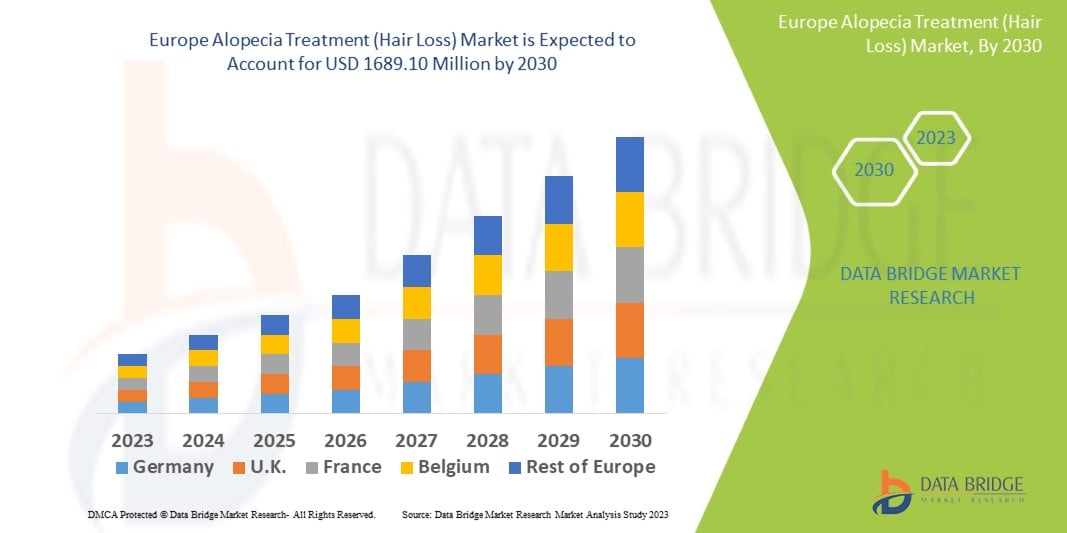
Data Bridge Market Research analyses a growth rate in the alopecia treatment (hair loss) market in the forecast period 2023-2030. The expected CAGR of alopecia treatment (hair loss) market is tend to be around 6.70% in the mentioned forecast period. The market value is USD 1005.4 million in 2022, and it would grow up to USD 1689.10 million by 2030. In addition to the market insights such as market value, growth rate, market segments, geographical coverage, market players, and market scenario, the market report curated by the Data Bridge Market Research team also includes in-depth expert analysis, patient epidemiology, pipeline analysis, pricing analysis, and regulatory framework.
Europe Alopecia Treatment (Hair Loss) Market Scope and Segmentation
|
Report Metric |
Details |
|
Forecast Period |
2023 to 2030 |
|
Base Year |
2022 |
|
Historic Years |
2021 (Customizable to 2015 - 2020) |
|
Quantitative Units |
Revenue in USD Million, Volumes in Units, Pricing in USD |
|
Segments Covered |
Disease Type (Non‒Cicatricial Alopecia, Traction Alopecia, Ciatricial Alopecia, Others), Treatment (Localized Therapies, Medical Devices, Systemic Therapies, Herbal Treatment), Gender (Male, Female), Form (Topical, Oral, Parenteral), End-Users (Hospitals, Specialty Clinics, Homecare, Others), Distribution Channel (Hospital Pharmacy, Retail Pharmacy, Online Pharmacy, Others) |
|
Countries Covered |
Germany, France, U.K., Netherlands, Switzerland, Belgium, Russia, Italy, Spain, Turkey, Rest of Europe in Europe |
|
Market Players Covered |
Johnson & Johnson Private Limited (U.S.), GSK plc (U.K.), Merck & Co., Inc. (U.S.), Pfizer Inc. (U.S.), Sun Pharmaceutical Industries Ltd. (India), Teva Pharmaceutical Industries Ltd. (Israel), Cipla Inc. (U.S.), Endo International plc (Ireland), Zydus Group (India), Abbott (U.S.), Aurobindo Pharma (India), Dr. Reddy’s Laboratories Ltd. (India), Perrigo Company plc (Ireland), Curallux, LLC. (U.S.), DR. KURT WOLFF GMBH & CO. KG (Germany), WOCKHARDT (India) |
|
Market Opportunities |
|
Market Definition
With the increasing hair fall issues, there is a huge rise in demand for hair loss treatment products all over the world. There is rising awareness that hair loss treatment can help to avoid hair loss and revive hair growth. Alopecia is a kind of hair loss that is caused by particular medical illnesses or nutritional disorders. Hair loss is becoming more prevalent due to sedentary lifestyles and unhealthy eating habits. As per the American Hair Loss Association, androgenetic alopecia results for approximately 95% of hair loss in men.
Europe Alopecia Treatment (Hair Loss) Market Dynamics
Drivers
- Increasing Incidence of Hair Loss
The increasing prevalence of hair loss is projected to boost the growth of the alopecia treatment (hair loss) market. For instance, around half of the men get bald at 42.79%, baldness is very common in the Czech Republic. Furthermore, spain is on the second-highest number in hair losing men at 42.6% which Germany follows with 41.2% of men losing their hair further followed by France with 39.24%. Additionally, nearly 2% of the entire population, irrespective of gender, is at high risk of acquiring alopecia treatment (hair loss) in their lifetime. Further statistics from health departments witness that Europe’s urban residents' consumption of hair care is increasing each year at an increasing pace of 30 %, which over the upcoming years, is anticipated to increase the hair nutrition, restoration, and transplantation business. Nevertheless, 8 out of 10 countries with the significant and maximum hair-loss issues are European nations. Thus, it boosts the market growth.
Opportunities
- Wide Adoption of Platelet-Rich Plasma Therapy
Increasing adoption of platelet-rich plasma therapy is anticipated to offer huge growth opportunities for players in the market. For instance, several researchers from Plastic and Reconstructive Surgery, “Tor Vergata” University, Italy, stated that platelet-rich plasma is considered a safe and effective alternative to treat hair loss compared with Minoxidil and Finasteride in April 2020. Thus, this boosts the market growth.
- Increasing Adoption of Organic Hair Products
Traditional natural and herbal based products are more incident for the treatment of hair loss problems in countries such as India and China. The organic hair loss products are most likely to be pushed by males, because they are more susceptible to hair losses. In general, the hair type among Asians is not quite as vulnerable to genetic thinning as western hair, but that affects a million men and women with hair loss. Thus, it increases the market growth.
Restraints/Challenges
- Limited Efficacy of Hair Loss Drugs
Limited efficacy and lack of evidence suggest that clinical efficacy of the existing hair loss drugs is hindering market growth. For instance, current topical hair loss treatments are widely available in the market such as minoxidil are not 100% effective for the treatment of alopecia, although it has been clinically proven to decrease the progression of hair loss.
- Lack of Reimbursement Policies
There is a lack of reimbursement for hair loss treatment services, which are expected to restrict the market growth. Both public and private payers do not reimburse majority of the laser treatment services. The cost of such services varies greatly and there cannot be any standardization.
This alopecia treatment (hair loss) market report provides details of new recent developments, trade regulations, import-export analysis, production analysis, value chain optimization, market share, impact of domestic and localized market players, analyses opportunities in terms of emerging revenue pockets, changes in market regulations, strategic market growth analysis, market size, category market growths, application niches and dominance, product approvals, product launches, geographic expansions, technological innovations in the market. To gain more info on the alopecia treatment (hair loss) market contact Data Bridge Market Research for an Analyst Brief, our team will help you take an informed market decision to achieve market growth.
Recent Development
- In 2022, Clariant Natural Ingredients launched Prunizen, a new natural “feel good” active with the goal of treating stress-induced hair loss, enhancing the vitality of the hair and density, and confirming the well-being of the hair and scalp.
- In 2021, Procter & Gamble acquired a haircare and lifestyle brand, Ouai, founded by beauty influencer and celebrity hairstylist Jen Atkin.
- In 2021, TRESemmé launched a new line of natural hair care products in the U.K. named Pro Pure. The range included three shampoo and conditioner pairs: Damage Recovery, Radiant Color, and Airlight Volume.
Europe Alopecia Treatment (Hair Loss) Market Scope
The alopecia treatment (hair loss) market is segmented on the basis of disease type, treatment, gender, form, end user and distribution channel. The growth amongst these segments will help you analyze meagre growth segments in the industries and provide the users with a valuable market overview and market insights to help them make strategic decisions for identifying core market applications.
Disease Type
- Non‒Cicatricial Alopecia
- Traction Alopecia
- Ciatricial Alopecia
- Others
Treatment
- Localized Therapies
- Medical Devices
- Systemic Therapies
- Herbal Treatment
Gender
- Male
- Female
Form
- Topical
- Oral
- Parenteral
End-Users
- Hospitals
- Specialty Clinics
- Homecare
- Others
Distribution Channel
- Hospital Pharmacy
- Retail Pharmacy
- Online Pharmacy
- Others
Alopecia Treatment (Hair Loss) Regional Analysis/Insights
The alopecia treatment (hair loss) market is analyzed and market size insights and trends are provided by disease type, treatment, gender, form, end user and distribution channel as referenced above.
The major countries covered in the alopecia treatment (hair loss) market report are Germany, France, U.K., Netherlands, Switzerland, Belgium, Russia, Italy, Spain, Turkey, Rest of Europe in Europe.
Germany is leading the market growth rate due to the increased awareness among the population about the huge benefits of natural and organic products and the wide effects of harmful chemicals in the existing ones. Besides that, the rise in the population stating the issue or problem of hair loss among them is also driving the market's growth.
The country section of the report also provides individual market impacting factors and changes in regulation in the market domestically that impacts the current and future trends of the market. Also, the presence and availability of europe brands and their challenges faced due to large or scarce competition from local and domestic brands, impact of domestic tariffs and trade routes are considered while providing forecast analysis of the country data.
Competitive Landscape and Europe Alopecia Treatment (Hair Loss) Share Analysis
The alopecia treatment (hair loss) market competitive landscape provides details by competitor. Details included are company overview, company financials, revenue generated, market potential, investment in research and development, new market initiatives, europe presence, production sites and facilities, production capacities, company strengths and weaknesses, product launch, product width and breadth, application dominance. The above data points provided are only related to the companies' focus related to alopecia treatment (hair loss) market
Key players operating in the alopecia treatment (hair loss) market include:
- Johnson & Johnson Private Limited (U.S.)
- GSK plc (U.K.)
- Merck & Co., Inc. (U.S.)
- Pfizer Inc. (U.S.)
- Sun Pharmaceutical Industries Ltd. (India)
- Teva Pharmaceutical Industries Ltd. (Israel)
- Cipla Inc. (U.S.)
- Endo International plc (Ireland)
- Zydus Group (India)
- Abbott (U.S.)
- Aurobindo Pharma (India)
- Dr. Reddy’s Laboratories Ltd. (India)
- Perrigo Company plc (Ireland)
- Curallux, LLC. (U.S.)
- DR. KURT WOLFF GMBH & CO. KG (Germany)
- WOCKHARDT (India)
SKU-
Obtenha acesso online ao relatório sobre a primeira nuvem de inteligência de mercado do mundo
- Painel interativo de análise de dados
- Painel de análise da empresa para oportunidades de elevado potencial de crescimento
- Acesso de analista de pesquisa para personalização e customização. consultas
- Análise da concorrência com painel interativo
- Últimas notícias, atualizações e atualizações Análise de tendências
- Aproveite o poder da análise de benchmark para um rastreio abrangente da concorrência
Metodologia de Investigação
A recolha de dados e a análise do ano base são feitas através de módulos de recolha de dados com amostras grandes. A etapa inclui a obtenção de informações de mercado ou dados relacionados através de diversas fontes e estratégias. Inclui examinar e planear antecipadamente todos os dados adquiridos no passado. Da mesma forma, envolve o exame de inconsistências de informação observadas em diferentes fontes de informação. Os dados de mercado são analisados e estimados utilizando modelos estatísticos e coerentes de mercado. Além disso, a análise da quota de mercado e a análise das principais tendências são os principais fatores de sucesso no relatório de mercado. Para saber mais, solicite uma chamada de analista ou abra a sua consulta.
A principal metodologia de investigação utilizada pela equipa de investigação do DBMR é a triangulação de dados que envolve a mineração de dados, a análise do impacto das variáveis de dados no mercado e a validação primária (especialista do setor). Os modelos de dados incluem grelha de posicionamento de fornecedores, análise da linha de tempo do mercado, visão geral e guia de mercado, grelha de posicionamento da empresa, análise de patentes, análise de preços, análise da quota de mercado da empresa, normas de medição, análise global versus regional e de participação dos fornecedores. Para saber mais sobre a metodologia de investigação, faça uma consulta para falar com os nossos especialistas do setor.
Personalização disponível
A Data Bridge Market Research é líder em investigação formativa avançada. Orgulhamo-nos de servir os nossos clientes novos e existentes com dados e análises que correspondem e atendem aos seus objetivos. O relatório pode ser personalizado para incluir análise de tendências de preços de marcas-alvo, compreensão do mercado para países adicionais (solicite a lista de países), dados de resultados de ensaios clínicos, revisão de literatura, mercado remodelado e análise de base de produtos . A análise de mercado dos concorrentes-alvo pode ser analisada desde análises baseadas em tecnologia até estratégias de carteira de mercado. Podemos adicionar quantos concorrentes necessitar de dados no formato e estilo de dados que procura. A nossa equipa de analistas também pode fornecer dados em tabelas dinâmicas de ficheiros Excel em bruto (livro de factos) ou pode ajudá-lo a criar apresentações a partir dos conjuntos de dados disponíveis no relatório.