


Europe and U.S. Lubricants Market, By Product (Engine Oils, Hydraulic Oils, Circulation Fluids, Gear Oil, Grease, Metalworking Fluids, Wind Turbine Oils, Compressor Oils, Gas Turbine Oils, Heat Transfer Oils, Rust Preventive Oils, and Others), Base Oil (Mineral Oil, Synthetic Oil, Semi-Synthetic Oil, and Bio-Based Oil), Sales Channel (B2B and B2C), End Use (Automotive, General Manufacturing, Electrical/Utility, Building & Construction, Marine, Agriculture, Mining, Aviation/Aerospace, and Food & Beverages) - Industry Trends and Forecast to 2030.
Europe and U.S. Lubricants Market Analysis and Size
The market is expected to grow significantly in the forecast period of 2023 to 2030. Data Bridge Market Research analyses that the Europe and U.S. lubricants market is growing with a CAGR of 2.8% in the forecast period of 2023 to 2030 and is expected to reach USD 54,663.48 million by 2030. The growing use of lubricants in various industries has been the major driver for the market.
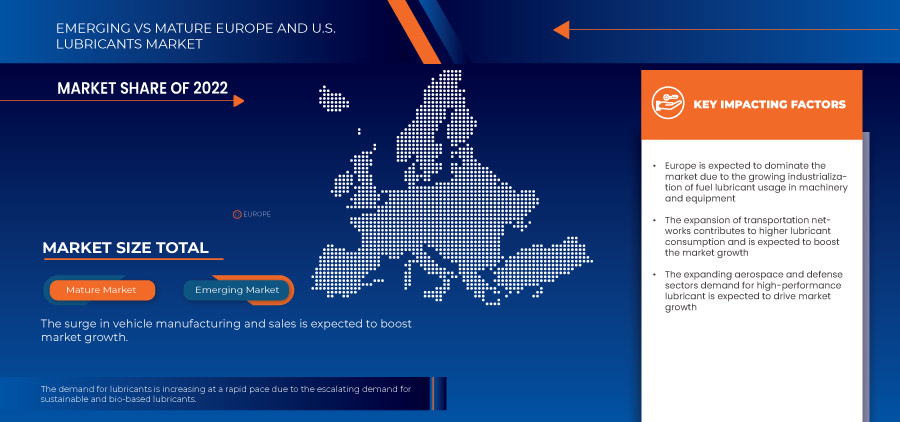
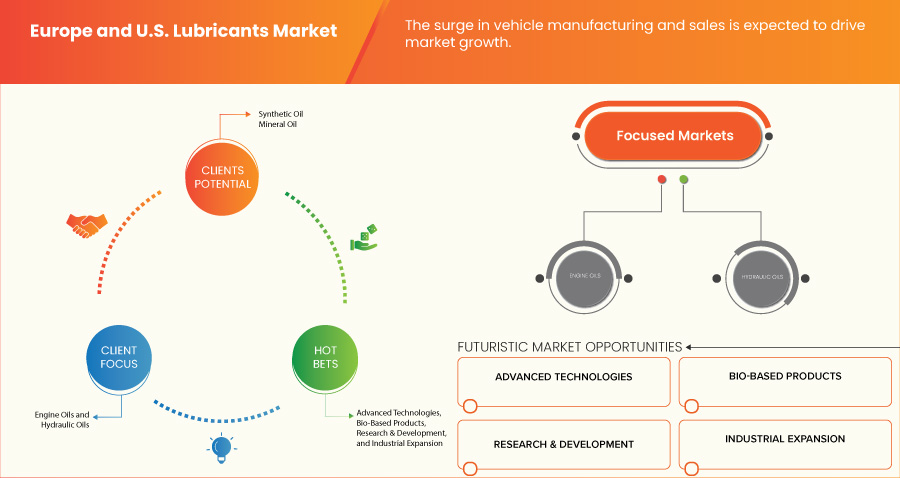
The Europe and U.S. lubricants market report provides details of market share, new developments, and the impact of domestic and localized market players, analyses opportunities in terms of emerging revenue pockets, changes in market regulations, product approvals, strategic decisions, product launches, geographic expansions, and technological innovations in the market. To understand the analysis and the market scenario, contact us for an analyst brief. Our team will help you create a revenue-impact solution to achieve your desired goal.
|
Report Metric |
Details |
|
Forecast Period |
2023 to 2030 |
|
Base Year |
2022 |
|
Historic Years |
2021 (Customizable to 2015 - 2020) |
|
Quantitative Units |
Revenue in USD Million, Volume in Kilo Tons |
|
Segments Covered |
Product (Engine Oils, Hydraulic Oils, Circulation Fluids, Gear Oil, Grease, Metalworking Fluids, Wind Turbine Oils, Compressor Oils, Gas Turbine Oils, Heat Transfer Oils, Rust Preventive Oils, and Others), Base Oil (Mineral Oil, Synthetic Oil, Semi-Synthetic Oil, and Bio-Based Oil), Sales Channel (B2B and B2C), End Use (Automotive, General Manufacturing, Electrical/Utility, Building & Construction, Marine, Agriculture, Mining, Aviation/Aerospace, and Food & Beverages) |
|
Countries Covered |
U.S., Germany, U.K., France, Poland, and Rest of Europe |
|
Market Players Covered |
Exxon Mobil Corporation, Shell, TotalEnergies, Chevron Corporation, BP p.l.c., FUCHS, Repsol, Eni S.p.A., Quaker Chemical Corporation d/b/a Quaker Houghton, Valvoline Inc., BASF SE, and LANXESS, among others |
Europe and U.S. Lubricants Market Definition
Lubricants are organic compounds employed to minimize friction and heat generation between interacting surfaces. They may also possess properties for conveying forces and particles or regulating temperature, with the expectation of maintaining their effectiveness at elevated temperatures.
Europe and U.S. Lubricants Market Dynamics
This section deals with understanding the market drivers, opportunities, challenges, and restraints. All of this is discussed in detail below:
Drivers
- The Surge in Vehicle Manufacturing and Sales
The surge in vehicle manufacturing and sales has emerged as a significant driver for the market. This surge has several interrelated factors that contribute to its impact on the lubricants industry.
Rapid expansion of the automotive industry: The Europe and U.S. automotive industry has witnessed remarkable growth, driven by rising consumer demand, expanding middle-class populations in emerging economies, and increasing urbanization. There has been a surge in vehicle manufacturing to meet this demand, as more people aspire to own vehicles. This, in turn, leads to higher lubricant consumption, as vehicles require lubricants for engine performance and maintenance.
- Growing Industrialization Fuels Lubricant Usage in Machinery and Equipment
Growing industrialization is a pivotal driver for the market, significantly impacting lubricant consumption and the overall industry landscape. This driver encompasses a wide range of factors that underscore the symbiotic relationship between industrialization and lubricants.
Industrial Expansion - Industrialization with economic growth and the establishment of manufacturing facilities across various sectors, including automotive, machinery, aerospace, and energy. The demand for lubricants in machinery and equipment also grows, as industries expand.
Energy Sector - The energy sector, comprising oil and gas exploration, power generation, and renewable energy installations, relies heavily on lubricants for critical applications. Lubricants are essential in maintaining the integrity of equipment used in drilling, refining, and power generation processes.

Opportunities
- Escalating Demand for Sustainable and Bio-Based Lubricants
Escalating demand for sustainable and bio-based lubricants presents a significant opportunity for the market. Industries and consumers are actively seeking lubricant solutions that are not only effective but also environmentally friendly, as environmental concerns continue to gain momentum. This shift in demand has opened up several avenues for growth and innovation within the lubricants industry.
One of the key opportunities lies in the development and production of bio-based lubricants. These lubricants are derived from renewable resources such as plant oils, animal fats, and even microbial sources. Different from traditional mineral oil-based lubricants, bio-based lubricants have the advantage of being biodegradable and less harmful to the environment. They also offer improved biodegradability and reduced toxicity, making them a preferred choice in applications where environmental impact is a concern.
- Continued Industrial Expansion Offers a Substantial Market Growth Opportunity
Continued industrial expansion presents a substantial growth opportunity for the market. The demand for lubricants across various sectors is expected to surge, as economies evolve and industrialization remains a driving force. This opportunity arises from the indispensable role lubricants play in maintaining the efficiency, performance, and longevity of industrial machinery and equipment.
The rapid urbanization and infrastructure development witnessed in emerging economies. The need for heavy machinery and equipment increases significantly, as these countries invest in building and upgrading infrastructure, such as roads, bridges, airports, and manufacturing facilities. Lubricants are critical for ensuring the smooth operation of these machines, reducing friction, and preventing wear and tear. Moreover, the expansion of construction and infrastructure projects often requires specialized lubricants designed to withstand extreme conditions, further driving demand.
Restraints/Challenges
- Fluctuations in Crude Oil Prices Affect the Cost of Lubricant Production
Fluctuations in crude oil prices act as a significant restraint for the market. Crude oil serves as the primary raw material for lubricant production, and its price volatility can have profound implications for the industry. Several factors contribute to the restraint posed by crude oil price fluctuations.
For instance, Oil prices rose by USD 1 after Russia announced a ban on most fuel exports. Morgan Stanley increased its Brent forecast due to Saudi-Russia production cuts but cautioned that USD 100 per barrel was a "stretched" target.
Firstly, these fluctuations introduce variability in input costs. The cost of crude oil directly affects the manufacturing costs of base oils, additives, and other raw materials used in lubricant formulations. Such cost fluctuations can be sudden and unpredictable, challenging manufacturers to manage production expenses effectively. The uncertainty in crude oil prices creates pricing challenges. The lubricants market operates in a competitive environment, and rapid price changes in crude oil can disrupt pricing strategies. Manufacturers may find it challenging to pass on increased costs to customers promptly, potentially eroding profit margins during periods of rising crude oil prices.
- Highly Competitive Lubricant Industry Manufacturers Requires Constant Innovation and Differentiation
The market faces a formidable challenge driven by the highly competitive nature of the industry. Lubricant manufacturers operate in a dynamic environment where innovation and differentiation are essential for survival and success. This challenge is multi-faceted and demands continuous efforts to stay ahead in the fiercely competitive landscape.
The primary challenge in the market is the need for constant innovation. Lubricants play a critical role in machinery and equipment maintenance, and their performance directly impacts the efficiency, reliability, and lifespan of these assets. Lubricant manufacturers must continually innovate to develop formulations that address specific challenges and requirements, as industries and applications become more demanding and diverse.
Recent Development
- In June 2023, Shell Lubricants (Shell) and Ducati Corse cooperated to develop a new high-performance motorcycle oil particularly intended for the new Ducati Panigale V4 R with dry clutch – the closest production model to a racing motorcycle ever manufactured. It employs Shell's unique PurePlus technology to power and safeguard Ducati engines by minimizing friction to enhance power, preventing the engine from wear, and maintaining gearbox performance
- In September 2023, Lubmarine was at IMPA London 2023, a global gathering of maritime procurement experts. Visit Booth 15 to explore lubrication strategies supporting the industry's low-carbon transition beyond 2030
- In February 2023, CASTROL LIMITED announced a redesigned brand with a new appearance and feel. The brand makeover is intended to better represent the company's distinctive market positioning and the potential it sees in satisfying consumers' shifting requirements. Their dedication to investing in the future and providing new prospects for development and success is reflected in their refreshed brand identity
- In August 2022, Exxon Mobil Corporation established a strategic agreement with THINK Gas Distribution Pvt Ltd., a company specializing in the distribution of clean fuel to customers, to sell its line of Compressed Natural Gas (CNG) lubricants for passenger and commercial vehicles. This collaboration will make Mobil's specialty gas engine oil supplies available at THINK Gas-owned and managed outlets across India Regional Analysis
Europe and U.S. Lubricants Market Scope
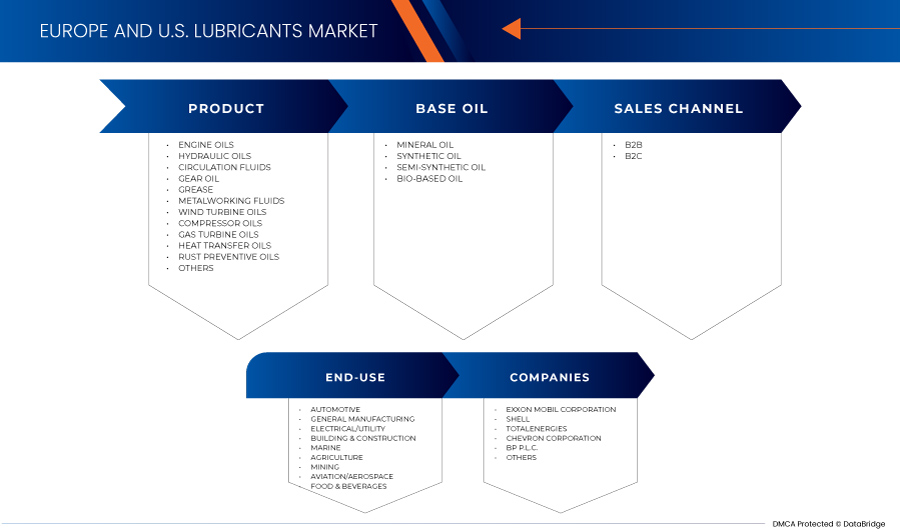
The Europe and U.S. Lubricants market is categorized based on product, base oil, sales channel, and end-use. The growth amongst these segments will help you analyze major growth segments in the industries and provide the users with a valuable market overview and market insights to make strategic decisions to identify core market applications.
Product
- Engine Oils
- Hydraulic Oils
- Circulation Fluids
- Gear Oil
- Grease
- Metalworking Fluids
- Wind Turbine Oils
- Compressor Oils
- Gas Turbine Oils
- Heat Transfer Oils
- Rust Preventive Oils
- Others
On the basis of product, the market is segmented engine oil, hydraulic oil, circulation fluids, gear oil, grease, metalworking fluids, wind turbine oils, compressor oils, gas turbine oils, heat transfer oils, rust preventive oils, and others.
Base Oil
- Mineral Oil
- Synthetic Oil
- Semi-Synthetic Oil
- Bio-Based Oil
On the basis of base oil, the market is segmented into mineral oil, synthetic oil, semi-synthetic oil, and bio-based oil.
Sales Channel
- B2B
- B2C
On the basis of sales channel, the market is segmented into B2B and B2C.
End-Use
- Automotive
- General Manufacturing
- Electrical/Utility
- Building & Construction
- Marine
- Agriculture
- Mining
- Aviation/Aerospace
- Food & Beverage
On the basis of end-use, the market is segmented into automotive, general manufacturing, electrical/utility, building & construction, marine, agriculture, mining, aviation/aerospace, and food & beverage.
Europe and U.S. Lubricants Market Regional Analysis/Insights
The Europe and U.S. lubricants market is segmented on the basis of product, base oil, sales channel, and end-use.
The countries covered in the Europe and U.S. lubricants market are U.S., Germany, U.K., France, Poland, and Rest of Europe.
Germany is expected to dominate the market due to the increasing demand in the automotive industry.
The country section of the report also provides individual market-impacting factors and changes in market regulation that impact the current and future trends of the market. Data point downstream and upstream value chain analysis, technical trends porter's five forces analysis, and case studies are some of the pointers used to forecast the market scenario for individual countries. Also, the presence and availability of regional brands and their challenges faced due to large or scarce competition from local and domestic brands, the impact of domestic tariffs, and trade routes are considered while providing forecast analysis of the country data.
Competitive Landscape and Europe and U.S. Lubricants Market Share Analysis
The Europe and U.S. lubricants market competitive landscape provides details of competitors. Details included are company overview, company financials, revenue generated, market potential, investment in research and development, new market initiatives, production sites and facilities, company strengths and weaknesses, product launch, product trials pipelines, product approvals, patents, product width and breadth, application dominance, technology lifeline curve. The above data points provided are only related to the companies’ focus related to the market.
Some of the major market players operating in the market are Exxon Mobil Corporation, Shell, TotalEnergies, Chevron Corporation, BP p.l.c., FUCHS, Repsol, Eni S.p.A., Quaker Chemical Corporation d/b/a Quaker Houghton, Valvoline Inc., BASF SE, and LANXESS, among others.
SKU-
Obtenha acesso online ao relatório sobre a primeira nuvem de inteligência de mercado do mundo

- Painel interativo de análise de dados
- Painel de análise da empresa para oportunidades de elevado potencial de crescimento
- Acesso de analista de pesquisa para personalização e customização. consultas
- Análise da concorrência com painel interativo
- Últimas notícias, atualizações e atualizações Análise de tendências
- Aproveite o poder da análise de benchmark para um rastreio abrangente da concorrência
Metodologia de Investigação
A recolha de dados e a análise do ano base são feitas através de módulos de recolha de dados com amostras grandes. A etapa inclui a obtenção de informações de mercado ou dados relacionados através de diversas fontes e estratégias. Inclui examinar e planear antecipadamente todos os dados adquiridos no passado. Da mesma forma, envolve o exame de inconsistências de informação observadas em diferentes fontes de informação. Os dados de mercado são analisados e estimados utilizando modelos estatísticos e coerentes de mercado. Além disso, a análise da quota de mercado e a análise das principais tendências são os principais fatores de sucesso no relatório de mercado. Para saber mais, solicite uma chamada de analista ou abra a sua consulta.
A principal metodologia de investigação utilizada pela equipa de investigação do DBMR é a triangulação de dados que envolve a mineração de dados, a análise do impacto das variáveis de dados no mercado e a validação primária (especialista do setor). Os modelos de dados incluem grelha de posicionamento de fornecedores, análise da linha de tempo do mercado, visão geral e guia de mercado, grelha de posicionamento da empresa, análise de patentes, análise de preços, análise da quota de mercado da empresa, normas de medição, análise global versus regional e de participação dos fornecedores. Para saber mais sobre a metodologia de investigação, faça uma consulta para falar com os nossos especialistas do setor.
Personalização disponível
A Data Bridge Market Research é líder em investigação formativa avançada. Orgulhamo-nos de servir os nossos clientes novos e existentes com dados e análises que correspondem e atendem aos seus objetivos. O relatório pode ser personalizado para incluir análise de tendências de preços de marcas-alvo, compreensão do mercado para países adicionais (solicite a lista de países), dados de resultados de ensaios clínicos, revisão de literatura, mercado remodelado e análise de base de produtos . A análise de mercado dos concorrentes-alvo pode ser analisada desde análises baseadas em tecnologia até estratégias de carteira de mercado. Podemos adicionar quantos concorrentes necessitar de dados no formato e estilo de dados que procura. A nossa equipa de analistas também pode fornecer dados em tabelas dinâmicas de ficheiros Excel em bruto (livro de factos) ou pode ajudá-lo a criar apresentações a partir dos conjuntos de dados disponíveis no relatório.











