



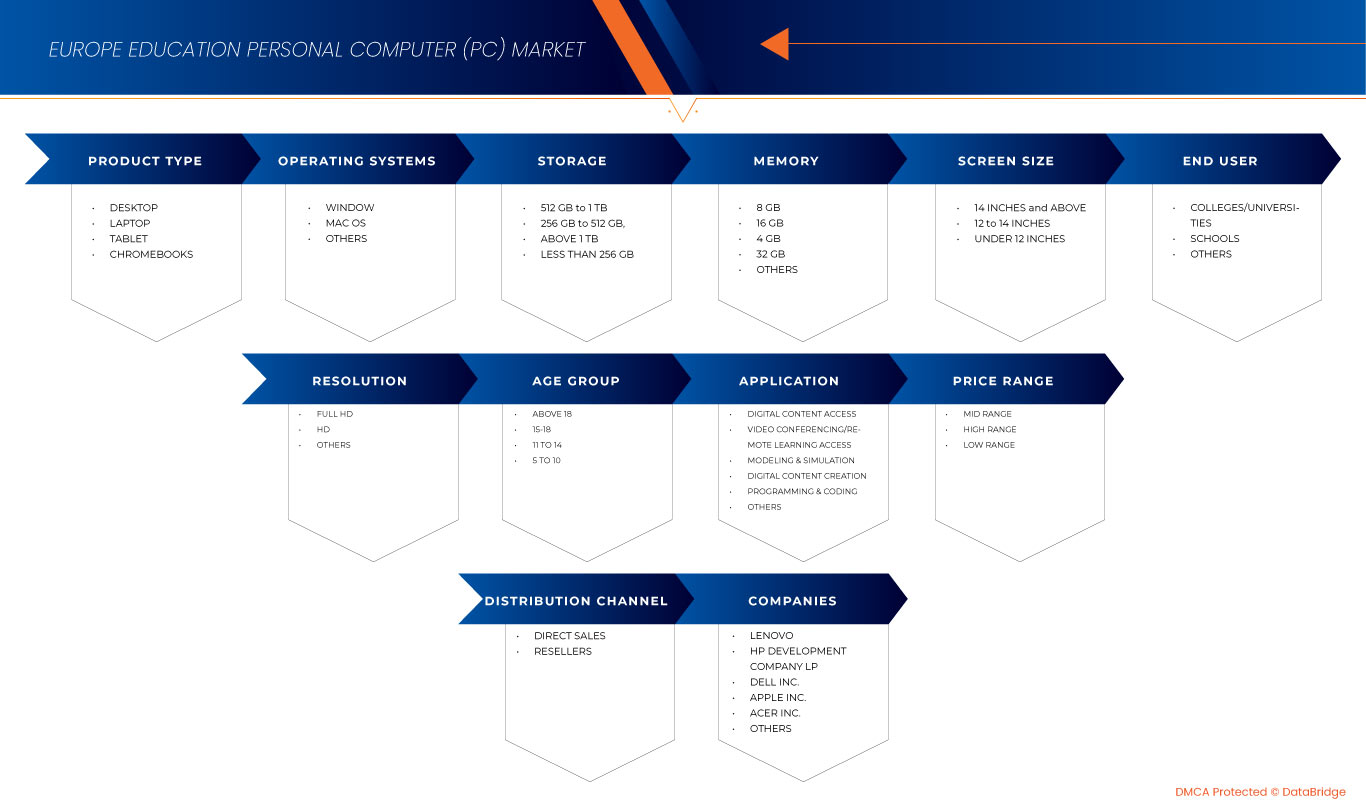
Europe Education Personal Computer (PC) Market, By Product Type (Desktop, Laptop, Tablet, and Chromebook), Operating System (Window, Mac OS, and Others), Storage (512 GB to 1 TB, 256 GB to 512 GB, Above 1 TB, and Less than 256 GB), Memory (8 GB, 16 GB, 4 GB, and 32 GB), Screen Size (14 Inches & Above, 12 To 14 Inches, Under 12 Inches), Resolution (Full HD, HD, and Others), Age Group (Above 18, 15-18, 11 to 14, 5 to 10), Application (Digital Content Access, Video Conferencing/Remote Learning Access, Modeling and Simulation, Digital Content Creation, Programming & Coding, and Others), Price Range (Mid-Range High Range, and Low Range), Distribution Channel (Direct Sales and Resellers), End User (Colleges/Universities, Schools and Others) - Industry Trends and Forecast to 2030
Europe Education Personal Computer (PC) Market Analysis and Size
In Europe, integration personal computers into education have been a revolutionary endeavour aiming at improving student’s learning experiences and digital literacy. The relationship between computer use in schools and academic outcomes has also been studied, revealing the favourable impact of technology on learning. Europe is actively educating its students for a future that requires technical fluency by bringing personal computers into educational environments, ensuring they well prepared to negotiate the intricacies. Major factors expected to boost the growth of the Europe education personal computer (PC) market in the forecast period are the rise in several industry applications, including aerospace, steel, power, chemical, and others. Furthermore, increase in growth of e-commerce industry is the benefit of Digital Identity Solution, which is further anticipated to propel the growth of the market.
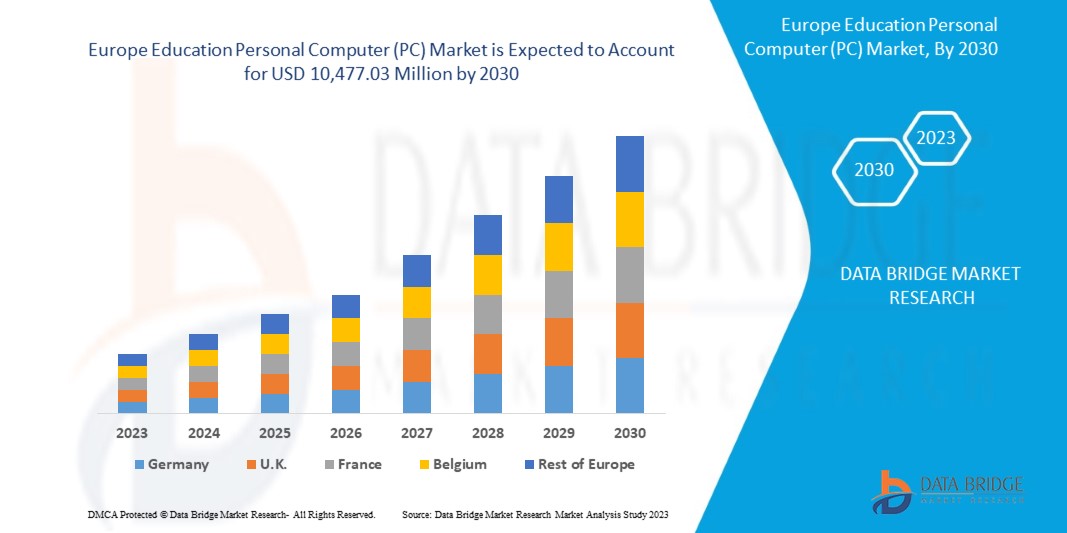
Data Bridge Market Research analyses that Europe education personal computer (PC) market is expected to reach the value of USD 10,477.03 million by 2030, at a CAGR of 11.2% during the forecast period. The Europe education personal computer (PC) market report also covers pricing analysis, patent analysis, and technological advancements in depth.
|
Report Metric |
Details |
|
Forecast Period |
2023 to 2030 |
|
Base Year |
2022 |
|
Historic Years |
2021 (Customizable to 2015-2020) |
|
Quantitative Units |
Revenue in USD Million |
|
Segments Covered |
Product Type (Desktop, Laptop, Tablet, and Chromebook), Operating System (Window, Mac OS, and Others), Storage (512 GB to 1 TB, 256 GB to 512 GB, Above 1 TB, and Less than 256 GB), Memory (8 GB, 16 GB, 4 GB, and 32 GB), Screen Size (14 Inches & Above, 12 To 14 Inches, Under 12 Inches), Resolution (Full HD, HD, and Others), Age Group (Above 18, 15-18, 11 to 14, 5 to 10), Application (Digital Content Access, Video Conferencing/Remote Learning Access, Modeling and Simulation, Digital Content Creation, Programming & Coding, and Others), Price Range (Mid-Range High Range, and Low Range), Distribution Channel (Direct Sales and Resellers), End User (Colleges/Universities, Schools and Others) |
|
Countries Covered |
U.K., Germany, France, Spain, Italy, Russia, Netherlands, Switzerland, Denmark, Sweden, Poland, Belgium, Turkey, Norway, Finland, and Rest of Europe |
|
Market Players Covered |
Lenovo, HP Development Company LP, Dell Inc., Apple Inc., Acer Inc., ASUSTeK Computer Inc., SAMSUNG, Microsoft, Google Inc., LG Electronics, Intel Corporation, Micro-Star INT'L CO., LTD., Razer Inc., Cybernet Manufacturing, Inc. among others |
Market Definition
Personal computers play an important role in modern education, considerably improving the learning experience. These adaptable gadgets give students access to a wide range of instructional resources, from digital textbooks to interactive learning platforms, enabling personalized and dynamic learning experiences. They also encourage collaboration among students and teachers through online classrooms and virtual communication tools, breaking down geographical barriers in education. Furthermore, personal computers assist students learn critical digital literacy and problem solving abilities, preparing them for a technological driven job market.
Europe Education Personal Computer (PC) Market Dynamics
This section deals with understanding the market drivers, opportunities, restraints and challenges. All of this is discussed in detail as below:
Drivers
- Growing Demand for Digital Learning
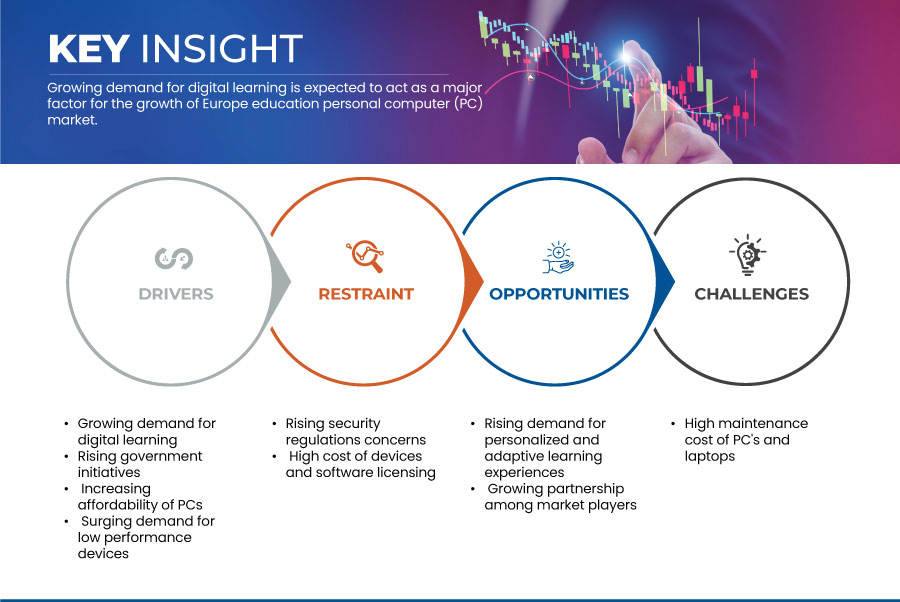
The growing demand for digital learning has undeniably become a significant driver for the Europe education personal computer (PC) market. In recent years, the education sector across Europe has undergone a rapid transformation, with an increasing emphasis on digital and remote learning methods. This shift, accelerated by factors such as the COVID-19 pandemic, has created a burgeoning demand for personal computers in educational institutions. Schools, colleges, and universities have had to invest in PCs to facilitate online classes, digital resource access, and collaborative learning platforms. In addition, students and parents have recognized the importance of personal computers for research, homework, and skill development, further boosting the demand. As digital learning becomes an integral part of the education system, the Europe education PC market is expected to witness sustained growth in the coming years.
- Rising Government Initiatives
Rising government initiatives can indeed serve as a significant driver for the Europe education personal computer (PC) market. Governments across Europe have recognized the pivotal role that digital technology plays in modern education and are increasingly investing in initiatives to promote the integration of PCs and digital tools in schools and educational institutions. These initiatives often take the form of funding programs, subsidies, or incentives aimed at providing educational institutions with the resources needed to acquire and deploy personal computers for students and educators. They may also encompass policies and regulations that promote the use of technology in the classroom.
Opportunity
- Rising Demand for Personalized and Adaptive Learning Experiences
The rising demand for personalized and adaptive learning experiences presents a significant opportunity for the Europe education personal computer (PC) market. As education continues to evolve, there is a growing recognition of the importance of tailoring learning materials and approaches to individual student needs. Personalized and adaptive learning technologies rely heavily on digital platforms, and this is where the opportunity for the PC market lies. To facilitate personalized and adaptive learning, educational institutions require a robust IT infrastructure that includes PCs capable of running educational software, accessing online resources, and supporting interactive learning experiences. These PCs need to be equipped with adequate processing power, memory, and connectivity to deliver content seamlessly. In addition, the demand for such systems extends beyond traditional classroom settings, as remote and online learning becomes more prevalent.
Restraints/Challenges
- Rising Security and Regulatory Concerns
The Europe education personal computer (PC) market has witnessed substantial growth, driven by the increasing adoption of technology in educational institutions. However, one significant restraining factor in this market is the rising security and regulatory concerns, including the General Data Protection Regulation (GDPR). Educational institutions deal with sensitive student and faculty data, making data protection a paramount concern. GDPR, a stringent data protection regulation in the European Union, imposes strict rules on the collection, storage, and processing of personal data. Compliance with GDPR necessitates robust data security measures, which can increase the cost of adopting and maintaining PC infrastructure in educational settings. Institutions need to invest in data encryption, secure storage solutions, and cybersecurity measures to ensure GDPR compliance, which can strain their budgets.
- High Cost of Devices and Software Licensing
High content and software licensing costs pose a significant constraint on the growth of the Europe education personal computer (PC) market. Educational institutions in Europe are often burdened with substantial expenses related to securing licenses for essential software and digital learning materials. This financial burden can limit their ability to invest in modern PC infrastructure, hindering the overall development of digital learning environments. Institutions are compelled to allocate a substantial portion of their budgets to software licensing, which could otherwise be directed towards upgrading hardware, expanding digital resources, or enhancing the overall quality of education.
Recent Developments
- In July 2023, HP Development Company LP successfully launched a range of versatile and affordable laptops tailored for college students, offering solutions suitable for various academic needs. This strategic move helped HP tap into the education sector, expand its customer base, and potentially boost sales by providing quality laptops designed to cater to the specific requirements of students.
- In June 2023, Lenovo launched the Legion Pro series gaming laptops, featuring Intel 13th Gen and AMD Ryzen 7000 series processors, enhanced their product offerings for the laptop segment. These laptops, equipped with advanced features like 16:10 displays and Lenovo Artificial Intelligence (LA) chips for real-time hardware optimization, catered to the needs of gaming enthusiasts, potentially increasing sales and market share in the laptop segment. Additionally, the inclusion of AI technology highlighted Lenovo's commitment to delivering cutting-edge gaming solutions.
- In April 2023, Dell Inc. introduced 11 new Latitude and Precision laptops with enhanced security features catered specifically to business users, bolstered the company's position as a provider of reliable and secure computing solutions for the corporate market. This strategic move addressed the increasing demand for remote and hybrid work solutions while reinforcing Dell's commitment to delivering efficient and secure IT solutions for businesses, potentially increasing sales and market share in the enterprise sector.
- In February 2023, Intel partnered with Croma to offer high-performance laptops from various brands, providing customers with significant discounts of up to 45 percent. The collaboration with Croma likely led to an increase in the sales of Intel-powered laptops as it made high-performance laptops more accessible and affordable to a wider range of customers.
- In November 2022, Microsoft launched Windows 11 SE and the Surface Laptop SE for students which marked a significant move by the tech giant to cater specifically to the educational sector. Windows 11 SE is a streamlined, education-focused version of its flagship operating system, designed to provide a secure, efficient, and user-friendly computing experience for students and educators. The launch of Windows 11 SE and the Surface Laptop SE for students enabled Microsoft to further solidify its presence in the education sector, offer tailored solutions, compete effectively, expand its ecosystem, and establish lasting relationships with educational institutions.
Europe Education Personal Computer (PC) Market Scope
Europe education personal computer (PC) market is segmented on the basis of product type, operating system, storage, memory, screen size, resolution, age group, application, price range, distribution channel, and end user. The growth amongst these segments will help you analyze meagre growth segments in the industries and provide the users with a valuable market overview and market insights to help them make strategic decisions for identifying core market applications.
Product Type
- Laptop
- Desktop
- Tablet
- Chromebook
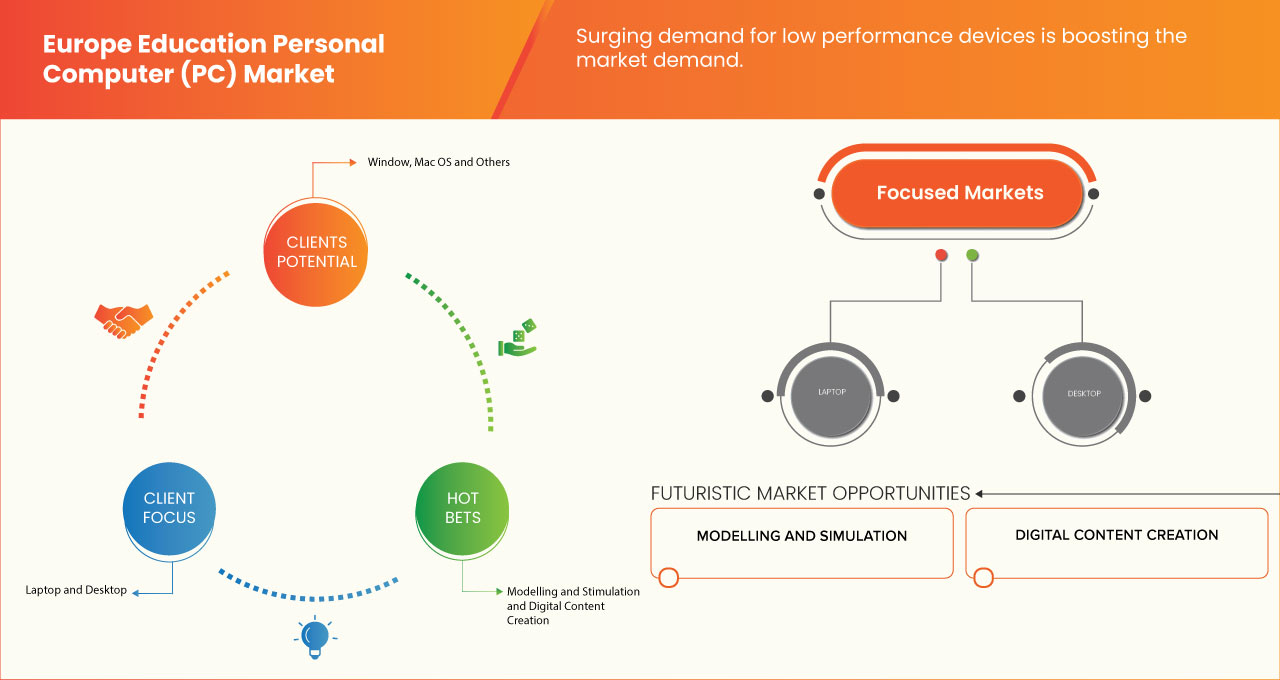
On the basis of product type, the market is segmented into laptop, desktop, tablet, and chromebooks.
Operating System
- Window
- Mac OS
- Others
On the basis of operating system, the market is segmented into window, mac OS, and others.
Storage
- 512 GB to 1 TB
- 256 GB to 512 GB
- Above 1 TB
- Less than 256 GB
On the basis of storage, the market is segmented into 512 GB to 1 TB, 256 GB to 512 GB, above 1 TB and less than 256 GB.
Memory
- 8 GB
- 16 GB
- 4 GB
- 32 GB
- Others
On the basis of memory, the market is segmented into 8 GB, 16 GB, 4 GB, 32 GB, and others.
Screen size
- 14 Inches and Above
- 12 to 14 Inches
- Under 12 Inches
On the basis of screen size, the market is segmented into 14 inches and above, 12 to 14 inches, and under 12 inches.
Resolution
- Full HD
- HD
- Others
On the basis of resolution, the market is segmented into full HD, HD, and others.
Age Group
- Above 18
- 15-18
- 11 to 14
- 5 to 10
On the basis of age group, the market is segmented into above 18, 15-18, 11 to 14, and 5 to 10.
Application
- Digital Content Access
- Video Conferencing/Remote Learning Access
- Modeling and Simulation
- Digital Content Creation
- Programming and Coding
- Others
On the basis of application, the market is segmented into digital content access, video conferencing/remote learning access, modeling and simulation, digital content creation, programming and coding, and others.
Price Range
- Mid-Range
- High Range
- Low Range
On the basis of price range, the market is segmented into mid-range, high range, and low range.
Distribution Channel
- Direct Sales
- Resellers
On the basis of distribution channel, the market is segmented into direct sales and resellers.
End User
- Colleges/Universities
- Schools
- Others
On the basis of end user, the market is segmented into colleges/universities, schools, and others.
Europe Education Personal Computer (PC) Market Regional Analysis/Insights
Europe education personal computer (PC) market is analysed and market size insights and trends are provided by country, product type, operating system, storage, memory, screen size, resolution, age group, application, price range, distribution channel, end-user as referenced above.
The countries covered in the Europe education personal computer (PC) market report are U.K., Germany, France, Spain, Italy, Russia, Netherlands, Switzerland, Denmark, Sweden, Poland, Belgium, Turkey, Norway, Finland, and Rest of Europe.
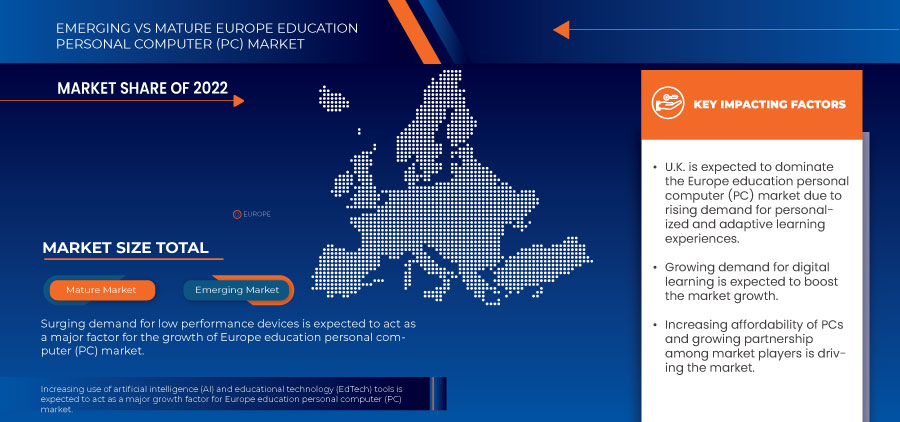
U.K. region is expected to dominate the Europe education personal computer (PC) market due to its early adoption of advanced technology, robust regulatory frameworks and presence of significant tech businesses which contributes to the increase in dominance in the Europe education personal computer (PC) market. The U.K. is expected to grow during the forecast period due to the rising cybersecurity threats and awareness of identity solutions in protecting sensitive data, resulting in high market growth in Europe region.
The country section of the report also provides individual market impacting factors and changes in market regulation that impact the current and future trends of the market. Data points such as down-stream and up-stream value chain analysis, technical trends and porter's five forces analysis, case studies are some of the pointers used to forecast the market scenario for individual countries. Also, the presence and availability of brands and their challenges faced due to large or scarce competition from local and domestic brands, impact of domestic tariffs and trade routes are considered while providing forecast analysis of the country data.
Competitive Landscape and Europe Education Personal Computer (PC) Market Share Analysis
Europe education personal computer (PC) market competitive landscape provides details by competitor. Details included are company overview, company financials, revenue generated, market potential, investment in research and development, new market initiatives, regional presence, production sites and facilities, production capacities, company strengths and weaknesses, product launch, product width and breadth, application dominance. The above data points provided are only related to the company’s focus related to Europe education personal computer (PC) market.
Some of the major players operating in Europe education personal computer (PC) market are Lenovo, HP Development Company LP, Dell Inc., Apple Inc., Acer Inc., ASUSTeK Computer Inc., SAMSUNG, Microsoft, Google Inc., LG Electronics, Intel Corporation, Micro-Star INT'L CO., LTD., Razer Inc., Cybernet Manufacturing, Inc. among others.
SKU-
Obtenha acesso online ao relatório sobre a primeira nuvem de inteligência de mercado do mundo

- Painel interativo de análise de dados
- Painel de análise da empresa para oportunidades de elevado potencial de crescimento
- Acesso de analista de pesquisa para personalização e customização. consultas
- Análise da concorrência com painel interativo
- Últimas notícias, atualizações e atualizações Análise de tendências
- Aproveite o poder da análise de benchmark para um rastreio abrangente da concorrência
Metodologia de Investigação
A recolha de dados e a análise do ano base são feitas através de módulos de recolha de dados com amostras grandes. A etapa inclui a obtenção de informações de mercado ou dados relacionados através de diversas fontes e estratégias. Inclui examinar e planear antecipadamente todos os dados adquiridos no passado. Da mesma forma, envolve o exame de inconsistências de informação observadas em diferentes fontes de informação. Os dados de mercado são analisados e estimados utilizando modelos estatísticos e coerentes de mercado. Além disso, a análise da quota de mercado e a análise das principais tendências são os principais fatores de sucesso no relatório de mercado. Para saber mais, solicite uma chamada de analista ou abra a sua consulta.
A principal metodologia de investigação utilizada pela equipa de investigação do DBMR é a triangulação de dados que envolve a mineração de dados, a análise do impacto das variáveis de dados no mercado e a validação primária (especialista do setor). Os modelos de dados incluem grelha de posicionamento de fornecedores, análise da linha de tempo do mercado, visão geral e guia de mercado, grelha de posicionamento da empresa, análise de patentes, análise de preços, análise da quota de mercado da empresa, normas de medição, análise global versus regional e de participação dos fornecedores. Para saber mais sobre a metodologia de investigação, faça uma consulta para falar com os nossos especialistas do setor.
Personalização disponível
A Data Bridge Market Research é líder em investigação formativa avançada. Orgulhamo-nos de servir os nossos clientes novos e existentes com dados e análises que correspondem e atendem aos seus objetivos. O relatório pode ser personalizado para incluir análise de tendências de preços de marcas-alvo, compreensão do mercado para países adicionais (solicite a lista de países), dados de resultados de ensaios clínicos, revisão de literatura, mercado remodelado e análise de base de produtos . A análise de mercado dos concorrentes-alvo pode ser analisada desde análises baseadas em tecnologia até estratégias de carteira de mercado. Podemos adicionar quantos concorrentes necessitar de dados no formato e estilo de dados que procura. A nossa equipa de analistas também pode fornecer dados em tabelas dinâmicas de ficheiros Excel em bruto (livro de factos) ou pode ajudá-lo a criar apresentações a partir dos conjuntos de dados disponíveis no relatório.











