



Europe Gluten-Free Breakfast Cereals Market, By Type (Hot Cereal, Ready To Eat Cereal), Breakfast Cereal Product Type (Porridge, Flakes, Loops, Crunchies, Crispies, Muesli, Others) , Breakfast Cereal Source (Corn, Rice, Wheat, Buckwheat, Granola, Bran, Millet, Multi-Grains, Others), Flavor (Plain, Flavored), Sugar Content (With Added Sugar, Without Added Sugar), Product Category (Plain, With Nuts, With Fruits, Both Nuts And Fruits), Organic Category (Organic, Conventional), Nature (GMO, Non-GMO), Packaging Type (Plastic Wraps/Pouches, Cardboard Paper Boxes, Plastic Jars, Others), Packaging Size (Less Than 5 OZ, 5 - 7 OZ, 8 – 10 OZ, 11 – 13 OZ, More Than 13 OZ), Consumer Category (Adults, Kids), Distribution Channel (Store-Based Retailing, Online Retailing)- Industry Trends and Forecast to 2029.
Market Analysis and Size
Gluten-free breakfast cereals are highly processed, with many ingredients added to reduce the risk of developing diseases such as coronary heart disease, cancer, diabetes, and diverticular disease. Breakfast cereals may be puffed, flaked, shredded, or coated in chocolate or frosting before it is dried, and finally, they are shaped into forms, such as balls, stars, loops, or rectangles.
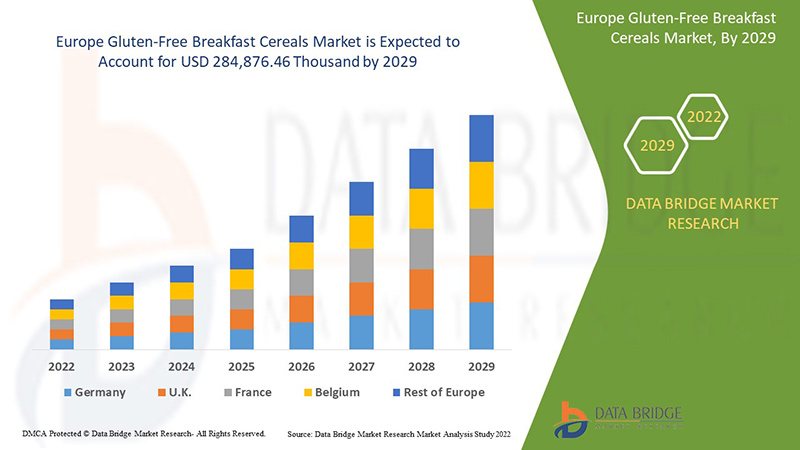
The increasing demand for ready-to-cook breakfast cereals and increased health awareness among the consumers are expected to drive the demand for the Europe gluten-free breakfast cereals market. Data Bridge Market Research analyses that the gluten-free breakfast cereals market is expected to reach the value of USD 284,876.46 thousand by the year 2029, at a CAGR of 6.5% during the forecast period. "Adults" accounts for the most prominent consumer category segment in the respective market owing to rise in the demand for gluten-free breakfast cereals due to increased awareness for healthy lifestyle. The market report curated by the Data Bridge Market Research team includes in-depth expert analysis, import/export analysis, pricing analysis, production consumption analysis, and climate chain scenario.
|
Report Metric |
Details |
|
Forecast Period |
2022 to 2029 |
|
Base Year |
2021 |
|
Historic Years |
2020 (Customizable to 2019 - 2014) |
|
Quantitative Units |
Revenue in USD Thousand, Pricing in USD |
|
Segments Covered |
By Type (Hot Cereal, Ready To Eat Cereal), Breakfast Cereal Product Type (Porridge, Flakes, Loops, Crunchies, Crispies, Muesli, Others) , Breakfast Cereal Source (Corn, Rice, Wheat, Buckwheat, Granola, Bran, Millet, Multi-Grains, Others), Flavour (Plain, Flavoured), Sugar Content (With Added Sugar, Without Added Sugar), Product Category (Plain, With Nuts, With Fruits, Both Nuts And Fruits), Organic Category (Organic, Conventional), Nature (GMO, Non-GMO), Packaging Type (Plastic Wraps/Pouches, Cardboard Paper Boxes, Plastic Jars, Others), Packaging Size (Less Than 5 OZ, 5 - 7 OZ, 8 – 10 OZ, 11 – 13 OZ, More Than 13 OZ), Consumer Category (Adults, Kids), Distribution Channel (Store-Based Retailing, Online Retailing) |
|
Countries Covered |
Germany, France, U.K., Netherlands, Switzerland, Belgium, Russia, Italy, Spain, Turkey, Poland, Sweden, Denmark & Rest of Europe. |
|
Market Players Covered |
General Mills Inc. (Minnesota, U.S.), Kellogg's Company (Michigan, U.S.), Nestlé (Vevey, Switzerland), Nature's Path Foods (Richmond, Canada), The Quaker Oats Company (a subsidiary of PepsiCo)( Illinois, U.S.), among others. |
Market Definition
Gluten-free breakfast cereal is made from processed grains and often fortified with vitamins and minerals, which is commonly eaten with milk, yogurt, fruit, or nuts. Gluten-free breakfast cereals are processed grains for human consumption and are usually packaged for sale as ready-to-eat (RTE) or hot cereals (HC) and must be cooked before consumption. The cereals are manufactured by continuous cooking, molding, and drying operations, after which flavors, sweeteners, vitamins, mineral fortifications, and particulate additive options are added before packaging. A cereal that has been derived from a gluten-containing grain can be labeled as “gluten-free” if it has been processed to remove gluten and consumption of that cereal results in the presence of less than 20 ppm of gluten in the food.
Regulatory Framework
Food and Drug Administration (FDA): The rule specifies, among other criteria, that any foods that carry the label “gluten-free,” “no gluten,” “free of gluten,” or “without gluten” must contain less than 20 parts per thousand (ppm) of gluten. This level is the lowest that can be reliably detected in foods using scientifically validated analytical methods. Other countries and international bodies use these same criteria, as most people with celiac disease can tolerate foods with very small amounts of gluten.
Market Dynamics of the Gluten-Free Breakfast Cereals Market Include:
Drivers/Opportunities in the Gluten-Free Breakfast Cereals Market
- Rising advancement in food retail infrastructure
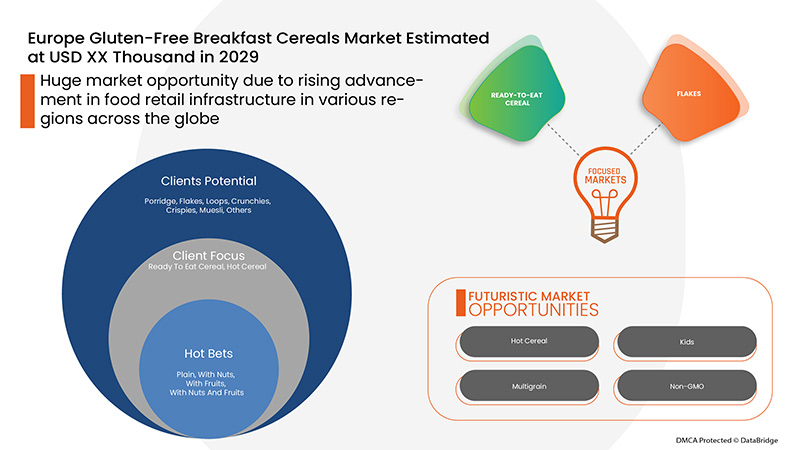
Technology is set to shape the future of the grocery sector, as retailers have recently sought to become more prominent with the introduction of new and innovative infrastructure. Leading retailers adapt their games to meet ever-changing consumer demand and seize market opportunities. Personalizing the customer experience is becoming an important strategy for many retailers to differentiate themselves from competitors.
- Shifting consumer preference toward gluten-free, organic, and whole grain-based cereals
Increased awareness among end-users towards personal health and environmental concerns have increased the inclination of consumers toward the use of gluten-free organic products. In the current scenario, consumers mostly prefer organic food due to attributes such as nutrition value, taste, freshness, and appearance of organic food matters, which has eventually created opportunities for gluten-free organic-based products.
- Positive outlook towards convenience food products
The busy lifestyle of the millennial workforce, the increase in total family income, and the concept of nuclear family retention have all contributed to the significant growth of the convenience food products segment, including cereals, in recent years. The surge in demand for health foods has spawned an entire segment of packaged foods, including immune-boosting foods, healthy whole grains, and cereals.
- Increasing health awareness among consumers
Consumers are becoming more active, engaged in health care, using various digital tools to track their health, and using this data to make health decisions. Progressive health and wellness consumers are looking for alternatives to fear-based information, a phenomenon that has driven the view of wellness for decades. Consumer nutrition awareness encourages informed decisions regarding the purchase and consumption of cereals, grains, and many other healthy food items.
Restraints/Challenges faced by the Gluten-Free Breakfast Cereals Market
- Volatility in supply of raw materials
Volatile and unpredictable global marketplaces have far-reaching consequences for food manufacturing companies. Unanticipated hurdles, such as rising infrastructural cost and variations in raw material pricing, can disrupt supply chains and make it harder for businesses to stay profitable. Variations in raw material prices make cereals put up additional costs on the price of the finished product.
- Huge commercialization of counterfeit products
The rise of digital channels that drive the buying and selling of consumer goods has led to a rapid increase in counterfeit trade worldwide. Some food brands are trying to stop selling counterfeit versions of their products. Counterfeit products are indeed similar to low-quality products. This may not seem like a serious threat, but the truth is that poor-quality items can have dire consequences in reality.
COVID-19 had a Minimal Impact on Gluten-Free Breakfast Cereals Market
COVID-19 impacted various manufacturing and service providing industries in the year 2020-2021 as it led to the closure of workplaces, disruption of supply chains, and restrictions on transportation. Though, the imbalance between demand and supply and its impact on pricing is considered short-term and is expected to recover as this pandemic comes to an end. Due to outbreak of covid19 throughout the globe, the demand for gluten-free breakfast cereals was decreased. Thus, food industries suffered a lot during covid19 outbreak, the gluten-free breakfast cereals industry will hopefully grow with the removed restrictions in varied countries.
Recent Developments
- In May 2022, General Mills Inc. agreed to acquire TNT Crust, a manufacturer of high-quality frozen pizza crusts for regional and national pizza chains, foodservice distributors, and retail outlets. This acquisition will help the company expand its operations in the market.
- In 2020, Kellogg’s Co. was awarded America’s Most Trusted Brands (Morning Consult). This has enhanced company’s image in the Europe market.
Europe Gluten-Free Breakfast Cereals Market Scope
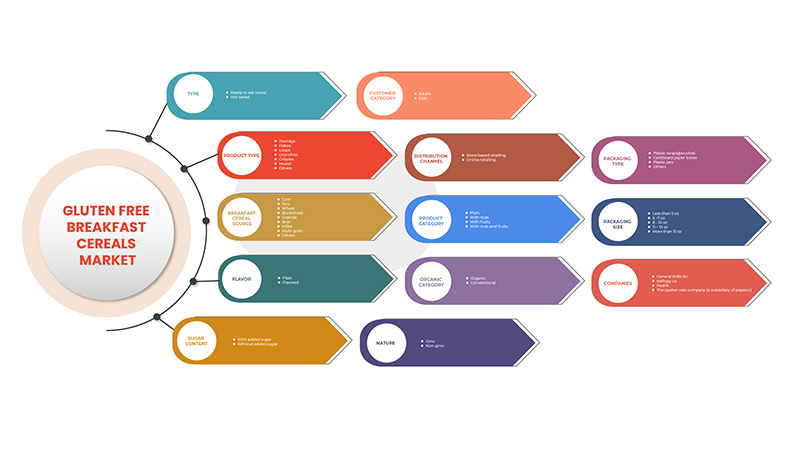
The gluten-free breakfast cereals market is segmented on the basis of type, breakfast cereal product type, breakfast cereal sources, flavor, sugar content, product category, organic category, nature, packaging size, packaging type, consumer category, distribution channel. The growth amongst these segments will help you analyze meagre growth segments in the industries and provide the users with a valuable market overview and market insights to help them make strategic decisions for identifying core market applications.
Type
- Ready To Eat Cereal
- Hot Cereal
On the basis of type, the gluten-free breakfast cereals market is segmented into hot cereal and ready to eat cereal.
Breakfast Cereal Product Type
- Porridge
- Flakes
- Loops
- Crunchies
- Crispies
- Muesli
- Others
On the basis of breakfast cereal product type, the gluten-free breakfast cereals market is segmented into porridge, flakes, loops, crunchies, crispies, muesli and others.
Breakfast Cereal Source
- Corn
- Wheat
- Bran
- Multi-Grain
- Millet
- Rice
- Buckwheat
- Granola
- Others
On the basis of breakfast cereal source, the gluten-free breakfast cereals market is segmented into corn, rice, wheat, buckwheat, granola, bran, millet, multi-grains, and others.
Flavor
- Plain
- Flavored
On the basis of flavor, the gluten-free breakfast cereals market is segmented into plain and flavored.
Sugar Content
- With Added Sugar
- Without Added Sugar
On the basis of sugar content, the gluten-free breakfast cereals market is segmented into with added sugar, without added sugar.
Product Category
- Plain
- With Nuts
- With Fruits
- Both Nuts and Fruits
On the basis of product category, the gluten-free breakfast cereals market is segmented into plain, with nuts, with fruits, both nuts and fruits.
Organic Category
- Organic
- Conventional
On the basis of organic category, the gluten-free breakfast cereals market is segmented into organic and conventional.
Nature
- GMO
- NON-GMO
On the basis of nature, the gluten-free breakfast cereals market is segmented into GMO and non-GMO.
Packaging Type
- Plastic Wraps/Pouches
- Cardboard Paper Boxes
- Plastic Jars
- Others
On the basis of packaging type, the gluten-free breakfast cereals market is segmented into plastic wraps/pouches, cardboard paper boxes, plastic jars and others.
Packaging Size
- Less Than 5 Oz
- 5 –7 Oz
- 8 - 10 Oz
- 11 – 13 Oz
- More Than 13 Oz
On the basis of packaging size, the gluten-free breakfast cereals market is segmented into less than 5 OZ, 5-7 OZ, 8-10 OZ, 11-13 OZ and more than 13 OZ.
Consumer Category
- Adults
- Kids
On the basis of consumer category, the gluten-free breakfast cereals market is segmented into adults and kids.
Distribution Channel
- Store-Based Retailing
- Online Retailing
On the basis of distribution channel, the gluten-free breakfast cereals market is segmented into store-based retailing and online retailing.
Gluten-Free Breakfast Cereals Market Regional Analysis/Insights
The gluten-free breakfast cereals market is analyzed and market size insights and trends are provided by country, type, breakfast cereal product type, breakfast cereal sources, flavor, sugar content, product category, organic category, nature, packaging size, packaging type, consumer category, distribution channel as referenced above.
The countries covered in the gluten-free breakfast cereals market report are the Germany, France, U.K., Netherlands, Switzerland, Belgium, Russia, Italy, Spain, Turkey, Poland, Sweden, Denmark & Rest of Europe.
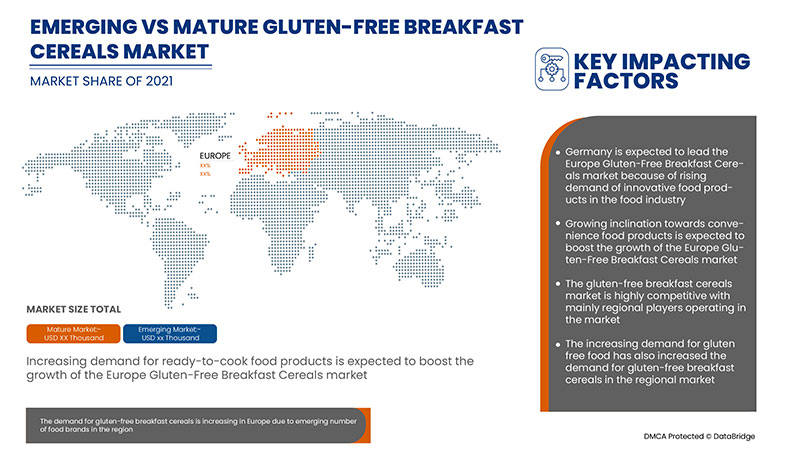
Germany dominates the gluten-free breakfast cereals market because of the increasing demand for ready to eat cereals. Germany is followed by U.K. and is expected to witness significant growth during the forecast period of 2022 to 2029 due to growing demand for gluten-free breakfast cereals from adult consumer in the region. U.K. is followed by France and is expected to grow due to positive outlook towards convenience food products.
The country section of the report also provides individual market impacting factors and changes in market regulation that impact the current and future trends of the market. Data points such as down-stream and upstream value chain analysis, technical trends and porter's five forces analysis, case studies are some of the pointers used to forecast the market scenario for individual countries. Also, the presence and availability of Europe brands and their challenges faced due to large or scarce competition from local and domestic brands, impact of domestic tariffs and trade routes are considered while providing forecast analysis of the country data.
Competitive Landscape and Gluten-Free Breakfast Cereals Market Share Analysis
The gluten-free breakfast cereals market competitive landscape provides details by competitor. Details included are company overview, company financials, revenue generated, market potential, investment in research and development, new market initiatives, Europe presence, production sites and facilities, production capacities, company strengths and weaknesses, product launch, product width and breadth, application dominance. The above data points provided are only related to the companies' focus related to gluten-free breakfast cereals market.
Some of the major market players engaged in the Europe gluten-free breakfast cereals market are General Mills Inc., Kellogg's Company, Nestlé, Nature's Path Foods, The Quaker Oats Company (a subsidiary of PepsiCo), among others.
SKU-
Obtenha acesso online ao relatório sobre a primeira nuvem de inteligência de mercado do mundo

- Painel interativo de análise de dados
- Painel de análise da empresa para oportunidades de elevado potencial de crescimento
- Acesso de analista de pesquisa para personalização e customização. consultas
- Análise da concorrência com painel interativo
- Últimas notícias, atualizações e atualizações Análise de tendências
- Aproveite o poder da análise de benchmark para um rastreio abrangente da concorrência
Metodologia de Investigação
A recolha de dados e a análise do ano base são feitas através de módulos de recolha de dados com amostras grandes. A etapa inclui a obtenção de informações de mercado ou dados relacionados através de diversas fontes e estratégias. Inclui examinar e planear antecipadamente todos os dados adquiridos no passado. Da mesma forma, envolve o exame de inconsistências de informação observadas em diferentes fontes de informação. Os dados de mercado são analisados e estimados utilizando modelos estatísticos e coerentes de mercado. Além disso, a análise da quota de mercado e a análise das principais tendências são os principais fatores de sucesso no relatório de mercado. Para saber mais, solicite uma chamada de analista ou abra a sua consulta.
A principal metodologia de investigação utilizada pela equipa de investigação do DBMR é a triangulação de dados que envolve a mineração de dados, a análise do impacto das variáveis de dados no mercado e a validação primária (especialista do setor). Os modelos de dados incluem grelha de posicionamento de fornecedores, análise da linha de tempo do mercado, visão geral e guia de mercado, grelha de posicionamento da empresa, análise de patentes, análise de preços, análise da quota de mercado da empresa, normas de medição, análise global versus regional e de participação dos fornecedores. Para saber mais sobre a metodologia de investigação, faça uma consulta para falar com os nossos especialistas do setor.
Personalização disponível
A Data Bridge Market Research é líder em investigação formativa avançada. Orgulhamo-nos de servir os nossos clientes novos e existentes com dados e análises que correspondem e atendem aos seus objetivos. O relatório pode ser personalizado para incluir análise de tendências de preços de marcas-alvo, compreensão do mercado para países adicionais (solicite a lista de países), dados de resultados de ensaios clínicos, revisão de literatura, mercado remodelado e análise de base de produtos . A análise de mercado dos concorrentes-alvo pode ser analisada desde análises baseadas em tecnologia até estratégias de carteira de mercado. Podemos adicionar quantos concorrentes necessitar de dados no formato e estilo de dados que procura. A nossa equipa de analistas também pode fornecer dados em tabelas dinâmicas de ficheiros Excel em bruto (livro de factos) ou pode ajudá-lo a criar apresentações a partir dos conjuntos de dados disponíveis no relatório.











