



Europe Hyper-Converged Infrastructure Market, By Component (Hardware, Software, Services), Hypervisor Type (VMware, Kernel-based Virtual Machine (KVM), and Hyper-V), Organization Size (Medium and Small Sized Enterprises and Large Enterprises), Application (Virtualizing Critical Applications, Data Centre Consolidation, Data Protection, Cloud Computing, Virtual Desktop Infrastructure (VDI), Remote Office Branch Office (ROBO)), Deployment Mode (Private Cloud, Public Cloud and Hybrid Cloud), End User (Banking, Financial Services, and Insurance (BFSI), IT and Telecom, Government, Healthcare and Life Science, Retail, Power and Energy, Manufacturing, Oil and Gas, Mining, Education, Transportation and Logistics and Media and Entertainment) – Industry Trends and Forecast to 2030.
Europe Hyper-Converged Infrastructure Market Analysis and Size
The hyper-converged infrastructure market is expected to grow significantly during the forecast period because hyper-converged infrastructure solutions are progressively capable of operating business workloads through decreasing data-center complexity and promoting affordability. Hyper-converged infrastructure is used to maintain strong control over all IT resources because more industries adopt a cloud-first strategy. The firms expect hyper-converged infrastructure to become progressively prevalent because cloud adoption increases. Vendors of hyper-converged infrastructure already know the advantages of leveraging the public cloud, which numerous businesses trust for its flexibility and manageability to manage both environments in an integrated manner.
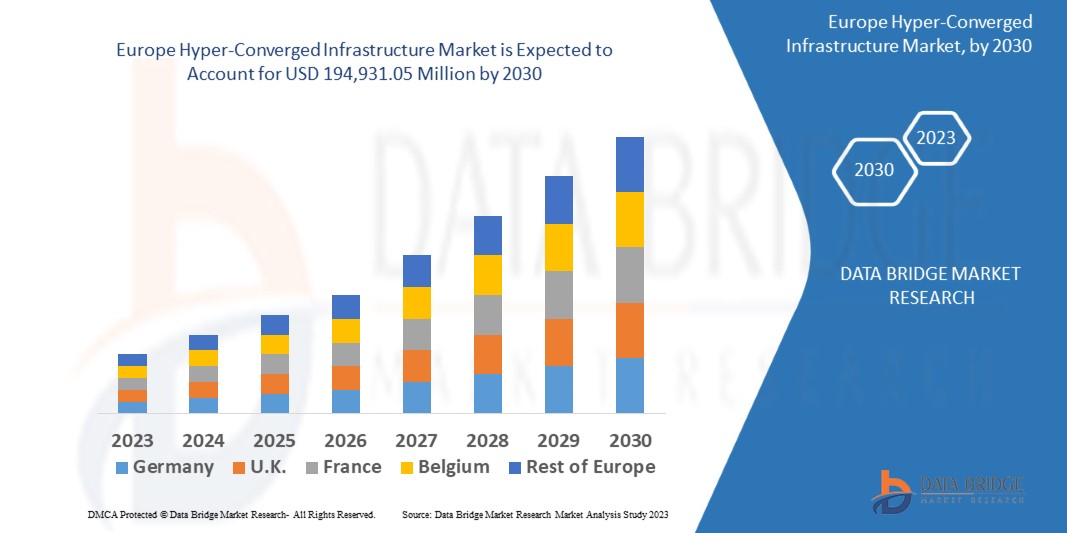
Data Bridge Market Research analyses that the hyper-converged infrastructure market is expected to reach USD 194,931.05 million by 2030, which was USD 5,614.89 million in 2022, at a CAGR of 55.80% during the forecast period. In addition to the market insights such as market value, growth rate, market segments, geographical coverage, market players, and market scenario, the market report curated by the Data Bridge Market Research team includes in-depth expert analysis, import/export analysis, pricing analysis, production consumption analysis, and pestle analysis.
Europe Hyper-Converged Infrastructure Market Scope and Segmentation
|
Report Metric |
Details |
|
Forecast Period |
2023 to 2030 |
|
Base Year |
2022 |
|
Historic Years |
2021 (Customizable to 2015 - 2020) |
|
Quantitative Units |
Revenue in USD Million, Volumes in Units, Pricing in USD |
|
Segments Covered |
Component (Hardware, Software, Services), Hypervisor Type (VMware, Kernel-based Virtual Machine (KVM), and Hyper-V), Organization Size (Medium and Small Sized Enterprises and Large Enterprises), Application (Virtualizing Critical Applications, Data Centre Consolidation, Data Protection, Cloud Computing, Virtual Desktop Infrastructure (VDI), Remote Office Branch Office (ROBO)), Deployment Mode (Private Cloud, Public Cloud, Hybrid Cloud), End User (Banking, Financial Services, and Insurance (BFSI), IT and Telecom, Government, Healthcare and Life Science, Retail, Power and Energy, Manufacturing, Oil and Gas, Mining, Education, Transportation and Logistics and Media and Entertainment) |
|
Countries Covered |
Germany, France, U.K., Netherlands, Switzerland, Belgium, Russia, Italy, Spain, Turkey, Rest of Europe in Europe |
|
Market Players Covered |
Hitachi Vantara LLC (U.S.), NEC Corporation (Japan), Riverbed Technology (U.S.), Cisco Systems, Inc.(U.S.), VMware, Inc. (U.S.), Hewlett Packard Enterprise Development LP (U.S.), Dell Inc (U.S.), Huawei Technologies Co., Ltd.(China), FUJITSU (Japan), IBM (U.S.), Nutanix (U.S.), Microsoft (U.S.), NetApp (U.S.), Quantum Corporation (U.S.), Scale Computing (U.S.), DataCore Software (U.S.), Maxta (U.S.), SANGFOR TECHNOLOGIES (China) |
|
Market Opportunities |
|
Market Definition
Hyper-converged infrastructure is a software-centric, unified system that transforms and combines a traditional data center's management, storage, computer, and network into a distributed platform. It relies on intelligent software modules to generate flexible building blocks that substitute the legacy infrastructure of separate servers and storage networks.
Europe Hyper-Converged Infrastructure Market
Drivers
- Increasing demand for data security
A growing number of remote workers has generated new security challenges for businesses during the forecast period. Hyper-converged infrastructure provides a scalable and secure infrastructure for these services, which supports businesses to protect their data and decrease cyberattack risks. Overall, the growing demand for data security in businesses is a major factor likely to drive the growth of the hyper-converged infrastructure market.
- Multiple advantages associated with hyper-converged infrastructure
Organizations need storage performance that is fast and reliable. Hyper-converged infrastructure (HCI) offers safe and secure infrastructure. Hyper-Converged infrastructure consolidates resources, streamlines management, and lowers costs by integrating networking and computation into a single system. These advantages have led to the augmented adoption of hyper-converged infrastructure in many enterprises. As a result, the demand for hyper-converged infrastructure increases, likely enhancing market growth.
Opportunities
- Increasing investments by data center companies in hyper-scale data centers
Various data center companies have invested highly in hyper-scale data centers, which will be expected to generate lucrative market growth opportunities. Last year, Equinix announced plans to construct around 32 hyper-scale data centers in a few major markets in Europe. With a total capacity of around 600 megawatts and above USD 6.9 billion in investment, the company goals to gain a better position in the rising landscape of hyper-scale data centers. Such growth in the region's data centers will increase the demand for the region's HCI market.
- Growing acceptance of the cloud platforms for businesses
The increasing acceptance of cloud platforms for businesses, mainly in developing countries, is expected to increase hyper-converged infrastructure market growth in Asia-Pacific. For instance, in 2020, as per the Nutanix Cloud Index 2018, India will observe triple growth in adopting hybrid cloud workloads from 13 percent to 43 percent. The increasing adoption of digital technology for customer engagement is growing the company's focus on business expansion and developing new products.
- Growing adoption of various advanced technologies
The augmented adoption of various advanced technologies is further expected to create lucrative opportunities for the growth of the hyper-converged infrastructure market, which will further expand the market's growth rate in the upcoming period. The increasing usage of the internet of things (IoT) and big data analytics have also helped the business enhance the application's features and surge the demand for the system. These technologies are increasing worldwide because of expanding usage across various industries.
Restraints
- High prices associated with hyper-converged infrastructure products
Hyper-converged infrastructure products normally carry a premium price tag because there is no integrated interoperability between seller offerings. Aggregated nodes can enforce undesirable capital charges for resources that might not all be required. Furthermore, maintenance contract and software licensing costs can increase recurring hyper-converged infrastructure costs. These factors will hamper the market growth.
- Increasing limitations on hyper-converged infrastructure standards
Growing limitations on hyper-converged infrastructure standards are expected to obstruct the market's growth during the forecast period. For instance, problems with cloud compatibility and scalability can create major problems for organizations or enterprises that want to deploy hyper-converged infrastructure systems.
This hyper-converged infrastructure market report provides details of new recent developments, trade regulations, import-export analysis, production analysis, value chain optimization, market share, impact of domestic and localized market players, analyses opportunities in terms of emerging revenue pockets, changes in market regulations, strategic market growth analysis, market size, category market growths, application niches and dominance, product approvals, product launches, geographic expansions, technological innovations in the market. To gain more info on the hyper-converged infrastructure market contact Data Bridge Market Research for an Analyst Brief, our team will help you take an informed market decision to achieve market growth.
Recent Developments
- In 2022, Dell and Equinix extended their partnership for hyper-converged data center offerings. Expansion to Equinix Metal line of bare metal appliances includes releasing various new offerings, such as Dell VxRail on Equinix Metal, Dell PowerStoreon Equinix Metal, and Dell EMC PowerProtectDDVE on Equinix Metal.
- In 2022, Kyndryl, one of the leading IT infrastructure services providers, announced the expansion of their global partnership with Lenovo, one To offer optimal solutions for customers across the hyper-converged infrastructure and edge computing applications with a complete portfolio of plug-and-play and ready-to-roll solutions.
- In 2022, the green panel was selected to update its data center and streamline business and manufacturing processes by deploying Dell EMC VxRailHCI. The green panel planned to update its IT infrastructure and implement new technologies. To allow mission-critical workloads, the woodworking giant selected Dell EMC VxRailHCI over the public cloud option.
Europe Hyper-Converged Infrastructure Market Scope
The hyper-converged infrastructure market is segmented on the basis of component, hypervisor type, organization size, application, deployment mode and end user. The growth amongst these segments will help you analyze meagre growth segments in the industries and provide the users with a valuable market overview and market insights to help them make strategic decisions for identifying core market applications.
Component
- Hardware
- Software
- Processors
- Networking
- Memory
- Service
- Professional
- Managed
Hypervisor Type
- VMware
- Kernel-based Virtual Machine (KVM)
- Hyper-V
Organization Size
- Medium and Small Sized Enterprises
- Large Enterprises
Application
- Virtualizing Critical Applications
- Data Centre Consolidation
- Data Protection
- Cloud Computing
- Virtual Desktop Infrastructure (VDI)
- Remote Office Branch Office (ROBO)
Deployment Mode
- Private Cloud
- Public Cloud
- Hybrid Cloud
End User
- Banking, Financial Services, and Insurance (BFSI)
- IT and Telecom
- Government
- Healthcare and Life Science
- Retail
- Power and Energy
- Manufacturing
- Oil and Gas
- Mining
- Education
- Transportation and Logistics
- Media and Entertainment
Hyper-Converged Infrastructure Market Regional Analysis/Insights
The hyper-converged infrastructure market is analyzed and market size insights and trends are provided by country, component, hypervisor type, organization size, application, deployment mode and end user as referenced above.
The countries covered in the hyper-converged infrastructure market report are Germany, France, U.K., Netherlands, Switzerland, Belgium, Russia, Italy, Spain, Turkey, Rest of Europe in Europe.
U.K. dominates the hyper-converged infrastructure market due to the increasing competition between several industries because they create digital services in this region. Furthermore, the growing adoption of hyper-converged infrastructure by the banking and IT & telecom industries will further increase the market growth in this region.
The country section of the report also provides individual market impacting factors and changes in market regulation that impact the current and future trends of the market. Data points like down-stream and upstream value chain analysis, technical trends and porter's five forces analysis, case studies are some of the pointers used to forecast the market scenario for individual countries. Also, the presence and availability of Global brands and their challenges faced due to large or scarce competition from local and domestic brands, impact of domestic tariffs and trade routes are considered while providing forecast analysis of the country data.
Competitive Landscape and Hyper-Converged Infrastructure Market Share Analysis
The hyper-converged infrastructure market competitive landscape provides details by competitor. Details included are company overview, company financials, revenue generated, market potential, investment in research and development, new market initiatives, Global presence, production sites and facilities, production capacities, company strengths and weaknesses, product launch, product width and breadth, application dominance. The above data points provided are only related to the companies' focus related to hyper-converged infrastructure market.
Some of the major players operating in the hyper-converged infrastructure market are:
- Hitachi Vantara LLC (U.S.)
- NEC Corporation (Japan)
- Riverbed Technology (U.S.)
- Cisco Systems, Inc.(U.S.)
- VMware, Inc. (U.S.)
- Hewlett Packard Enterprise Development LP (U.S.)
- Dell Inc (U.S.)
- Huawei Technologies Co., Ltd.(China)
- FUJITSU (Japan), IBM (U.S.)
- Nutanix (U.S.)
- Microsoft (U.S.)
- NetApp (U.S.)
- Quantum Corporation (U.S.)
- Scale Computing (U.S.)
- DataCore Software (U.S.)
- Maxta (U.S.)
- SANGFOR TECHNOLOGIES (China)
SKU-
Obtenha acesso online ao relatório sobre a primeira nuvem de inteligência de mercado do mundo

- Painel interativo de análise de dados
- Painel de análise da empresa para oportunidades de elevado potencial de crescimento
- Acesso de analista de pesquisa para personalização e customização. consultas
- Análise da concorrência com painel interativo
- Últimas notícias, atualizações e atualizações Análise de tendências
- Aproveite o poder da análise de benchmark para um rastreio abrangente da concorrência
Metodologia de Investigação
A recolha de dados e a análise do ano base são feitas através de módulos de recolha de dados com amostras grandes. A etapa inclui a obtenção de informações de mercado ou dados relacionados através de diversas fontes e estratégias. Inclui examinar e planear antecipadamente todos os dados adquiridos no passado. Da mesma forma, envolve o exame de inconsistências de informação observadas em diferentes fontes de informação. Os dados de mercado são analisados e estimados utilizando modelos estatísticos e coerentes de mercado. Além disso, a análise da quota de mercado e a análise das principais tendências são os principais fatores de sucesso no relatório de mercado. Para saber mais, solicite uma chamada de analista ou abra a sua consulta.
A principal metodologia de investigação utilizada pela equipa de investigação do DBMR é a triangulação de dados que envolve a mineração de dados, a análise do impacto das variáveis de dados no mercado e a validação primária (especialista do setor). Os modelos de dados incluem grelha de posicionamento de fornecedores, análise da linha de tempo do mercado, visão geral e guia de mercado, grelha de posicionamento da empresa, análise de patentes, análise de preços, análise da quota de mercado da empresa, normas de medição, análise global versus regional e de participação dos fornecedores. Para saber mais sobre a metodologia de investigação, faça uma consulta para falar com os nossos especialistas do setor.
Personalização disponível
A Data Bridge Market Research é líder em investigação formativa avançada. Orgulhamo-nos de servir os nossos clientes novos e existentes com dados e análises que correspondem e atendem aos seus objetivos. O relatório pode ser personalizado para incluir análise de tendências de preços de marcas-alvo, compreensão do mercado para países adicionais (solicite a lista de países), dados de resultados de ensaios clínicos, revisão de literatura, mercado remodelado e análise de base de produtos . A análise de mercado dos concorrentes-alvo pode ser analisada desde análises baseadas em tecnologia até estratégias de carteira de mercado. Podemos adicionar quantos concorrentes necessitar de dados no formato e estilo de dados que procura. A nossa equipa de analistas também pode fornecer dados em tabelas dinâmicas de ficheiros Excel em bruto (livro de factos) ou pode ajudá-lo a criar apresentações a partir dos conjuntos de dados disponíveis no relatório.











