


Europe Low-light imaging Market, By Technology (Complementary Metal-Oxide Semiconductor (CMOS), Charge-Coupled Device (CCD)), Application (Photography, Monitoring, Inspection & Detection, Security & Surveillance), Vertical (Consumer Electronics, Automotive, Medical & Life Sciences, Military & Defence and Industrial, Commercial & Residential Infrastructure) – Industry Trends and Forecast to 2030.
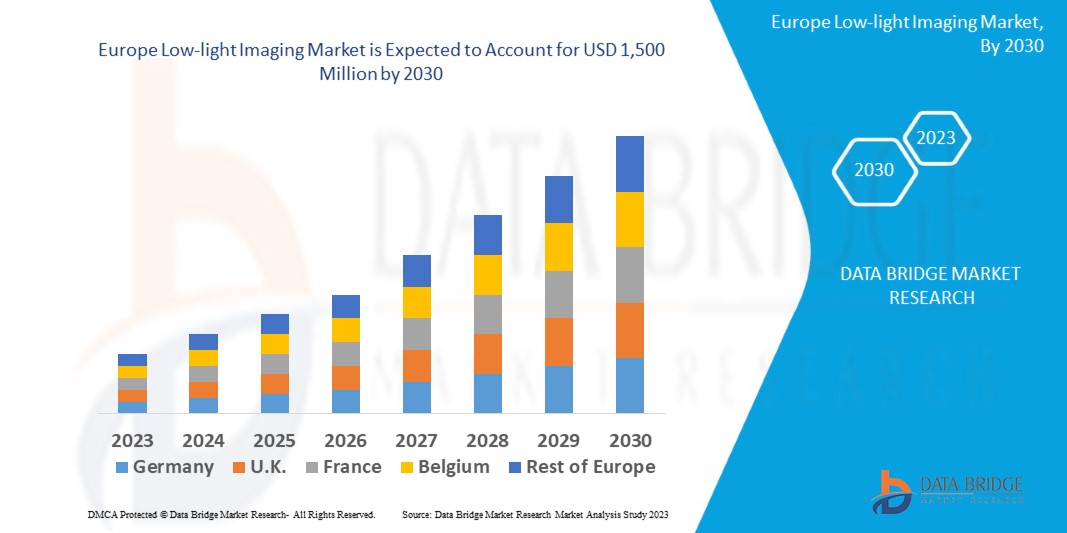
Europe Low-Light Imaging Market Analysis and Size
Europe low-light imaging market is segmented on the basis of technology, application, and vertical. The growth among segments helps you analyse niche pockets of growth and strategies to approach the market and determine your core application areas and the difference in your target markets.
Data Bridge Market Research analyses that the Europe low-light imaging market which was USD 801.6 million in 2021, would rocket up to USD 1,500 million by 2030, and is expected to undergo a CAGR of 9.4% during the forecast period. This indicates the market value. “Complementary Metal-Oxide Semiconductor (CMOS)” dominates the technology segment of the Europe low-light imaging market considering its advantage of low noise in comparison to CCD sensors. Also, individual amplification of pixel signals allows CMOS to operate at a higher speed. In addition to the insights on market scenarios such as market value, growth rate, segmentation, geographical coverage, and major players, the market reports curated by the Data Bridge Market Research also include depth expert analysis, patient epidemiology, pipeline analysis, pricing analysis, and regulatory framework.
Europe Low-Light Imaging Market Scope and Segmentation
|
Report Metric |
Details |
|
Forecast Period |
2023 to 2030 |
|
Base Year |
2022 |
|
Historic Years |
2021 |
|
Quantitative Units |
Revenue in USD Million, Volumes in Units, Pricing in USD |
|
Segments Covered |
Technology (Complementary Metal-Oxide Semiconductor (CMOS), Charge-Coupled Device (CCD)), Application (Photography, Monitoring, Inspection & Detection, Security & Surveillance), Vertical (Consumer Electronics, Automotive, Medical & Life Sciences, Military & Defence and Industrial, Commercial & Residential Infrastructure) |
|
Countries Covered |
Germany, France, U.K., Netherlands, Switzerland, Belgium, Russia, Italy, Spain, Turkey, Rest of Europe |
|
Market Players Covered |
Samsung Electronics Co., Ltd. (Samsung Group) (South Korea), Sony Corporation (Japan), Teledyne FLIR LLC (U.S.), STMicroelectronics N.V. (Switzerland), Panasonic Corporation (Japan), Canon, Inc. (Japan), ON Semiconductor Corporation (U.S.), Hamamatsu Photonics K.K. (Japan), PixArt Imaging, Inc. (U.S.), OmniVision Technologies, Inc. (U.S.) |
|
Market Opportunities |
|
Market Definition
The Europe low-light imaging market refers to the industry sector that involves the production, distribution, and utilization of imaging technologies and solutions specifically designed to capture high-quality images and videos in low-light or challenging lighting conditions. Low-light imaging technologies are developed to address the limitations of traditional imaging systems that struggle to perform effectively in situations with limited light, such as night-time, indoor settings with low ambient lighting, or environments with uneven lighting. The market encompasses a wide range of products and solutions, including low-light cameras, image sensors, lenses, image-processing software, and related components. These technologies employ various techniques such as sensor optimization, noise reduction algorithms, enhanced sensitivity, and high dynamic range (HDR) imaging to capture clear and detailed images even in low-light environments.
Europe Low-Light Imaging Market Dynamics
Drivers
- Growing Applications in Healthcare and Life Sciences
In the healthcare and life sciences sectors, low-light imaging has significant applications in medical imaging systems, research, and diagnostics. These technologies enable clear visualization of internal structures in low-light conditions, supporting procedures such as endoscopy, laparoscopy, and microscopy. The demand for improved medical imaging solutions and the advancements in healthcare technology are driving the adoption of low-light imaging in these sectors.
- Increasing Security Concerns
The rising need for improved security and surveillance systems has driven the demand for low-light imaging solutions. Low-light cameras provide enhanced visibility and accurate monitoring capabilities in dimly lit or night-time environments, making them essential for applications such as perimeter security, facial recognition, and traffic monitoring. This demand is fuelled by factors like increasing urbanization, the need for public safety, and the rise in security threats.
- Advancements in Sensor Technology
The development of advanced image sensors with improved sensitivity and noise reduction capabilities has significantly contributed to the growth of the Europe low-light imaging market. Sensor technologies such as backside-illuminated (BSI) sensors, larger pixel sizes, and improved signal-to-noise ratios have enabled better performance in low-light environments, leading to increased adoption of low-light imaging solutions.
Opportunities
Low-light imaging solutions find applications in various industrial sectors, such as manufacturing, quality control, and inspection. They can be used for tasks like product inspection, machine vision, and monitoring of critical processes. Low-light cameras enable enhanced visibility in dimly lit environments, facilitating accurate analysis and decision-making.
Restraints/Challenges
Low-light imaging technologies often involve advanced sensors, specialized lenses, and sophisticated image processing algorithms, which can contribute to higher costs compared to traditional imaging systems. The high cost of implementation and equipment can act as a restraint, especially for budget-conscious customers or industries with cost-sensitive requirements.
This Europe low-light imaging market report provides details of new recent developments, trade regulations, import-export analysis, production analysis, value chain optimization, market share, the impact of domestic and localized market players, analyses opportunities in terms of emerging revenue pockets, changes in market regulations, strategic market growth analysis, market size, category market growths, application niches and dominance, product approvals, product launches, geographic expansions, technological innovations in the market. To gain more info on the low-light imaging market contact Data Bridge Market Research for an Analyst Brief, our team will help you make an informed market decision to achieve market growth.
Recent Development
- In January 2023, Samsung has unveiled its new ISOCELL HP2 image sensor, featuring 200 million 0.6-micrometer pixels for high-end smartphones. The sensor utilizes pixel binding technology to adapt to low-light conditions, switching between 50MP and 12.5MP modes, while also supporting 8K video capture at 33MP resolution.
- In January 2023, Panasonic Holdings Corporation has developed highly sensitive hyperspectral imaging technology using compressed sensing. This breakthrough enables the identification of subtle color differences, enhancing image analysis and recognition accuracy while maintaining the usability of conventional color cameras. The achievement was published in Nature Photonics in collaboration with imec, a Belgian research institute, marking the world's first demonstration of efficient hyperspectral imaging with compressed sensing.
Europe Low-light Imaging Market Scope
The Europe low-light imaging market is segmented on the basis of technology, application, and vertical. The growth amongst these segments will help you analyse meagre growth segments in the industries and provide the users with a valuable market overview and market insights to help them make strategic decisions for identifying core market applications.
Technology
- Complementary Metal-Oxide Semiconductor (CMOS)
- Charge-Coupled Device (CCD)
Application
- Photography, Monitoring
- Inspection & Detection
- Security & Surveillance
Vertical
- Consumer Electronics
- Automotive
- Medical & Life Sciences
- Military & Defense and Industrial
- Commercial & Residential Infrastructure
Europe Low-Light Imaging Market Regional Analysis/Insights
The Europe low-light imaging market is analysed and market size insights and trends are provided by country, technology, application, and vertical as referenced above.
The countries covered in the Europe low-light imaging market report are Germany, France, U.K., Netherlands, Switzerland, Belgium, Russia, Italy, Spain, Turkey, Rest of Europe in Europe.
Germany dominates the low-light imaging market because Germany is known for its strong technological expertise and innovation capabilities. The country has a robust research and development infrastructure and is home to several renowned universities and research institutes specializing in imaging technologies. This ecosystem fosters the development of cutting-edge low-light imaging solutions and facilitates collaborations between academia and industry.
The country section of the report also provides individual market-impacting factors and changes in regulation in the market domestically that impact the current and future trends of the market. Data points like downstream and upstream value chain analysis, technical trends, and porter's five forces analysis, case studies are some of the pointers used to forecast the market scenario for individual countries. Also, the presence and availability of Europe brands and the challenges faced due to large or scarce competition from local and domestic brands, the impact of domestic tariffs, and trade routes are considered while providing forecast analysis of the country data.
Semiconductor Infrastructure growth Installed base and New Technology Penetration
The Europe low-light imaging market also provides you with a detailed market analysis for every country’s growth in healthcare expenditure for capital equipment, installed base of different kinds of products for Europe low-light imaging market, the impact of technology using lifeline curves, and changes in healthcare regulatory scenarios and their impact on the low-light imaging market. The data is available for the historical period 2010-2020.
Competitive Landscape and Europe Low-light Imaging Market Share Analysis
The low-light imaging market competitive landscape provides details by competitors. Details included are company overview, company financials, revenue generated, market potential, investment in research and development, new market initiatives, Europe presence, production sites and facilities, production capacities, company strengths and weaknesses, product launch, product width and breadth, and application dominance. The above data points provided are only related to the companies' focus related to the low-light imaging market.
Some of the major players operating in the Europe low-light imaging market are:
- Samsung Electronics Co., Ltd. (Samsung Group)
- Sony Corporation
- Teledyne FLIR LLC
- STMicroelectronics N.V.
- Panasonic Corporation
- Canon, Inc.
- ON Semiconductor Corporation
- Hamamatsu Photonics K.K.
- PixArt Imaging, Inc.
- OmniVision Technologies, Inc.
SKU-
Obtenha acesso online ao relatório sobre a primeira nuvem de inteligência de mercado do mundo

- Painel interativo de análise de dados
- Painel de análise da empresa para oportunidades de elevado potencial de crescimento
- Acesso de analista de pesquisa para personalização e customização. consultas
- Análise da concorrência com painel interativo
- Últimas notícias, atualizações e atualizações Análise de tendências
- Aproveite o poder da análise de benchmark para um rastreio abrangente da concorrência
Metodologia de Investigação
A recolha de dados e a análise do ano base são feitas através de módulos de recolha de dados com amostras grandes. A etapa inclui a obtenção de informações de mercado ou dados relacionados através de diversas fontes e estratégias. Inclui examinar e planear antecipadamente todos os dados adquiridos no passado. Da mesma forma, envolve o exame de inconsistências de informação observadas em diferentes fontes de informação. Os dados de mercado são analisados e estimados utilizando modelos estatísticos e coerentes de mercado. Além disso, a análise da quota de mercado e a análise das principais tendências são os principais fatores de sucesso no relatório de mercado. Para saber mais, solicite uma chamada de analista ou abra a sua consulta.
A principal metodologia de investigação utilizada pela equipa de investigação do DBMR é a triangulação de dados que envolve a mineração de dados, a análise do impacto das variáveis de dados no mercado e a validação primária (especialista do setor). Os modelos de dados incluem grelha de posicionamento de fornecedores, análise da linha de tempo do mercado, visão geral e guia de mercado, grelha de posicionamento da empresa, análise de patentes, análise de preços, análise da quota de mercado da empresa, normas de medição, análise global versus regional e de participação dos fornecedores. Para saber mais sobre a metodologia de investigação, faça uma consulta para falar com os nossos especialistas do setor.
Personalização disponível
A Data Bridge Market Research é líder em investigação formativa avançada. Orgulhamo-nos de servir os nossos clientes novos e existentes com dados e análises que correspondem e atendem aos seus objetivos. O relatório pode ser personalizado para incluir análise de tendências de preços de marcas-alvo, compreensão do mercado para países adicionais (solicite a lista de países), dados de resultados de ensaios clínicos, revisão de literatura, mercado remodelado e análise de base de produtos . A análise de mercado dos concorrentes-alvo pode ser analisada desde análises baseadas em tecnologia até estratégias de carteira de mercado. Podemos adicionar quantos concorrentes necessitar de dados no formato e estilo de dados que procura. A nossa equipa de analistas também pode fornecer dados em tabelas dinâmicas de ficheiros Excel em bruto (livro de factos) ou pode ajudá-lo a criar apresentações a partir dos conjuntos de dados disponíveis no relatório.











