


Europe Self-Organizing Network (SON) Market, By Offering (Software, Services), Network (RAN, Wi-Fi, Core Network, Backhaul), Architecture (C-SON (Centralised), D-SON (Decentralized), H-SON (Hybrid)), Network Technology (4G/LTE, 2G/3G, 5G), Application (Network Security and Authentication, WAP, Intermachine Communication, Global Positioning System, Gaming, and Others) - Industry Trends and Forecast to 2030.
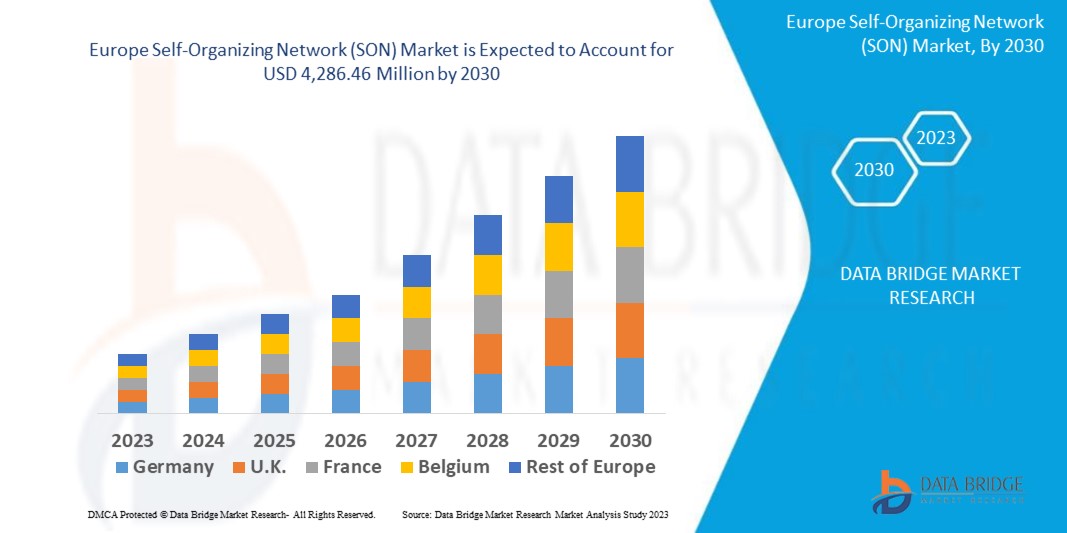
Europe Self-Organizing Network (SON) Market Analysis and Size
The self-organizing network (SON) market is segmented based on offering, network, architecture, network technology and application. Factors driving the SON market include the growing demand for high-speed connectivity, the proliferation of mobile devices, the emergence of IoT applications, the need for network automation and optimization, and the continuous advancements in wireless communication technologies.
Data Bridge Market Research analyses that the Europe Self-Organizing Network (SON) market which was USD 1,496.93 million in 2022, is expected to reach USD 4,286.46 million by 2030, and is expected to undergo a CAGR of 12.4% during the forecast period of 2023 to 2030. “C-SON” dominates the architecture segment of the Europe self-organizing network (SON) market as telecommunications networks are becoming increasingly complex with the deployment of multiple technologies, frequency bands, and network layers (2G, 3G, 4G, and 5G). C-SON helps manage this complexity by automating network optimization, configuration, and troubleshooting tasks, leading to more efficient network operations. In addition to the insights on market scenarios such as market value, growth rate, segmentation, geographical coverage, and major players, the market reports curated by the Data Bridge Market Research also include in-depth expert analysis, geographically represented company-wise production and capacity, network layouts of distributors and partners, detailed and updated price trend analysis and deficit analysis of supply chain and demand.
Europe Self-Organizing Network (SON) Market Scope and Segmentation
|
Report Metric |
Details |
|
Forecast Period |
2023 to 2030 |
|
Base Year |
2022 |
|
Historic Years |
2021 |
|
Quantitative Units |
Revenue in USD Million, Volumes in Units, Pricing in USD |
|
Segments Covered |
Offering (Software, Services), Network (RAN, Wi-Fi, Core Network, Backhaul), Architecture (C-SON (Centralised), D-SON (Decentralized), H-SON (Hybrid)), Network Technology (4G/LTE, 2G/3G, 5G), Application (Network Security & Authentication, WAP, Intermachine Communication, Global Positioning System, Gaming, and Others) |
|
Countries Covered |
Germany, France, Russia, U.K., Italy, Spain, Netherlands, Belgium, Switzerland, Turkey and Rest of Europe |
|
Market Players Covered |
Nokia Corporation (Finland), Huawei Technologies (China), Telefonaktiebolaget LM Ericsson (Sweden), Cisco Systems, Inc. (U.S.), ZTE Corporation (China). Samsung Electronics Co., Ltd. (South Korea), NEC Corporation (Japan), CommScope Holding Company, Inc. (U.S.), AirHop Communications (U.S.), Cellwize Wireless Technologies Pte Ltd. (Israel), Amdocs (U.S.), ASOCS Ltd. (Israel), P.I. Works (Turkey), VIAVI Solutions Inc. (U.S.), Siradel (France), Reverb Networks (U.S.), InfoVista (France), Accedian (Canada), Telcordia Technologies (U.S.), AIRCOM International (U.K.) |
|
Market Opportunities |
5G Network Deployment Network Virtualization and Software-Defined Networking (SDN) Cloud and Edge Computing |
Market Definition
The Europe self-organizing network (SON) market involves both hardware and software components, including base stations, access points, network management system, network controllers, and SON platforms. It also includes professional services such as consulting, deployment, integration, and support services related to SON implementation. The Europe SON market serves network operators, telecommunications service providers, and equipment vendors seeking to improve network efficiency, optimize resources, enhance user experience, and reduce operational costs. SON solutions play a critical role in managing the increasing complexity of modern networks, supporting the deployment of new technologies such as 5G, and enabling the efficient management of network infrastructure in dynamic and evolving environments.
Europe Self-Organizing Network (SON) Market Dynamics
Drivers
Increasing Network Complexity
The growing complexity of modern networks, driven by the deployment of multiple technologies (2G, 3G, 4G, and 5G), diverse frequency bands, and heterogeneous network elements, is a key driver for SON. This solution automate network management tasks, such as configuration, optimization, and troubleshooting, to efficiently handle the complexity and improve network performance.
Growing Demand for Efficient Network Management
With the exponential increase in mobile data traffic and the need for seamless connectivity, there is a rising demand for efficient network management solutions. SON offers automation, real-time optimization, and self-configuration capabilities, enabling network operators to efficiently manage network resources, enhance user experience, and reduce operational costs.
Opportunity
Integration with IoT and mMTC
SON presents opportunities to manage and optimize networks for the growing internet of things (IoT) and massive machine type communications (mMTC) applications. By intelligently managing connectivity, interference, and resource allocation, SON can support the scaling and efficient operation of IoT and mMTC devices, enabling new business opportunities.
Restraint/Challenge
Lack of Standardization and Interoperability
The absence of standardized interfaces and protocols for SON solutions poses a restraint. The interoperability challenges can arise when integrating SON with existing network infrastructures or with equipment from different vendors, hindering seamless deployment and compatibility.
The Europe self-organizing network (SON) market report provides details of new recent developments, trade regulations, import-export analysis, production analysis, value chain optimization, market share, the impact of domestic and localized market players, analyses opportunities in terms of emerging revenue pockets, changes in market regulations, strategic market growth analysis, market size, category market growths, application niches and dominance, product approvals, product launches, geographic expansions, technological innovations in the market. To gain more info on the Europe self-organising network (SON) market contact Data Bridge Market Research for an Analyst Brief, our team will help you make an informed market decision to achieve market growth.
Impact and Current Market Scenario of Raw Material Shortage and Shipping Delays
Data Bridge Market Research offers a high-level analysis of the market and delivers information by keeping in account the impact and current market environment of raw material shortage and shipping delays. This translates into assessing strategic possibilities, creating effective action plans, and assisting businesses in making important decisions.
Apart from the standard report, we also offer in-depth analysis of the procurement level from forecasted shipping delays, distributor mapping by region, commodity analysis, production analysis, price mapping trends, sourcing, category performance analysis, supply chain risk management solutions, advanced benchmarking, and other services for procurement and strategic support.
Expected Impact of Economic Slowdown on the Pricing and Availability of Products
When economic activity slows, industries begin to suffer. The forecasted effects of the economic downturn on the pricing and accessibility of the products are taken into account in the market insight reports and intelligence services provided by DBMR. With this, our clients can typically keep one step ahead of their competitors, project their sales and revenue, and estimate their profit and loss expenditures.
Recent Developments
- In June 2021, Nokia, a portfolio company of KPS Capital Partners, completed the acquisition of Schlumberger's North American Land Rod Lift Business. This acquisition strengthens Lufkin's position as a leading provider of rod lifts products and services in North America, offering a comprehensive product portfolio and differentiated technology offerings. With a significant manufacturing and distribution capacity and a presence in major oil-producing regions, this acquisition expands Lufkin's footprint in the industry announced that BT mobile network, EE, is deploying Nokia’s self-organizing network (SON) software solution to enhance network reliability and service in its 4G and 5G networks, as part of a new vendor deal
- In August 2021, Ericsson announced that it had partnered with Telefónica Peru to deploy its SON solution, enabling network automation, optimization, and improved user experience for Telefónica's subscribers
Europe Self-Organizing Network (SON) Market Scope
The Europe self-organizing network (SON) market is segmented on the basis of offering, network, architecture, network technology, and application. The growth amongst these segments will help you analzse meagre growth segments in the industries and provide the users with a valuable market overview and market insights to help them make strategic decisions for identifying core market applications.
Offering
- Software
- Services
Network
- RAN
- Wi-Fi
- Core Network
- Backhaul
Architecture
- C-SON (centralised)
- D-SON (decentralized)
- H-SON (hybrid)
Application
- Network security and authentication
- WAP
- Intermachine Communication
- Global Positioning System
- Gaming
- Others
Network Technology
- 4G/LTE
- 2G/3G
- 5G
Europe Self-Organizing Network (SON) Market Regional Analysis/Insights
The Europe self-organizing network (SON) market is analysed and market size insights and trends are provided by country, offering, network, architecture, network technology, applicationas referenced above.
The countries covered in the Europe self-organizing network (SON) market report are Germany, France, Russia, U.K., Italy, Spain, Netherlands, Belgium, Switzerland, Turkey and Rest of Europe
The Germany dominates the Europe self-organizing network (SON) market because of robust telecommunications industry with well-established network operators, equipment vendors, and research institutions. Companies such asDeutsche Telekom, Vodafone Germany, and Telefonica Germany are major players in the market, driving the adoption and development of SON solutions.
The country section of the report also provides individual market-impacting factors and changes in regulation in the market domestically that impact the current and future trends of the market. Data points like downstream and upstream value chain analysis, technical trends, and Porter’s five forces analysis, case studies are some of the pointers used to forecast the market scenario for individual countries. Also, the presence and availability of Europe brands and the challenges faced due to large or scarce competition from local and domestic brands, the impact of domestic tariffs, and trade routes are considered while providing forecast analysis of the country data.
Competitive Landscape and Europe Self-Organizing Network (SON) Market Share Analysis
The Europe self-organizing network (SON) market competitive landscape provides details by competitors. Details included are company overview, company financials, revenue generated, market potential, investment in research and development, new market initiatives, Europe presence, production sites and facilities, production capacities, company strengths and weaknesses, product launch, product width and breadth, and application dominance. The above data points provided are only related to the companies' focus related to the Europe self-organizing network (SON) market.
Some of the major players operating in the Europe self-organizing network (SON) market are:
- Nokia Corporation (Finland)
- Huawei Technologies (China)
- Telefonaktiebolaget LM Ericsson (Sweden)
- Cisco Systems, Inc. (U.S.)
- ZTE Corporation (China)
- Samsung Electronics Co., Ltd. (South Korea)
- NEC Corporation (Japan)
- CommScope Holding Company, Inc. (U.S.)
- AirHop Communications (U.S.)
- Cellwize Wireless Technologies Pte Ltd. (Israel)
- Amdocs (U.S.)
- ASOCS Ltd. (Israel)
- P.I. Works (Turkey)
- VIAVI Solutions Inc. (U.S.)
- Siradel (France)
- Reverb Networks (U.S.)
- InfoVista (France)
- Accedian (Canada)
- Telcordia Technologies (U.S.)
- AIRCOM International (U.K.)
SKU-
Obtenha acesso online ao relatório sobre a primeira nuvem de inteligência de mercado do mundo

- Painel interativo de análise de dados
- Painel de análise da empresa para oportunidades de elevado potencial de crescimento
- Acesso de analista de pesquisa para personalização e customização. consultas
- Análise da concorrência com painel interativo
- Últimas notícias, atualizações e atualizações Análise de tendências
- Aproveite o poder da análise de benchmark para um rastreio abrangente da concorrência
Metodologia de Investigação
A recolha de dados e a análise do ano base são feitas através de módulos de recolha de dados com amostras grandes. A etapa inclui a obtenção de informações de mercado ou dados relacionados através de diversas fontes e estratégias. Inclui examinar e planear antecipadamente todos os dados adquiridos no passado. Da mesma forma, envolve o exame de inconsistências de informação observadas em diferentes fontes de informação. Os dados de mercado são analisados e estimados utilizando modelos estatísticos e coerentes de mercado. Além disso, a análise da quota de mercado e a análise das principais tendências são os principais fatores de sucesso no relatório de mercado. Para saber mais, solicite uma chamada de analista ou abra a sua consulta.
A principal metodologia de investigação utilizada pela equipa de investigação do DBMR é a triangulação de dados que envolve a mineração de dados, a análise do impacto das variáveis de dados no mercado e a validação primária (especialista do setor). Os modelos de dados incluem grelha de posicionamento de fornecedores, análise da linha de tempo do mercado, visão geral e guia de mercado, grelha de posicionamento da empresa, análise de patentes, análise de preços, análise da quota de mercado da empresa, normas de medição, análise global versus regional e de participação dos fornecedores. Para saber mais sobre a metodologia de investigação, faça uma consulta para falar com os nossos especialistas do setor.
Personalização disponível
A Data Bridge Market Research é líder em investigação formativa avançada. Orgulhamo-nos de servir os nossos clientes novos e existentes com dados e análises que correspondem e atendem aos seus objetivos. O relatório pode ser personalizado para incluir análise de tendências de preços de marcas-alvo, compreensão do mercado para países adicionais (solicite a lista de países), dados de resultados de ensaios clínicos, revisão de literatura, mercado remodelado e análise de base de produtos . A análise de mercado dos concorrentes-alvo pode ser analisada desde análises baseadas em tecnologia até estratégias de carteira de mercado. Podemos adicionar quantos concorrentes necessitar de dados no formato e estilo de dados que procura. A nossa equipa de analistas também pode fornecer dados em tabelas dinâmicas de ficheiros Excel em bruto (livro de factos) ou pode ajudá-lo a criar apresentações a partir dos conjuntos de dados disponíveis no relatório.











