



Global Acidulants Market, By Type (Citric Acid, Sodium Citrate, Potassium Citrate, Acetic Acid, Formic Acid, Gluconic Acid, Malic Acid, Phosphoric Acid and Salts, Tartaric Acid, Lactic Acid, Tannic Acid, Fumaric Acid, Succinic Acid, and Ascorbic Acid) Industry Trends and Forecast to 2029
Market Analysis and Insights
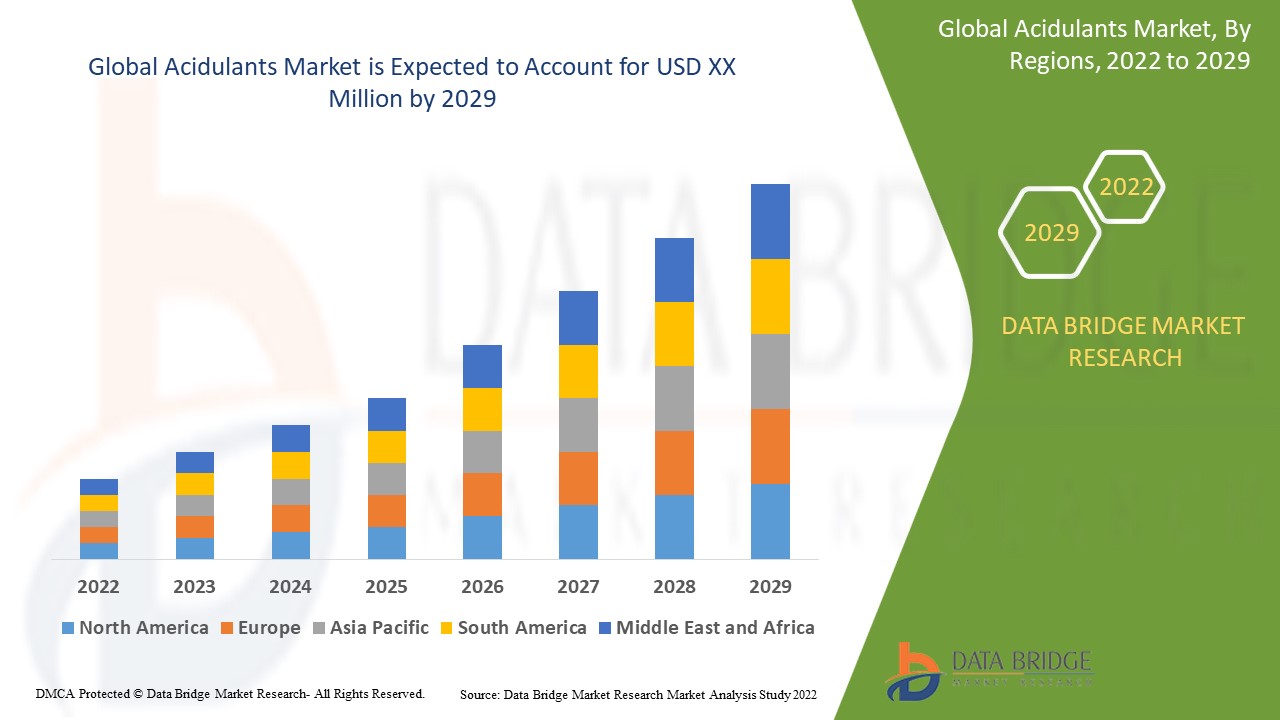
The global acidulants market is gaining significant growth due to the growing application in food & beverage, feed, chemical, cosmetic etc. industries. The increase in demand for acidulants in alcoholic beverages such as wine is also boosting the growth of the global acidulants market. However, stringent government regulations associated with acidulants and health risks associated with some acidulants, such as phosphoric acid is expected to restrain the market growth of acidulants market during the forecast period.

Data Bridge Market Research analyses that the global acidulants market will grow at a CAGR of 6.5% during the forecast period of 2022 to 2029.
|
Report Metric |
Details |
|
Forecast Period |
2022 to 2029 |
|
Base Year |
2021 |
|
Historic Year |
2020 (Customizable to 2019 - 2015) |
|
Quantitative Units |
Revenue in USD Million, Pricing in USD |
|
Segments Covered |
By Type (Citric Acid, Sodium Citrate, Potassium Citrate, Acetic Acid, Formic Acid, Gluconic Acid, Malic Acid, Phosphoric Acid And Salts, Tartaric Acid, Lactic Acid, Tannic Acid, Fumaric Acid, Succinic Acid, and Ascorbic Acid) |
|
Countries Covered |
U.S., Canada, Mexico, China, Japan, Australia, India, South Korea, Malaysia, Singapore, Indonesia, Thailand, Vietnam, New Zealand, Philippines, and the rest of Asia-Pacific, U.K., France, Germany, Italy, Spain, Russia, Netherlands, Belgium, Turkey, Poland, Denmark, Sweden, Switzerland and Rest of Europe, South Africa, Oman, Qatar, Saudi Arabia, U.A.E., Kuwait and Rest of Middle East and Africa |
|
Market Players Covered |
Cargill, Incorporated, Brenntag, Tate & Lyle, ADM, Jungbunzlauer Suisse AG, Corbion, Bartek Ingredients Inc., INDUSTRIAL TECNICA PECUARIA, S.A., DIARYCHEM, Weifang Ensign Industry Co., Ltd, FBC Industries, Chemvera Specialty Chemicals Pvt. Ltd., Direct Food Ingredients, Richest Group, Suntran.cn, Foodchem International Corporation, Arshine Pharmaceutical Co., Limited, Hawkins Watts Limited, Arihant Chemical, and Innova Corporate |
Market Definition
Acidulants are chemical compounds that give a tart, sour, or acidic flavor to foods or enhance the perceived sweetness of foods. Acidulants can also function as leavening agents and emulsifiers in some kinds of processed foods. Though acidulants can lower pH, they differ from acidity regulators, which are food additives specifically intended to modify food stability or enzymes within it. Typical acidulants are acetic acid (for instance, in pickles) and citric acid. Many beverages, such as colas, contain phosphoric acid. Sour candies often are formulated with malic acid. Other acidulants used are fumaric acid, tartaric acid, lactic acid, and gluconic acid.
Global Acidulants Market Dynamics
Drivers
-
Growing demand for instant beverages, carbonated drinks, and fermented drinks is likely to favour acidulants market growth
Owing to busy lifestyles, instant beverages and carbonated drinks have become popular amongst consumers. Growth in the young population in developing countries, along with rising disposable income, is enabling consumers to buy ready-to-drink beverages such as instant beverages. In addition, the rising demand for processed food and beverages is also increasing the demand for carbonated drinks and instant beverages. In addition, product innovations such as low/no-calorie drinks are also attracting health-conscious consumers.
Thus, the growing demand for instant beverages, carbonated drinks, and fermented drinks is projected to drive the demand for acidulants over the years to come.
-
Rise in demand for acidulants such as malic acid, lactic acid, and sodium lactate in the confectionery industry
Acidulants that are used in confectionery, such as malic acid, lactic acid, and sodium lactate, have unique taste and flavor effects. It also boosts the impact of some aromatic flavor notes due to its volatility. In addition, nowadays, the combinations of acidulants are commonly used in confectionery. Furthermore, malic acid as well as fumaric acid provide more persistent sourness than other food acids at the same concentration and enhances fruit flavors, and boost the impact of high-intensity sweeteners.
Hence, the increased demand for confectionery products increases the demand for acidulants such as malic acid, lactic acid, fumaric acid, sodium lactate, and others by food manufacturers in order to fulfil the demands.

Opportunities
-
Biological production of citric acid and acetic acid
Consumers are shifting towards sustainable products and are opting for products that are manufactured with the help of sustainable ingredients. Hence, the demand for sustainable and cost-effective, and biological food ingredients (acidulants) such as citric acid and acetic acid is increasing among the manufacturers. However, the production of bio-succinic acid is quite difficult through a sustainable production that is microbial fermentation, although it is cost-effective.
Thus, due to the availability of a wide range of bacteria, fungi and yeasts, biological production of acidulants can be increased, and sustainable bio-acidulants products can be offered to the global food & beverages industry, as it holds huge opportunity for food & beverages products that include biologically sustainable ingredients.
Restraints/Challenges
- High prices of acidulants
Fluctuating prices of raw materials such as plant-based sources and higher prices for better quality acidulants have resulted in increased prices of acidulants. Additionally, higher food taxes and growing demand for acidulants result in high prices.
Acidulants such as gluconic acid, tannic acid, and tartaric acid have slightly higher prices as these acidulants have fewer applications in food-grade products. Hence the demand is less, and the production of these acidulants for food-grade applications is minimum which results in higher prices. High prices of acidulants may change purchase patterns for food processing manufacturers over other acidulants.
- Rules and regulation of food regulatory bodies on acidulants products
The rules and regulations for the approval of acidulants laid by governmental bodies are to ensure that the acidulants have no side effects, which may restrict the growth of the global acidulants market. The rising concern related to the side effects of acidulants on health has forced the government to lay down strict rules for product approval. The acidulants may lead to elevated blood pressure, the temporary reddish coloration of the eye, and others. Therefore, the amount of acidulant used is checked properly before using it in any product. Thus, the stringent regulations for the approval process may hamper the market's growth.
Post COVID-19 Impact on Global Acidulants Market
The COVID-19 has affected the market to some extent due to lockdown the manufacturing and production of many small and large companies was halted as well as the demand from the acidulants also was hampered which affected the market. Post-pandemic, the demand for acidulants is increased due to increasing demand for fermented beverages, soft drinks, and many others. Due to the change in many mandates and regulation, manufactures are enabled to design and launch new products in the market, which will help the growth of the market.
Recent Developments
- In March 2022, Brenntag SE acquired the Israeli specialty chemicals distributor Y.S. Ashkenazi Agencies Ltd, along with its subsidiary, Biochem Trading. This acquisition represents Brenntag's entry into the Israeli market. This acquisition will increase the goodwill of the company.
- In December 2021, Tate & Lyle, a leading global provider of food and beverage solutions and ingredients, announced that it had signed up for the UK's Food and Drink Federation's (FDF) Action on Fiber. This development will increase the customer base of the company.
Global Acidulants Market Scope
The global acidulants market is segmented into notable segments based on type. The growth amongst these segments will help you analyze major growth segments in the industries and provide the users with a valuable market overview and market insights to make strategic decisions to identify core market applications.
Type
- Citric acid
- Sodium citrate
- Potassium citrate
- Acetic acid
- Formic acid
- Gluconic acid
- Fumaric acid
- Malic acid
- Phosphoric acid and salt
- Tartaric acid
- Lactic acid
- Tannic acid
- Succinic acid
- Ascorbic acid
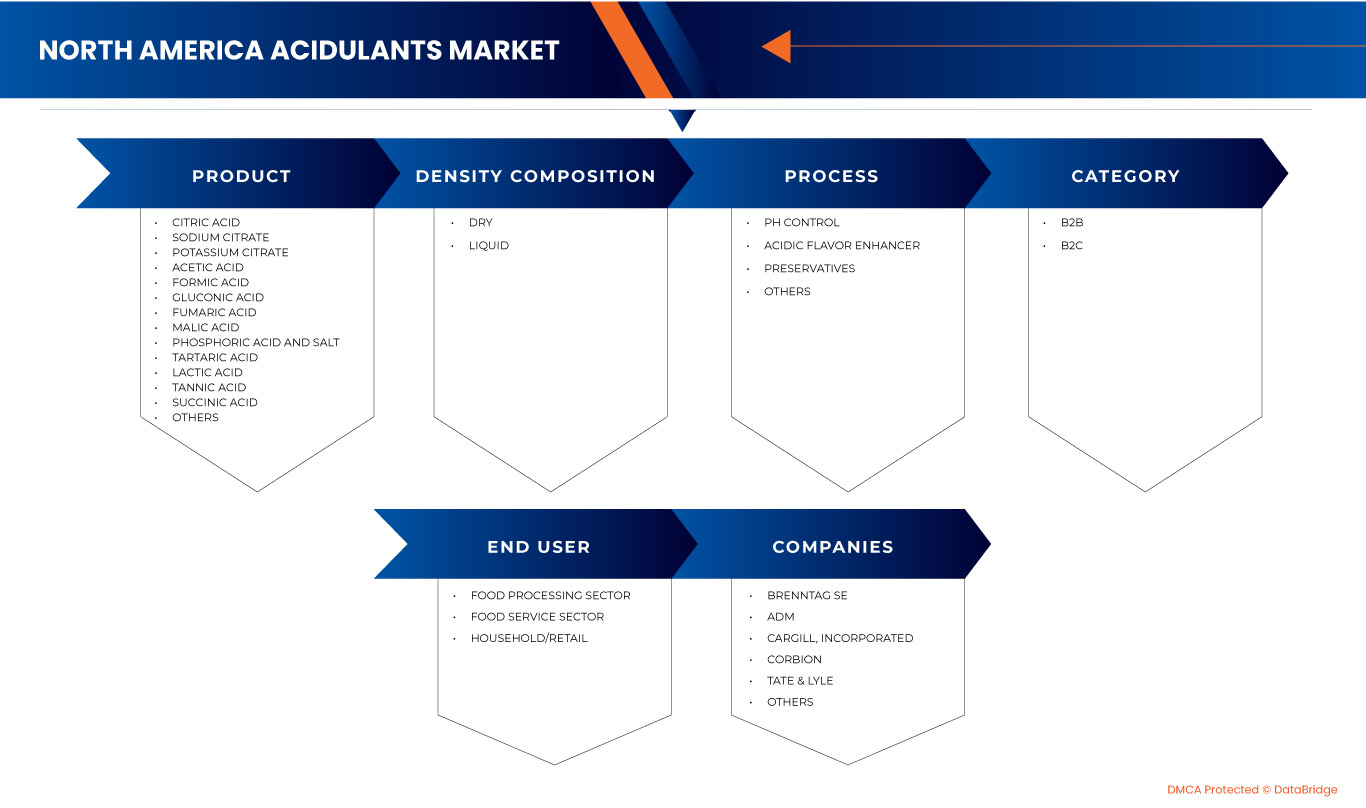
On the basis of type, the acidulants market is segmented into citric acid, sodium citrate, potassium citrate, acetic acid, formic acid, gluconic acid, malic acid, phosphoric acid and salts, tartaric acid, lactic acid, tannic acid, fumaric acid, succinic acid.
Global Acidulants Market Regional Analysis/Insights
The global acidulants market is analyzed and market size insights and trends are provided based on as referenced above.
The countries covered in the global acidulants market report are U.S., Canada, Mexico, China, Japan, Australia, India, South Korea, Malaysia, Singapore, Indonesia, Thailand, Vietnam, New Zealand, Philippines, and the rest of Asia-Pacific, U.K., France, Germany, Italy, Spain, Russia, Netherlands, Belgium, Turkey, Poland, Denmark, Sweden, Switzerland and Rest of Europe, South Africa, Oman, Qatar, Saudi Arabia, U.A.E., Kuwait and Rest of Middle East and Africa.
Asia-Pacific is expected to dominate the global acidulants market in terms of market share and market revenue and is estimated to maintain its dominance during the forecast period due to the growing surge for acidulants in various types of industries and growing consumer demand from the end users.
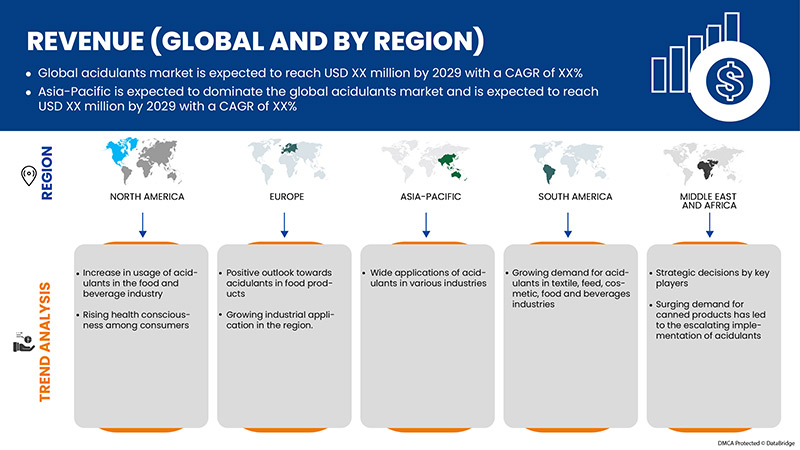
The region section of the report also provides individual market impacting factors and changes in regulations in the market that impact the current and future trends of the market. Data points, such as new and replacement sales, country demographics, disease epidemiology, and import-export tariffs, are some of the major pointers used to forecast the market scenario for individual countries. In addition, the presence and availability of Global brands and their challenges faced due to high competition from local and domestic brands, and the impact of sales channels are considered while providing forecast analysis of the country data.
Competitive Landscape and Global Acidulants Market Share Analysis
The global acidulants market competitive landscape provides details by the competitors. Details included are company overview, company financials, revenue generated, market potential, investment in research and development, new market initiatives, Global presence, production sites and facilities, production capacities, company strengths and weaknesses, product launch, product width and breadth, and application dominance. The above data points provided are only related to the companies' focus on global acidulants market.
Some of the major players operating in global acidulants market are Cargill, Incorporated, Brenntag, Tate & Lyle, ADM, Jungbunzlauer Suisse AG, Corbion, Bartek Ingredients Inc., INDUSTRIAL TECNICA PECUARIA, S.A., DIARYCHEM, Weifang Ensign Industry Co., Ltd, FBC Industries, Chemvera Specialty Chemicals Pvt. Ltd., Direct Food Ingredients, Richest Group, Suntran.cn, Foodchem International Corporation, Arshine Pharmaceutical Co., Limited, Hawkins Watts Limited, Arihant Chemical, and Innova Corporate.
Research Methodology
Data collection and base year analysis are done using data collection modules with large sample sizes. The market data is analyzed and estimated using market statistical and coherent models. In addition, market share analysis and key trend analysis are the major success factors in the market report. The key research methodology used by DBMR research team is data triangulation which involves data mining, analysis of the impact of data variables on the market, and primary (industry expert) validation. Apart from this, data models include Vendor Positioning Grid, Market Time Line Analysis, Market Overview and Guide, Company Positioning Grid, Company Market Share Analysis, Standards of Measurement, Global Vs Regional and Vendor Share Analysis. Please request analyst call in case of further inquiry.
SKU-
Obtenha acesso online ao relatório sobre a primeira nuvem de inteligência de mercado do mundo

- Painel interativo de análise de dados
- Painel de análise da empresa para oportunidades de elevado potencial de crescimento
- Acesso de analista de pesquisa para personalização e customização. consultas
- Análise da concorrência com painel interativo
- Últimas notícias, atualizações e atualizações Análise de tendências
- Aproveite o poder da análise de benchmark para um rastreio abrangente da concorrência
Índice
1 INTRODUÇÃO
1.1 OBJETIVOS DO ESTUDO
1.2 DEFINIÇÃO DE MERCADO
1.3 LIMITAÇÕES
2 MERCADO GLOBAL DE ACIDULANTES – PERCEPÇÕES DE MERCADO
2.1 ÁCIDO CÍTRICO
2.2 ÁCIDO LÁTICO
2.3 ÁCIDO FUMÁRICO
2.4 ÁCIDO MÁLICO
2,5 ÁCIDO CÉTICO
2.6 ÁCIDO TARTÁRICO
2.7 ÁCIDO FOSFÓRICO E SEUS SAIS
2.8 ÁCIDO SUCCÍNICO
2.9 ÁCIDO GLUCÔNICO
2.1 CITRATO DE SÓDIO
2.11 CITRATO DE POTÁSSIO
2.12 ÁCIDO TÂNICO
2.13 ÁCIDO FÓRMICO
2.14 ÁCIDO ASCÓRBICO
3 ANÁLISE DA CAPACIDADE DE PRODUÇÃO DO MERCADO GLOBAL DE ACIDULANTES
3.1 ANÁLISE DA CAPACIDADE DE PRODUÇÃO PARA CADA MERCADO DE ACIDULANTES
3.1.1 ÁCIDO CÍTRICO
3.1.2 ÁCIDO FÓRMICO
3.1.3 ÁCIDO SUCCÍNICO
3.1.4 CITRATO DE SÓDIO
3.1.5 ÁCIDO FOSFÓRICO E SAL
3.1.6 ÁCIDO TARTÁRICO
3.1.7 ÁCIDO FUMÁRICO
3.1.8 ÁCIDO MÁLICO
3.1.9 ÁCIDO LÁTICO
3.1.10 ÁCIDO ACÉTICO
3.1.11 ÁCIDO TÂNICO
3.2 LOCAL DE PRODUÇÃO E MERCADOS PRINCIPAIS DOS PRINCIPAIS PARTICIPANTES
3.2.1 CARGILL INCORPORATED
3.2.1.1 LOCAIS DE PRODUÇÃO
3.2.1.2 RISCOS/OPORTUNIDADES ESPECÍFICOS DO FORNECEDOR
3.2.1.3 MERCADOS PARA OS QUAIS VENDERAM
3.2.2 BRENNTAG SE
3.2.2.1 RISCOS/OPORTUNIDADES ESPECÍFICOS DO FORNECEDOR
3.2.2.2 MERCADOS PARA OS QUAIS VENDERAM
3.2.2.3 LOCAIS DE PRODUÇÃO
3.2.3 ADM
3.2.3.1 LOCAIS DE PRODUÇÃO
3.2.3.2 RISCOS/OPORTUNIDADES ESPECÍFICOS DO FORNECEDOR
3.2.3.3 MERCADOS PARA OS QUAIS VENDERAM
3.2.4 CORBION NV
3.2.4.1 LOCAIS DE PRODUÇÃO
3.2.4.2 RISCOS/OPORTUNIDADES ESPECÍFICOS DO FORNECEDOR
3.2.4.3 MERCADOS PARA OS QUAIS VENDE
3.2.5 TATE & LYLE
3.2.5.1 LOCAIS DE PRODUÇÃO
3.2.5.2 RISCOS/OPORTUNIDADES ESPECÍFICOS DO FORNECEDOR
3.2.5.3 MERCADOS PARA OS QUAIS VENDERAM
3.2.6 JUNGBUNZLAUER SUISSE AG
3.2.6.1 LOCAIS DE PRODUÇÃO
3.2.6.2 RISCOS/OPORTUNIDADES ESPECÍFICOS DO FORNECEDOR
3.2.6.3 MERCADOS PARA OS QUAIS VENDERAM
3.2.7 BARTEK INGREDIENTES INC.
3.2.7.1 LOCAIS DE PRODUÇÃO
3.2.7.2 RISCOS/OPORTUNIDADES ESPECÍFICOS DO FORNECEDOR
3.2.7.3 MERCADOS PARA OS QUAIS VENDERAM
3.2.8 DAIRYCHEM
3.2.8.1 LOCAIS DE PRODUÇÃO
3.2.8.2 RISCOS/OPORTUNIDADES ESPECÍFICOS DO FORNECEDOR
3.2.8.3 MERCADOS PARA OS QUAIS VENDERAM
3.2.9 WEIANG ENSIGN INDUSTRY CO., LTD.
3.2.9.1 LOCAIS DE PRODUÇÃO
3.2.9.2 RISCOS/OPORTUNIDADES ESPECÍFICOS DO FORNECEDOR
3.2.9.3 MERCADOS PARA OS QUAIS VENDE
3.2.10 INDUSTRIAL TÉCNICA PECUÁRIA, SA
3.2.10.1 LOCAIS DE PRODUÇÃO
3.2.10.2 RISCOS/OPORTUNIDADES ESPECÍFICOS DO FORNECEDOR
3.2.10.3 MERCADOS PARA OS QUAIS VENDERAM
4 MERCADO GLOBAL DE ACIDULANTES – ANÁLISE DE PREÇOS
4.1 ANÁLISE DE PREÇOS PARA O MERCADO DE ACIDULANTES ALIMENTARES
5 MERCADO GLOBAL DE ACIDULANTES – ANÁLISE DE MATÉRIA-PRIMA
5.1 ÁCIDO CÍTRICO
5.2 ÁCIDO ACÉTICO
5.3 CITRATO DE SÓDIO
5.4 ÁCIDO SUCCÍNICO
5.5 ÁCIDO LÁTICO
5.6 ÁCIDO FUMÁRICO
5.7 ÁCIDO TARTÁRICO
5.8 ÁCIDO MÁLICO
5.9 ÁCIDO GLUCÔNICO
5.1 ÁCIDO FOSFÓRICO E SAL
6 MERCADO GLOBAL DE ACIDULANTES – ANÁLISE DAS CINCO FORÇAS DE PORTER
6.1 ANÁLISE DAS CINCO FORÇAS DE PORTER PARA O ÁCIDO CÍTRICO -
6.1.1 PODER DE COMPRA
6.1.2 FORNECEDOR DE ENERGIA
6.1.3 AMEAÇA DE NOVOS ENTRADANTES
6.1.4 AMEAÇA DE SUBSTITUTOS
6.1.5 RIVALIDADE ENTRE CONCORRENTES EXISTENTES
6.2 ANÁLISE DAS CINCO FORÇAS DE PORTER PARA ÁCIDO LÁTICO -
6.2.1 PODER DE COMPRA
6.2.2 FORNECEDOR DE ENERGIA
6.2.3 AMEAÇA DE NOVOS ENTRADANTES
6.2.4 AMEAÇA DE SUBSTITUTOS
6.2.5 RIVALIDADE ENTRE CONCORRENTES EXISTENTES
6.3 ANÁLISE DAS CINCO FORÇAS DE PORTER PARA ÁCIDO ACÉTICO -
6.3.1 PODER DE COMPRA
6.3.2 FORNECEDOR DE ENERGIA
6.3.3 AMEAÇA DE NOVOS ENTRADANTES
6.3.4 AMEAÇA DE SUBSTITUTOS
6.3.5 RIVALIDADE ENTRE CONCORRENTES EXISTENTES
6.4 ANÁLISE DAS CINCO FORÇAS DE PORTER PARA ÁCIDO FUMÁRICO -
6.4.1 PODER DE COMPRA
6.4.2 FORNECEDOR DE ENERGIA
6.4.3 AMEAÇA DE NOVOS ENTRADANTES
6.4.4 AMEAÇA DE SUBSTITUTOS
6.4.5 RIVALIDADE ENTRE CONCORRENTES EXISTENTES
6.5 ANÁLISE DAS CINCO FORÇAS DE PORTER PARA O ÁCIDO TARTÁRICO -
6.5.1 PODER DE COMPRA
6.5.2 FORNECEDOR DE ENERGIA
6.5.3 AMEAÇA DE NOVOS ENTRADANTES
6.5.4 AMEAÇA DE SUBSTITUTOS
6.5.5 RIVALIDADE ENTRE CONCORRENTES EXISTENTES
6.6 ANÁLISE DAS CINCO FORÇAS DE PORTER PARA ÁCIDO MÁLICO -
6.6.1 PODER DE COMPRA
6.6.2 FORNECEDOR DE ENERGIA
6.6.3 AMEAÇA DE NOVOS ENTRADANTES
6.6.4 AMEAÇA DE SUBSTITUTOS
6.6.5 RIVALIDADE ENTRE CONCORRENTES EXISTENTES
6.7 ANÁLISE DAS CINCO FORÇAS DE PORTER PARA ÁCIDO GLUCÔNICO -
6.7.1 PODER DE COMPRA
6.7.2 FORNECEDOR DE ENERGIA
6.7.3 AMEAÇA DE NOVOS ENTRADANTES
6.7.4 AMEAÇA DE SUBSTITUTOS
6.7.5 RIVALIDADE ENTRE CONCORRENTES EXISTENTES
6.8 ANÁLISE DAS CINCO FORÇAS DE PORTER PARA ÁCIDO FOSFÓRICO E SAL -
6.8.1 PODER DE COMPRA
6.8.2 FORNECEDOR DE ENERGIA
6.8.3 AMEAÇA DE NOVOS ENTRADANTES
6.8.4 AMEAÇA DE SUBSTITUTOS
6.8.5 RIVALIDADE ENTRE CONCORRENTES EXISTENTES
6.9 ANÁLISE DAS CINCO FORÇAS DE PORTER PARA ÁCIDO SUCCÍNICO -
6.9.1 PODER DE COMPRA
6.9.2 FORNECEDOR DE ENERGIA
6.9.3 AMEAÇA DE NOVOS ENTRADANTES
6.9.4 AMEAÇA DE SUBSTITUTOS
6.9.5 RIVALIDADE ENTRE CONCORRENTES EXISTENTES
6.1 ANÁLISE DAS CINCO FORÇAS DE PORTER PARA O CITRATO DE SÓDIO -
6.10.1 PODER DE COMPRA
6.10.2 FORNECEDOR DE ENERGIA
6.10.3 AMEAÇA DE NOVOS ENTRADANTES
6.10.4 THREAT OF SUBSTITUTES
6.10.5 RIVALRY AMONG EXISTING COMPETITORS
7 GLOBAL ACIDULANTS MARKET – SWOT ANALYSIS
7.1 CITRIC ACID
7.2 ACETIC ACID
7.3 SODIUM CITRATE
7.4 SUCCINIC ACID
7.5 LACTIC ACID
7.6 FUMARIC ACID
7.7 TARTARIC ACID
7.8 MALIC ACID
7.9 GLUCONIC ACID
7.1 PHOSPHORIC ACID AND SALTS
8 GLOBAL ACIDULANTS MARKET – PATENT ANALYSIS
8.1 PATENT ANALYSIS
9 GLOBAL ACIDULANTS MARKET – RISK ANALYSIS
9.1 RISK ANALYSIS OF ACIDULANTS
9.1.1 CITRIC ACID
9.1.2 SODIUM CITRATE
9.1.3 ACETIC ACID
9.1.4 SUCCINIC ACID
9.1.5 MALIC ACID
9.1.6 TARTARIC ACID
9.1.7 POTASSIUM CITRATE
9.1.8 GLUCONIC ACID
9.1.9 FUMARIC ACID
9.1.10 LACTIC ACID
9.1.11 TANNIC ACID
9.1.12 FORMIC ACID
9.1.13 PHOSPHORIC ACID AND SALTS
9.2 RISK ANALYSIS (LIQUIDITY) – MAJOR PLAYERS
10 RUSSIA AND UKRAINE WAR IMPACT
10.1 COUNTRIES THAT ARE LIKELY TO BE IMPACTED THE MOST –
10.2 RISK OF CIVIL UNREST
Lista de Tabela
TABELA 1 MERCADO GLOBAL DE ACIDULANTES, POR VOLUME, 2020-2029 (MIL TONELADAS)
TABELA 2 MERCADO GLOBAL DE ACIDULANTES, POR VALOR, 2020-2029 (US$ MILHÕES)
TABELA 3 MERCADO GLOBAL DE ACIDULANTES, POR REGIÃO, 2020-2029 (MIL TONELADAS)
TABELA 4 MERCADO GLOBAL DE ACIDULANTES, POR REGIÃO, 2020-2029 (US$ MILHÕES)
TABELA 5 MERCADO GLOBAL DE ÁCIDO CÍTRICO EM ACIDULANTES, POR REGIÃO, 2020-2029 (MIL TONELADAS)
TABELA 6 MERCADO GLOBAL DE ÁCIDO CÍTRICO EM ACIDULANTES, POR REGIÃO, 2020-2029 (US$ MILHÕES)
TABELA 7 MERCADO GLOBAL DE ÁCIDO LÁTICO EM ACIDULANTES, POR REGIÃO, 2020-2029 (MIL TONELADAS)
TABELA 8 MERCADO GLOBAL DE ÁCIDO LÁTICO EM ACIDULANTES, POR REGIÃO, 2020-2029 (MIL TONELADAS)
TABELA 9 MERCADO GLOBAL DE ÁCIDO FUMÁRICO EM ACIDULANTES, POR REGIÃO, 2020-2029 (MIL TONELADAS)
TABELA 10 MERCADO GLOBAL DE ÁCIDO FUMÁRICO EM ACIDULANTES, POR REGIÃO, 2020-2029 (US$ MILHÕES)
TABELA 11 MERCADO GLOBAL DE ÁCIDO MÁLICO EM ACIDULANTES, POR REGIÃO, 2020-2029 (MIL TONELADAS)
TABELA 12 MERCADO GLOBAL DE ÁCIDO MÁLICO EM ACIDULANTES, POR REGIÃO, 2020-2029 (US$ MILHÕES)
TABELA 13 MERCADO GLOBAL DE ÁCIDO ACÉTICO EM ACIDULANTES, POR REGIÃO, 2020-2029 (MIL TONELADAS)
TABELA 14 MERCADO GLOBAL DE ÁCIDO ACÉTICO EM ACIDULANTES, POR REGIÃO, 2020-2029 (US$ MILHÕES)
TABELA 15 MERCADO GLOBAL DE ÁCIDO TARTÁRICO EM ACIDULANTES, POR REGIÃO, 2020-2029 (MIL TONELADAS)
TABELA 16 MERCADO GLOBAL DE ÁCIDO TARTÁRICO EM ACIDULANTES, POR REGIÃO, 2020-2029 (US$ MILHÕES)
TABELA 17 MERCADO GLOBAL DE ÁCIDO FOSFÓRICO E SEUS SAIS EM ACIDULANTES, POR REGIÃO, 2020-2029 (MIL TONELADAS)
TABELA 18 MERCADO GLOBAL DE ÁCIDO FOSFÓRICO E SEUS SAIS EM ACIDULANTES, POR REGIÃO, 2020-2029 (US$ MILHÕES)
TABELA 19 MERCADO GLOBAL DE ÁCIDO SUCCÍNICO EM ACIDULANTES, POR REGIÃO, 2020-2029 (MIL TONELADAS)
TABELA 20 MERCADO GLOBAL DE ÁCIDO SUCCÍNICO EM ACIDULANTES, POR REGIÃO, 2020-2029 (US$ MILHÕES)
TABELA 21 MERCADO GLOBAL DE ÁCIDO GLUCÔNICO EM ACIDULANTES, POR REGIÃO, 2020-2029 (MIL TONELADAS)
TABELA 22 MERCADO GLOBAL DE ÁCIDO GLUCÔNICO EM ACIDULANTES, POR REGIÃO, 2020-2029 (US$ MILHÕES)
TABELA 23 MERCADO GLOBAL DE CITRATO DE SÓDIO EM ACIDULANTES, POR REGIÃO, 2020-2029 (MIL TONELADAS)
TABELA 24 MERCADO GLOBAL DE CITRATO DE SÓDIO EM ACIDULANTES, POR REGIÃO, 2020-2029 (US$ MILHÕES)
TABELA 25 MERCADO GLOBAL DE CITRATO DE POTÁSSIO EM ACIDULANTES, POR REGIÃO, 2020-2029 (MIL TONELADAS)
TABELA 26 MERCADO GLOBAL DE CITRATO DE POTÁSSIO EM ACIDULANTES, POR REGIÃO, 2020-2029 (US$ MILHÕES)
TABELA 27 MERCADO GLOBAL DE ÁCIDO TÂNICO EM ACIDULANTES, POR REGIÃO, 2020-2029 (MIL TONELADAS)
TABELA 28 MERCADO GLOBAL DE ÁCIDO TÂNICO EM ACIDULANTES, POR REGIÃO, 2020-2029 (US$ MILHÕES)
TABELA 29 MERCADO GLOBAL DE ÁCIDO FÓRMICO EM ACIDULANTES, POR REGIÃO, 2020-2029 (MIL TONELADAS)
TABELA 30 MERCADO GLOBAL DE ÁCIDO FÓRMICO EM ACIDULANTES, POR REGIÃO, 2020-2029 (US$ MILHÕES)
TABELA 31 MERCADO GLOBAL DE ÁCIDO ASCÓRBICO EM ACIDULANTES, POR REGIÃO, 2020-2029 (MIL TONELADAS)
TABELA 32 MERCADO GLOBAL DE ÁCIDO ASCÓRBICO EM ACIDULANTES, POR REGIÃO, 2020-2029 (US$ MILHÕES)
TABELA 33 ÁCIDO CÍTRICO - CAPACIDADE DE PRODUÇÃO POR FABRICANTES (TONELADAS)
TABELA 34 ÁCIDO FÓRMICO - CAPACIDADE DE PRODUÇÃO POR FABRICANTES (TONELADAS)
TABELA 35 ÁCIDO SUCCÍNICO - CAPACIDADE DE PRODUÇÃO POR FABRICANTES (TONELADAS)
TABELA 36 CITRATO DE SÓDIO - CAPACIDADE DE PRODUÇÃO POR FABRICANTES (TONELADAS)
TABELA 37 ÁCIDO FOSFÓRICO E SAL - CAPACIDADE DE PRODUÇÃO POR FABRICANTES (TONELADAS)
TABELA 38 ÁCIDO TARTÁRICO - CAPACIDADE DE PRODUÇÃO POR FABRICANTES (TONELADAS)
TABELA 39 ÁCIDO FUMÁRICO - CAPACIDADE DE PRODUÇÃO POR FABRICANTES (TONELADAS)
TABELA 40 ÁCIDO MÁLICO - CAPACIDADE DE PRODUÇÃO POR FABRICANTES (TONELADAS)
TABELA 41 ÁCIDO LÁTICO - CAPACIDADE DE PRODUÇÃO POR FABRICANTES (TONELADAS)
TABELA 42 ÁCIDO ACÉTICO - CAPACIDADE DE PRODUÇÃO POR FABRICANTES (TONELADAS)
TABELA 43 ÁCIDO TÂNICO - CAPACIDADE DE PRODUÇÃO POR FABRICANTES (TONELADAS)
TABELA 44 PREÇOS MÉDIOS DE VENDA GLOBAIS DE ACIDULANTES, POR GRAU
TABELA 45 PREÇOS MÉDIOS DE VENDA GLOBAIS DE ACIDULANTES, POR REGIÃO
TABELA 46 MICRO-ORGANISMOS UTILIZADOS NA PRODUÇÃO DE ÁCIDO CÍTRICO
TABELA 47 COMPARAÇÃO DA PRODUÇÃO DE ÁCIDO CÍTRICO A PARTIR DE VÁRIOS SUBSTRATOS USANDO CEPAS DE Y. LIPOLYTICA
TABELA 48 APLICAÇÃO DE ÁCIDO CÍTRICO EM DIFERENTES INDÚSTRIAS
TABELA 49 MICRORGANISMOS UTILIZADOS NA PRODUÇÃO DE ÁCIDO ACÉTICO
TABELA 50 APLICAÇÃO DE ÁCIDO ACÉTICO EM DIFERENTES INDÚSTRIAS
TABELA 51 MICRORGANISMOS UTILIZADOS NA PRODUÇÃO DE CITRATO DE SÓDIO
TABELA 52 APLICAÇÃO DE CITRATO DE SÓDIO EM DIFERENTES INDÚSTRIAS DE ALIMENTOS E BEBIDAS
TABELA 53 MICRORGANISMOS UTILIZADOS NA PRODUÇÃO DE ÁCIDO BIO-SUCCÍNICO
TABELA 54 APLICAÇÃO DO ÁCIDO SUCCÍNICO NAS DIVERSAS INDÚSTRIAS -
TABELA 55 MICRORGANISMOS USADOS PARA PRODUZIR ÁCIDO LÁTICO-
TABELA 56 COMPARAÇÃO DE DIFERENTES CEPAS E SUBSTRATOS PARA PRODUÇÃO DE ÁCIDO LÁTICO
TABELA 57 APLICAÇÃO DE ÁCIDO LÁTICO EM DIFERENTES INDÚSTRIAS -
TABELA 58 MICRORGANISMOS UTILIZADOS NA PRODUÇÃO DE ÁCIDO FUMÁRICO
TABELA 59 APLICAÇÃO DE ÁCIDO FUMÁRICO EM DIFERENTES INDÚSTRIAS-
TABELA 60 APLICAÇÃO DO ÁCIDO TARTÁRICO EM DIFERENTES INDÚSTRIAS
TABELA 61 APLICAÇÃO DE ÁCIDO MÁLICO EM DIFERENTES INDÚSTRIAS DE ALIMENTOS E BEBIDAS
TABELA 62 APLICAÇÕES DO ÁCIDO GLUCÔNICO EM DIFERENTES INDÚSTRIAS-
TABELA 63 APLICAÇÃO DE ÁCIDO FOSFÓRICO E SAIS EM DIFERENTES INDÚSTRIAS

Metodologia de Investigação
A recolha de dados e a análise do ano base são feitas através de módulos de recolha de dados com amostras grandes. A etapa inclui a obtenção de informações de mercado ou dados relacionados através de diversas fontes e estratégias. Inclui examinar e planear antecipadamente todos os dados adquiridos no passado. Da mesma forma, envolve o exame de inconsistências de informação observadas em diferentes fontes de informação. Os dados de mercado são analisados e estimados utilizando modelos estatísticos e coerentes de mercado. Além disso, a análise da quota de mercado e a análise das principais tendências são os principais fatores de sucesso no relatório de mercado. Para saber mais, solicite uma chamada de analista ou abra a sua consulta.
A principal metodologia de investigação utilizada pela equipa de investigação do DBMR é a triangulação de dados que envolve a mineração de dados, a análise do impacto das variáveis de dados no mercado e a validação primária (especialista do setor). Os modelos de dados incluem grelha de posicionamento de fornecedores, análise da linha de tempo do mercado, visão geral e guia de mercado, grelha de posicionamento da empresa, análise de patentes, análise de preços, análise da quota de mercado da empresa, normas de medição, análise global versus regional e de participação dos fornecedores. Para saber mais sobre a metodologia de investigação, faça uma consulta para falar com os nossos especialistas do setor.
Personalização disponível
A Data Bridge Market Research é líder em investigação formativa avançada. Orgulhamo-nos de servir os nossos clientes novos e existentes com dados e análises que correspondem e atendem aos seus objetivos. O relatório pode ser personalizado para incluir análise de tendências de preços de marcas-alvo, compreensão do mercado para países adicionais (solicite a lista de países), dados de resultados de ensaios clínicos, revisão de literatura, mercado remodelado e análise de base de produtos . A análise de mercado dos concorrentes-alvo pode ser analisada desde análises baseadas em tecnologia até estratégias de carteira de mercado. Podemos adicionar quantos concorrentes necessitar de dados no formato e estilo de dados que procura. A nossa equipa de analistas também pode fornecer dados em tabelas dinâmicas de ficheiros Excel em bruto (livro de factos) ou pode ajudá-lo a criar apresentações a partir dos conjuntos de dados disponíveis no relatório.











