


Global Aircraft Door Dampers Market Segmentation, By Operation (Rotary Aircraft Dampers, Linear Aircraft Dampers, and Axial Aircraft Dampers), Sales Channel (OEM and Aftermarket) - Industry Trends and Forecast to 2033
What is the Global Aircraft Door Dampers Market Size and Growth Rate?
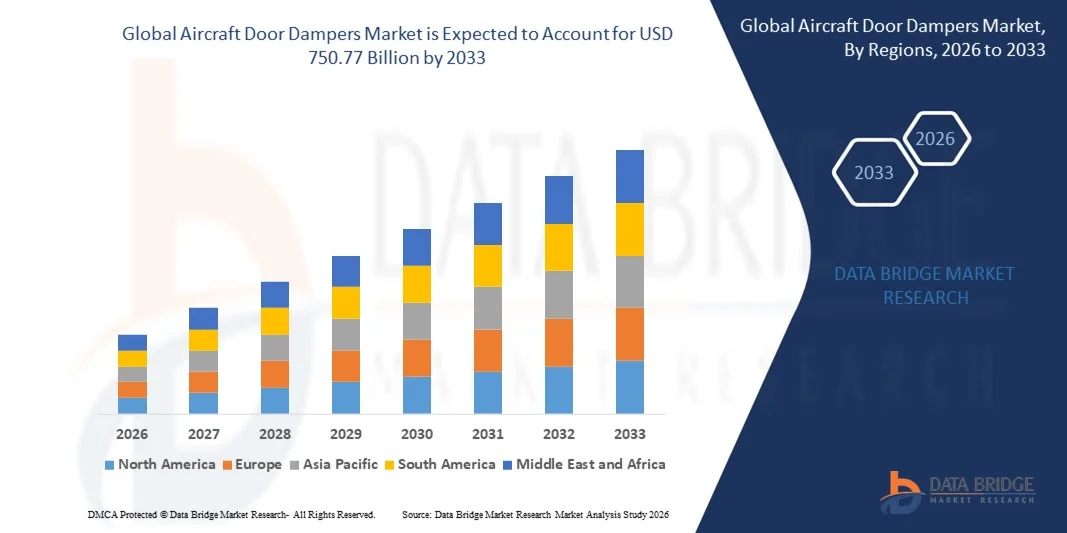
- The global aircraft door dampers market size was valued at USD 3.75 billion in 2025 and is expected to reach USD 750.77 billion by 2033, at a CAGR of 5.40% during the forecast period
- The rise in the preference of customers for airways travel across the globe acts as one of the major factors driving the growth of aircraft door dampers market
- The surge in government’s initiatives towards developing their air force strength through enhancement of existing war crafts and increasing their aircraft fleet, and their high usage in the aircrafts for smooth opening and closing of the doors accelerate the market growth
What are the Major Takeaways of Aircraft Door Dampers Market?
- The high focus on the comfort and safety of passengers by airlines and implementation of the fire protection regulations increasing the use of proper door dampers and use for avoiding banging noises and imparting protection to passenger figures from sudden closure of the lids or doors further influence the market
- In addition, rise in safety regulations for aircraft, increase in the investments, growth in commercial aircraft, and concerns regarding passenger safety positively affect the aircraft door dampers market. Furthermore, development in the product to maintain the sturdiness and lightweight of the entire structure extend profitable opportunities to the market players
- North America dominated the aircraft door dampers market with a 43.12% revenue share in 2025, driven by the strong presence of major aircraft OEMs, advanced aerospace component manufacturers, and well-established MRO infrastructure across the U.S. and Canada
- Asia-Pacific is projected to register the fastest CAGR of 10.82% from 2026 to 2033, driven by rapid airline fleet expansion, rising air passenger traffic, and increasing aircraft procurement across China, India, Japan, South Korea, and Southeast Asia
- The Linear Aircraft Dampers segment dominated the market with a 46.3% share in 2025, as they are widely used in passenger entry doors, cargo doors, and service panels to ensure smooth opening and controlled closing motion
Report Scope and Aircraft Door Dampers Market Segmentation
|
Attributes |
Aircraft Door Dampers Key Market Insights |
|
Segments Covered |
|
|
Countries Covered |
North America
Europe
Asia-Pacific
Middle East and Africa
South America
|
|
Key Market Players |
|
|
Market Opportunities |
|
|
Value Added Data Infosets |
In addition to the insights on market scenarios such as market value, growth rate, segmentation, geographical coverage, and major players, the market reports curated by the Data Bridge Market Research also include in-depth expert analysis, pricing analysis, brand share analysis, consumer survey, demography analysis, supply chain analysis, value chain analysis, raw material/consumables overview, vendor selection criteria, PESTLE Analysis, Porter Analysis, and regulatory framework. |
What is the Key Trend in the Aircraft Door Dampers Market?
Increasing Shift Toward Lightweight, High-Durability, and Smart Aircraft Door Dampers
- The aircraft door dampers market is witnessing strong adoption of lightweight, corrosion-resistant, and high-cycle-life damping systems designed to enhance passenger safety and door operational efficiency across commercial and military aircraft
- Manufacturers are introducing advanced hydraulic and gas-charged dampers integrated with smart monitoring capabilities to ensure controlled door movement, vibration reduction, and long-term reliability under extreme flight conditions
- Growing demand for fuel-efficient aircraft is encouraging the use of compact, weight-optimized components that reduce overall aircraft mass while maintaining structural integrity and performance
- For instance, leading aerospace component manufacturers are focusing on precision-engineered dampers compatible with next-generation narrow-body and wide-body aircraft platforms
- Increasing aircraft deliveries, fleet modernization programs, and retrofit activities are accelerating the integration of advanced door damping systems
- As airlines prioritize safety, durability, and maintenance efficiency, aircraft door dampers will remain critical for ensuring smooth operation, passenger comfort, and regulatory compliance
What are the Key Drivers of Aircraft Door Dampers Market?
- Rising global aircraft production supported by expanding air passenger traffic and airline fleet expansion programs
- For instance, during 2024–2025, major aircraft OEMs increased production rates of single-aisle aircraft, strengthening demand for high-performance door damping systems
- Growing emphasis on passenger safety standards and aviation regulatory compliance is boosting installation of certified, high-reliability damping components
- Increasing demand for lightweight composite aircraft structures is driving innovation in compact and high-strength damper materials
- Expansion of MRO (Maintenance, Repair, and Overhaul) activities and aircraft retrofitting programs is supporting replacement demand
- Supported by long-term commercial aviation growth and defence modernization programs, the Aircraft Door Dampers market is expected to witness steady expansion
Which Factor is Challenging the Growth of the Aircraft Door Dampers Market?
- High certification and compliance costs associated with aerospace components increase product development timelines and overall manufacturing expenses
- For instance, during 2024–2025, supply chain disruptions and raw material price fluctuations impacted production schedules for several aerospace component suppliers
- Stringent aviation safety regulations require extensive testing, validation, and documentation, adding complexity to market entry
- Limited number of certified aerospace-grade suppliers creates high competitive pressure and entry barriers
- Long aircraft production cycles and dependency on OEM order volumes may cause demand fluctuations
- To address these challenges, manufacturers are focusing on material innovation, supply chain optimization, modular designs, and long-life maintenance-free damping technologies to strengthen global adoption of Aircraft Door Dampers
How is the Aircraft Door Dampers Market Segmented?
The market is segmented on the basis of operation and sales channel.
- By Operation
On the basis of operation, the aircraft door dampers market is segmented into Rotary Aircraft Dampers, Linear Aircraft Dampers, and Axial Aircraft Dampers. The Linear Aircraft Dampers segment dominated the market with a 46.3% share in 2025, as they are widely used in passenger entry doors, cargo doors, and service panels to ensure smooth opening and controlled closing motion. Linear dampers provide reliable shock absorption, high load-bearing capability, and stable performance under varying cabin pressure and environmental conditions. Their simple design and compatibility with modern aircraft door assemblies make them the preferred choice across commercial aviation platforms.
The Rotary Aircraft Dampers segment is expected to grow at the fastest CAGR from 2026 to 2033, driven by increasing integration in compact door mechanisms and advanced aircraft interior systems. Growing adoption of lightweight rotary motion control solutions in next-generation aircraft designs is accelerating segment expansion.
- By Sales Channel
On the basis of sales channel, the aircraft door dampers market is segmented into OEM and Aftermarket. The OEM segment dominated the market with a 63.7% share in 2025, supported by rising aircraft production rates and strong demand from major commercial and defence aircraft manufacturers. Aircraft door dampers are primarily installed during original aircraft assembly to meet stringent aviation safety and certification standards. Increasing fleet expansion programs and new aircraft deliveries continue to drive strong OEM demand globally.
The Aftermarket segment is projected to grow at the fastest CAGR from 2026 to 2033, fueled by expanding global aircraft fleets, rising maintenance cycles, and growing MRO (Maintenance, Repair, and Overhaul) activities. Replacement of worn-out damping systems, regulatory compliance requirements, and aircraft retrofitting initiatives are contributing significantly to aftermarket growth.
Which Region Holds the Largest Share of the Aircraft Door Dampers Market?
- North America dominated the aircraft door dampers market with a 43.12% revenue share in 2025, driven by the strong presence of major aircraft OEMs, advanced aerospace component manufacturers, and well-established MRO infrastructure across the U.S. and Canada. Rising commercial aircraft deliveries, defence aircraft modernization programs, and continuous fleet upgrades are fueling demand for high-performance door damping systems
- Leading aerospace suppliers in North America are focusing on lightweight materials, corrosion-resistant alloys, and long-life hydraulic and rotary damping technologies to enhance aircraft safety and operational efficiency. Continuous investments in next-generation aircraft platforms and cabin system innovations further strengthen regional market leadership
- High aerospace R&D spending, strong regulatory compliance standards, and a mature aviation ecosystem reinforce North America’s dominance in aircraft door damper production and integration
U.S. Aircraft Door Dampers Market Insight
The U.S. is the largest contributor within North America, supported by robust commercial aviation activity, defence procurement programs, and expansion of aircraft manufacturing facilities. Increasing production of narrow-body aircraft, cargo planes, and military transport systems drives consistent demand for certified door damping components. Strong presence of Tier-1 aerospace suppliers and advanced engineering capabilities further support steady market growth.
Canada Aircraft Door Dampers Market Insight
Canada contributes significantly due to its established aerospace manufacturing clusters and growing participation in global aircraft supply chains. Expansion of regional aircraft production and increasing MRO activities support sustained demand for durable and high-precision damping systems.
Asia-Pacific Aircraft Door Dampers Market
Asia-Pacific is projected to register the fastest CAGR of 10.82% from 2026 to 2033, driven by rapid airline fleet expansion, rising air passenger traffic, and increasing aircraft procurement across China, India, Japan, South Korea, and Southeast Asia. Growing investments in domestic aircraft manufacturing programs, expanding aviation infrastructure, and strengthening aerospace component supply chains are accelerating regional market growth.
China Aircraft Door Dampers Market Insight
China leads the Asia-Pacific market due to significant investments in commercial aircraft programs and expanding domestic aerospace manufacturing capabilities. Rising aircraft assembly operations and increasing demand for certified aviation components drive adoption of advanced damping systems.
Japan Aircraft Door Dampers Market Insight
Japan demonstrates steady growth supported by precision aerospace engineering and participation in global aircraft component manufacturing programs. Focus on high-quality and lightweight aviation parts strengthens damper integration.
India Aircraft Door Dampers Market Insight
India is emerging rapidly due to expanding airline fleets, rising defence aviation programs, and increasing MRO activities. Government-backed aerospace manufacturing initiatives further boost market penetration.
South Korea Aircraft Door Dampers Market Insight
South Korea contributes steadily with growing aerospace production, defence modernization programs, and investments in advanced aircraft component manufacturing technologies, supporting long-term market expansion.
Which are the Top Companies in Aircraft Door Dampers Market?
The aircraft door dampers industry is primarily led by well-established companies, including:
- Collins Aerospace (U.S.)
- Aviation Fabricators (U.S.)
- TOK, Inc. (U.S.)
- Saab AB (Sweden)
- Kyntec Corporation (U.S.)
- DAHER (France)
- General Aerospace (U.S.)
- Safran (France)
- HUTCHINSON (France)
- Elbit Systems (Israel)
- Goodrich Aviation (U.S.)
- Latécoère (France)
- Sitec Aerospace GmbH (Germany)
- Ratier Figeac (France)
- TransDigm Group, Inc. (U.S.)
- Barnes Group Inc. (U.S.)
- GKN Aerospace (U.K.)
- HONEYCOMB. (U.S.)
- Triumph Group (U.S.)
- MITSUBISHI HEAVY INDUSTRIES, LTD. (Japan)
- Airbus SAS (France)
- Delastek (Canada)
SKU-
Obtenha acesso online ao relatório sobre a primeira nuvem de inteligência de mercado do mundo

- Painel interativo de análise de dados
- Painel de análise da empresa para oportunidades de elevado potencial de crescimento
- Acesso de analista de pesquisa para personalização e customização. consultas
- Análise da concorrência com painel interativo
- Últimas notícias, atualizações e atualizações Análise de tendências
- Aproveite o poder da análise de benchmark para um rastreio abrangente da concorrência
Metodologia de Investigação
A recolha de dados e a análise do ano base são feitas através de módulos de recolha de dados com amostras grandes. A etapa inclui a obtenção de informações de mercado ou dados relacionados através de diversas fontes e estratégias. Inclui examinar e planear antecipadamente todos os dados adquiridos no passado. Da mesma forma, envolve o exame de inconsistências de informação observadas em diferentes fontes de informação. Os dados de mercado são analisados e estimados utilizando modelos estatísticos e coerentes de mercado. Além disso, a análise da quota de mercado e a análise das principais tendências são os principais fatores de sucesso no relatório de mercado. Para saber mais, solicite uma chamada de analista ou abra a sua consulta.
A principal metodologia de investigação utilizada pela equipa de investigação do DBMR é a triangulação de dados que envolve a mineração de dados, a análise do impacto das variáveis de dados no mercado e a validação primária (especialista do setor). Os modelos de dados incluem grelha de posicionamento de fornecedores, análise da linha de tempo do mercado, visão geral e guia de mercado, grelha de posicionamento da empresa, análise de patentes, análise de preços, análise da quota de mercado da empresa, normas de medição, análise global versus regional e de participação dos fornecedores. Para saber mais sobre a metodologia de investigação, faça uma consulta para falar com os nossos especialistas do setor.
Personalização disponível
A Data Bridge Market Research é líder em investigação formativa avançada. Orgulhamo-nos de servir os nossos clientes novos e existentes com dados e análises que correspondem e atendem aos seus objetivos. O relatório pode ser personalizado para incluir análise de tendências de preços de marcas-alvo, compreensão do mercado para países adicionais (solicite a lista de países), dados de resultados de ensaios clínicos, revisão de literatura, mercado remodelado e análise de base de produtos . A análise de mercado dos concorrentes-alvo pode ser analisada desde análises baseadas em tecnologia até estratégias de carteira de mercado. Podemos adicionar quantos concorrentes necessitar de dados no formato e estilo de dados que procura. A nossa equipa de analistas também pode fornecer dados em tabelas dinâmicas de ficheiros Excel em bruto (livro de factos) ou pode ajudá-lo a criar apresentações a partir dos conjuntos de dados disponíveis no relatório.











