


Segmentação de Mercado Global de Produtos Baseados em Alumina, por Tipo (Substratos de Alumina Flat, Peças EV de Alumina e Outros), Aplicação (Eletrônica e Elétrica, Automotiva, Industrial e de Alta Temperatura e Outros) - Tendências e Previsão da Indústria para 2033
Qual é o tamanho e a taxa de crescimento do mercado de produtos baseados em alumina global
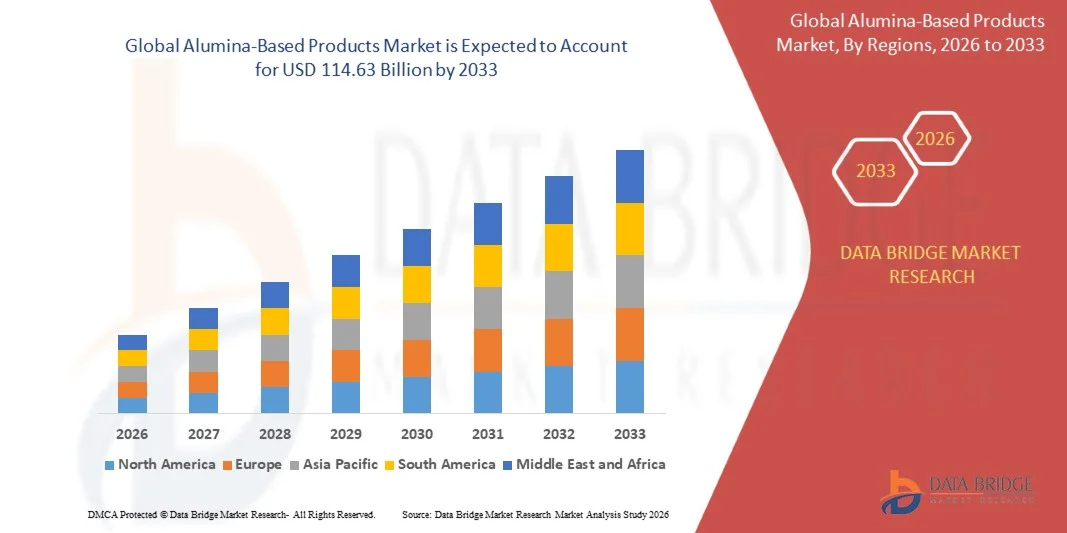
- A dimensão global do mercado de produtos baseados em alumina foi avaliada em76,41 mil milhões de dólares em 2025e espera-se alcançar114,63 mil milhões de USD até 2033, em umaCAGR de 5,20%durante o período de previsão
- A crescente demanda por eletrônicos eficientes e de alto desempenho, o uso crescente de alumina em componentes EV, a adoção crescente em aplicações industriais e de alta temperatura, a expansão da fabricação de eletrônicos e o foco crescente em materiais duráveis e estáveis termicamente são fatores fundamentais para o crescimento do mercado
Tamanho e previsão do mercado
- Valor de mercado global (2025): 76,41 mil milhões de dólares
- Valor de mercado previsto (2033): 114,63 mil milhões de USD
- Previsões CAGR (2026-2033): 5,20%
Quais são os principais destinos do mercado de produtos baseados em Alumina
- Aumento da procuraelectrónica de consumo, EVs, e sistemas industriais avançados, juntamente com as crescentes atividades de I&D em cerâmica e materiais eletrônicos, é esperado para criar oportunidades de crescimento significativas
- Altos custos de processamento, complexidades de projeto e falta de perícia em aplicações avançadas de alumina podem atuar como fatores de restrição para o crescimento do mercado
- A Ásia-Pacífico dominou o mercado de produtos baseados em alumina, com a maior quota de receita de 35,36% em 2025, impulsionada pelo forte crescimento na fabricação de eletrônicos,Embalagem de semicondutores, produção de automóveis e cerâmica industrial em toda a China, Japão, Índia, Coreia do Sul e Sudeste Asiático
- A América do Norte é projetada para registrar o CAGR mais rápido de 8,85% de 2026 a 2033, impulsionado pelo aumento da adoção de componentes baseados em alumina em EVs,Electrónica de potência, aeroespacial, defesa e aplicações avançadas de semicondutores
- O segmento Flat Alumina Substrates dominou o mercado com uma participação estimada de 46-48% em 2025, devido ao seu amplo uso em eletrônica e aplicações elétricas, como placas de circuito impresso (PCBs), embalagens de semicondutores, módulos de potência e circuitos integrados híbridos
Alcance do relatório e Segmentação de Mercado de Produtos Baseados em Alumina
|
Atributos |
Produtos baseados em alumina Principais perspectivas de mercado |
|
Segmentos Cobertos |
|
|
Países abrangidos |
América do Norte
Europa
Ásia- Pacífico
Médio Oriente e África
América do Sul
|
|
Jogadores do mercado chave |
|
|
Oportunidades de Mercado |
|
|
Informações sobre o Valor Adicionado |
Além dos insights sobre cenários de mercado, como valor de mercado, taxa de crescimento, segmentação, cobertura geográfica e principais atores, os relatórios de mercado curados pela Data Bridge Market Research também incluem análise de especialistas em profundidade, análise de preços, análise de compartilhamento de marca, inquérito ao consumidor, análise demografia, análise da cadeia de suprimentos, análise da cadeia de valor, visão geral da matéria-prima/consumíveis, critérios de seleção de fornecedores, Análise de PESTLE, Análise de Porter e marco regulatório. |
Qual é a tendência chave no mercado de produtos baseados em alumina
“Aumentando o deslocamento para materiais de alta performance, leves e de aplicação específica“
- O mercado de produtos baseados em alumina está testemunhando a adoção crescente de componentes de alta pureza, leve e termicamente estáveis de alumina em eletrônicos, EVs e sistemas industriais
- Os fabricantes estão focando em formulações avançadas de alumina, oferecendo melhor isolamento elétrico, resistência ao desgaste e condutividade térmica para aplicações compactas e de alta velocidade
- A demanda crescente por componentes eficientes, duráveis e miniaturizados está impulsionando o uso na fabricação de eletrônicos, sistemas de energia automotivos e ambientes industriais de alta temperatura
- Por exemplo, empresas como CoorsTek, Kyocera, Murata e Saint-Gobain estão expandindo portfólios de substratos de alumina, peças EV e componentes cerâmicos de precisão para aplicações avançadas
- Aumentar a necessidade de desempenho confiável sob temperaturas extremas, tensões e estresse mecânico está acelerando a adoção em tecnologias de próxima geração
- À medida que os dispositivos e sistemas se tornarem mais compactos e intensivos em desempenho, os produtos baseados em alumina permanecerão críticos para durabilidade, eficiência e confiabilidade a longo prazo
Quais são os Principais Drivers do Mercado de Produtos Baseados em Alumina
- Aumento da demanda por materiais de alto desempenho de isolamento elétrico e gerenciamento térmico em sistemas eletrônicos, EV e de energia
- Por exemplo, em 2024-2025, fabricantes líderes como Kyocera, CoorsTek e Morgan Advanced Materials investidos em expansão de capacidade e tecnologias avançadas de processamento de alumina
- A crescente adoção de veículos elétricos, sistemas de energia renovável e automação industrial está aumentando a demanda por componentes baseados em alumina nos EUA, Europa e Ásia-Pacífico
- Avanços no processamento cerâmico, usinagem de precisão e produção de alumina de alta pureza melhoraram o desempenho do produto e o escopo de aplicação
- O uso crescente de componentes de alta tensão, eletrônica de potência e embalagens de semicondutores está criando demanda por substratos de alumina de alta densidade
- Apoiado por investimentos sustentados em fabricação de eletrônicos, infraestrutura EV e modernização industrial, o mercado de produtos baseados em Alumina deve testemunhar crescimento constante a longo prazo
Que fator está desafiando o crescimento do mercado de produtos baseados em alumina
- Altos custos associados a materiais de alumina de alta pureza e processos de fabricação avançados limitam a adoção entre indústrias sensíveis aos custos
- Por exemplo, durante 2024-2025, a volatilidade dos preços da energia, as flutuações das matérias-primas e as perturbações na cadeia de abastecimento aumentaram os custos de produção para vários fabricantes globais
- Desafios técnicos relacionados à complexidade do projeto, precisão de usinagem e integração com sistemas eletrônicos avançados exigem expertise qualificada
- A sensibilização limitada nos mercados emergentes relativamente às aplicações avançadas de alumina e aos benefícios de desempenho a longo prazo atrasa a adopção
- Competição de materiais alternativos, como nitreto de alumínio, carboneto de silício e polímeros avançados cria pressão de preços
- Para enfrentar esses desafios, as empresas estão focando na otimização de processos, fabricação localizada e desenvolvimento de produtos específicos para aplicações para fortalecer a adoção global de produtos baseados em Alumina
Como é segmentado o mercado de produtos baseados em alumina
O mercado é segmentado com base emtipo e aplicação.
- Por Tipo
Com base no tipo, o mercado de produtos à base de alumina é segmentado em Substratos Flat Alumina, Peças EV Alumina e Outros. O segmento Flat Alumina Substrates dominou o mercado com uma participação estimada de 46-48% em 2025, devido ao seu amplo uso em eletrônica e aplicações elétricas, como placas de circuito impresso (PCBs), embalagens de semicondutores, módulos de potência e circuitos integrados híbridos. Estes substratos oferecem excelente isolamento elétrico, alta condutividade térmica, resistência mecânica e estabilidade dimensional, tornando-os ideais para sistemas eletrônicos miniaturizados e de alto desempenho. Um forte crescimento na eletrônica de consumo, infraestrutura de telecomunicações e fabricação de semicondutores continua apoiando a liderança deste segmento.
O segmento Alumina EV Parts deverá crescer no CAGR mais rápido de 2026 para 2033, impulsionado pela rápida expansão de veículos elétricos, aumentando a adoção de energia eletrônica, sistemas de gerenciamento de bateria e infraestrutura de carregamento. Os componentes da alumina são cada vez mais utilizados em inversores, sensores, peças de isolamento e sistemas de gerenciamento térmico EV devido à sua resistência ao calor e durabilidade.
- Por Aplicação
Com base na aplicação, o mercado de produtos baseados em alumina é segmentado em Eletrônica & Elétrica, Automotiva, Industrial & de alta temperatura, e Outros. O segmento Eletrônico & Elétrico teve a maior participação de cerca de 38–40% em 2025, apoiado pelo uso generalizado de alumina em semicondutores, substratos de circuito, isoladores, componentes LED e dispositivos de alimentação. A demanda crescente por produtos eletrônicos compactos, de alta velocidade e energeticamente eficientes, juntamente com avanços contínuos na fabricação de semicondutores, está impulsionando o forte consumo de materiais baseados em alumina neste segmento.
O segmento automotivo é projetado para testemunhar o crescimento mais rápido durante o período de previsão, alimentado pelo aumento da penetração de veículos elétricos, sistemas avançados de assistência ao motorista (ADAS), e unidades de controle eletrônico (ECUs). A capacidade da Alumina de suportar altas temperaturas, estresse elétrico e ambientes operacionais rigorosos torna-o um material preferido para sistemas eletrônicos e de energia automotivos. Enquanto isso, o segmento Industrial & High-Temperature continua vendo demanda constante de fornos, refractários e aplicações industriais pesadas.
Qual é a região que detém a maior parte do mercado de produtos baseados em alumina
- A Ásia-Pacífico dominou o mercado de produtos à base de alumina com a maior parte de receita de 35,36% em 2025, impulsionada pelo forte crescimento na fabricação de eletrônicos, embalagens de semicondutores, produção automotiva e cerâmica industrial em toda a China, Japão, Índia, Coreia do Sul e Sudeste Asiático. Alto consumo de substratos de alumina, isolantes eletrônicos, componentes EV e peças industriais de alta temperatura continua a demanda de combustível em eletrônicos de consumo, eletrônicos automotivos, sistemas de energia renovável e indústrias pesadas
- Os principais fabricantes da região estão expandindo a capacidade de produção e adotando tecnologias avançadas de processamento cerâmico para atender à crescente demanda de produtos de alumina específicos para aplicações e alta pureza. Forte apoio do governo para fabricação de eletrônicos, adoção de EV e modernização industrial reforça ainda mais o domínio regional
- Disponibilidade abundante de matéria-prima, fabricação econômica, mão-de-obra qualificada e indústrias de uso final em rápida expansão reforçam a liderança da Ásia-Pacífico no mercado global de produtos baseados em alumina
China Alumina-Based Products Market Insight
A China é o maior contribuinte da Ásia-Pacífico, apoiado pela enorme capacidade de fabricação de eletrônicos e automotivos, forte demanda de embalagens de semicondutores e uso extensivo de alumina em aplicações industriais e de alta temperatura. Investimentos apoiados pelo governo em EVs, energias renováveis e manufatura avançada continuam a impulsionar o crescimento do mercado.
Japão Alumina-Based Products Market Insight
O Japão mostra crescimento estável impulsionado por componentes eletrônicos de alta qualidade, automotivos e cerâmica industrial de precisão. Forte foco na confiabilidade, gerenciamento térmico e materiais avançados suportam demanda sustentada por produtos baseados em alumina.
Índia Visão de mercado de produtos baseados em alumina
A Índia está emergindo como um mercado de alto crescimento, apoiado pela expansão da fabricação de eletrônicos, produção de EV e desenvolvimento de infraestrutura. Aumentar as iniciativas governamentais e aumentar a industrialização estão acelerando o consumo de alumina.
Qual é a região que mais cresce no mercado de produtos baseados em alumina
A América do Norte é projetada para registrar o CAGR mais rápido de 8,85% de 2026 para 2033, impulsionado pelo aumento da adoção de componentes baseados em alumina em EVs, eletrônica de potência, aeroespacial, defesa e aplicações avançadas de semicondutores. Forte atividade de P&D, rápida adoção de materiais de alto desempenho e crescente investimento em energia limpa e infraestrutura EV estão acelerando a demanda nos EUA e Canadá. A inovação tecnológica, os elevados padrões de desempenho de materiais e a crescente utilização da alumina em sistemas de electrónica e industriais da próxima geração apoiam o crescimento regional a longo prazo.
U.S. Alumina-based Products Market Insight
Os EUA lideram a América do Norte, impulsionados pela forte demanda de embalagens de semicondutores, sistemas de energia EV, componentes aeroespaciais e aplicações industriais, suportadas por altos gastos em P&D e capacidades de fabricação avançadas.
Canadá Alumina-Based Products Market Insight
O Canadá contribui constantemente através da adoção crescente de alumina no processamento industrial, sistemas energéticos e eletrônicos automotivos, apoiados por políticas focadas na inovação e uma força de trabalho qualificada.
Quais são as principais empresas no mercado de produtos baseados em Alumina
A indústria de produtos baseados em alumina é liderada principalmente por empresas bem estabelecidas, incluindo:
- Kyocera Corporation(Japão)
- Cerâmica Saint-Gobain(França)
- Ortech, Incorporated (EUA)
- Isoladores NGK (Japão)
- CoorsTek (EUA)
- Cerâmica Du-Co(EUA)
- Grupo CeramTec (Alemanha)
- Indústrias Edgetech (EUA)
- Valley Design Corp. (EUA)
- Morgan Advanced Materials (U.K.)
Quais são os Desenvolvimentos Recentes no Mercado Global de Produtos Baseados em Alumina
- Em abril de 2022, a Saint-Gobain Ceramics adquiriu a Monofrax para melhorar seu portfólio de soluções refractárias fundidas para vidro, aço e outras aplicações industriais de alta temperatura. Esta aquisição reforça a capacidade da Saint-Gobain de fornecer materiais avançados à base de alumina com maior durabilidade, desempenho e confiabilidade
SKU-
Obtenha acesso online ao relatório sobre a primeira nuvem de inteligência de mercado do mundo

- Painel interativo de análise de dados
- Painel de análise da empresa para oportunidades de elevado potencial de crescimento
- Acesso de analista de pesquisa para personalização e customização. consultas
- Análise da concorrência com painel interativo
- Últimas notícias, atualizações e atualizações Análise de tendências
- Aproveite o poder da análise de benchmark para um rastreio abrangente da concorrência
Metodologia de Investigação
A recolha de dados e a análise do ano base são feitas através de módulos de recolha de dados com amostras grandes. A etapa inclui a obtenção de informações de mercado ou dados relacionados através de diversas fontes e estratégias. Inclui examinar e planear antecipadamente todos os dados adquiridos no passado. Da mesma forma, envolve o exame de inconsistências de informação observadas em diferentes fontes de informação. Os dados de mercado são analisados e estimados utilizando modelos estatísticos e coerentes de mercado. Além disso, a análise da quota de mercado e a análise das principais tendências são os principais fatores de sucesso no relatório de mercado. Para saber mais, solicite uma chamada de analista ou abra a sua consulta.
A principal metodologia de investigação utilizada pela equipa de investigação do DBMR é a triangulação de dados que envolve a mineração de dados, a análise do impacto das variáveis de dados no mercado e a validação primária (especialista do setor). Os modelos de dados incluem grelha de posicionamento de fornecedores, análise da linha de tempo do mercado, visão geral e guia de mercado, grelha de posicionamento da empresa, análise de patentes, análise de preços, análise da quota de mercado da empresa, normas de medição, análise global versus regional e de participação dos fornecedores. Para saber mais sobre a metodologia de investigação, faça uma consulta para falar com os nossos especialistas do setor.
Personalização disponível
A Data Bridge Market Research é líder em investigação formativa avançada. Orgulhamo-nos de servir os nossos clientes novos e existentes com dados e análises que correspondem e atendem aos seus objetivos. O relatório pode ser personalizado para incluir análise de tendências de preços de marcas-alvo, compreensão do mercado para países adicionais (solicite a lista de países), dados de resultados de ensaios clínicos, revisão de literatura, mercado remodelado e análise de base de produtos . A análise de mercado dos concorrentes-alvo pode ser analisada desde análises baseadas em tecnologia até estratégias de carteira de mercado. Podemos adicionar quantos concorrentes necessitar de dados no formato e estilo de dados que procura. A nossa equipa de analistas também pode fornecer dados em tabelas dinâmicas de ficheiros Excel em bruto (livro de factos) ou pode ajudá-lo a criar apresentações a partir dos conjuntos de dados disponíveis no relatório.











