


Global Antimicrobial Peptides Market Segmentation, By Product (Plant Antimicrobial Peptides, Bacterial Antimicrobial Peptides, Animal Antimicrobial Peptides, Insect Antimicrobial Peptides), Ailments (Pneumonia, Hepatitis, Bacterial infections, HIV), Distribution Channel (Hospital, Research Institutes, Specialty Clinic, Pharmacies), Route of Administration (Topical, Subcutaneous, Intravenous), End User (Pharma and Healthcare, Agriculture Industry, Biological Engineering) – Industry Trends and Forecast to 2032.
Antimicrobial Peptides Market Analysis
According to the US Centers for Disease Control and Prevention, over 2 million health-related issues were reported in 2013, with 23,000 people dying as a result of drug-resistant bacteria. More than 450,000 new cases of multidrug-resistant TB were reported in the United States in 2012. The growing number of drug-resistant patients around the world necessitates the development of novel antibiotics to combat common infectious diseases. Peptides like Oxytocin, Cyclosporin, Salmon Calcitonin, Integrillin, and Zoladex are well-known and are leading the peptide therapies business in new directions around the world.
Antimicrobial Peptides Market Size
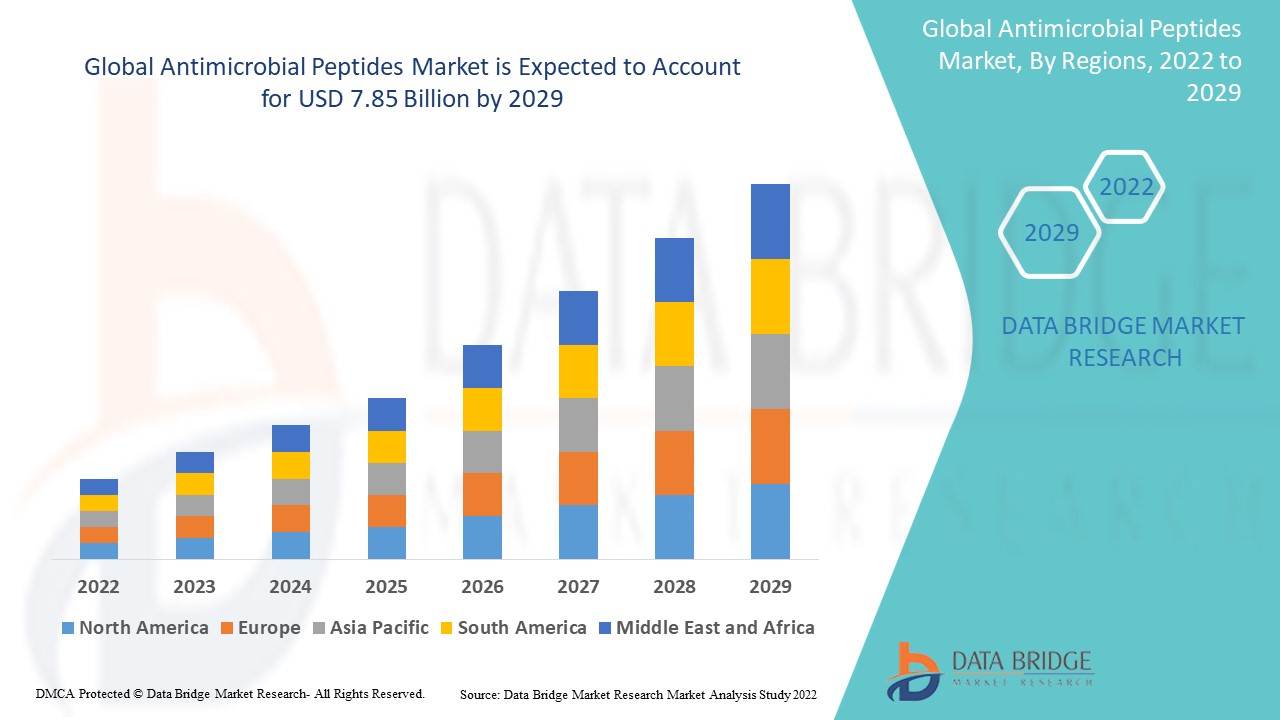
Global antimicrobial peptides market size was valued at USD 5.92 billion in 2024 and is projected to reach USD 9.30 billion by 2032, with a CAGR of 5.80% during the forecast period of 2025 to 2032.
Report Scope and Market Segmentation
|
Attributes |
Antimicrobial Peptides Key Market Insights |
|
Segmentation |
|
|
Countries Covered |
U.S., Canada and Mexico in North America, Germany, France, U.K., Netherlands, Switzerland, Belgium, Russia, Italy, Spain, Turkey, Rest of Europe in Europe, China, Japan, India, South Korea, Singapore, Malaysia, Australia, Thailand, Indonesia, Philippines, Rest of Asia-Pacific (APAC) in the Asia-Pacific (APAC), Saudi Arabia, U.A.E, South Africa, Egypt, Israel, Rest of Middle East and Africa (MEA) as a part of Middle East and Africa (MEA), Brazil, Argentina and Rest of South America as part of South America |
|
Key Market Players |
Eli Lilly and Company (U.S), Pfizer Inc. (U.S), GSK Group of Companies (U.S), Novartis AG (Switzerland), EnBiotix Inc. (U.S), Johnson & Johnson Private Limited (U.S), Merck & Co., Inc. (U.S), Alexion Pharmaceuticals, Inc. (U.S), Melinta Therapeutics, LLC (U.S), Vertex Pharmaceuticals Incorporated (U.S) AnaSpec (U.S), AMP Biotech (India), Phoenix Biotechnology Inc. (Canada), Novabiotics (U.K), Chinese Peptide Company (China), Ontores Biotechnologies Inc. (China) |
|
Market Opportunities |
|
Antimicrobial Peptides Market Definition
Antimicrobial peptides are compounds that are part of the host defence mechanism in both prokaryotic and eukaryotic cells, defending them from dangerous infective threats such as bacteria, viruses, and even fungi. Antimicrobial peptides is very dependent on their composition, and they are used to target cytoplasmic membranes, cell walls, DNA, and proteins.
Antimicrobial Peptides Market Dynamics
Drivers
- Technological advancements
With a growing pool of scientists and talented technocrats interested in the arena for innovative therapeutics containing antimicrobial peptides for rare diseases, institutional research is substantially invested. Antimicrobial peptides, for example, can be created for a variety of purposes ranging from extending the shelf life of food packaging to delivering bioactive substances in therapeutic sectors driving the market.
- Rise in infectious diseases
The rising frequency of infectious diseases and the rising demand for effective and safe medicines are driving the expansion of the antimicrobial peptides market. Furthermore, the use of AMPs in a variety of applications is likely to fuel market expansion throughout the forecast period.
- Usage of antimicrobial peptides
Antimicrobial peptides are gaining popularity as therapeutic agents for a variety of ailments, including skin infections. Antimicrobial peptides are a promising newcomer in the field of immune modulation and antifungal drugs. Anti-microbial peptides aid in the improvement of anti-inflammatory cell responses and have the ability to breakdown malignant cell membranes, making them a possible cancer treatment medicine. Anti-microbial peptides market is expected to develop in the near future due to rising demand for cancer, HIV, and diabetes therapy.
Opportunities
When compared to the hazards that exist, the prospects for producing antimicrobial peptides are greater. Antimicrobial peptides' use in the treatment of Hepatitis C, pneumonia, bacterial infections, HIV AIDS, and cancer is likely to increase public acceptability of the treatments. Due to increased awareness to medications and therapies incorporating antimicrobial peptides, the global market for antimicrobial peptides is expected to rise significantly. Chronic disorders where antibiotic resistance is ineffective give a more attractive opportunity for antimicrobial peptides manufacturers.
Restraints/Challenges
Furthermore, antimicrobial peptides are now undergoing clinical trials, and the stability and half-life of antimicrobial peptides in vivo are unknown. These issues are limiting the global growth of the antimicrobial peptides market.
This antimicrobial peptides market report provides details of new recent developments, trade regulations, import-export analysis, production analysis, value chain optimization, market share, impact of domestic and localized market players, analyses opportunities in terms of emerging revenue pockets, changes in market regulations, strategic market growth analysis, market size, category market growths, application niches and dominance, product approvals, product launches, geographic expansions, technological innovations in the market. To gain more info on the antimicrobial peptides market contact Data Bridge Market Research for an Analyst Brief, our team will help you take an informed market decision to achieve market growth.
Antimicrobial Peptides Market Scope
The antimicrobial peptides market is segmented on the basis of product type, ailments, distribution channel, route of administration, application and end-user. The growth amongst these segments will help you analyze meagre growth segments in the industries and provide the users with a valuable market overview and market insights to help them make strategic decisions for identifying core market applications.
Type
- Plant Antimicrobial Peptides
- Bacterial Antimicrobial Peptides
- Animal Antimicrobial Peptides
- Insect Antimicrobial Peptides
Ailments
- Pneumonia
- Hepatitis
- Bacterial infections
- HIV
Distribution Channel
- Hospital
- Research Institutes
- Specialty Clinic
- Pharmacies
Route of Administration
- Topical
- Subcutaneous
- Intravenous
End-user
- Pharma and Healthcare
- Agriculture Industry
- Biological Engineering
Antimicrobial Peptides Market Regional Analysis
The antimicrobial peptides market is analyzed and market size insights and trends are provided by country, product type, application and end-user as referenced above.
The countries covered in the antimicrobial peptides market report are U.S., Canada and Mexico in North America, Germany, France, U.K., Netherlands, Switzerland, Belgium, Russia, Italy, Spain, Turkey, Rest of Europe in Europe, China, Japan, India, South Korea, Singapore, Malaysia, Australia, Thailand, Indonesia, Philippines, Rest of Asia-Pacific (APAC) in the Asia-Pacific (APAC), Saudi Arabia, U.A.E, South Africa, Egypt, Israel, Rest of Middle East and Africa (MEA) as a part of Middle East and Africa (MEA), Brazil, Argentina and Rest of South America as part of South America.
North America dominating the market due to advanced or emerging healthcare settings help in restoring the market and increase the reach to a wider section of patients in need.
Asia-Pacific region is expected to be the fastest-growing market during the forecast period 2025-2032. This growth can be attributed to the growing population, increasing income levels, and expanding healthcare infrastructure in this region.
The country section of the report also provides individual market impacting factors and changes in regulation in the market domestically that impacts the current and future trends of the market. Data points like down-stream and upstream value chain analysis, technical trends and porter's five forces analysis, case studies are some of the pointers used to forecast the market scenario for individual countries. Also, the presence and availability of global brands and their challenges faced due to large or scarce competition from local and domestic brands, impact of domestic tariffs and trade routes are considered while providing forecast analysis of the country data.
Antimicrobial Peptides Market Share
The antimicrobial peptides market competitive landscape provides details by competitor. Details included are company overview, company financials, revenue generated, market potential, investment in research and development, new market initiatives, global presence, production sites and facilities, production capacities, company strengths and weaknesses, product launch, product width and breadth, application dominance. The above data points provided are only related to the companies' focus related to antimicrobial peptides market.
Antimicrobial Peptides Market Leaders Operating in the Market Are:
- Eli Lilly and Company (U.S)
- Pfizer Inc. (U.S)
- GSK Group of Companies (U.S)
- Novartis AG (Switzerland)
- EnBiotix Inc. (U.S)
- Johnson & Johnson Private Limited (U.S)
- Merck & Co., Inc. (U.S)
- Alexion Pharmaceuticals, Inc. (U.S)
- Melinta Therapeutics, LLC (U.S)
- Vertex Pharmaceuticals Incorporated (U.S)
- AnaSpec (U.S)
- AMP Biotech (India)
- Phoenix Biotechnology Inc. (Canada)
- Novabiotics (U.K)
- Chinese Peptide Company (China)
- Ontores Biotechnologies Inc. (China)
SKU-
Obtenha acesso online ao relatório sobre a primeira nuvem de inteligência de mercado do mundo

- Painel interativo de análise de dados
- Painel de análise da empresa para oportunidades de elevado potencial de crescimento
- Acesso de analista de pesquisa para personalização e customização. consultas
- Análise da concorrência com painel interativo
- Últimas notícias, atualizações e atualizações Análise de tendências
- Aproveite o poder da análise de benchmark para um rastreio abrangente da concorrência
Metodologia de Investigação
A recolha de dados e a análise do ano base são feitas através de módulos de recolha de dados com amostras grandes. A etapa inclui a obtenção de informações de mercado ou dados relacionados através de diversas fontes e estratégias. Inclui examinar e planear antecipadamente todos os dados adquiridos no passado. Da mesma forma, envolve o exame de inconsistências de informação observadas em diferentes fontes de informação. Os dados de mercado são analisados e estimados utilizando modelos estatísticos e coerentes de mercado. Além disso, a análise da quota de mercado e a análise das principais tendências são os principais fatores de sucesso no relatório de mercado. Para saber mais, solicite uma chamada de analista ou abra a sua consulta.
A principal metodologia de investigação utilizada pela equipa de investigação do DBMR é a triangulação de dados que envolve a mineração de dados, a análise do impacto das variáveis de dados no mercado e a validação primária (especialista do setor). Os modelos de dados incluem grelha de posicionamento de fornecedores, análise da linha de tempo do mercado, visão geral e guia de mercado, grelha de posicionamento da empresa, análise de patentes, análise de preços, análise da quota de mercado da empresa, normas de medição, análise global versus regional e de participação dos fornecedores. Para saber mais sobre a metodologia de investigação, faça uma consulta para falar com os nossos especialistas do setor.
Personalização disponível
A Data Bridge Market Research é líder em investigação formativa avançada. Orgulhamo-nos de servir os nossos clientes novos e existentes com dados e análises que correspondem e atendem aos seus objetivos. O relatório pode ser personalizado para incluir análise de tendências de preços de marcas-alvo, compreensão do mercado para países adicionais (solicite a lista de países), dados de resultados de ensaios clínicos, revisão de literatura, mercado remodelado e análise de base de produtos . A análise de mercado dos concorrentes-alvo pode ser analisada desde análises baseadas em tecnologia até estratégias de carteira de mercado. Podemos adicionar quantos concorrentes necessitar de dados no formato e estilo de dados que procura. A nossa equipa de analistas também pode fornecer dados em tabelas dinâmicas de ficheiros Excel em bruto (livro de factos) ou pode ajudá-lo a criar apresentações a partir dos conjuntos de dados disponíveis no relatório.











