



Global Automotive Battery Management System Market, By Battery Type (Lithium-Ion Based, Advanced Lead-Acid Based, Nickel-Based, Flow Batteries), Vehicle Type (Passenger Vehicle, Commercial Vehicle, Golf Cart, E-Bikes), Connection Topology (Centralized, Distributed, Modular), Component (Battery IC, Battery Sensor, Other Component), Propulsion Type (IC Engine Vehicle, Electric Vehicle), Battery Capacity (500 kWh), Technology (Active, Passive), End Use (OEMs, Aftermarket) – Industry Trends and Forecast to 2029.
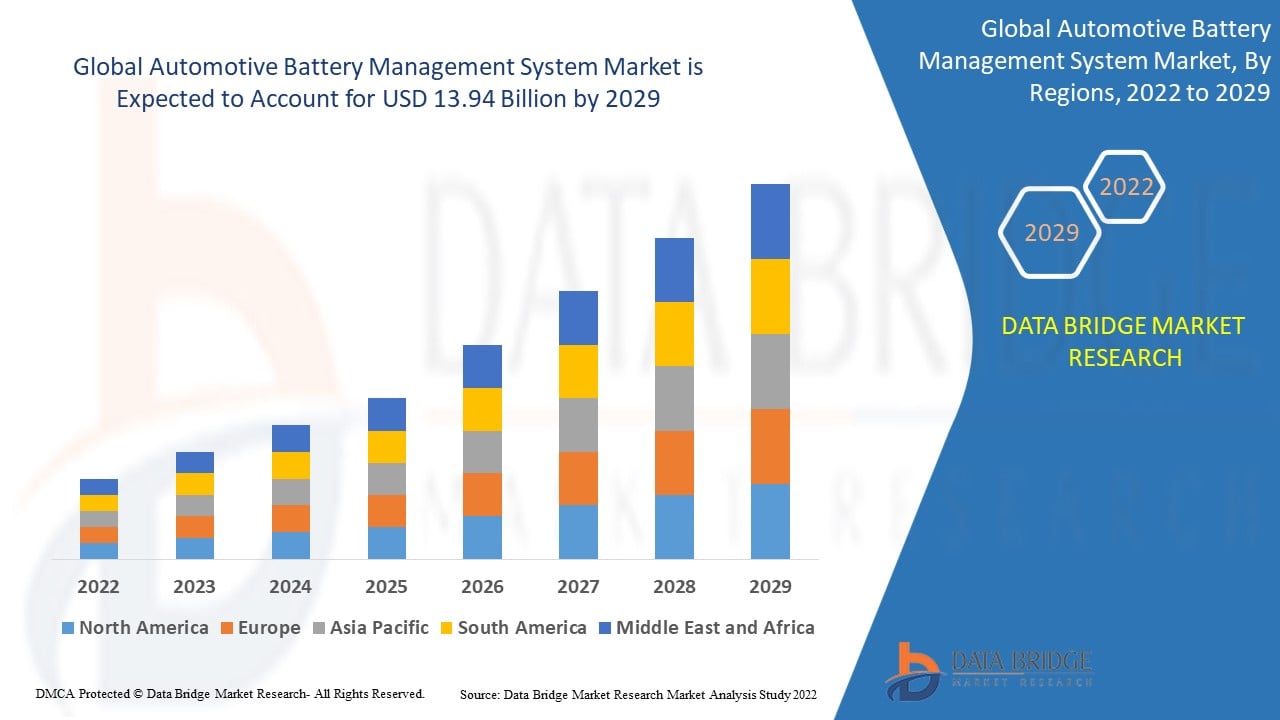
Automotive Battery Management System Market Analysis and Size
The rising demand for hybrid electric and battery electric vehicles is expected to propel the global market for automotive battery management systems to considerable growth over the recent years. The introduction of strict government rules regarding environmental degradation and government incentives in the form of subsidies, grants, and tax rebates to promote the use of eco-friendly forms of transportation have led to an increase in demand for these cars. Consequently, such growth determinants give the market a positive outlook over the forecasted timeline.
Global automotive battery management system market was valued at USD 5.17 billion in 2021 and is expected to reach USD 13.94 billion by 2029, registering a CAGR of 13.20% during the forecast period of 2022-2029. In addition to the market insights such as market value, growth rate, market segments, geographical coverage, market players, and market scenario, the market report curated by the Data Bridge Market Research team includes in-depth expert analysis, import/export analysis, pricing analysis, production consumption analysis, and pestle analysis.
Automotive Battery Management System Market Scope and Segmentation
|
Report Metric |
Details |
|
Forecast Period |
2022 to 2029 |
|
Base Year |
2021 |
|
Historic Years |
2020 (Customizable to 2014 - 2019) |
|
Quantitative Units |
Revenue in USD Billion, Volumes in Units, Pricing in USD |
|
Segments Covered |
Battery Type (Lithium-Ion Based, Advanced Lead-Acid Based, Nickel-Based, Flow Batteries), Vehicle Type (Passenger Vehicle, Commercial Vehicle, Golf Cart, E-Bikes), Connection Topology (Centralized, Distributed, Modular), Component (Battery IC, Battery Sensor, Other Component), Propulsion Type (IC Engine Vehicle, Electric Vehicle), Battery Capacity (<100 kWh, 100-200 kWh, 200-500 kWh, >500 kWh), Technology (Active, Passive), End Use (OEMs, Aftermarket) |
|
Countries Covered |
U.S., Canada and Mexico in North America, Germany, France, U.K., Netherlands, Switzerland, Belgium, Russia, Italy, Spain, Turkey, Rest of Europe in Europe, China, Japan, India, South Korea, Singapore, Malaysia, Australia, Thailand, Indonesia, Philippines, Rest of Asia-Pacific (APAC) in the Asia-Pacific (APAC), Saudi Arabia, U.A.E, Israel, Egypt, South Africa, Rest of Middle East and Africa (MEA) as a part of Middle East and Africa (MEA), Brazil, Argentina and Rest of South America as part of South America |
|
Market Players Covered |
Robert Bosch GmbH (Germany), Continental AG (Germany), Toshiba Corporation (Japan), Intel Corporation (U.S.), Texas Instruments Incorporated (U.S.), NXP Semiconductors (Netherlands), Analog Devices, Inc. (U.S.), Denso Corporation (Japan), Johnson Matthey (U.K.), LG Chem (South Korea), Midtronics, Inc. (U.S.), Sensata Technologies, Inc. (Denmark), Midtronics, Inc. (U.S.), Microchip Technology Inc. (U.S.), Nuvation (U.S.) |
|
Market Opportunities |
|
Market Definition
The automotive battery management system aids in keeping track of a battery's performance and consumption. By regulating the operating area, balancing the battery, and providing protection for the battery, this system further manages rechargeable batteries. It also manages how an electric car's battery is recharged. The market for automotive battery management systems is expanding due to factors including temperature control, data logging, and improving battery longevity.
Automotive Battery Management System Market Dynamics
This section deals with understanding the market drivers, advantages, opportunities, restraints and challenges. All of this is discussed in detail as below:
Drivers
- Increasing Usage across Vehicles
The automotive battery management system connects with other drivetrain parts to keep track of the charge level. It aids in cell balance, battery heat protection, and current regulation during charging and is one of the essential components of an electric vehicle's powertrain. Along with protecting the operating of the car, it also seeks to protect the battery. To avoid situations where a battery management system can impair the motion or movement of the vehicles, it is also crucial to identify what control functions should be allocated to it. Therefore, during the coming years, the market is anticipated to witness the development of improved automotive battery management systems due to the increased usage of electric vehicles.
- Growth in Urbanization
The majority of the population has been migrating there in recent years, urbanisation is reaching its pinnacle due to the increasing employment opportunities and rapid industrialisation in urban regions. Additionally, metropolitan passengers are more inclined to support the environmentally friendly and technologically advanced movements. The electric automobile battery management system is one of the best high-tech options due to its compact form. Urbanization is a common phenomenon, and as a result, demand for better travel and transportation infrastructure has significantly increased. The demand for electric vehicles has increased as a result of growing urbanisation and a renewed focus on green mobility.
Furthermore, the factors such as high need for effective electric grid management will accelerate the overall market expansion during the forecast period. Additionally, the rising sales of automotive is anticipated to drive the growth rate of the automotive battery management system market. The adoption and implementation of technologies, such as the IoT, AI, machine learning, and others, will further positively impact the market's growth rate during the forecast period. The expansion of the market is projected to be aided by the rising demand for battery management systems revenue in order to reduce greenhouse gas emissions and the disputed government policy.
Opportunities
- Increasing Trend of Electric Vehicles (EVs)
The increasing trend of electric vehicles is estimated to generate lucrative opportunities for the market, which will further expand the automotive battery management system market's growth rate in the future. During the projection period, the number of electric vehicles is expected to increase dramatically. The International Energy Agency (IEA) projects that by 2030, there will be 145 million electric automobiles, heavy trucks, vans, and buses on the road worldwide based on existing trends and legislation. Thus, it is important to note that the industry players are confident that once the epidemic eases down, this market is poised to grow quickly because of the huge increase in electric car sales that occurred during the pandemic.
- Surging Technological Advancements
Additionally, the surging product launches and other innovations by market players further offer numerous growth opportunities within the market. The introduction and development of battery and charging technology for electric vehicles are in high demand. The market's top manufacturers are creating and introducing a variety of technologically sophisticated battery management systems for battery-operated and hybrid automobiles. For instance, Grinntech, a start-up that specializes in Lithium-ion batteries for electric cars and energy storage systems, introduced IoT-based battery monitoring & control systems for 2-wheelers, 3-wheelers, and tractors/light vehicles in August 2020. As a result, significant prospects for market expansion are being created by technological advancement in automotive battery monitoring & control systems with benefits like decreased complexity, greater battery efficiency, and improved reliability, among others.
Restraints/Challenges
- High Cost
The automotive battery management system sector is facing financial constraints in the developing nations due to problems with many of these nations' weak foundations. Import taxes have been consistently higher for parts other than those from emerging regions. The cost of import requirements for systems and components is another annoyance. Thus, during the forecast period, the market for automotive battery management systems is anticipated to be constrained by the high cost of producing battery management systems due to obstacles including port obligations, import levies, and taxes.
- Complications in Battery Structures
The battery packs, main and aux chargers, motor controllers, safety devices, cooling and heating elements, SOC displays, and BMS main control units are just a few examples of the various parts that make up an electric vehicle's battery management system. As a result, market expansion is hampered by battery management systems that are incapable of handling complicated battery structures. Additionally, according to our primary research, technologically deficient battery management systems cannot be combined with the intricate battery structure, severely limiting market expansion. This factor is therefore estimated to be significant challenge for the automotive battery management system market over the forecast period.
This automotive battery management system market report provides details of new recent developments, trade regulations, import-export analysis, production analysis, value chain optimization, market share, impact of domestic and localized market players, analyses opportunities in terms of emerging revenue pockets, changes in market regulations, strategic market growth analysis, market size, category market growths, application niches and dominance, product approvals, product launches, geographic expansions, technological innovations in the market. To gain more info on the automotive battery management system market contact Data Bridge Market Research for an Analyst Brief, our team will help you take an informed market decision to achieve market growth.
COVID-19 Impact on Automotive Battery Management System Market
The automotive battery management system market was immensely impacted by the outbreak of COVID-19. The demand for automotive battery management systems has diminished due to the worldwide travel and transportation bans as well as the stoppage of manufacturing operations. The big corporations are experiencing a halt due to the pandemic as they cannot start new initiatives and complete product development. A Chinese battery manufacturer, BYD, was unable to finish the sequence of testing for new battery models, and as a result, the company had to decrease the quantity of batteries for the European markets due to the lockdown. Similar to Umicore, a Belgian firm, the production of cars decreased by 25% in the first quarter of FY'2020 as a result of large losses in the automotive sector. Losing regions rely on their own governments to provide doors for electronic vehicle packages, the renewable energy industry, and energy storage where a GST decrease is incorporated for a set amount of time. The corporations are anticipated to benefit from this approach by reducing future losses and easing the effects of previous losses.
Recent Developments
-
In September 2020, In order to give automakers more flexibility in scaling up the manufacturing of their electric vehicle fleets across a variety of vehicle classes, Analog Devices, Inc. has developed a wireless battery management system (wBMS). The business's wBMS enhances design adaptability and manufactureability without compromising precision and range over the course of the battery. This can reduce the wiring by up to 90% and the battery pack space by up to 15%.
-
In March 2022, Aston Martin and Britishvolt disclosed a partnership to create high-performance cars' next-generation battery technology. This collaboration will concentrate on the creation of new battery modules and automotive BMS as part of Aston Martin's efforts to introduce an electric vehicle.
-
In May 2022, Marelli Holdings Co., Ltd. introduced the Wireless Distributed Battery Management System to expand its battery management technology for electric vehicles (wBMS). With this technology, connected physical connections are no longer necessary, resulting in better flexibility, enhanced efficiency, improved reliability, and lower costs than traditional battery management system architectures.
Global Automotive Battery Management System Market Scope
The automotive battery management system market is segmented on the basis of battery type, vehicle type, connection topology, component, propulsion type, battery capacity, technology and end use. The growth amongst these segments will help you analyze meagre growth segments in the industries and provide the users with a valuable market overview and market insights to help them make strategic decisions for identifying core market applications.
Battery Type
- Lithium-Ion Based
- Advanced Lead-Acid Based
- Nickel-Based
- Flow Batteries
Vehicle Type
- Passenger Vehicle
- Commercial Vehicle
- Golf Cart
- E-Bikes
Connection Topology
- Centralized
- Distributed
- Modular
Component
- Battery IC
- Battery Sensor
- Other Component
Propulsion Type
- IC Engine Vehicle
- Electric Vehicle
Battery Capacity
- <100 kWh
- 100-200 kWh
- 200-500 kWh
- >500 kWh
Technology
- Active
- Passive
End Use
- OEMs
- Aftermarket
Automotive Battery Management System Market Regional Analysis/Insights
The automotive battery management system market is analyzed and market size insights and trends are provided by country, battery type, vehicle type, connection topology, component, propulsion type, battery capacity, technology and end use as referenced above.
The countries covered in the automotive battery management system market report are U.S., Canada and Mexico in North America, Germany, France, U.K., Netherlands, Switzerland, Belgium, Russia, Italy, Spain, Turkey, Rest of Europe in Europe, China, Japan, India, South Korea, Singapore, Malaysia, Australia, Thailand, Indonesia, Philippines, Rest of Asia-Pacific (APAC) in the Asia-Pacific (APAC), Saudi Arabia, U.A.E, Israel, Egypt, South Africa, Rest of Middle East and Africa (MEA) as a part of Middle East and Africa (MEA), Brazil, Argentina and Rest of South America as part of South America.
North America dominates the automotive battery management system market because of the increasing demand of the commercial and passenger vehicle within the region over the forecast period of 2022 to 2029. Moreover, the presence of manufacturing facilities of major automotive manufacturers is further estimated to accelerate the expansion over the forecast period.
Asia-Pacific is expected to witness significant growth during the forecast period of 2022 to 2029 due to improved infrastructure development in India and China within the region. The increase in battery-electric automotive is also a significant contributor to the regional market expansion.
The country section of the report also provides individual market impacting factors and changes in regulation in the market domestically that impacts the current and future trends of the market. Data points like down-stream and upstream value chain analysis, technical trends and porter's five forces analysis, case studies are some of the pointers used to forecast the market scenario for individual countries. Also, the presence and availability of global brands and their challenges faced due to large or scarce competition from local and domestic brands, impact of domestic tariffs and trade routes are considered while providing forecast analysis of the country data.
Competitive Landscape and Automotive Battery Management System Market Share Analysis
The automotive battery management system market competitive landscape provides details by competitor. Details included are company overview, company financials, revenue generated, market potential, investment in research and development, new market initiatives, global presence, production sites and facilities, production capacities, company strengths and weaknesses, product launch, product width and breadth, application dominance. The above data points provided are only related to the companies' focus related to automotive battery management system market.
Some of the major players operating in the automotive battery management system market are
- Robert Bosch GmbH (Germany)
- Continental AG (Germany)
- Toshiba Corporation (Japan)
- Intel Corporation (U.S.)
- Texas Instruments Incorporated (U.S.)
- NXP Semiconductors (Netherlands)
- Analog Devices, Inc. (U.S.)
- Denso Corporation (Japan)
- Johnson Matthey (U.K.)
- LG Chem (South Korea)
- Midtronics, Inc. (U.S.)
- Sensata Technologies, Inc. (Denmark)
- Midtronics, Inc. (U.S.)
- Microchip Technology Inc. (U.S.)
- Nuvation (U.S.)
SKU-
Obtenha acesso online ao relatório sobre a primeira nuvem de inteligência de mercado do mundo

- Painel interativo de análise de dados
- Painel de análise da empresa para oportunidades de elevado potencial de crescimento
- Acesso de analista de pesquisa para personalização e customização. consultas
- Análise da concorrência com painel interativo
- Últimas notícias, atualizações e atualizações Análise de tendências
- Aproveite o poder da análise de benchmark para um rastreio abrangente da concorrência
Metodologia de Investigação
A recolha de dados e a análise do ano base são feitas através de módulos de recolha de dados com amostras grandes. A etapa inclui a obtenção de informações de mercado ou dados relacionados através de diversas fontes e estratégias. Inclui examinar e planear antecipadamente todos os dados adquiridos no passado. Da mesma forma, envolve o exame de inconsistências de informação observadas em diferentes fontes de informação. Os dados de mercado são analisados e estimados utilizando modelos estatísticos e coerentes de mercado. Além disso, a análise da quota de mercado e a análise das principais tendências são os principais fatores de sucesso no relatório de mercado. Para saber mais, solicite uma chamada de analista ou abra a sua consulta.
A principal metodologia de investigação utilizada pela equipa de investigação do DBMR é a triangulação de dados que envolve a mineração de dados, a análise do impacto das variáveis de dados no mercado e a validação primária (especialista do setor). Os modelos de dados incluem grelha de posicionamento de fornecedores, análise da linha de tempo do mercado, visão geral e guia de mercado, grelha de posicionamento da empresa, análise de patentes, análise de preços, análise da quota de mercado da empresa, normas de medição, análise global versus regional e de participação dos fornecedores. Para saber mais sobre a metodologia de investigação, faça uma consulta para falar com os nossos especialistas do setor.
Personalização disponível
A Data Bridge Market Research é líder em investigação formativa avançada. Orgulhamo-nos de servir os nossos clientes novos e existentes com dados e análises que correspondem e atendem aos seus objetivos. O relatório pode ser personalizado para incluir análise de tendências de preços de marcas-alvo, compreensão do mercado para países adicionais (solicite a lista de países), dados de resultados de ensaios clínicos, revisão de literatura, mercado remodelado e análise de base de produtos . A análise de mercado dos concorrentes-alvo pode ser analisada desde análises baseadas em tecnologia até estratégias de carteira de mercado. Podemos adicionar quantos concorrentes necessitar de dados no formato e estilo de dados que procura. A nossa equipa de analistas também pode fornecer dados em tabelas dinâmicas de ficheiros Excel em bruto (livro de factos) ou pode ajudá-lo a criar apresentações a partir dos conjuntos de dados disponíveis no relatório.











