


Global Building Thermal Insulation Market, By Material (Plastic Foam, Glass Wool, Stone Wool, Others), Building Type (Residential Building, Non-Residential Building), Application (Roof Insulation, Wall Insulation, Floor Insulation) – Industry Trends and Forecast to 2030.
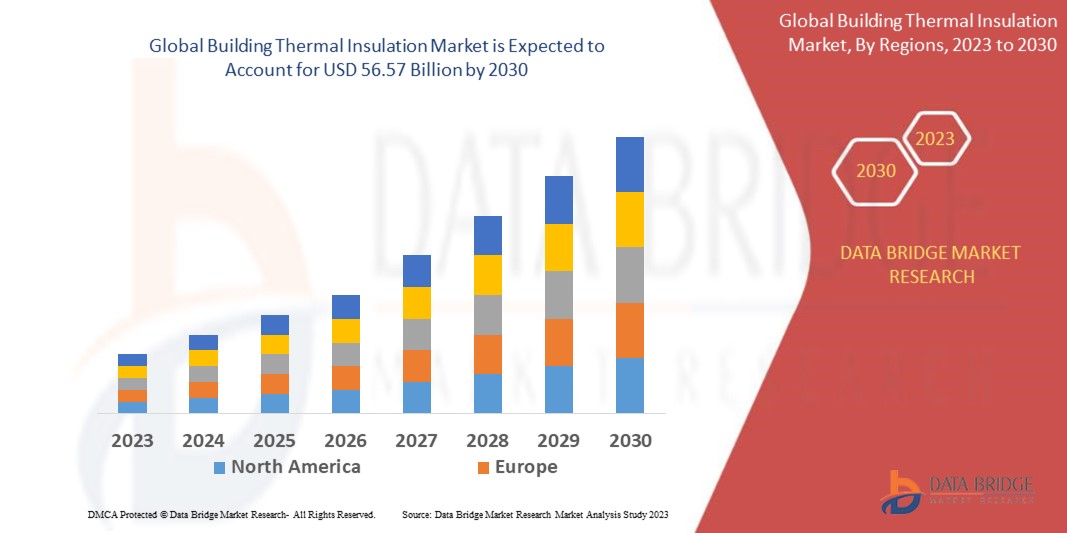
Building Thermal Insulation Market Analysis and Size
The building thermal insulation sector anticipates steady growth throughout the forecast period. Analyzing the market's dynamics in different geographical regions affected by temperature extremes is crucial. Insulating buildings is essential to uphold consistent temperatures and ideal conditions, benefiting both occupants and the environment. It facilitates energy conservation by preventing heat or cooling dissipation, a valuable contribution to sustainability.
Data Bridge Market Research analyses that the global building thermal insulation market which was USD 38.55 billion in 2022, would rocket up to USD 56.57 billion by 2030, and is expected to undergo a CAGR of 4.91% during the forecast period of 2023 to 2030. “Plastic foam” dominates the type segment of the global building thermal insulation market due to its superb insulation capabilities, versatility, cost-efficiency, and resistance to moisture. In addition to the insights on market scenarios such as market value, growth rate, segmentation, geographical coverage, and major players, the market reports curated by the Data Bridge Market Research also include in-depth expert analysis, geographically represented company-wise production and capacity, network layouts of distributors and partners, detailed and updated price trend analysis and deficit analysis of supply chain and demand.
Building Thermal Insulation Market Scope and Segmentation
|
Report Metric |
Details |
|
Forecast Period |
2023 to 2030 |
|
Base Year |
2022 |
|
Historic Years |
2021 (Customizable to 2015-2020) |
|
Quantitative Units |
Revenue in USD Thousand, Pricing in USD, Volume in Kilotone |
|
Segments Covered |
By Material (Plastic Foam, Glass Wool, Stone Wool, Others), Building Type (Residential Building, Non-Residential Building), Application (Roof Insulation, Wall Insulation, Floor Insulation) |
|
Countries Covered |
U.S., Canada and Mexico in North America, Germany, France, U.K., Netherlands, Switzerland, Belgium, Russia, Italy, Spain, Turkey, Rest of Europe in Europe, China, Japan, India, South Korea, Singapore, Malaysia, Australia, Thailand, Indonesia, Philippines, Rest of Asia-Pacific , Saudi Arabia, U.A.E., South Africa, Egypt, Israel, Rest of Middle East and Africa, Brazil, Argentina and Rest of South America |
|
Market Players Covered |
Honeywell International Inc. (U.S.), Siemens (Germany), Johnson Controls (Ireland), Schneider Electric (France), ASSA ABLOY (Sweden) ADT (U.S.), ABB (Switzerland), Robert Bosch GmbH (Germany), Ooma Inc., (U.S.), Delta Controls (Canada) SimpliSafe Inc., (U.S.), Armorax (U.S.), LG Electronics (South Korea and Legrand (France) |
|
Market Opportunities |
|
Market Definition
Thermal insulation is a vital method for managing heat exchange in buildings, maintaining a comfortable indoor temperature. It plays a crucial role in reducing the carbon footprint of structures by curbing energy requirements for temperature control and preventing excessive heat loss or gain to the external surroundings. This not only enhances energy efficiency but also minimizes the impact of buildings on the environment, aligning with sustainability goals.
Global Building Thermal Insulation Market Dynamics
Drivers
- Energy Efficiency Regulations Boosting Thermal Insulation
Stringent energy efficiency regulations are a driving force behind the adoption of thermal insulation in construction. These regulations aim to enhance energy efficiency in buildings by reducing heating and cooling costs. By improving insulation, structures can better maintain their desired temperature, leading to a reduced carbon footprint. This is achieved by lowering the energy required to keep indoor spaces comfortable while limiting heat transfer to the external environment. As a result, thermal insulation plays a crucial role in sustainable construction practices and environmental conservation
- Increasing Awareness Of Climate Change
Rising concerns about climate change and the imperative to reduce greenhouse gas emissions are driving the demand for efficient thermal insulation solutions. These concerns have led to a growing emphasis on curbing energy consumption in buildings. Effective thermal insulation helps in achieving this goal by reducing the need for heating and cooling, thus minimizing energy usage and environmental impact. As a result, the awareness of climate change is pushing the construction industry towards adopting more sustainable and eco-friendly practices through enhanced insulation measures
Opportunities
- Green Building Trends
The growing emphasis on sustainable and environmentally friendly construction practices creates opportunities for thermal insulation materials that contribute to green building certifications
- Technological Advancements
Continual advancements in technology, particularly within the realm of thermal insulation materials, are poised to propel market expansion. These advancements aim to enhance insulation properties, boost energy efficiency, and offer sustainable solutions. As a result, the market is witnessing a surge in demand for these cutting-edge insulation technologies as industries and consumers seek more effective ways to conserve energy and reduce environmental impact
Restraints/Challenges
- High Initial Costs
Substantial initial costs associated with premium thermal insulation materials can act as a deterrent for prospective users, including builders and homeowners. Despite long-term energy savings, the significant upfront investment may dissuade some from adopting these materials, thereby impacting their widespread adoption in the market
- Market Competition
Market competition, marked by intense rivalry among manufacturers, may influence pricing and profit margins in the thermal insulation industry. This competitive landscape can drive innovation and product development while also affecting affordability and market dynamics
Recent Developments
- In March 2023, Knauf Insulation is investing €120 million in its Croatia plant, doubling its energy-saving manufacturing capacity, creating 70 jobs, and expanding its European presence. The expansion includes an electric melting furnace that reduces emissions by 80%, green electricity sourcing, and increased production process recycling. Construction begins in 2023, with full operation expected by 2025. This aligns with Croatia's energy-efficient building renovation goals, and the plant will mainly serve foreign markets, aiming for a 90% export share
- In July 2023, Kingspan Group is acquiring a majority stake in Steico SE, a leader in wood-fibre insulation and wood-based building envelope products. This move aligns with Kingspan's strategy to broaden its insulation product range and enhance sustainability solutions. The acquisition is subject to regulatory approval and expected to complete in early 2024
Global Building Thermal Insulation Market Scope
The building thermal insulation market is segmented on the basis of material, building type and application. The growth amongst these segments will help you analyze meagre growth segments in the industries and provide the users with a valuable market overview and market insights to help them make strategic decisions for identifying core market applications.
Material
- Plastic Foam
- Glass Wool
- Stone Wool
- Others
Building Type
- Residential Building
- Non-residential Building
Application
- Roof Insulation
- Wall Insulation
- Floor Insulation
Global Building Thermal Insulation Market Regional Analysis/Insights
The global building thermal insulation market is analysed and market size insights and trends are provided by material, building type and application as referenced above.
The countries covered in the global building thermal insulation market report are U.S., Canada and Mexico in North America, Germany, France, U.K., Netherlands, Switzerland, Belgium, Russia, Italy, Spain, Turkey, Rest of Europe in Europe, China, Japan, India, South Korea, Singapore, Malaysia, Australia, Thailand, Indonesia, Philippines, Rest of Asia-Pacific , Saudi Arabia, U.A.E., South Africa, Egypt, Israel, Rest of Middle East and Africa, Brazil, Argentina and Rest of South America
Asia Pacific dominates the global building thermal insulation market due to its rapid urbanization, increasing construction activities, and stringent energy efficiency regulations.
The country section of the report also provides individual market impacting factors and changes in regulation in the market domestically that impacts the current and future trends of the market. Data points such as down-stream and up-stream value chain analysis, technical trends and porter's five forces analysis, case studies are some of the pointers used to forecast the market scenario for individual countries. Also, the presence and availability of global brands and their challenges faced due to large or scarce competition from local and domestic brands, impact of domestic tariffs and trade routes are considered while providing forecast analysis of the country data.
Competitive Landscape and Global Building Thermal Insulation Market Share Analysis
The global building thermal insulation market competitive landscape provides details by competitor. Details included are company overview, company financials, revenue generated, market potential, investment in research and development, new market initiatives, global presence, production sites and facilities, production capacities, company strengths and weaknesses, product launch, product width and breadth, application dominance. The above data points provided are only related to the company’s focus related to global building thermal insulation market.
Some of the major players operating in the global building thermal insulation market are:
- Honeywell International Inc. (U.S.)
- Siemens (Germany)
- Johnson Controls (Ireland)
- Axis Communications AB (Sweden)
- Schneider Electric (France)
- ASSA ABLOY (Sweden)
- ADT (U.S.)
- ABB (Switzerland)
- Robert Bosch GmbH (Germany)
- Ooma Inc., (U.S.)
- Delta Controls (Canada)
- SimpliSafe Inc., (U.S.)
- Armorax (U.S.)
- Legrand (France)
SKU-
Obtenha acesso online ao relatório sobre a primeira nuvem de inteligência de mercado do mundo

- Painel interativo de análise de dados
- Painel de análise da empresa para oportunidades de elevado potencial de crescimento
- Acesso de analista de pesquisa para personalização e customização. consultas
- Análise da concorrência com painel interativo
- Últimas notícias, atualizações e atualizações Análise de tendências
- Aproveite o poder da análise de benchmark para um rastreio abrangente da concorrência
Metodologia de Investigação
A recolha de dados e a análise do ano base são feitas através de módulos de recolha de dados com amostras grandes. A etapa inclui a obtenção de informações de mercado ou dados relacionados através de diversas fontes e estratégias. Inclui examinar e planear antecipadamente todos os dados adquiridos no passado. Da mesma forma, envolve o exame de inconsistências de informação observadas em diferentes fontes de informação. Os dados de mercado são analisados e estimados utilizando modelos estatísticos e coerentes de mercado. Além disso, a análise da quota de mercado e a análise das principais tendências são os principais fatores de sucesso no relatório de mercado. Para saber mais, solicite uma chamada de analista ou abra a sua consulta.
A principal metodologia de investigação utilizada pela equipa de investigação do DBMR é a triangulação de dados que envolve a mineração de dados, a análise do impacto das variáveis de dados no mercado e a validação primária (especialista do setor). Os modelos de dados incluem grelha de posicionamento de fornecedores, análise da linha de tempo do mercado, visão geral e guia de mercado, grelha de posicionamento da empresa, análise de patentes, análise de preços, análise da quota de mercado da empresa, normas de medição, análise global versus regional e de participação dos fornecedores. Para saber mais sobre a metodologia de investigação, faça uma consulta para falar com os nossos especialistas do setor.
Personalização disponível
A Data Bridge Market Research é líder em investigação formativa avançada. Orgulhamo-nos de servir os nossos clientes novos e existentes com dados e análises que correspondem e atendem aos seus objetivos. O relatório pode ser personalizado para incluir análise de tendências de preços de marcas-alvo, compreensão do mercado para países adicionais (solicite a lista de países), dados de resultados de ensaios clínicos, revisão de literatura, mercado remodelado e análise de base de produtos . A análise de mercado dos concorrentes-alvo pode ser analisada desde análises baseadas em tecnologia até estratégias de carteira de mercado. Podemos adicionar quantos concorrentes necessitar de dados no formato e estilo de dados que procura. A nossa equipa de analistas também pode fornecer dados em tabelas dinâmicas de ficheiros Excel em bruto (livro de factos) ou pode ajudá-lo a criar apresentações a partir dos conjuntos de dados disponíveis no relatório.











