



Global Clinical Microscopes Market Segmentation, By Product (Optical Microscopes, Electron Microscopes, Scanning Probe Microscopes, and Others), Ergonomics (Inverted Microscope and Upright Microscope), Modality (Digital and Optical), Application (Microbiology, Cell Biology, Pathology, Neuroscience, and Others), End User (Research and Academic Institutes, Hospitals, Outpatient Facilities, and Others), Distribution Channel (Direct Tender and Retail Sales) – Industry Trends and Forecast to 2032
Clinical Microscopes Market Analysis
The clinical microscopes market has seen significant advancements in technology, particularly with the integration of digital and automated features. One of the key innovations is the incorporation of digital imaging systems, which enable high-resolution imaging and facilitate real-time image analysis and remote consultations. These microscopes allow clinicians to capture and store images, improving diagnostic accuracy and patient care. In addition, AI-based software is being integrated to enhance image analysis, offering automated detection and identification of cells or tissues, which increases efficiency and precision.
In addition, the advancement is the development of optical coherence tomography (OCT), which provides non-invasive, high-resolution imaging for better examination of biological tissues, contributing to better disease diagnosis and monitoring. These developments have improved the usability and versatility of clinical microscopes in areas such as pathology, dermatology, and neurology.
The growth of the clinical microscopes market is driven by the rising demand for early disease detection, the increasing prevalence of chronic diseases, and advancements in healthcare infrastructure. Hospitals and diagnostic labs are adopting cutting-edge microscopes to improve patient outcomes, fueling market expansion.
Clinical Microscopes Market Size
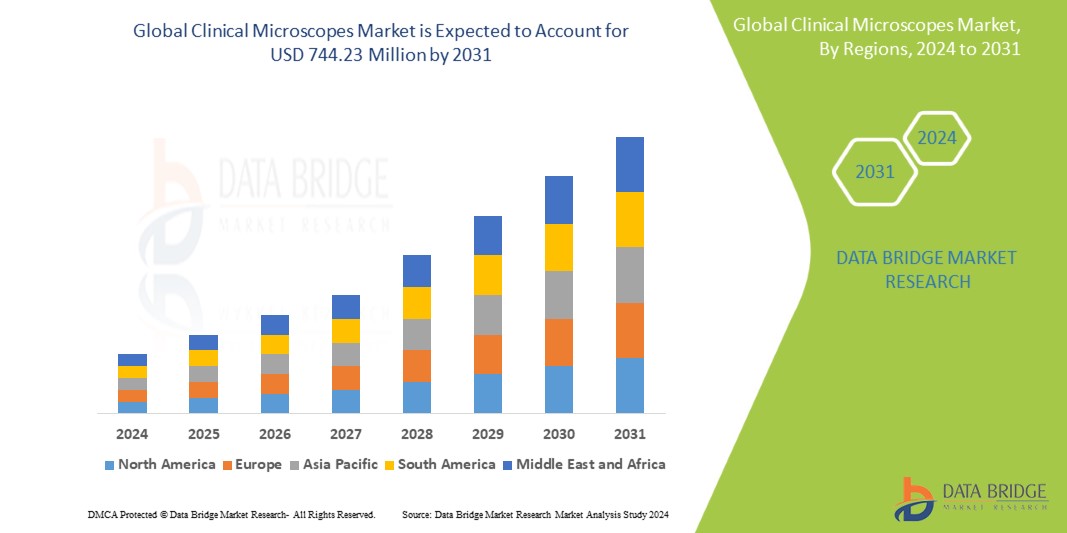
The global clinical microscopes market size was valued at USD 419.08 million in 2024 and is projected to reach USD 698.80 million by 2032, with a CAGR of 6.6% during the forecast period of 2025 to 2032. In addition to the insights on market scenarios such as market value, growth rate, segmentation, geographical coverage, and major players, the market reports curated by the Data Bridge Market Research also include depth expert analysis, patient epidemiology, pipeline analysis, pricing analysis, and regulatory framework.
Clinical Microscopes Market Trends
“Advancements in Digital Imaging Technologies”
One significant trend driving growth in the clinical microscopes market is the integration of advanced digital imaging technologies. This innovation allows for enhanced imaging capabilities, such as high-definition and 3D imaging, improving diagnostic accuracy and efficiency in clinical settings. The rise of automated image analysis, paired with artificial intelligence (AI), aids in faster, more precise interpretation of microscopic samples. For instance, companies such as Olympus and Leica Microsystems are incorporating AI-powered software that can identify cellular structures and abnormalities, enhancing pathologist workflows. This trend is not only streamlining diagnostic processes but also expanding the use of clinical microscopes in research and personalized medicine, significantly contributing to the market's growth.
Report Scope and Clinical Microscopes Market Segmentation
|
Attributes |
Clinical Microscopes Key Market Insights |
|
Segments Covered |
|
|
Countries Covered |
U.S., Canada and Mexico in North America, Germany, France, U.K., Netherlands, Switzerland, Belgium, Russia, Italy, Spain, Turkey, Rest of Europe in Europe, China, Japan, India, South Korea, Singapore, Malaysia, Australia, Thailand, Indonesia, Philippines, Rest of Asia-Pacific (APAC) in the Asia-Pacific (APAC), Saudi Arabia, U.A.E, South Africa, Egypt, Israel, Rest of Middle East and Africa (MEA) as a part of Middle East and Africa (MEA), Brazil, Argentina and Rest of South America as part of South America |
|
Key Market Players |
Olympus Corporation (Japan), F. Hoffmann-La Roche Ltd (Switzerland), Hitachi Ltd., (Japan), JEOL Ltd (Japan), Leica Microsystems (Germany), Thermo Fisher Scientific Inc. (U.S.), KEYENCE CORPORATION (Japan), Caliber Imaging & Diagnostics. (U.S.), Oxford Instruments (U.K), Bruker (U.S), Shimadzu Corporation (Japan), TESCAN GROUP, a.s. (Czech Republic), Leica Microsystems (Germany), HORIBA Group (Japan), Renishaw plc. (U.K.), Nikon Instruments Inc. (Japan), Cole-Parmer Instrument Company, LLC. (India), Celestron, LLC. (U.S.), NT-MDT and NT‑MDT SPECTRUM INSTRUMENTS (Ireland), Meiji Techno America (U.S.), AND Carl Zeiss (Germany) |
|
Market Opportunities |
|
|
Value Added Data Infosets |
In addition to the insights on market scenarios such as market value, growth rate, segmentation, geographical coverage, and major players, the market reports curated by the Data Bridge Market Research also include depth expert analysis, patient epidemiology, pipeline analysis, pricing analysis, and regulatory framework. |
Clinical Microscopes Market Definition
Clinical microscopes are laboratory instruments designed for medical and biological analysis, enabling detailed examination of biological samples such as blood, tissue, and bacteria. These microscopes typically feature high magnification capabilities, ranging from 40x to 1000x, and are used in clinical settings for diagnostic purposes. Equipped with advanced optics and illumination systems, they aid in identifying diseases, abnormalities, and pathogens. Clinical microscopes come in various types, such as brightfield, phase contrast, and fluorescence, each suited for different applications. These tools play a crucial role in research, education, and patient diagnosis, making them essential in medical laboratories and healthcare facilities.
Clinical Microscopes Market Dynamics
Drivers
- Growing Prevalence of Chronic Diseases
The growing prevalence of chronic diseases, such as cancer, diabetes, and neurological disorders, is significantly driving the clinical microscopes market. As the incidence of these diseases rises globally, there is a heightened need for accurate diagnostic tools to aid in early detection and effective disease management. For instance, in cancer diagnostics, clinical microscopes are vital for examining tissue samples and identifying abnormal cell structures, enabling early intervention. Similarly, in diabetes, microscopes help assess microvascular complications, while in neurological disorders, they assist in analyzing brain tissue and identifying cellular abnormalities. These applications highlight the increasing demand for advanced clinical microscopes, further propelling the market's growth.
- Rising Demand for Minimally Invasive Procedures
The increasing preference for minimally invasive surgeries is a significant driver for the clinical microscopes market. These procedures require advanced visualization tools, and clinical microscopes provide high-resolution images that are essential for accurate diagnostics and precise surgical interventions. The ability to observe tissues in real-time, with minimal incisions, improves patient outcomes and recovery times, making these procedures highly desirable. As hospitals and surgical centers adopt more sophisticated technologies for enhanced precision, the demand for clinical microscopes grows. This trend is particularly evident in fields such as neurology, orthopedics, and oncology, where microscopic examination plays a crucial role in successful treatment and diagnostics, further fueling market expansion.
Opportunities
- Rising Demand for Point-of-Care Diagnostics
The rising demand for point-of-care (POC) diagnostics presents a significant opportunity in the clinical microscopes market. As healthcare shifts toward rapid and on-site diagnostics, there is an increasing need for portable, compact, and efficient clinical microscopes capable of delivering real-time results. These microscopes enable faster disease detection, especially in remote and underserved areas, reducing patient wait times and enhancing treatment outcomes. Their integration with digital platforms also supports telemedicine, offering broader accessibility. As healthcare providers emphasize immediate diagnostic capabilities, manufacturers are innovating to meet these needs, thus opening up new growth avenues for the clinical microscopes market globally.
- Advancements in Technology
Technological advancements in digital imaging, automation, and AI integration are creating significant opportunities in the clinical microscopes market. Digital imaging enables high-resolution imaging and data capture, while AI enhances image analysis, offering faster and more accurate diagnoses. Automation in microscopy systems reduces human error and improves workflow efficiency, making them indispensable in high-volume clinical settings. Furthermore, AI-based solutions can identify subtle patterns, aiding in the detection of diseases at early stages. These innovations increase the demand for advanced microscopes in hospitals, diagnostic centers, and research labs. As healthcare providers strive for precision, these technological developments present a growing market opportunity, driving adoption and investment in next-gen clinical microscopes.
Restraints/Challenges
- High Cost of Equipment
The high cost of clinical microscopes, especially advanced models such as confocal and electron microscopes, poses a significant restraint on the market. These microscopes are expensive to purchase, install, and maintain, which limits their accessibility, particularly in developing countries and smaller healthcare facilities with limited budgets. The substantial initial investment required for these systems, combined with ongoing operational and maintenance costs, makes it difficult for many institutions to afford these technologies. This financial barrier results in a slower adoption rate and hinders the expansion of the market, particularly in regions where healthcare budgets are constrained or where alternative diagnostic methods are more cost-effective.
- Issue in Maintenance and Repairs
The maintenance and repair of high-tech microscopes pose a significant issue in the clinical microscopes market. These advanced instruments often require specialized technicians for servicing, which can be both time-consuming and costly. Clinics and hospitals face increased operational expenses due to the need for regular calibration, cleaning, and repairs to maintain optimal performance. In addition, the unavailability of replacement parts or technical expertise in certain regions can further exacerbate delays and increase costs. This ongoing maintenance burden limits the adoption of newer, more sophisticated models and discourages the investment in microscopes, especially in smaller healthcare settings with limited resources, ultimately hindering market growth.
This market report provides details of new recent developments, trade regulations, import-export analysis, production analysis, value chain optimization, market share, impact of domestic and localized market players, analyses opportunities in terms of emerging revenue pockets, changes in market regulations, strategic market growth analysis, market size, category market growths, application niches and dominance, product approvals, product launches, geographic expansions, technological innovations in the market. To gain more info on the market contact Data Bridge Market Research for an Analyst Brief, our team will help you take an informed market decision to achieve market growth.
Clinical Microscopes Market Scope
The market is segmented on the basis of product, ergonomics, modality, application, end user and distribution channel. The growth amongst these segments will help you analyze meagre growth segments in the industries and provide the users with a valuable market overview and market insights to help them make strategic decisions for identifying core market applications.
Product
- Optical Microscopes
- Electron Microscopes
- Scanning Probe Microscopes
- Others
Ergonomics
- Inverted Microscope
- Upright Microscope
Modality
- Digital
- Optical
Application
- Microbiology
- Cell Biology
- Pathology
- Neuroscience
- Others
End User
- Research and Academic Institutes
- Hospitals
- Outpatient Facilities
- Others
Distribution Channel
- Direct Tender
- Retail Sales
Clinical Microscopes Market Regional Analysis
The market is analysed and market size insights and trends are provided by country, product, ergonomics, modality, application, end user and distribution channel as referenced above.
The countries covered in the market report are U.S., Canada, Mexico in North America, Germany, Sweden, Poland, Denmark, Italy, U.K., France, Spain, Netherland, Belgium, Switzerland, Turkey, Russia, Rest of Europe in Europe, Japan, China, India, South Korea, New Zealand, Vietnam, Australia, Singapore, Malaysia, Thailand, Indonesia, Philippines, Rest of Asia-Pacific (APAC) in Asia-Pacific (APAC), Brazil, Argentina, Rest of South America as a part of South America, U.A.E, Saudi Arabia, Oman, Qatar, Kuwait, South Africa, Rest of Middle East and Africa (MEA) as a part of Middle East and Africa (MEA)
North America is expected to dominate the clinical microscopes market due to the significant increase in research and development investments, along with the growing number of government initiatives to enhance healthcare. The region benefits from advanced healthcare infrastructure, which drives demand for sophisticated diagnostic tools such as clinical microscopes. In addition, the presence of leading manufacturers and continuous technological advancements further support North America's leadership in the market. This growth is further fueled by the rising healthcare awareness and medical needs.
Asia-Pacific is expected to exhibit the highest growth rate in the clinical microscopes market during the forecast period due to increasing government expenditure on the healthcare sector. The region's rising technological advancements and government initiatives to improve healthcare infrastructure are key drivers of market growth. In addition, growing investments in medical research and healthcare facilities in countries such as China, India, and Japan are further boosting the demand for clinical microscopes in the region.
The country section of the report also provides individual market impacting factors and changes in regulation in the market domestically that impacts the current and future trends of the market. Data points such as down-stream and upstream value chain analysis, technical trends and porter's five forces analysis, case studies are some of the pointers used to forecast the market scenario for individual countries. Also, the presence and availability of global brands and their challenges faced due to large or scarce competition from local and domestic brands, impact of domestic tariffs and trade routes are considered while providing forecast analysis of the country data.
Clinical Microscopes Market Share
The market competitive landscape provides details by competitor. Details included are company overview, company financials, revenue generated, market potential, investment in research and development, new market initiatives, global presence, production sites and facilities, production capacities, company strengths and weaknesses, product launch, product width and breadth, application dominance. The above data points provided are only related to the companies' focus related to market.
Clinical Microscopes Market Leaders Operating in the Market Are:
- Olympus Corporation (Japan)
- F. Hoffmann-La Roche Ltd (Switzerland)
- Hitachi Ltd., (Japan)
- JEOL Ltd (Japan)
- Leica Microsystems (Germany)
- Thermo Fisher Scientific Inc. (U.S.)
- KEYENCE CORPORATION (Japan)
- Zeiss International (Germany)
- Intertek Group plc (U.K.)
- Caliber Imaging & Diagnostics. (U.S.)
- Oxford Instruments (U.K)
- Bruker (U.S)
- Shimadzu Corporation (Japan)
- TESCAN GROUP, a.s. (Czech Republic)
- Leica Microsystems (Germany)
- HORIBA Group (Japan)
- Renishaw plc. (U.K.)
- Nikon Instruments Inc. (Japan)
- Cole-Parmer Instrument Company, LLC. (India)
- Celestron, LLC. (U.S.)
- NT-MDT and NT‑MDT SPECTRUM INSTRUMENTS (Ireland)
- Meiji Techno America (U.S.)
- Carl Zeiss (Germany)
Latest Developments in Clinical Microscopes Market
- In June 2023, Carl Zeiss AG launched the Axiovert 5, a state-of-the-art cell imaging system integrated with pre-built AI. This innovation automates complex laboratory workflows, streamlining research and enhancing productivity. The system is designed for advanced imaging, improving the efficiency and precision of cell analysis in various scientific fields
- In June 2023, Thermo Fisher Scientific introduced the METRIOS 6 (S)TEM, a cutting-edge model for Transmission Electron Microscopy (TEM). This advanced tool is equipped with features that provide in-depth imaging of internal sample sections, enabling more precise analysis. It enhances the accuracy of research in materials science and biological studies by offering higher resolution images
- In March 2023, Joseph N France General Hospital adopted the Leica M690 Surgical Operating Microscope System, a breakthrough technology aimed at transforming surgical procedures. This system enhances visualization during surgeries, leading to greater precision. The integration of the Leica M690 promises improved patient outcomes, enabling surgeons to perform more accurate and minimally invasive procedures
- In January 2023, Leica Microsystems partnered with DB Surgical Inc. through a distribution agreement, expanding their presence in North and South Carolina. This collaboration enables Leica Microsystems to broaden its reach in the surgical and medical technology markets, providing advanced microscope and imaging solutions to healthcare professionals, thereby improving surgical precision and patient care
- In January 2022, Olympus Corporation launched the DP28 and DP23 microscope cameras, featuring high megapixel resolution for enhanced imaging. This launch allowed Olympus to expand its portfolio of microscope accessories, offering better image quality for research and medical applications. The cameras provide superior clarity, contributing to more detailed observations and improving Olympus' competitive edge in the market
SKU-
Obtenha acesso online ao relatório sobre a primeira nuvem de inteligência de mercado do mundo

- Painel interativo de análise de dados
- Painel de análise da empresa para oportunidades de elevado potencial de crescimento
- Acesso de analista de pesquisa para personalização e customização. consultas
- Análise da concorrência com painel interativo
- Últimas notícias, atualizações e atualizações Análise de tendências
- Aproveite o poder da análise de benchmark para um rastreio abrangente da concorrência
Metodologia de Investigação
A recolha de dados e a análise do ano base são feitas através de módulos de recolha de dados com amostras grandes. A etapa inclui a obtenção de informações de mercado ou dados relacionados através de diversas fontes e estratégias. Inclui examinar e planear antecipadamente todos os dados adquiridos no passado. Da mesma forma, envolve o exame de inconsistências de informação observadas em diferentes fontes de informação. Os dados de mercado são analisados e estimados utilizando modelos estatísticos e coerentes de mercado. Além disso, a análise da quota de mercado e a análise das principais tendências são os principais fatores de sucesso no relatório de mercado. Para saber mais, solicite uma chamada de analista ou abra a sua consulta.
A principal metodologia de investigação utilizada pela equipa de investigação do DBMR é a triangulação de dados que envolve a mineração de dados, a análise do impacto das variáveis de dados no mercado e a validação primária (especialista do setor). Os modelos de dados incluem grelha de posicionamento de fornecedores, análise da linha de tempo do mercado, visão geral e guia de mercado, grelha de posicionamento da empresa, análise de patentes, análise de preços, análise da quota de mercado da empresa, normas de medição, análise global versus regional e de participação dos fornecedores. Para saber mais sobre a metodologia de investigação, faça uma consulta para falar com os nossos especialistas do setor.
Personalização disponível
A Data Bridge Market Research é líder em investigação formativa avançada. Orgulhamo-nos de servir os nossos clientes novos e existentes com dados e análises que correspondem e atendem aos seus objetivos. O relatório pode ser personalizado para incluir análise de tendências de preços de marcas-alvo, compreensão do mercado para países adicionais (solicite a lista de países), dados de resultados de ensaios clínicos, revisão de literatura, mercado remodelado e análise de base de produtos . A análise de mercado dos concorrentes-alvo pode ser analisada desde análises baseadas em tecnologia até estratégias de carteira de mercado. Podemos adicionar quantos concorrentes necessitar de dados no formato e estilo de dados que procura. A nossa equipa de analistas também pode fornecer dados em tabelas dinâmicas de ficheiros Excel em bruto (livro de factos) ou pode ajudá-lo a criar apresentações a partir dos conjuntos de dados disponíveis no relatório.











