


Global Electronic Shelf Label Market, By Component (Displays, Batteries, Transceivers, Microprocessors, Others), Product Type (LCD ESL, Segmented E-Paper ESL, Full-Graphic E-Paper ESL), Technology (ZigBee, BLE, Wi-Fi), Display Size (Less than 3 inches, 3 to 7 inches, 7 to 10 inches, More than 10 inches), Store Type (Hypermarkets, Supermarkets, Non-Food Retail Stores, Specialty Stores, Other Store Types), Communication Technology (Radio Frequency, Infrared, Near Field Communication, Other Communication Technologies) – Industry Trends and Forecast to 2030.
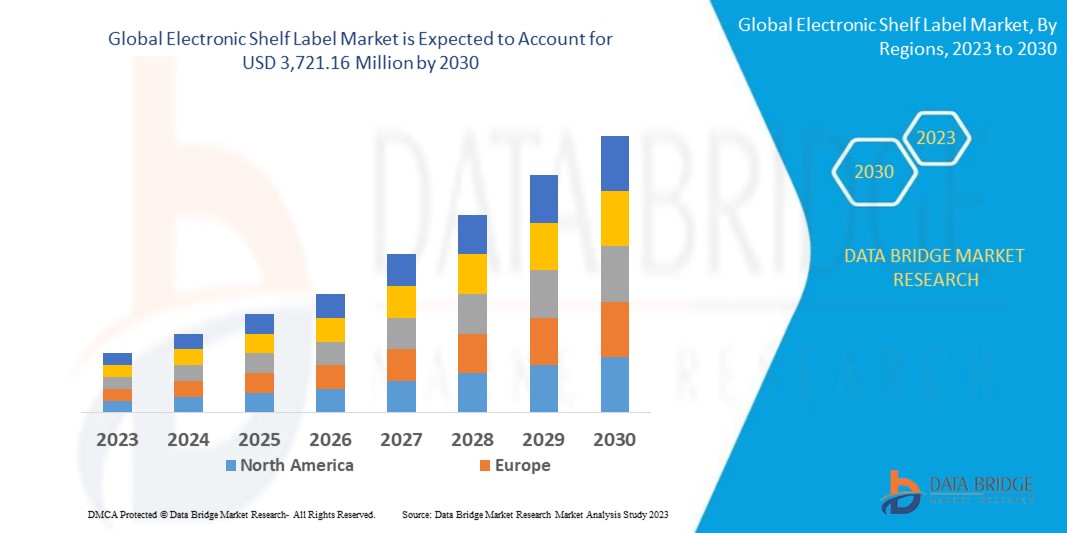
Electronic Shelf Label Market Analysis and Size
The global electronic shelf label market is segmented on the basis of component, product type, technology, display size, store type, communication technology. The growth among segments helps you analyze niche pockets of growth and strategies to approach the market and determine your core application areas and the difference in your target markets.
Data Bridge Market Research analyses that the global electronic shelf label market which was USD 920.24 million in 2022, would rocket up to USD 3,721.16 million by 2030, and is expected to undergo a CAGR of 20.12% during the forecast period. This indicates the market value. The “hypermarkets” accounts for the largest store type segment in the electronic shelf label market within the forecasted period owing to the growing adoption of digital technologies in the retail sector. In addition to the insights on market scenarios such as market value, growth rate, segmentation, geographical coverage, and major players, the market reports curated by the Data Bridge Market Research also include in-depth expert analysis, geographically represented company-wise production and capacity, network layouts of distributors and partners, detailed and updated price trend analysis and deficit analysis of supply chain and demand.
Electronic Shelf Label Market Scope and Segmentation
|
Report Metric |
Details |
|
Forecast Period |
2023 to 2030 |
|
Base Year |
2022 |
|
Historic Years |
2021 (Customizable to 2015 - 2020) |
|
Quantitative Units |
Revenue in USD Million, Volumes in Units, Pricing in USD |
|
Segments Covered |
Component (Displays, Batteries, Transceivers, Microprocessors, Others), Product Type (LCD ESL, Segmented E-Paper ESL, Full-Graphic E-Paper ESL), Technology (ZigBee, BLE, Wi-Fi), Display Size (Less than 3 inches, 3 to 7 inches, 7 to 10 inches, More than 10 inches), Store Type (Hypermarkets, Supermarkets, Non-Food Retail Stores, Specialty Stores, Other Store Types), Communication Technology (Radio Frequency, Infrared, Near Field Communication, Other Communication Technologies) |
|
Countries Covered |
U.S., Canada, Mexico, Brazil, Argentina, Rest of South America, Germany, Italy, U.K., France, Spain, Netherlands, Belgium, Switzerland, Turkey, Russia, Rest of Europe, Japan, China, India, South Korea, Australia, Singapore, Malaysia, Thailand, Indonesia, Philippines, Rest of Asia-Pacific, Saudi Arabia, U.A.E., South Africa, Egypt, Israel, Rest of the Middle East and Africa |
|
Market Players Covered |
SES-imagotag (France), Pricer AB (Sweden), E Ink Holdings Inc., (Taiwan), Displaydata Limited (U.K.), M2COMM (Taiwan), SAMSUNG (South Korea), Diebold Nixdorf, Incorporated (U.S.), Opticon Sensors Europe B.V. (Netherlands), Teraoka Seiko Co., Ltd., (Japan), and NZ Electronic Shelf Labelling (New Zealand), Advantech Co., Ltd (Taiwan), FORBIX SEMICON (India), LANCOM Systems GmbH (Germany), SOLUM Group HQ (Germany), Cicor Management AG (Switzerland) and CSY Retail Systems Ltd (U.K.) |
|
Market Opportunities |
|
Market Definition
Electronic shelf label is basically utilized by the retailers for displaying product pricing on shelves. When a price is altered under the management of a central server, the product pricing is automatically updated. On the front edge of retail shelves, electronic display modules are typically connected. They are widely used across various stores such as hypermarkets, supermarkets, non-food retail stores, specialty stores and other store types.
Global Electronic Shelf Label Market Dynamics
Drivers
- Surge in Digitalization and Automation in Stores
Factors such as the introduction of new channels for the supply of goods, rising wages and higher investments in the e-commerce sector all significantly impact the adoption of automation in the retail sector. Technologies such as automated backroom unloading, self-checkout terminals, self-checking robots, and electronic shelf labels have proven effective at a large scale in the retail business and given retailers huge returns. Given that businesses are investing more and more in technologies to improve the shopping experience for customers, store digitalization is here to stay for a very long time. Retailers worldwide are giving customers many options throughout the entire purchasing process, and a seamless transition between online and offline shopping platforms is becoming more and more crucial
- Growing Efficiency and Accuracy in Pricing
ESLs allow retailers to update prices and product information in real-time electronically. This enhances pricing accuracy, reduces pricing errors, and ensures consistency across all shelves, leading to improved operational efficiency
- Enhanced Customer Experience
ESLs enable dynamic pricing strategies, such as personalized pricing, promotions, and flash sales, which can enhance the shopping experience and attract more customers. Shoppers can also access real-time product information and reviews through ESLs
Opportunity
- Rising Expansion of E-commerce
As the e-commerce sector grows, ESLs can help traditional brick-and-mortar retailers compete by offering online-like shopping experiences. ESLs enable online price matching, which can attract customers back to physical stores
Restraints/Challenges
- High Initial Implementation Costs
The upfront costs associated with implementing ESL systems can be significant for retailers, particularly smaller businesses. These costs include the purchase of hardware (ESL tags and infrastructure) and software, such as installation and training expenses
- Infrastructure and Compatibility Challenges
Retailers need to invest in the necessary infrastructure, including Wi-Fi networks and back-end systems, to support ESLs. Ensuring compatibility with existing systems and integrating ESLs can be complex and costly
This global electronic shelf label market report provides details of new recent developments, trade regulations, import-export analysis, production analysis, value chain optimization, market share, the impact of domestic and localized market players, analyses opportunities in terms of emerging revenue pockets, changes in market regulations, strategic market growth analysis, market size, category market growths, application niches and dominance, product approvals, product launches, geographic expansions, technological innovations in the market. To gain more info on the variable frequency drive market contact the Data Bridge Market Research for an Analyst Brief, our team will help you make an informed market decision to achieve market growth
Recent Developments
- In July 2020, In accordance with a Master Framework Agreement signed by Pricer AB and the Canadian Tire Dealer Association (CTDA), Pricer will serve as the CTDA's sole provider of electronic shelf label systems. ESL equipment will be installed in 38 locations across the nation as part of Pricer's first delivery under the deal
- In February 2020, A distribution contract was struck by Bison Schweiz AG, based in Switzerland, and Hanshow Technology to work together on developing the German and Swiss markets. As part of their agreement, the businesses will combine top-tier ESL systems from Bison with world-class ESL solutions from Hanshow to drive digitization trends in the European retail sector
The Global Electronic Shelf Label Market Scope
The global electronic shelf label market is segmented on the basis of component, product type, technology, display size, store type, communication technology. the growth amongst these segments will help you analyze meager growth segments in the industries and provide the users with a valuable market overview and market insights to help them make strategic decisions for identifying core market applications
Component
- Displays
- Batteries
- Transceivers
- Microprocessors
- Others
Product Type
- LCD ESL
- Segmented E-Paper ESL
- Full-Graphic E-Paper ESL
Technology
- ZigBee
- BLE
- Wi-Fi
Display Size
- Less than 3 inches
- 3 to 7 inches
- 7 to 10 inches
- More than 10 inches
Store Type
- Hypermarkets
- Supermarkets
- Non-Food Retail Stores
- Specialty Stores
- Other Store Types
Communication Technology
- Radio Frequency
- Infrared
- Near Field Communication
- Other Communication Technologies
The Global Electronic Shelf Label Market Region Analysis/Insights
The global electronic shelf label market is analyzed and market size insights and trends are provided by component, product type, technology, display size, store type, communication technology, as referenced above.
The regions covered in the global electronic shelf label market are North America, South America, Europe, Asia-Pacific, and the Middle East and Africa. The countries covered in the global Electronic Shelf Label market report are U.S., Canada, Mexico, Brazil, Argentina, the Rest of South America, Germany, Italy, U.K., France, Spain, Netherlands, Belgium, Switzerland, Turkey, Russia, Rest of Europe, Japan, China, India, South Korea, Australia, Singapore, Malaysia, Thailand, Indonesia, Philippines, Rest of Asia-Pacific, Saudi Arabia, U.A.E., South Africa, Egypt, Israel, Rest of the Middle East and Africa
Europe dominates the global electronic shelf label market. The market is estimated to grow within the region because of the high growth of full graphic e-paper display along with the prevalence of majority of electronics manufacturers within the region. Asia-Pacific is expected to witness significant growth during the forecast period of 2023 to 2030 due to the prevalence of labor at low cost along with increased presence of retail giants with higher customers’ interest within the region.
The region section of the report also provides individual market-impacting factors and changes in regulation in the market domestically that impact the current and future trends of the market. Data points such as down-stream and up-stream value chain analysis, technical trends, and Porter’s five forces analysis, case studies are some of the pointers used to forecast the market scenario for individual countries. Also, the presence and availability of global brands and the challenges faced due to large or scarce competition from local and domestic brands, the impact of domestic tariffs, and trade routes are considered while providing forecast analysis of the region data.
Semiconductor Infrastructure Growth Installed Base and New Technology Penetration
The global electronic shelf label market also provides you with a detailed market analysis for every region’s growth in healthcare expenditure for capital equipment, installed base of different kinds of products for the global electronic shelf label market, the impact of technology using lifeline curves, and changes in battery regulatory scenarios and their impact on the variable frequency drive market. The data is available for the historic period 2010 to 2020.
Competitive Landscape and Global Electronic Shelf Label Market Share Analysis
The global electronic shelf label market competitive landscape provides details of competitors. Details included are company overview, company financials, revenue generated, market potential, investment in research and development, new market initiatives, global presence, production sites and facilities, production capacities, company strengths and weaknesses, product launch, product width and breadth, and application dominance. The above data points provided are only related to the companies' focus related to the global electronic shelf label market.
Some of the major players operating in the global electronic shelf label market are:
- SES-imagotag (France)
- Pricer AB (Sweden)
- E Ink Holdings Inc., (Taiwan)
- Displaydata Limited (U.K.)
- M2COMM (Taiwan)
- SAMSUNG (South Korea)
- Diebold Nixdorf, Incorporated (U.S.)
- Opticon Sensors Europe B.V. (Netherlands)
- Teraoka Seiko Co., Ltd., (Japan)
- NZ Electronic Shelf Labelling (New Zealand)
- Advantech Co., Ltd (Taiwan)
- FORBIX SEMICON (India)
- LANCOM Systems GmbH (Germany)
- SOLUM Group HQ (Germany)
- Cicor Management AG (Switzerland)
- CSY Retail Systems Ltd (U.K.)
SKU-
Obtenha acesso online ao relatório sobre a primeira nuvem de inteligência de mercado do mundo

- Painel interativo de análise de dados
- Painel de análise da empresa para oportunidades de elevado potencial de crescimento
- Acesso de analista de pesquisa para personalização e customização. consultas
- Análise da concorrência com painel interativo
- Últimas notícias, atualizações e atualizações Análise de tendências
- Aproveite o poder da análise de benchmark para um rastreio abrangente da concorrência
Metodologia de Investigação
A recolha de dados e a análise do ano base são feitas através de módulos de recolha de dados com amostras grandes. A etapa inclui a obtenção de informações de mercado ou dados relacionados através de diversas fontes e estratégias. Inclui examinar e planear antecipadamente todos os dados adquiridos no passado. Da mesma forma, envolve o exame de inconsistências de informação observadas em diferentes fontes de informação. Os dados de mercado são analisados e estimados utilizando modelos estatísticos e coerentes de mercado. Além disso, a análise da quota de mercado e a análise das principais tendências são os principais fatores de sucesso no relatório de mercado. Para saber mais, solicite uma chamada de analista ou abra a sua consulta.
A principal metodologia de investigação utilizada pela equipa de investigação do DBMR é a triangulação de dados que envolve a mineração de dados, a análise do impacto das variáveis de dados no mercado e a validação primária (especialista do setor). Os modelos de dados incluem grelha de posicionamento de fornecedores, análise da linha de tempo do mercado, visão geral e guia de mercado, grelha de posicionamento da empresa, análise de patentes, análise de preços, análise da quota de mercado da empresa, normas de medição, análise global versus regional e de participação dos fornecedores. Para saber mais sobre a metodologia de investigação, faça uma consulta para falar com os nossos especialistas do setor.
Personalização disponível
A Data Bridge Market Research é líder em investigação formativa avançada. Orgulhamo-nos de servir os nossos clientes novos e existentes com dados e análises que correspondem e atendem aos seus objetivos. O relatório pode ser personalizado para incluir análise de tendências de preços de marcas-alvo, compreensão do mercado para países adicionais (solicite a lista de países), dados de resultados de ensaios clínicos, revisão de literatura, mercado remodelado e análise de base de produtos . A análise de mercado dos concorrentes-alvo pode ser analisada desde análises baseadas em tecnologia até estratégias de carteira de mercado. Podemos adicionar quantos concorrentes necessitar de dados no formato e estilo de dados que procura. A nossa equipa de analistas também pode fornecer dados em tabelas dinâmicas de ficheiros Excel em bruto (livro de factos) ou pode ajudá-lo a criar apresentações a partir dos conjuntos de dados disponíveis no relatório.











