


Global Feed Fats and Proteins Market, By Source (Animal, Plant, Other Sources), Livestock (Ruminants, Poultry, Aqua, Swine, Equine, Others) – Industry Trends and Forecast to 2029.
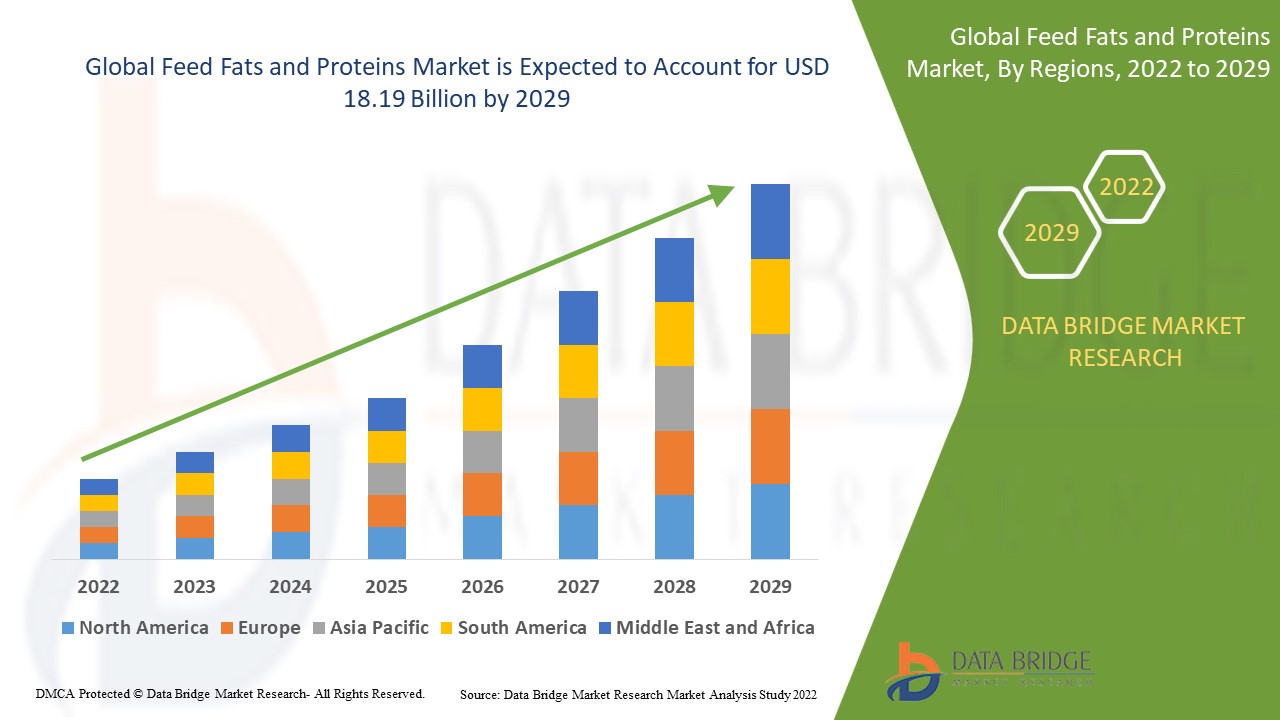
Feed Fats and Proteins Market Analysis and Size
Globally, there is an increase in demand for feed fats and proteins due to rising middle-class incomes and rapid urbanisation. The relationship between a well-balanced diet and maximum productivity is well understood by livestock producers. In fact, animal feed is a major factor influencing the profitability of the livestock production industry. As a result, industries are no longer conservative when it comes to producing high-quality animal feed ingredients.
Data Bridge Market Research analyses that the feed fats and proteins market which was growing at a value of 10.35 billion in 2021 and is expected to reach the value of USD 18.19 billion by 2029, at a CAGR of 7.30% during the forecast period. In addition to the market insights such as market value, growth rate, market segments, geographical coverage, market players, and market scenario, the market report curated by the Data Bridge Market Research team includes in-depth expert analysis, import/export analysis, pricing analysis, production consumption analysis, technological advancements and patent analysis.
Feed Fats and Proteins Market Scope and Segmentation
|
Report Metric |
Details |
|
Forecast Period |
2022 to 2029 |
|
Base Year |
2021 |
|
Historic Years |
2020 (Customizable to 2014 - 2019) |
|
Quantitative Units |
Revenue in USD Billion, Volumes in Units, Pricing in USD |
|
Segments Covered |
Source (Animal, Plant, Other Sources), Livestock (Ruminants, Poultry, Aqua, Swine, Equine, Others) |
|
Countries Covered |
U.S., Canada and Mexico in North America, Germany, France, U.K., Netherlands, Switzerland, Belgium, Russia, Italy, Spain, Turkey, Rest of Europe in Europe, China, Japan, India, South Korea, Singapore, Malaysia, Australia, Thailand, Indonesia, Philippines, Rest of Asia-Pacific (APAC) in the Asia-Pacific (APAC), Saudi Arabia, U.A.E, Israel, Egypt, South Africa, Rest of Middle East and Africa (MEA) as a part of Middle East and Africa (MEA), Brazil, Argentina and Rest of South America as part of South America |
|
Market Players Covered |
Dow (U.S.), BASF SE (Germany), Chr. Hansen Holding A/S (Denmark), DSM (Netherlands), DuPont (U.S.), Evonik Industries AG (Germany), NOVUS INTERNATIONAL (U.S.), Alltech (Nicholasville), Associated British Foods plc (U.K.), Charoen Pokphand Foods PCL (Thailand), Cargill, Incorporated (U.S.), Nutreco (Netherlands), ForFarmers. (Netherlands), De Heus Animal Nutrition (Netherlands), Land O'Lakes (U.S.), Kent Nutrition Group (U.S.), J. D. HEISKELL & CO. (U.S.), Perdue Farms (U.S.), SunOpta (Canada), Scratch and Peck Feeds (U.S.), De Heus Animal Nutrition (Netherlands), MEGAMIX (Russia), Agrofeed (Hungary) |
|
Opportunities |
|
Market Definition
Fats and proteins are essential nutrients derived from animal by-products and plant sources. Because of their high nutritional content, these are effective ingredients in animal feed and pet food. Animal by-products with high nutritional value include meat and bone meal, blood meal, fish meal, poultry meal, hydrolysed feather meal, and animal fats. These are a concentrated source of protein, amino acids, vitamins, and a variety of essential minerals. Heat processing of these products results in digestible protein for animal feed production.
Feed Fats and Proteins Market Dynamics
Drivers
- Growing nutritional standards for livestock feed
The growing awareness of the importance of nutritional feed products in the overall well-being of animals is the primary driver of the global feed fats and proteins market. Feeding enough nitrified feed improves the quality of meat, milk, and overall produce. With the growing demand for meat and consumer concern about its safety, several nutritional standards for poultry and cattle feed were established, driving the demand for protein-rich ingredients. The rendering industry's hygiene and improved purification technologies increase the amount of animal protein and fat in processed foods.
- Implementation of new rearing practices
Food safety concerns have increased the demand for feed fats and proteins to ensure meat safety. Another factor driving the growth of the feed fats and proteins market is the growing awareness among farm owners of the importance of maintaining a healthy animal based diet. As a result, they are transitioning from standard feed additives to functional and premium variants that help improve the animals' immunity against enzootic diseases while also lowering the risk of metabolic disorders, acidosis, injuries, and infections.
Furthermore, an increase in demand for organic meat from developed-country consumers, as well as the implementation of new animal rearing practises and the maintenance of high farming standards, has created a positive outlook for the industry.
Opportunity
Development in the rendering industry, rising applications from emerging economies will create more lucrative opportunities, leading to the growth of the feed fats and proteins market during the forecast period.
Restraints
The growing number of environmental concerns, as well as disease outbreaks, will likely act as market restraints for the growth of the feed fats and proteins market during the forecast period. Imposing restrictions on the use of animal protein in cattle and other ruminant animals will be the most significant challenge to market growth.
This feed fats and proteins market report provides details of new recent developments, trade regulations, import-export analysis, production analysis, value chain optimization, market share, impact of domestic and localized market players, analyses opportunities in terms of emerging revenue pockets, changes in market regulations, strategic market growth analysis, market size, category market growths, application niches and dominance, product approvals, product launches, geographic expansions, technological innovations in the market. To gain more info on the feed fats and proteins market contact Data Bridge Market Research for an Analyst Brief, our team will help you take an informed market decision to achieve market growth.
COVID-19 Impact on Feed Fats and Proteins Market
Agriculture and food production have been identified as critical sectors global during the COVID-19 situation. As a result, farmers have continued to ensure that farm animals receive high-quality nutrition in order to feed an increasing number of global consumers. However, the disruption of the supply chain has become the most significant factor affecting the feed fats and proteins market. China is a major producer and exporter of amino acids premix for feed, and it stockpiled significant amounts of product during the emergence of the COVID-19 situation while businesses were closed for the Lunar New Year, which was enough for 2-3 months’ supply. Furthermore, logistics issues have hampered the supply of containers and vessels, as well as the transport of certain micro-ingredients.
Recent Development
- Cargill and BASF partnered in the animal nutrition business in October 2021, adding research and development capabilities and new markets to the partners' existing feed enzymes distribution agreements. This collaboration aided in the development, production, marketing, and sale of customer-focused enzyme products and solutions for animals, including swine.
- De Heus acquired Coppens Diervoeding, a feed manufacturing company based in the Netherlands that specialises in the pig farming sector, in July 2021. This acquisition enabled the company to double its production capacity and strengthen its regional presence by 400k.
- ADM opened a new livestock feed plant in Ha Nam province, Vietnam, in November 2019. The new facility adds to ADM's growing list of investments in Vietnam, becoming the company's fifth plant dedicated to animal nutrition in the country. The plant is
Global Feed Fats and Proteins Market Scope
The feed fats and proteins market is segmented on the basis of source and livestock. The growth amongst these segments will help you analyze meagre growth segments in the industries and provide the users with a valuable market overview and market insights to help them make strategic decisions for identifying core market applications.
Source
- Animal
- Meat and bone meal
- Poultry meal
- Tallow
- Others
- Plant
- Corn
- Soybean
- Cotton seeds
- Others
- Other Sources
Livestock
- Ruminant Feed
- Aquatic Feed
- Equine Feed
- Poultry Feed
- Swine Feed
Feed Fats and Proteins Market Regional Analysis/Insights
The feed fats and proteins market is analysed and market size insights and trends are provided by country, source and livestock as referenced above.
The countries covered in the feed fats and proteins market report are U.S., Canada and Mexico in North America, Germany, France, U.K., Netherlands, Switzerland, Belgium, Russia, Italy, Spain, Turkey, Rest of Europe in Europe, China, Japan, India, South Korea, Singapore, Malaysia, Australia, Thailand, Indonesia, Philippines, Rest of Asia-Pacific (APAC) in the Asia-Pacific (APAC), Saudi Arabia, U.A.E, Israel, Egypt, South Africa, Rest of Middle East and Africa (MEA) as a part of Middle East and Africa (MEA), Brazil, Argentina and Rest of South America as part of South America.
Asia-Pacific dominates the feed fats and proteins market due to rising consumption of milk, meat, and meat products, as well as a growing population in the region, whereas North America and Europe are expected to grow during the forecast period due to the presence of various manufacturing companies in the region.
The country section of the report also provides individual market impacting factors and changes in market regulation that impact the current and future trends of the market. Data points like down-stream and upstream value chain analysis, technical trends and porter's five forces analysis, case studies are some of the pointers used to forecast the market scenario for individual countries. Also, the presence and availability of Global brands and their challenges faced due to large or scarce competition from local and domestic brands, impact of domestic tariffs and trade routes are considered while providing forecast analysis of the country data.
Competitive Landscape and Feed Fats and Proteins Market Share Analysis
The feed fats and proteins market competitive landscape provides details by competitor. Details included are company overview, company financials, revenue generated, market potential, investment in research and development, new market initiatives, Global presence, production sites and facilities, production capacities, company strengths and weaknesses, product launch, product width and breadth, application dominance. The above data points provided are only related to the companies' focus related to feed fats and proteins market.
Some of the major players operating in the feed fats and proteins market are:
- Cargill, Incorporated (U.S.)
- Dow (U.S.)
- BASF SE (Germany)
- Chr. Hansen Holding A/S (Denmark)
- DSM (Netherlands)
- DuPont (U.S.)
- Evonik Industries AG (Germany)
- NOVUS INTERNATIONAL (U.S.)
- Alltech (Nicholasville)
- Associated British Foods plc (U.K.)
- Charoen Pokphand Foods PCL (Thailand)
- Nutreco (Netherlands)
- ForFarmers. (Netherlands)
- De Heus Animal Nutrition (Netherlands)
- Land O'Lakes (U.S.)
- Kent Nutrition Group (U.S.)
- J. D. HEISKELL & CO. (U.S.)
- Perdue Farms (U.S.)
- SunOpta (Canada)
- Scratch Peck Feeds (U.S.)
SKU-
Obtenha acesso online ao relatório sobre a primeira nuvem de inteligência de mercado do mundo

- Painel interativo de análise de dados
- Painel de análise da empresa para oportunidades de elevado potencial de crescimento
- Acesso de analista de pesquisa para personalização e customização. consultas
- Análise da concorrência com painel interativo
- Últimas notícias, atualizações e atualizações Análise de tendências
- Aproveite o poder da análise de benchmark para um rastreio abrangente da concorrência
Metodologia de Investigação
A recolha de dados e a análise do ano base são feitas através de módulos de recolha de dados com amostras grandes. A etapa inclui a obtenção de informações de mercado ou dados relacionados através de diversas fontes e estratégias. Inclui examinar e planear antecipadamente todos os dados adquiridos no passado. Da mesma forma, envolve o exame de inconsistências de informação observadas em diferentes fontes de informação. Os dados de mercado são analisados e estimados utilizando modelos estatísticos e coerentes de mercado. Além disso, a análise da quota de mercado e a análise das principais tendências são os principais fatores de sucesso no relatório de mercado. Para saber mais, solicite uma chamada de analista ou abra a sua consulta.
A principal metodologia de investigação utilizada pela equipa de investigação do DBMR é a triangulação de dados que envolve a mineração de dados, a análise do impacto das variáveis de dados no mercado e a validação primária (especialista do setor). Os modelos de dados incluem grelha de posicionamento de fornecedores, análise da linha de tempo do mercado, visão geral e guia de mercado, grelha de posicionamento da empresa, análise de patentes, análise de preços, análise da quota de mercado da empresa, normas de medição, análise global versus regional e de participação dos fornecedores. Para saber mais sobre a metodologia de investigação, faça uma consulta para falar com os nossos especialistas do setor.
Personalização disponível
A Data Bridge Market Research é líder em investigação formativa avançada. Orgulhamo-nos de servir os nossos clientes novos e existentes com dados e análises que correspondem e atendem aos seus objetivos. O relatório pode ser personalizado para incluir análise de tendências de preços de marcas-alvo, compreensão do mercado para países adicionais (solicite a lista de países), dados de resultados de ensaios clínicos, revisão de literatura, mercado remodelado e análise de base de produtos . A análise de mercado dos concorrentes-alvo pode ser analisada desde análises baseadas em tecnologia até estratégias de carteira de mercado. Podemos adicionar quantos concorrentes necessitar de dados no formato e estilo de dados que procura. A nossa equipa de analistas também pode fornecer dados em tabelas dinâmicas de ficheiros Excel em bruto (livro de factos) ou pode ajudá-lo a criar apresentações a partir dos conjuntos de dados disponíveis no relatório.











