



Segmentação do Mercado de Encapsulamento Global de Alimentos Nano, por Material de Shell (polissacarídeos, emulsionantes, lípidos e proteínas), Método (físico, químico e físico-químico), Aplicação (suplementos dietéticos, produtos alimentares funcionais, produtos da padaria, confeitaria, bebidas, produtos congelados e produtos lácteos), Fase Principal (vitaminas e minerais, vitamina A, vitamina D, vitamina E, vitamina K, complexo de vitamina B, vitamina C, enzimas, ácidos orgânicos, probióticos, adoçantes, lípidos nutricionais, prebióticos, conservativos, cores, ácido amino, proteínas, sabores e outros)- Tendências da indústria para 2033
Qual é o tamanho e a taxa de crescimento do mercado de encapsulamento de Nano
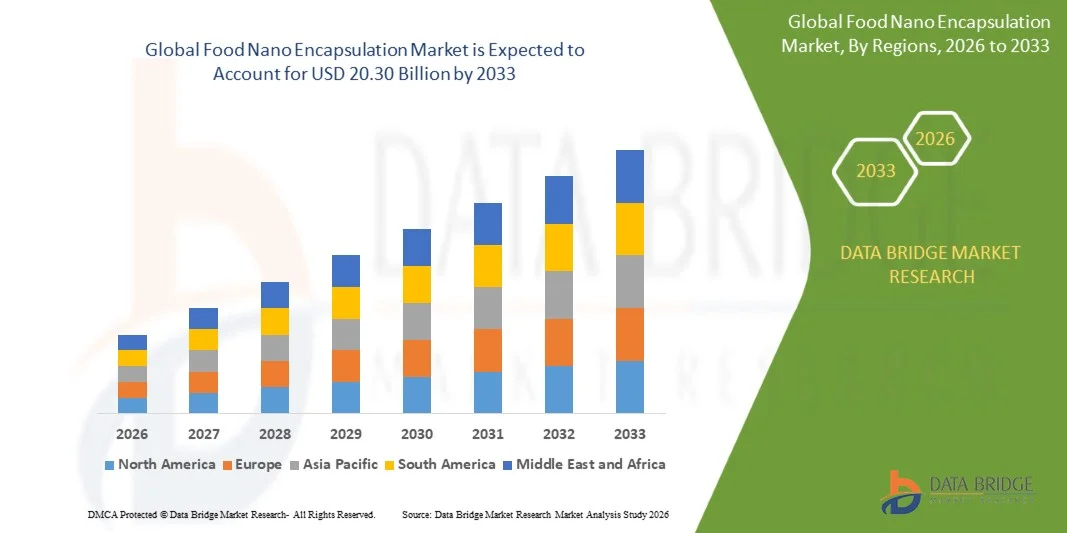
- De acordo com a análise da Data Bridge Market Research, o mercado de encapsulamento de nanoprodutos alimentares foi avaliado em10,73 mil milhões de dólares em 2025e é projetado para alcançar20,30 mil milhões de USD até 2033, crescendo emCAGR de 8,30% de 2026 a 2033.
- O mercado vive um crescimento consistente, impulsionado pela crescente demanda por alimentos funcionais e fortificados, pela crescente adoção de tecnologias avançadas de encapsulamento e pela crescente necessidade de melhorar a estabilidade, biodisponibilidade e fornecimento controlado de nutrientes e ingredientes bioativos.
- A crescente demanda por produtos alimentares ricos em nutracêuticos, aliada ao crescente interesse do consumidor pela nutrição funcional e pelo aumento da absorção de nutrientes, obriga os fabricantes de alimentos a adotarem tecnologias de nanoencapsulação. Nanoencapsulação ajuda a proteger ingredientes sensíveis, como vitaminas, probióticos, ácidos graxos ômega-3, sabores e antioxidantes da degradação, permitindo liberação controlada e melhoria da biodisponibilidade em aplicações de alimentos e bebidas.
Tamanho e previsão do mercado
- Valor de Mercado Global (2025): USD 10,73 Bilhões
- Valor de Mercado esperado (2033): USD 20,30 Bilhões
- Previsões CAGR (2026-2033): 8,30%
- Região líder em 2025: América do Norte
- Região de crescimento mais rápido: Ásia Pacífico
Quais são os principais takeaways do mercado de encapsulamento de Nano alimentos
- A América do Norte dominou o mercado de nanoencapsulação de alimentos com a maior parcela de receita de 34,1% em 2025, apoiada pela infraestrutura avançada de tecnologia alimentar, forte demanda por nutrição funcional e adoção estabelecida de tecnologias de encapsulação.
- Espera-se que a Ásia-Pacífico seja a região de crescimento mais rápido em um CAGR de 12,1% de 2026 a 2033, alimentada pela crescente demanda por alimentos funcionais e fortificados, aumentando a conscientização da saúde, expandindo o consumo de classe média e crescente adoção de tecnologias de nanoencapsulação
- O segmento de polissacarídeos liderou o mercado com uma participação de 39,92% em 2025, impulsionada por sua ampla funcionalidade, compatibilidade alimentar e uso extensivo na proteção de ingredientes bioativos sensíveis.
- As proteínas são o tipo de material de casca de crescimento mais rápido, projetado para registrar um CAGR de 12,63%, refletindo o aumento no interesse em materiais de encapsulamento naturalmente derivados e multifuncionais.
- O segmento de métodos físicos dominou a categoria tipo de método com 45% de receita em 2025, liderada por suas técnicas de processamento estabelecidas, escalabilidade e adequação para aplicações comerciais de alimentos.
- Os produtos alimentares funcionais representaram 42% da quota de mercado em 2025, preferindo-se o aumento da incorporação de ingredientes bioativos em produtos alimentares saudáveis.
- O segmento de suplementos alimentares é a categoria de aplicação de crescimento mais rápido, com um CAGR de 13,02%, impulsionado pelo aumento da demanda por sistemas avançados de entrega de vitaminas, minerais, probióticos, compostos botânicos e outros ingredientes bioativos
Relatar Escopo e Segmentação de Mercado de Encapsulamento de Nano
|
Atributos |
Encapsulamento de alimentos Nano Principais perspectivas do mercado |
|
Segmentos Cobertos |
|
|
Países abrangidos |
América do Norte
Europa
Ásia- Pacífico
Médio Oriente e África
América do Sul
|
|
Jogadores do mercado chave |
|
|
Oportunidades de Mercado |
|
|
Informações sobre o Valor Adicionado |
Além dos insights sobre cenários de mercado, como valor de mercado, taxa de crescimento, segmentação, cobertura geográfica e principais atores, os relatórios de mercado curados pela Data Bridge Market Research também incluem análise de especialistas em profundidade, análise de preços, análise de compartilhamento de marca, inquérito ao consumidor, análise demografia, análise da cadeia de suprimentos, análise da cadeia de valor, visão geral da matéria-prima/consumíveis, critérios de seleção de fornecedores, Análise de PESTLE, Análise de Porter e marco regulatório. |
Qual é a tendência chave no mercado de encapsulamento de Nano alimentos
- Os fabricantes e pesquisadores de alimentos estão adotando cada vez mais a nanoencapsulação para melhorar a estabilidade, solubilidade, biodisponibilidade e entrega controlada de nutracêuticos sensíveis e compostos bioativos em alimentos e bebidas funcionais.
- Por exemplo, em março de 2024, FoodNavigator relatou que a micro e nanoencapsulação estavam sendo exploradas para proteger as gorduras poliinsaturadas em óleo de semente de cânhamo da oxidação e para melhorar a entrega de aminoácidos essenciais, destacando o uso de tecnologias de encapsulação para melhorar a estabilidade e funcionalidade de ingredientes alimentares bioativos.
- Nanotransportadores avançados estão cada vez mais sendo projetados para proteger ingredientes bioativos contra o calor, oxidação, luz, umidade e degradação gastrointestinal, melhorando a absorção.
- Pesquisadores de tecnologia alimentar estão alavancando nanocarregadores à base de proteínas e lipídeos para desenvolver sistemas de entrega direcionados para ingredientes funcionais e aplicações nutracêuticos.
- Por exemplo, em novembro de 2024, FoodNavigator relatou crescente demanda por alimentos funcionais contendo botânicos, probióticos e outros ingredientes orientados para a saúde, com os fabricantes diversificando cada vez mais esses ingredientes em lanches, bebidas e outras categorias de alimentos. Esta tendência apoia a aplicação de tecnologias de entrega como a nanoencapsulação para melhorar a incorporação e o desempenho de ingredientes funcionais sensíveis em alimentos.
- À medida que os fabricantes de alimentos priorizam cada vez mais a nutrição funcional, a estabilidade dos ingredientes e a maior biodisponibilidade, espera-se que a nanoencapsulação se torne uma tecnologia cada vez mais importante para o desenvolvimento de alimentos funcionais, bebidas e produtos nutracêuticos de próxima geração.
Quais são os Principais Drivers do Mercado de Encapsulamento de Nano Alimentos
- A crescente demanda por alimentos funcionais, nutracêuticos e bebidas fortificadas tem aumentado significativamente a demanda por tecnologias de nanoencapsulação capazes de melhorar a biodisponibilidade e proteger ingredientes bioativos sensíveis durante o processamento e digestão.
- Por exemplo, em fevereiro de 2025, um estudo sobre Química Alimentar destacou que muitos compostos bioativos derivados de alimentos têm solubilidade e biodisponibilidade limitadas, enquanto as tecnologias de nanoencapsulação e nanoemulsão podem melhorar sua estabilidade, absorção e entrega. Esta crescente necessidade de tornar os ingredientes nutracêuticos e funcionais mais biodisponível está impulsionando a adoção de nanoencapsulação em aplicações alimentares.
- Fabricantes de alimentos, fornecedores de ingredientes e pesquisadores estão integrando tecnologias nanocarregadoras no desenvolvimento de produtos para melhorar a estabilidade dos ingredientes, ampliar o desempenho funcional, permitir liberação controlada e melhorar a eficácia nutricional.
- Por exemplo, em janeiro de 2026, uma revisão Frontiers in Nutrition relatou que a nanoencapsulação pode proteger nutracêuticos sensíveis dos extremos de luz, calor, oxidação e pH, melhorando a solubilidade, liberação controlada e biodisponibilidade oral. O estudo também identificou aplicações em bebidas funcionais, laticínios, suplementos dietéticos e outros produtos alimentares, suportando a demanda por sistemas de entrega nanoproibidos.
- Com os consumidores buscando cada vez mais alimentos oferecendo benefícios nutricionais mensuráveis e os fabricantes exigindo ingredientes funcionais mais estáveis e biodisponível, a nanoencapsulação de alimentos continuará a ser importante para o avanço de alimentos fortificados, bebidas funcionais, suplementos alimentares e aplicações nutricionais de precisão
Que fatores estão desafiando o crescimento do mercado de encapsulamento de Nano
- A nanoencapsulação de alimentos requer rigorosa segurança, toxicologia, caracterização e avaliação regulatória, pois os materiais em escala nanoscópica podem apresentar diferentes propriedades biológicas e físico-químicas de ingredientes alimentares convencionais.
- Por exemplo, em Agosto de 2025, a Autoridade Europeia para a Segurança dos Alimentos (AESA) realizou um seminário sobre a avaliação dos riscos de nanomateriais e de pequenas/nanopartículas na cadeia alimentar humana e animal, assinalando os desafios da implementação das orientações existentes e a necessidade de uma maior harmonização entre os quadros científicos e regulamentares. Tal complexidade regulatória pode aumentar o tempo e o custo necessários para comercializar ingredientes alimentares nanoencapsulados
- Estes requisitos regulamentares e harmonização limitada em todos os países podem aumentar a complexidade do desenvolvimento e retardar a comercialização de ingredientes e produtos alimentares nano-abilitados.
- Por exemplo, em outubro de 2024, pesquisas publicadas no Appetite examinaram as atitudes dos consumidores norte-americanos em relação à nanotecnologia no processamento de alimentos e enfatizaram que entender a aceitação dos consumidores é importante para a adoção de nanotecnologias alimentares e o desenvolvimento de quadros regulatórios adequados. As preocupações com o uso da nanotecnologia em alimentos podem, portanto, criar uma barreira adicional à comercialização mais ampla de tecnologias de nanoencapsulação.
- A necessidade de fabricação escalável, características consistentes de partículas, validação de segurança, conformidade regulatória e aceitação do consumidor continua a aumentar a complexidade do desenvolvimento, potencialmente limitando a comercialização apesar do forte interesse em aplicações de alimentos nano-enabled.
Como é o alimento Nano Encapsulamento Mercado Segmentado
O mercado de nanoencapsulação de alimentos é segmentado com base em material de casca, método, aplicação e fase principal
- Por Material de Concha
Com base no material de casca, o mercado de encapsulamento de nanoalimentos é segmentado em polissacarídeos, emulsionantes, lipídios e proteínas. O segmento de polissacarídeos dominou o mercado com 39,92% de participação em 2025, devido à sua ampla funcionalidade, compatibilidade alimentar e uso extensivo na proteção de ingredientes bioativos sensíveis. Polissacarídeos como derivados de amido, alginato, pectina e outros hidrocoloides podem formar barreiras protetoras em torno de compostos sensíveis. Estes materiais ajudam a melhorar a estabilidade de vitaminas, probióticos, sabores e outros ingredientes funcionais durante o processamento e armazenamento. As suas propriedades formadoras e emulsionantes tornam-nas adequadas para uma ampla gama de formulações alimentares. A crescente procura de materiais de encapsulamento de origem natural e de rótulo limpo apoia ainda mais a sua utilização.
O segmento de proteínas é projetado para registrar o crescimento mais rápido em um CAGR de 12,63% de 2026 a 2033, impulsionado pelo crescente interesse em materiais de encapsulamento naturalmente derivados e multifuncionais. As proteínas podem fornecer emulsificação, formação de filmes, ligação e características de libertação controlada para ingredientes encapsulados. Eles estão sendo cada vez mais investigados para proteger probióticos, vitaminas, lipídios, sabores e outros compostos sensíveis. Avanços na modificação de proteínas estão melhorando a solubilidade e a eficiência de encapsulamento. As proteínas à base de plantas também estão ganhando atenção quando os fabricantes buscam materiais encapsuladores de qualidade alimentar alternativos. A compatibilidade de proteínas com formulações alimentares funcionais e de rótulo limpo está a apoiar ainda mais a sua adopção.
- Por Método
Com base no método, o mercado de encapsulamento de nanoprodutos alimentares é segmentado em métodos físicos, químicos e físico-químicos. O segmento de métodos físicos dominou o mercado com 45% de participação em 2025, apoiado pelas técnicas de processamento estabelecidas, escalabilidade e adequação para aplicações de alimentos comerciais. Os métodos físicos podem proteger ingredientes alimentares sensíveis sem exigir uma modificação química extensa. As técnicas desta categoria podem ser incorporadas nas operações de transformação de alimentos existentes. São amplamente aplicáveis a vitaminas, minerais, sabores, probióticos, enzimas e lipídios nutricionais. Suas características de processamento relativamente simples suportam a adoção entre fabricantes de alimentos e ingredientes.
O segmento de métodos físico-químicos é projetado para registrar o crescimento mais rápido em um CAGR aproximado de 9,0% de 2026 a 2033, impulsionado pelo aumento da demanda por melhor eficiência de encapsulamento e entrega controlada de ingredientes sensíveis. As abordagens físico-químicas podem fornecer maior controle sobre as características das partículas e o comportamento de liberação. Estes métodos são particularmente relevantes para nutracêuticos, probióticos, vitaminas, sabores e lipídios nutricionais. Avanços em nanoemulsões, sistemas lipossomais e outras tecnologias de entrega estruturadas estão expandindo seu potencial de aplicação. Os fabricantes estão cada vez mais buscando sistemas capazes de melhorar a estabilidade dos ingredientes, mantendo a funcionalidade em matrizes alimentares complexas. O crescente interesse em sistemas avançados de entrega está, portanto, apoiando a adoção de métodos físico-químicos.
- Por Aplicação
Com base na aplicação, o mercado de nanoencapsulação de alimentos é segmentado em suplementos alimentares, produtos alimentares funcionais, produtos de padaria, confeitaria, bebidas, produtos congelados e produtos lácteos. O segmento de produtos alimentares funcionais dominou o mercado com 42% de participação em 2025, apoiado pelo aumento da incorporação de ingredientes bioativos em produtos alimentares orientados para a saúde. Nanoencapsulação ajuda a proteger nutrientes sensíveis e ingredientes funcionais contra oxidação, calor, umidade e outras tensões de processamento. Pode também suportar melhor biodisponibilidade e liberação controlada de compostos selecionados. Os fabricantes funcionais de alimentos estão cada vez mais incorporando vitaminas, probióticos, antioxidantes, sabores e lipídios nutricionais em formulações alimentares. A tecnologia pode melhorar a estabilidade e funcionalidade desses ingredientes durante todo o processamento e armazenamento.
O segmento de suplementos alimentares é projetado para registrar o crescimento mais rápido em um CAGR de 13,02% de 2026 a 2033, impulsionado pelo aumento da demanda por sistemas avançados de entrega de vitaminas, minerais, probióticos, compostos botânicos e outros ingredientes bioativos. Nanoencapsulação pode melhorar a estabilidade e dispersão de nutrientes sensíveis em formulações de suplemento. Ele também pode suportar liberação controlada e melhorar as características de entrega de ingredientes mal solúveis. Os fabricantes estão cada vez mais focados em formulações convenientes com múltiplos ingredientes funcionais. O crescente interesse do consumidor em nutrição preventiva e suplementação direcionada está apoiando a demanda por tecnologias avançadas de encapsulamento. Sistemas de entrega habilitados para Nano também podem ajudar a enfrentar desafios associados ao gosto, estabilidade e degradação de ingredientes.
- Por Fase Principal
Com base na fase central, o mercado de nanoencapsulação de alimentos é segmentado em vitaminas e minerais, vitamina A, vitamina D, vitamina E, vitamina K, complexo de vitamina B, vitamina C, enzimas, ácidos orgânicos, probióticos, adoçantes, lipídios nutricionais, prebióticos, conservantes, cores, aminoácidos, proteínas, sabores, entre outros. O segmento de vitaminas e minerais dominou o mercado com 27,45% de participação em 2025, devido à ampla utilização do encapsulamento para proteger nutrientes sensíveis da degradação durante o processamento e armazenamento de alimentos. As vitaminas podem ser afetadas pelo calor, oxigênio, luz, umidade e outras condições ambientais. A nanoencapsulação proporciona um ambiente protetor que pode melhorar sua estabilidade e entrega. As vitaminas encapsuladas também podem ser incorporadas em alimentos funcionais, bebidas e suplementos alimentares. A crescente demanda por produtos alimentares fortificados está apoiando a incorporação de micronutrientes protegidos.
O segmento de probióticos é projetado para registrar o crescimento mais rápido em um CAGR de 11,66% de 2026 a 2033, impulsionado pela crescente demanda por produtos de apoio à saúde digestiva e microbioma. Os microrganismos probióticos são sensíveis ao calor, oxigênio, umidade e condições ácidas, criando uma forte exigência para sistemas de liberação protetora. A nanoencapsulação pode proporcionar um ambiente protetor que ajuda a manter a estabilidade probiótica durante o processamento e armazenamento. Pode também facilitar a libertação controlada de probióticos em condições gastrintestinais apropriadas. Aumentar a incorporação de probióticos em alimentos funcionais, bebidas, produtos lácteos e suplementos alimentares está expandindo sua base de aplicação. Avanços em materiais de encapsulamento e tecnologias de entrega estão melhorando a viabilidade e funcionalidade de ingredientes probióticos.
Que região detém a maior parte do mercado de encapsulamento de Nano alimentos
- A América do Norte dominou o mercado de nanoencapsulação de alimentos com a maior parcela de receita de 34,1% em 2025, apoiada pela infraestrutura avançada de tecnologia alimentar, forte demanda por nutrição funcional e adoção estabelecida de tecnologias de encapsulação.
- A região também se beneficia de uma indústria bem estabelecida de processamento de alimentos, adoção forte de produtos alimentares fortificados e funcionais, e de quadros regulatórios que apoiam a inovação alimentar-ingrediente. Aumento da demanda por estabilidade, biodisponibilidade, liberação controlada e proteção de nutrientes sensíveis, como vitaminas, probióticos e lipídios nutricionais, continua a fortalecer a posição de liderança da América do Norte no mercado global
U.S. Food Nano Encapsulation Market Insight
O mercado de encapsulamento de alimentos dos EUA está testemunhando um forte crescimento devido à crescente demanda por alimentos funcionais, suplementos alimentares e sistemas avançados de entrega de ingredientes nutricionais sensíveis. A indústria de processamento de alimentos madura do país, juntamente com a adoção crescente de tecnologias nanoproibidas para melhorar a estabilidade dos ingredientes, biodisponibilidade e liberação controlada, está impulsionando a demanda em aplicações de alimentação e nutrição. Além disso, o crescente interesse do consumidor em alimentos fortificados, probióticos, vitaminas e outros ingredientes orientados para a saúde está acelerando a adoção de tecnologias de encapsulamento de nanoalimentos.
Visão do mercado de encapsulamento de Nano na Ásia-Pacífico
Espera-se que o mercado de nanocapsulação de alimentos Ásia-Pacífico testemunhe um rápido crescimento, impulsionado pelo aumento da demanda por alimentos funcionais, pela expansão das indústrias de processamento de alimentos e pela crescente conscientização dos consumidores sobre produtos nutricionais e orientados para a saúde em países como China, Índia e Japão. A crescente adoção de tecnologias alimentares avançadas, o aumento do consumo de suplementos alimentares e a demanda por ingredientes funcionais estáveis e biodisponível estão apoiando a expansão regional do mercado. Além disso, a crescente presença dos fabricantes de ingredientes alimentares e o aumento dos investimentos em produtos nutricionais inovadores estão acelerando a adoção de nanoencapsulação em toda a região.
Japan Food Nano Encapsulation Market Insight
O mercado japonês de encapsulamento de alimentos está testemunhando um crescimento consistente devido ao aumento dos investimentos em alimentos funcionais, inovação nutracêutica e tecnologias avançadas de processamento de alimentos. Fabricantes de alimentos e empresas de ingredientes estão cada vez mais adotando sistemas de encapsulamento para melhorar a estabilidade, entrega e funcionalidade de vitaminas, probióticos, lipídios nutricionais e outros ingredientes bioativos. Além disso, o aumento da procura de alimentos centrados na saúde e a ênfase do país nas soluções nutricionais avançadas contribuem ainda mais para o crescimento do mercado.
China Food Nano Encapsulation Market Insight
O mercado de encapsulamento de alimentos da China está crescendo rapidamente, impulsionado pela expansão das indústrias de processamento de alimentos, aumento da demanda por alimentos funcionais e aumento do interesse do consumidor em produtos nutricionais e orientados para a saúde. A adoção crescente de tecnologias avançadas de encapsulamento para vitaminas, probióticos, sabores e lipídios nutricionais em aplicações de alimentos e suplementos dietéticos está aumentando significativamente a demanda do mercado. Além disso, o aumento dos investimentos em tecnologia alimentar, o aumento da demanda por produtos fortificados e o rápido desenvolvimento de sistemas inovadores de entrega de ingredientes estão posicionando a China como um dos mercados de crescimento mais rápido para encapsulamento de nanoalimentares globalmente.
U.K. Food Nano Encapsulation Market Insight
O mercado de encapsulamento de alimentos do Reino Unido está experimentando crescimento constante, apoiado pela adoção crescente de tecnologias avançadas de entrega de ingredientes em alimentos funcionais, suplementos alimentares e bebidas. O aumento dos investimentos em tecnologia alimentar e a crescente demanda por ingredientes nutricionais estáveis, biodisponível e de liberação controlada contribuem para o crescimento do mercado. Além disso, a integração de sistemas de entrega nanoproibidos com formulações alimentares inovadoras está melhorando a funcionalidade e estabilidade de ingredientes sensíveis, posicionando o Reino Unido como um mercado chave para o encapsulamento de nanoalimentares.
Alemanha Alimentação Nano Encapsulamento Mercado Insight
O mercado de encapsulamento de alimentos da Alemanha está se expandindo constantemente devido à forte base de processamento de alimentos do país, capacidades avançadas de pesquisa e crescente adoção de tecnologias de entrega de ingredientes da próxima geração. Fabricantes de alimentos, produtores de ingredientes e organizações de pesquisa estão cada vez mais utilizando nanoencapsulação para melhorar a estabilidade e entrega de vitaminas, probióticos, sabores e lipídios nutricionais. Avanços contínuos na nanotecnologia de alimentos, desenvolvimento funcional de ingredientes e técnicas de encapsulamento, juntamente com forte ênfase na inovação de alimentos e qualidade do produto, estão impulsionando o crescimento do mercado na Alemanha.
Quais são as Principais Empresas no Mercado de Encapsulamento de Nano Alimentos
A indústria de nanoencapsulação de alimentos é liderada principalmente por empresas bem estabelecidas, incluindo:
- Flavores e Fragrâncias Internacionais, Inc.. (EUA)
- Grupo Kerry plc(Irlanda)
- Ingredião Incorporado(EUA)
- dsm-firmenich(Suíça)
- Givaudan SA(Suíça)
- BASF SE (Alemanha)
- Tate & Lyle PLC (U.K.)
- Balchem Corporation (EUA)
- Cargill, Incorporated (EUA)
- Sensient Technologies Corporation (EUA)
- Lonza Group Ltd. (Suíça)
- TasteTech Limited (UK)
- AQUANOVA AG (Alemanha)
- Blue California, Inc. (EUA)
- Nulixir Inc. (EUA)
- NUCAPS Nanotecnologia S.L. (Espanha)
- PHS Ciências da Vida (EUA)
- Policápsulas (Alemanha)
- Grupo AVEKA (EUA)
- TAGRA Biotechnologies Ltd. (Israel)
Quais são as últimas evoluções no mercado de encapsulamento de Nano Alimentos
- Em fevereiro de 2025, pesquisadores publicaram um estudo em Food Research International revisando recentes avanços na encapsulamento carotenóide, incluindo abordagens de nanoencapsulação projetadas para melhorar a estabilidade, bioacessibilidade e funcionalidade de carotenoides em aplicações alimentares. A pesquisa destacou como sistemas avançados de encapsulamento podem proteger carotenoides sensíveis da degradação e apoiar sua incorporação em produtos alimentares funcionais. Este desenvolvimento reflete a inovação contínua em sistemas de entrega nanoproibidos para bioativos alimentares.
- Em novembro de 2024, pesquisadores da Universidade Federal da Bahia publicaram uma revisão de acesso aberto na ACS Food Science & Technology examinando micro e nanoencapsulação de probióticos para alimentos de origem animal. O estudo avaliou as aplicações de encapsulamento em laticínios e produtos à base de carne e avaliou como os métodos de encapsulamento e materiais de parede afetam a proteção probiótica, viabilidade e características do produto alimentício. O trabalho destaca o desenvolvimento contínuo da nanoencapsulação para alimentos probióticos funcionais.
- Em dezembro de 2022, pesquisadores da Universidade de São Paulo desenvolveram nanoemulsões de vitamina D3 com uso do método de ponto de inversão de emulsão para enriquecimento de iogurte de coco. O estudo demonstrou a incorporação da vitamina D3 nanoencapsulada em uma matriz alimentar e avaliou sua retenção, estabilidade e aceitação sensorial, fornecendo um exemplo direto de desenvolvimento da nanoencapsulação para alimentos funcionais fortificados.
- Em setembro de 2022, pesquisadores publicaram um estudo em Bioresource Technology Reports, analisando avanços na nanoencapsulação de constituintes bioativos de alimentos usando nanoemulsões, nanolipossomos, nanopartículas de lipídios sólidos, nanocarregadores biopoliméricos e nanocápsulas de inspiração natural. A pesquisa destacou sua aplicação na proteção e entrega de nutrientes, nutracêuticos e outros bioativos alimentares, apoiando o desenvolvimento de formulações alimentares avançadas e capacitadas.
- Em março de 2021, pesquisadores publicaram um estudo em Moléculas sobre nanoencapsulação de compostos bioativos promissores para melhorar sua absorção, estabilidade, funcionalidade e incorporação em produtos alimentares finais. A pesquisa analisou nanocarregadores à base de carboidratos, proteínas e lipídeos e sua capacidade de proteger compostos bioativos e controlar sua liberação, demonstrando o desenvolvimento contínuo de tecnologias de nanoencapsulação para aplicações alimentares e nutracêuticos.
SKU-
Obtenha acesso online ao relatório sobre a primeira nuvem de inteligência de mercado do mundo

- Painel interativo de análise de dados
- Painel de análise da empresa para oportunidades de elevado potencial de crescimento
- Acesso de analista de pesquisa para personalização e customização. consultas
- Análise da concorrência com painel interativo
- Últimas notícias, atualizações e atualizações Análise de tendências
- Aproveite o poder da análise de benchmark para um rastreio abrangente da concorrência
Metodologia de Investigação
A recolha de dados e a análise do ano base são feitas através de módulos de recolha de dados com amostras grandes. A etapa inclui a obtenção de informações de mercado ou dados relacionados através de diversas fontes e estratégias. Inclui examinar e planear antecipadamente todos os dados adquiridos no passado. Da mesma forma, envolve o exame de inconsistências de informação observadas em diferentes fontes de informação. Os dados de mercado são analisados e estimados utilizando modelos estatísticos e coerentes de mercado. Além disso, a análise da quota de mercado e a análise das principais tendências são os principais fatores de sucesso no relatório de mercado. Para saber mais, solicite uma chamada de analista ou abra a sua consulta.
A principal metodologia de investigação utilizada pela equipa de investigação do DBMR é a triangulação de dados que envolve a mineração de dados, a análise do impacto das variáveis de dados no mercado e a validação primária (especialista do setor). Os modelos de dados incluem grelha de posicionamento de fornecedores, análise da linha de tempo do mercado, visão geral e guia de mercado, grelha de posicionamento da empresa, análise de patentes, análise de preços, análise da quota de mercado da empresa, normas de medição, análise global versus regional e de participação dos fornecedores. Para saber mais sobre a metodologia de investigação, faça uma consulta para falar com os nossos especialistas do setor.
Personalização disponível
A Data Bridge Market Research é líder em investigação formativa avançada. Orgulhamo-nos de servir os nossos clientes novos e existentes com dados e análises que correspondem e atendem aos seus objetivos. O relatório pode ser personalizado para incluir análise de tendências de preços de marcas-alvo, compreensão do mercado para países adicionais (solicite a lista de países), dados de resultados de ensaios clínicos, revisão de literatura, mercado remodelado e análise de base de produtos . A análise de mercado dos concorrentes-alvo pode ser analisada desde análises baseadas em tecnologia até estratégias de carteira de mercado. Podemos adicionar quantos concorrentes necessitar de dados no formato e estilo de dados que procura. A nossa equipa de analistas também pode fornecer dados em tabelas dinâmicas de ficheiros Excel em bruto (livro de factos) ou pode ajudá-lo a criar apresentações a partir dos conjuntos de dados disponíveis no relatório.











