



Segmentação de Mercado de Sistemas de Estabilização de Alimentos Globais, Por Tipo (Pectina, Gelatina, Carrageenan, Xanthan Gum, Guar Gum, Outros), Função (Estabilização, Texturização, Gelagem, Espessura, Retenção de Humidade), Aplicação (Produtos de Bakery, Sobremesas Dairy & Congelados, Bebidas, Confeitaria, Molhos & Vestidos, Alimentos Conveniência, Carne & Aves), Fonte (Plant-based, Seaweed-based, Microbial, Animal-based, Synthetic) – Tendências e Previsão da Indústria para 2033
Sistemas de estabilização de alimentosTamanho do Mercado
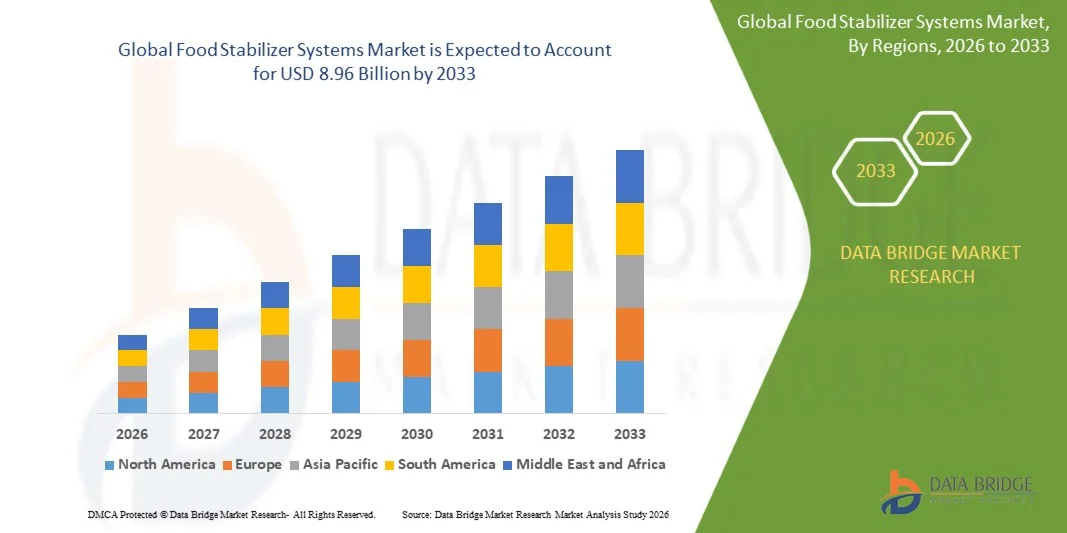
- O mercado global de Sistemas de Estabilização de Alimentos foi avaliado em4,92 mil milhões de dólares em 2025e espera-se alcançarUSD 8,96 mil milhões até 2033, emCAGR de 7,8%durante o período de previsão
- A expansão do mercado está a ser alimentada pelo aumento do consumo de alimentos transformados e de conveniência, especialmente nas regiões urbanas, juntamente com o aumento da preferência dos consumidores por rótulos limpos e ingredientes naturalmente derivados. Além disso, a necessidade de melhoria da textura, consistência e prazo de validade prolongado em padaria, laticínios e produtos prontos para comer está incentivando os fabricantes a adotar sistemas avançados de estabilizadores em mercados desenvolvidos e emergentes
- Além disso, a inovação contínua em misturas hidrocolóides, o crescente uso de estabilizadores à base de plantas e algas e a expansão de aplicações em alimentos funcionais e fortificados estão fortalecendo o papel dos sistemas estabilizadores de alimentos em formulações modernas. O aumento do foco na qualidade dos produtos, a conformidade regulamentar para a segurança alimentar e a evolução das tendências alimentares apoiam coletivamente o crescimento sustentado do mercado globalmente
Sistemas de estabilização de alimentosAnálise de mercado
- Sistemas de estabilização de alimentos, que melhoram a textura, consistência, emulsificação e estabilidade de prateleira dos produtos alimentares, são cada vez mais integrais ao processamento moderno de alimentos em todos os segmentos de padaria, laticínios, bebidas e pronto para comer, devido à sua capacidade de manter a qualidade do produto, melhorar a sensação de boca e apoiar a eficiência da formulação em diferentes condições de processamento
- A crescente demanda por Sistemas de Estabilização de Alimentos é amplamente influenciada pelo aumento do consumo de alimentos de conveniência, aumento da inclinação para ingredientes de marca limpa e derivados de plantas, e evolução das preferências alimentares, juntamente com o foco dos fabricantes em melhorar a vida de prateleira do produto, atributos sensoriais e aceitação global do consumidor
- A América do Norte foi responsável pela maior participação do mercado de Sistemas de Estabilização de Alimentos em 36,58% em 2025, apoiada por uma indústria de alimentos processados bem estabelecida, alta demanda por ingredientes funcionais e forte presença de principais fabricantes de alimentos, com os Estados Unidos desempenhando um papel central na inovação e consumo
- Asia-Pacific é projetado para testemunhar o crescimento mais rápido no mercado de Sistemas de Estabilização de Alimentos durante o período de previsão, impulsionado pela urbanização rápida, expansão da população de classe média, e aumento da demanda por alimentos embalados e de conveniência, particularmente em países como China, Índia, e economias do Sudeste Asiático
- O segmento de sobremesas leiteiras e congeladas liderou o mercado de Food Stabilizer Systems com uma participação de 31,47% em 2025, atribuída ao uso extensivo de estabilizadores em produtos como sorvete, iogurte e leite aromatizado para melhorar a textura, prevenir a separação de fases e aumentar a estabilidade do produto durante o armazenamento e distribuição
Âmbito do relatório eSistemas de estabilização de alimentosSegmentação do mercado
|
Atributos |
Sistemas de estabilização de alimentosChavePerspectivas de mercado |
|
Segmentos Cobertos |
|
|
Países abrangidos |
América do Norte · U.S. · Canadá · México Europa · Alemanha · França · U.K. · Países Baixos · Suíça · Bélgica · Rússia · Itália · Espanha · Turquia · Resto da Europa Ásia- Pacífico · China · Japão · Índia · Coreia do Sul · Singapura · Malásia · Austrália · Tailândia · Indonésia · Filipinas · Resto da Ásia-Pacífico Médio Oriente e África · Arábia Saudita · U.A.E. · África do Sul · Egito · Israel · Resto do Oriente Médio e África América do Sul · Brasil · Argentina · Resto da América do Sul |
|
Jogadores do mercado chave |
· BASF SE (Alemanha) · Dow Inc. (EUA) · Evonik Industries AG (Alemanha) · Arkema S.A. (França) · Clariant AG (Suíça) · LANXESS AG (Alemanha) · Solvay S.A. (Bélgica) · LyondellBasell Industries N.V. (Países Baixos) · Avient Corporation (EUA) · Croda International Plc (U.K.) · ADEKA Corporation (Japão) · Songwon Industrial Co. Ltd. (Coreia do Sul) · Nouryon (Países Baixos) · Emery Oleochemicals (Malásia) · Cargill Incorporated (EUA) · Corbion N.V. (Países Baixos) · NatureWorks LLC (EUA) · Braskem S.A. (Brasil) · Novamont S.p.A. (Itália) · Palsgaard A/S (Dinamarca) |
|
Oportunidades de Mercado |
· Aumentar o consumo de alimentos processados e prontos para consumo está impulsionando a demanda por Sistemas de Estabilização de Alimentos · Aumentar a demanda de alimentos de conveniência está aumentando o uso de estabilizadores para melhor textura e vida útil |
|
Informações sobre o Valor Adicionado |
Além dos insights sobre cenários de mercado, como valor de mercado, taxa de crescimento, segmentação, cobertura geográfica e principais atores, os relatórios de mercado curados pela Data Bridge Market Research também incluem análise de especialistas em profundidade, análise de preços, análise de compartilhamento de marca, inquérito ao consumidor, análise demografia, análise da cadeia de suprimentos, análise da cadeia de valor, visão geral da matéria-prima/consumíveis, critérios de seleção de fornecedores, Análise de PESTLE, Análise de Porter e marco regulatório. |
Sistemas de Estabilização de Alimentos Tendências do Mercado
“Preferência crescente para ingredientes alimentares de limpeza, funcionalidade e desempenho”
- Uma tendência chave e em rápida evolução no mercado global de Sistemas de Estabilização de Alimentos é a mudança crescente para soluções de ingredientes com rótulo limpo, multifuncional e com desempenho que melhoram a qualidade dos alimentos, ao mesmo tempo que se alinham com a demanda do consumidor por formulações naturais e transparentes em várias categorias de alimentos
- Por exemplo, empresas como Cargill e DuPont estão ativamente expandindo seus portfólios de hidrocoloides à base de plantas e misturas estabilizantes sob medida projetadas para melhorar a textura, estabilidade e vida útil em aplicações de laticínios, padaria e bebidas
- Avanços na ciência de alimentos e tecnologia de ingredientes estão permitindo o desenvolvimento de sistemas estabilizadores personalizados com propriedades de controle de emulsificação, ligação à água e viscosidade melhoradas, ajudando os fabricantes a manter a consistência do produto enquanto atendem aos padrões de rótulo limpo
- O crescente consumo de alimentos funcionais e fortificados está impulsionando a demanda por sistemas estabilizadores que apoiem a entrega de nutrientes, mantenham a integridade do produto e melhorem os atributos sensoriais nos segmentos de produtos focados na saúde
- Esta transição para ingredientes naturais de alto desempenho está reformulando as expectativas da indústria em torno da eficiência da formulação, transparência de ingredientes e conformidade regulatória em todos os mercados mundiais de alimentos e bebidas
- A procura de estabilizadores derivados de plantas e minimamente processados, com maior funcionalidade, está a aumentar de forma constante nas economias desenvolvidas e emergentes, apoiada pela crescente sensibilização para a saúde e pela evolução das preferências alimentares
- A adoção crescente de práticas sustentáveis de abastecimento e de matérias-primas naturais, como extratos de algas, gomas vegetais e ingredientes derivados da fermentação, está ganhando ímpeto, pois os fabricantes visam melhorar a sustentabilidade da cadeia de suprimentos e reduzir o impacto ambiental na indústria alimentar.
Sistemas de Estabilização de Alimentos Dinâmica de Mercado
Controlador
“Growing Demand for Processed Foods and Functional Ingredient Optimization”
- O crescente consumo de produtos alimentares processados, de conveniência e prontos para comer, apoiado por mudanças de estilo de vida e urbanização, é um fator fundamental para o crescimento do mercado mundial de Sistemas de Estabilização Alimentar
- Por exemplo, organismos reguladores como a Autoridade para a Segurança dos Alimentos e Normas da Índia e a Autoridade Europeia para a Segurança dos Alimentos enfatizam a utilização de aditivos alimentares seguros e aprovados para garantir a estabilidade, consistência e segurança dos produtos
- Como os fabricantes de alimentos focam no aumento da textura, vida útil e uniformidade do produto, os sistemas estabilizadores oferecem benefícios funcionais críticos, incluindo emulsificação, espessamento e retenção de umidade em diversas aplicações
- Além disso, a crescente procura de produtos alimentares à base de plantas e de rótulos limpos encoraja a adopção de estabilizadores naturais provenientes de fontes como algas, gomas vegetais e processos de fermentação
- A capacidade desses sistemas de melhorar a qualidade do produto, mantendo a eficiência da formulação e compatibilidade de processamento, está apoiando seu uso generalizado nas indústrias de padaria, laticínios e bebidas
- O rápido crescimento do setor de processamento de alimentos nas economias emergentes, juntamente com o aumento dos investimentos em inovação de produtos, está acelerando ainda mais a expansão do mercado. Iniciativas governamentais de apoio à segurança alimentar, padrões de qualidade e consumo de alimentos embalados contribuem para o aumento da adoção de sistemas avançados de ingredientes
Restrição/Desafio
“Sensitividade de preço e restrições funcionais em aplicações alimentares complexas”
- Os custos de formulação mais elevados associados a misturas de estabilizadores especializados e ingredientes de rótulo limpo continuam a ser um desafio fundamental, especialmente para os fabricantes que operam em mercados sensíveis aos custos
- Por exemplo, o fornecimento de hidrocolóides naturais de alta qualidade e gomas à base de plantas pode envolver complexidades da cadeia de abastecimento e flutuações de preços, especialmente devido à disponibilidade sazonal e dependência das produções agrícolas
- Enquanto a demanda por ingredientes naturais está aumentando, manter o desempenho consistente em diferentes condições de processamento, como alta temperatura, variação de pH e armazenamento prolongado pode ser desafiador em certas aplicações de alimentos
- Enfrentar essas limitações através da otimização da formulação, mistura de ingredientes e inovação tecnológica é essencial para melhorar a eficiência de custo e desempenho do produto. A disponibilidade limitada de determinadas matérias-primas, como a carragenina e a goma de guar, juntamente com a volatilidade na oferta global, pode ter impacto na estabilidade da produção e nas estratégias de preços
- O cumprimento de normas rigorosas de segurança alimentar e os requisitos de rotulagem em todas as regiões podem aumentar a complexidade operacional e estender os prazos de desenvolvimento dos produtos. Investimentos contínuos em I&D e avanços na funcionalidade de ingredientes serão cruciais para superar essas barreiras e apoiar o crescimento do mercado a longo prazo
Sistemas de Estabilização de Alimentos Âmbito de mercado
O mercado é segmentado com base no tipo , função , aplicação e fonte .
- Por Tipo
Com base no tipo, o mercado global de Sistemas de Estabilização de Alimentos é segmentado em pectina, gelatina, carragenina, goma xantana, goma guar, entre outros. O segmento carrageniano teve a maior parcela de receita de 27,64% em 2025, apoiada pela sua ampla utilização em produtos lácteos e processados para melhorar a textura, suspensão e estabilidade. A sua forte compatibilidade com proteínas do leite e eficácia em baixas concentrações tornam-no uma escolha preferencial entre os fabricantes. O aumento da procura de ingredientes derivados de plantas e algas está a reforçar ainda mais a sua adopção em várias aplicações alimentares.
O segmento de goma xantana é esperado para registrar o crescimento mais rápido ao longo do período de previsão, impulsionado pela sua eficiência de espessamento superior, estabilidade em uma ampla faixa de pH, e crescente uso em formulações de alimentos sem glúten e conveniência. A inovação contínua na produção baseada na fermentação também está aumentando a confiabilidade da oferta e o desempenho funcional.
- Por função
Com base na função, o mercado é categorizado em estabilização, texturização, gelificação, espessamento e retenção de umidade. O segmento texturizador representou a maior parcela de 31,82% em 2025, devido ao seu papel crítico no aumento da sensação bucal, consistência e apelo sensorial geral dos produtos alimentares. Aumentar a demanda por alimentos processados de qualidade superior e melhorar a experiência alimentar está impulsionando o domínio do segmento em aplicações de padaria e laticínios.
O segmento estabilizador é projetado para testemunhar o crescimento mais rápido, apoiado pela crescente necessidade de manter a uniformidade do produto, prevenir a separação de fases e prolongar a vida útil em bebidas e alimentos prontos para consumo. Avanços em sistemas de ingredientes multifuncionais estão aumentando ainda mais a expansão do segmento.
- Por Aplicação
Com base na aplicação, o mercado é segmentado em produtos de padaria, laticínios e sobremesas congeladas, bebidas, confeitaria, molhos e molhos, alimentos de conveniência e carne e aves. O segmento de sobremesas leiteiras e congeladas dominou o mercado com uma parcela de 32,47% em 2025, atribuída ao alto uso de sistemas estabilizadores em sorvete, iogurte e leite aromatizado para controlar a cristalização, melhorar a textura e aumentar a estabilidade de armazenamento. O aumento do consumo mundial de produtos lácteos continua a apoiar o crescimento dos segmentos.
Espera-se que o segmento de alimentos de conveniência cresça ao ritmo mais rápido, impulsionado pelo aumento da demanda por refeições prontas, mixagens instantâneas e alimentos embalados, particularmente nos mercados urbanos. Os estabilizadores desempenham um papel fundamental na manutenção da qualidade do produto durante o processamento e armazenamento, acelerando sua adoção.
- Por Fonte
Com base na fonte, o mercado é dividido em plantas, algas marinhas, microbianas, animais e sintéticos. O segmento de base vegetal liderou o mercado com uma parte de 42,19% em 2025, apoiada pela forte preferência do consumidor por ingredientes naturais e de rótulo limpo. Ampla disponibilidade de gomas vegetais e crescente demanda por formulações veganas são fatores fundamentais que contribuem para a dominância do segmento.
O segmento microbiano é esperado para testemunhar o crescimento mais rápido devido aos avanços nas tecnologias de fermentação e crescente demanda por ingredientes consistentes e de alta pureza. Estes estabilizadores oferecem desempenho e escalabilidade confiáveis, tornando-os atraentes para a produção de alimentos em grande escala.
Análise regional do mercado de sistemas estabilizadores de alimentos
- A América do Norte liderou o mercado de Sistemas de Estabilização de Alimentos com a maior contribuição de receita de 36,58% em 2025, apoiada por uma indústria bem estabelecida de alimentos processados, forte demanda por ingredientes funcionais e adoção precoce de tecnologias avançadas de formulação em segmentos de padaria, laticínios e bebidas
- Fabricantes de alimentos e fornecedores de ingredientes em toda a região estão altamente focados na qualidade do produto, formulações de rótulo limpo e consistência, que está acelerando a integração de sistemas estabilizadores no processamento de alimentos para melhorar a textura, vida útil e desempenho sensorial global
- Esta posição de liderança é ainda reforçada por investimentos significativos em inovação alimentar, presença de grandes atores da indústria, como Cargill e Ingredion Incorporated, e quadros regulatórios rigorosos que garantem segurança alimentar e padrões de ingredientes, posicionando sistemas estabilizadores como componentes essenciais no desenvolvimento moderno de produtos alimentares
Sistemas de Estabilização de Alimentos dos EUA
O mercado de Sistemas de Estabilização de Alimentos dos EUA representou a maior parte de 81,26% em 2025 na América do Norte, impulsionado pelo forte consumo de alimentos processados e embalados em todas as categorias de padaria, laticínios e bebidas. Os fabricantes estão cada vez mais focados em formulações de rótulo limpo e otimização funcional de ingredientes para melhorar a qualidade do produto e estabilidade de prateleira. A crescente demanda por alimentos de conveniência, juntamente com a infraestrutura avançada de processamento de alimentos, está apoiando a expansão do mercado. Além disso, a presença de fornecedores de ingredientes importantes, como Cargill e Ingredion Incorporated, continua a reforçar as capacidades de inovação e fornecimento na região.
Europa Sistemas de estabilização alimentar
Espera-se que o mercado europeu de sistemas de estabilização alimentar cresça de forma constante ao longo do período de previsão, apoiado por regulamentações rigorosas em matéria de segurança alimentar e por uma forte ênfase nos ingredientes naturais e no rótulo limpo. O aumento da demanda por alimentos processados de alta qualidade e formulações de produtos premium está impulsionando a adoção de sistemas estabilizadores avançados. O foco da região na transparência de ingredientes e nas práticas de abastecimento sustentável está incentivando ainda mais a utilização de estabilizadores derivados de plantas e algas em múltiplas aplicações alimentares.
U.K. Sistemas de Estabilização de Alimentos
O mercado de Sistemas de Estabilização de Alimentos do Reino Unido é projetado para expandir em um ritmo notável, impulsionado pela crescente demanda por alimentos de conveniência e crescente preferência por ingredientes de rótulo limpo. Aumentar a consciência sobre a qualidade dos alimentos, nutrição e transparência de ingredientes está incentivando os fabricantes a incorporar sistemas avançados de estabilizadores. Além disso, os fortes sectores retalhistas e de serviços alimentares do país estão a acelerar o desenvolvimento de produtos alimentares inovadores, com uma melhor textura e estabilidade.
Alemanha Sistemas de Estabilização Alimentar Insight Mercado
Prevê-se que o mercado dos Sistemas de Estabilização Alimentar da Alemanha testemunhe um crescimento considerável, apoiado por uma forte indústria de transformação de alimentos e uma elevada procura de produtos alimentares de qualidade superior. A ênfase do país na consistência do produto, práticas de fabricação avançadas e formulações de rótulo limpo está impulsionando a adoção. O aumento da inovação em ingredientes alimentares e o foco no desempenho funcional estão apoiando ainda mais o uso de sistemas estabilizadores nos segmentos de padaria, laticínios e bebidas.
Sistemas de estabilização de alimentos Ásia-Pacíficos
O mercado Asia-Pacific Food Stabilizer Systems está projetado para crescer ao ritmo mais rápido durante o período de previsão de 2026 a 2033, impulsionado pela urbanização rápida, mudança de hábitos alimentares e aumento do consumo de alimentos embalados em países como China, Índia e Japão. A expansão das indústrias de transformação de alimentos e o aumento do rendimento disponível estão a acelerar a procura de sistemas estabilizadores. Além disso, a melhoria das cadeias de abastecimento e a disponibilidade de matérias-primas estão a apoiar o crescimento do mercado regional.
Japão Sistemas de estabilização de alimentos Visão do mercado
O mercado Japan Food Stabilizer Systems está ganhando força devido à forte demanda por produtos alimentares de alta qualidade, visualmente atraentes e com maior potencial de textura. As tecnologias avançadas de processamento de alimentos do país e o foco na precisão na formulação de produtos estão incentivando a adoção de sistemas especializados de estabilizadores. Aumentar o consumo de conveniência e alimentos prontos para consumo contribui ainda mais para a expansão do mercado.
Índia Sistemas de estabilização de alimentos Visão do mercado
O mercado India Food Stabilizer Systems teve uma participação notável na Ásia-Pacífico em 2025, apoiada pela urbanização rápida e crescente demanda por produtos alimentícios embalados e prontos para comer. A elevação da população de classe média e a alteração dos padrões de consumo estão a conduzir a necessidade de melhorar a qualidade dos alimentos e a vida de prateleira. Os sistemas estabilizadores são cada vez mais utilizados nas indústrias de laticínios, padarias e bebidas devido aos seus benefícios funcionais e eficiência de custo. O enfoque do governo no desenvolvimento do processamento de alimentos e na expansão do setor de varejo são fatores fundamentais para o crescimento sustentado do mercado.
Sistemas de estabilização de alimentos Market Share
ASistemas de estabilização de alimentosa indústria é liderada principalmente por empresas bem estabelecidas, incluindo:
- BASF SE (Alemanha)
- Dow Inc. (EUA)
- Evonik Industries AG (Alemanha)
- Arkema S.A. (França)
- Clariant AG (Suíça)
- LANXESS AG (Alemanha)
- Solvay S.A. (Bélgica)
- LyondellBasell Industries N.V. (Países Baixos)
- Avient Corporation (EUA)
- Croda International Plc (U.K.)
- ADEKA Corporation (Japão)
- Songwon Industrial Co. Ltd (Coreia do Sul)
- Nouryon (Países Baixos)
- Emery Oleochemicals (Malásia)
- Cargill Incorporated (EUA)
- Corbion N.V. (Países Baixos)
- NatureWorks LLC (EUA)
- Braskem S.A. (Brasil)
- Novamont S.p.A. (Itália)
Quais são os recentes desenvolvimentos no mercado global de sistemas estabilizadores de alimentos
- Em março de 2024, a Cargill introduziu um avançado sistema estabilizador baseado em carragena projetado para melhorar o desempenho de textura em produtos lácteos e vegetais, melhorando a consistência do produto e atendendo à crescente demanda por formulações de rótulo limpo
- Em janeiro de 2025, a CP Kelco focou-se em expandir seu portfólio de pectina e hidrocoloides especializados visando melhorar a estabilidade e a sensação bucal em bebidas de baixo teor de açúcar e alimentos funcionais, abordando a crescente demanda por formulações mais saudáveis
- Em agosto de 2024, a Ingredion Incorporated lançou novas soluções de texturização e estabilização à base de plantas visando aplicações alternativas de leite e proteínas, apoiando o rápido crescimento das categorias de alimentos à base de plantas
- Em fevereiro de 2025, o Kerry Group plc desenvolveu misturas de estabilizadores integrados para padaria e produtos prontos para comer, com foco em melhorar a vida de prateleira, retenção de umidade e apelo sensorial em formulações de alimentos processados
- Em outubro de 2024, a DSM-Firmenich avançou suas soluções hidrocolóides derivadas da fermentação para melhorar a emulsificação e estabilidade em sistemas de bebidas, alinhando-se com a crescente demanda de sistemas de ingredientes funcionais e de rótulo limpo
SKU-
Obtenha acesso online ao relatório sobre a primeira nuvem de inteligência de mercado do mundo

- Painel interativo de análise de dados
- Painel de análise da empresa para oportunidades de elevado potencial de crescimento
- Acesso de analista de pesquisa para personalização e customização. consultas
- Análise da concorrência com painel interativo
- Últimas notícias, atualizações e atualizações Análise de tendências
- Aproveite o poder da análise de benchmark para um rastreio abrangente da concorrência
Metodologia de Investigação
A recolha de dados e a análise do ano base são feitas através de módulos de recolha de dados com amostras grandes. A etapa inclui a obtenção de informações de mercado ou dados relacionados através de diversas fontes e estratégias. Inclui examinar e planear antecipadamente todos os dados adquiridos no passado. Da mesma forma, envolve o exame de inconsistências de informação observadas em diferentes fontes de informação. Os dados de mercado são analisados e estimados utilizando modelos estatísticos e coerentes de mercado. Além disso, a análise da quota de mercado e a análise das principais tendências são os principais fatores de sucesso no relatório de mercado. Para saber mais, solicite uma chamada de analista ou abra a sua consulta.
A principal metodologia de investigação utilizada pela equipa de investigação do DBMR é a triangulação de dados que envolve a mineração de dados, a análise do impacto das variáveis de dados no mercado e a validação primária (especialista do setor). Os modelos de dados incluem grelha de posicionamento de fornecedores, análise da linha de tempo do mercado, visão geral e guia de mercado, grelha de posicionamento da empresa, análise de patentes, análise de preços, análise da quota de mercado da empresa, normas de medição, análise global versus regional e de participação dos fornecedores. Para saber mais sobre a metodologia de investigação, faça uma consulta para falar com os nossos especialistas do setor.
Personalização disponível
A Data Bridge Market Research é líder em investigação formativa avançada. Orgulhamo-nos de servir os nossos clientes novos e existentes com dados e análises que correspondem e atendem aos seus objetivos. O relatório pode ser personalizado para incluir análise de tendências de preços de marcas-alvo, compreensão do mercado para países adicionais (solicite a lista de países), dados de resultados de ensaios clínicos, revisão de literatura, mercado remodelado e análise de base de produtos . A análise de mercado dos concorrentes-alvo pode ser analisada desde análises baseadas em tecnologia até estratégias de carteira de mercado. Podemos adicionar quantos concorrentes necessitar de dados no formato e estilo de dados que procura. A nossa equipa de analistas também pode fornecer dados em tabelas dinâmicas de ficheiros Excel em bruto (livro de factos) ou pode ajudá-lo a criar apresentações a partir dos conjuntos de dados disponíveis no relatório.











