


Global Glass Flexible Display Market, By Component (Organic Material, Substrate, Conductive Layer, Backlight Panel, Other Components), Manufacturing Technology (Flexible Flat Panel Display, Flexible Plasma Display, Photographic Technology), Display Technology (OLED Display, E-Paper Display, Quantum Dot LED Display, LED-Backlit LCD), Panel Size (Up to 6”, 6-20”, 20-50”, Above 50”), Application (Smartphone and Tablet, Smartwatches and Wearables, Television and Digital Signage Systems, PC Monitors and Laptops, E-Reader, Electronic Shelf Labels (ESLS), Vehicles and Public Transports, Smart Home Appliances), Display Type (Bendable, Rollable, Foldable), End User (Automotive, Aerospace, Retail, Transportation, Government, Utilities Others) – Industry Trends and Forecast to 2030.
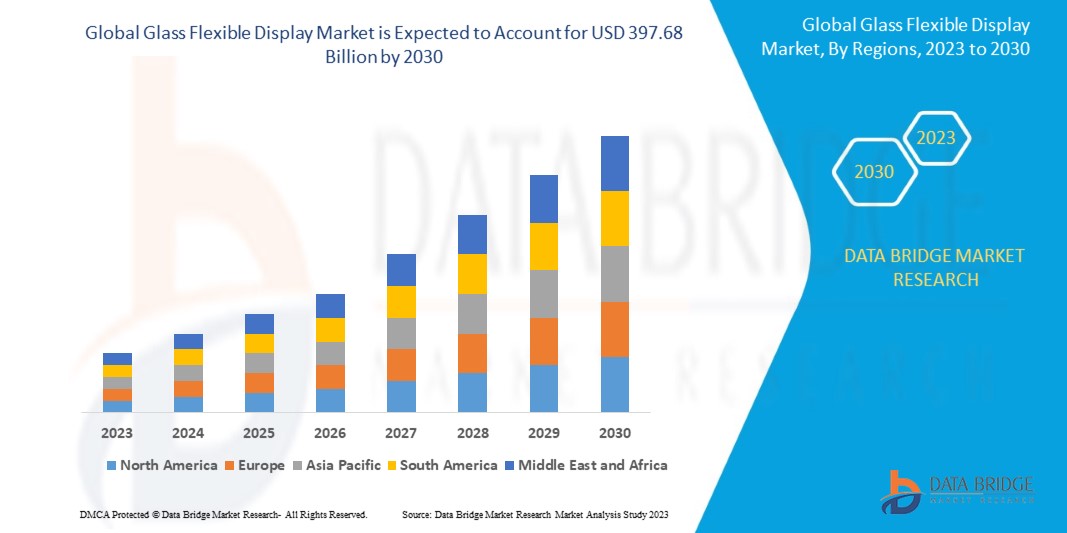
Glass Flexible Display Market Analysis and Size
Contrary to the conventional displays found in most electronic devices, flexible displays are flexible in design. For computer monitors, televisions, and cell phones, these screens replace flat bits of glass or plastic. In contrast to conventional screens, they are robust. They have greater resistance to impact and can be bent as well.
Data Bridge Market Research analyzes that the global glass flexible display market was valued at USD 20 billion in 2022 and is expected to reach USD 397.68 billion by 2030, registering a CAGR of 25.10% during the forecast period. This indicates that the market value. “Substrate” dominates the component segment of glass flexible display market because it serves as the foundational material that provides structural integrity and support for the flexible display, making it a crucial component for ensuring the display's performance and durability. In addition to the insights on market scenarios such as market value, growth rate, segmentation, geographical coverage, and major players, the market reports curated by the Data Bridge Market Research also include in-depth expert analysis, geographically represented company-wise production and capacity, network layouts of distributors and partners, detailed and updated price trend analysis and deficit analysis of supply chain and demand.
Report Scope and Market Segmentation
|
Report Metric |
Details |
|
Forecast Period |
2023 to 2030 |
|
Base Year |
2022 |
|
Historic Years |
2021 (Customizable to 2015-2020) |
|
Quantitative Units |
Revenue in USD Billion, Volumes in Units, Pricing in USD |
|
Segments Covered |
Component (Organic Material, Substrate, Conductive Layer, Backlight Panel, Other Components), Manufacturing Technology (Flexible Flat Panel Display, Flexible Plasma Display, Photographic Technology), Display Technology (OLED Display, E-Paper Display, Quantum Dot LED Display, LED-Backlit LCD), Panel Size (Up to 6”, 6-20”, 20-50”, Above 50”), Application (Smartphone and Tablet, Smartwatches and Wearables, Television and Digital Signage Systems, PC Monitors and Laptops, E-Reader, Electronic Shelf Labels (ESLS), Vehicles and Public Transports, Smart Home Appliances), Display Type (Bendable, Rollable, Foldable), End User (Automotive, Aerospace, Retail, Transportation, Government, Utilities Others) |
|
Countries Covered |
U.S., Canada, Mexico, Brazil, Argentina, Rest of South America, Germany, Italy, U.K., France, Spain, Netherlands, Belgium, Switzerland, Turkey, Russia, Rest of Europe, Japan, China, India, South Korea, Australia, Singapore, Malaysia, Thailand, Indonesia, Philippines, Rest of Asia-Pacific, Saudi Arabia, U.A.E, South Africa, Egypt, Israel, Rest of the Middle East and Africa |
|
Market Players Covered |
LG Display Co., Ltd. (South Korea), SAMSUNG (South Korea), Innolux Corporation (Taiwan), AU Optronics Corp. (Taiwan), Japan Display Inc. (Japan), BOE Technology Group Co., Ltd. (China), SHARP CORPORATION (Japan), Visionox Company (China), E Ink Holdings Inc. (Taiwan), Corning Incorporated (U.S.), DuPont (U.S.), FlexEnable Limited (U.K.), Kateeva (U.S.), Royole Corporation (China), Koninklijke Philips N.V. (Netherlands), Sony Corporation (Japan), DELTA ELECTRONICS, INC. (Taiwan), Hewlett Packard Development Company, L.P. (U.S.), Materion Corporation (U.S.), NanoLumens (U.S.), Novaled GmbH (Germany), among others |
|
Market Opportunities |
|
Market Definition
A glass flexible display, also known as a flexible glass display, is a type of display technology that combines the durability and optical properties of traditional glass with the flexibility and bendability required for various innovative electronic devices.
Global Glass Flexible Display Market Dynamics
Drivers
- Increasing demand for smartphones and wearable devices
The growing demand for smartphones and wearable devices has been a significant driver for the glass flexible display market. Consumers are increasingly seeking devices with larger and more flexible displays, which has led to a surge in demand for flexible display technology. Glass flexible displays offer enhanced durability and performance, making them a preferred choice for manufacturers looking to meet consumer demands for innovative, foldable, and curved screen designs.
- Advancements in display technology
Advancements in display technology have played a crucial role in propelling the glass flexible display market. Manufacturers have been investing in research and development to create thinner, lighter, and more robust glass substrates. These technological innovations have led to the development of flexible displays that can withstand bending and curving without compromising on image quality. As display technology continues to evolve, glass flexible displays are poised to become an integral part of the consumer electronics landscape.
Opportunities
- Automotive applications
One of the significant opportunities for the glass flexible display market lies in the automotive industry. The integration of glass flexible displays in car interiors for instrument clusters, infotainment systems, and heads-up displays can enhance the driving experience. With the increasing demand for smart and connected vehicles, there is a vast potential market for glass flexible displays in the automotive sector.
- Healthcare and medical devices
The healthcare industry presents another promising opportunity for glass flexible displays. These displays can be used in medical devices such as wearable health monitors, medical imaging equipment, and telemedicine applications. The flexibility and durability of glass flexible displays make them suitable for healthcare devices, enabling the monitoring of patients' health and enhancing the efficiency of medical professionals.
Restraints/Challenges
- High manufacturing costs
One of the primary challenges in the glass flexible display market is the high manufacturing costs associated with producing flexible display panels. The specialized equipment and manufacturing processes required to create these displays can drive up production expenses. As a result, manufacturers need to find ways to lower costs and make glass flexible displays more affordable for mass production.
- Fragility and durability
While glass flexible displays offer several advantages, they are not immune to challenges related to fragility and durability. Glass, even in its flexible form, can still break or crack upon impact, making it less robust than some alternative materials. Ensuring that glass flexible displays can withstand the wear and tear of daily use and are less prone to damage will be a critical challenge that manufacturers need to address to gain wider market acceptance.
This glass flexible display market report provides details of new recent developments, trade regulations, import-export analysis, production analysis, value chain optimization, market share, impact of domestic and localized market players, analyses opportunities in terms of emerging revenue pockets, changes in market regulations, strategic market growth analysis, market size, category market growths, application niches and dominance, product approvals, product launches, geographic expansions, technological innovations in the market. To gain more info on the glass flexible display market contact Data Bridge Market Research for an Analyst Brief, our team will help you take an informed market decision to achieve market growth.
Recent Developments
- In September 2020, In the virtual event held at Galaxy unpacked 2020, Samsung introduced the Galaxy Z fold 2. this is a foldable phone which is considered to be the 3rd model in the series which started in 2019. Many advanced features have been observed in this new device which has attracted potential consumers.
- In August 2020, a smart phone company, Nubia disclosed the introduction or for smart wearable product which has a flexible AMOLED display. Various advanced features have been observed in this smart watch which is having a curved shape such as sports and health tracking. The message notifications can be received on this device too. An advanced visual experience along with stunning panoramas is offered by this display.
The Global Glass Flexible Display Market Scope
Glass flexible display market is segmented on the basis of component, manufacturing technology, display technology, panel size, display type, application, and end user. The growth amongst these segments will help you analyze meagre growth segments in the industries and provide the users with a valuable market overview and market insights to help them make strategic decisions for identifying core market applications.
Component
- Organic Material
- Substrate
- Conductive Layer
- Backlight Panel
- Other Components
Manufacturing Technology
- Flexible Flat Panel Display
- Flexible Plasma Display
- Photographic Technology
- Display Technology
- OLED Display
- E-Paper Display
- Quantum Dot LED Display
- LED-Backlit LCD
Panel Size
- Up to 6”
- 6-20”
- 20-50”
- Above 50”
Application
- Smartphone and Tablet
- Smartwatches and Wearables
- Television and Digital Signage Systems
- PC Monitors and Laptops
- E-Reader
- Electronic Shelf Labels (ESLS)
- Vehicles and Public Transports
- Smart Home Appliances
Display Type
- Bendable
- Rollable
- Foldable
End User
- Automotive
- Aerospace
- Retail
- Transportation
- Government
- Utilities Others
The Global Glass Flexible Display Market Region Analysis/Insights
Glass flexible display market is analysed and market size, volume information is provided by country, component, manufacturing technology, display technology, panel size, display type, application, and end user as referenced above.
The countries covered in the glass flexible display market report are U.S., Canada and Mexico in North America, Brazil, Argentina and rest of South America as part of South America, Germany, Italy, U.K., France, Spain, Netherlands, Belgium, Switzerland, Turkey, Russia, rest of Europe in Europe, Japan, China, India, South Korea, Australia, Singapore, Malaysia, Thailand, Indonesia, Philippines, rest of Asia-Pacific (APAC) in the Asia-Pacific (APAC), Saudi Arabia, U.A.E, South Africa, Egypt, Israel, rest of Middle East and Africa (MEA) as a part of Middle East and Africa (MEA).
Asia-Pacific is expected to dominate the glass flexible display market due to the increasing demand for compact and light weight electronic devices along with prevalence of large number of consumer electronics manufacturers in the region while North America is expected to grow in the forecast period of 2023-2030 due to the increasing demand of energy efficient devices along with growth of the automotive industry in the region.
The country section of the report also provides individual market impacting factors and changes in regulation in the market domestically that impacts the current and future trends of the market. Data points like down-stream and upstream value chain analysis, technical trends and porter's five forces analysis, case studies are some of the pointers used to forecast the market scenario for individual countries. Also, the presence and availability of global brands and their challenges faced due to large or scarce competition from local and domestic brands, impact of domestic tariffs and trade routes are considered while providing forecast analysis of the country data.
Competitive Landscape and Global Glass Flexible Display Market Share Analysis
Glass flexible display market competitive landscape provides details by competitor. Details included are company overview, company financials, revenue generated, market potential, investment in research and development, new market initiatives, regional presence, company strengths and weaknesses, product launch, product width and breadth, application dominance. The above data points provided are only related to the companies’ focus related to glass flexible display market.
Some of the major players operating in the Glass flexible display market are
- LG Display Co., Ltd. (South Korea)
- SAMSUNG (South Korea)
- Innolux Corporation (Taiwan)
- AU Optronics Corp. (Taiwan)
- Japan Display Inc. (Japan)
- BOE Technology Group Co., Ltd. (China)
- SHARP CORPORATION (Japan)
- Visionox Company (China)
- E Ink Holdings Inc. (Taiwan)
- Corning Incorporated (U.S.)
- DuPont (U.S.)
- FlexEnable Limited (U.K.)
- Kateeva (U.S.)
- Royole Corporation (China)
- Koninklijke Philips N.V. (Netherlands)
- Sony Corporation (Japan)
- DELTA ELECTRONICS, INC. (Taiwan)
- Hewlett Packard Development Company, L.P. (U.S.)
- Materion Corporation (U.S.)
- NanoLumens (U.S.)
- Novaled GmbH (Germany)
SKU-
Obtenha acesso online ao relatório sobre a primeira nuvem de inteligência de mercado do mundo

- Painel interativo de análise de dados
- Painel de análise da empresa para oportunidades de elevado potencial de crescimento
- Acesso de analista de pesquisa para personalização e customização. consultas
- Análise da concorrência com painel interativo
- Últimas notícias, atualizações e atualizações Análise de tendências
- Aproveite o poder da análise de benchmark para um rastreio abrangente da concorrência
Metodologia de Investigação
A recolha de dados e a análise do ano base são feitas através de módulos de recolha de dados com amostras grandes. A etapa inclui a obtenção de informações de mercado ou dados relacionados através de diversas fontes e estratégias. Inclui examinar e planear antecipadamente todos os dados adquiridos no passado. Da mesma forma, envolve o exame de inconsistências de informação observadas em diferentes fontes de informação. Os dados de mercado são analisados e estimados utilizando modelos estatísticos e coerentes de mercado. Além disso, a análise da quota de mercado e a análise das principais tendências são os principais fatores de sucesso no relatório de mercado. Para saber mais, solicite uma chamada de analista ou abra a sua consulta.
A principal metodologia de investigação utilizada pela equipa de investigação do DBMR é a triangulação de dados que envolve a mineração de dados, a análise do impacto das variáveis de dados no mercado e a validação primária (especialista do setor). Os modelos de dados incluem grelha de posicionamento de fornecedores, análise da linha de tempo do mercado, visão geral e guia de mercado, grelha de posicionamento da empresa, análise de patentes, análise de preços, análise da quota de mercado da empresa, normas de medição, análise global versus regional e de participação dos fornecedores. Para saber mais sobre a metodologia de investigação, faça uma consulta para falar com os nossos especialistas do setor.
Personalização disponível
A Data Bridge Market Research é líder em investigação formativa avançada. Orgulhamo-nos de servir os nossos clientes novos e existentes com dados e análises que correspondem e atendem aos seus objetivos. O relatório pode ser personalizado para incluir análise de tendências de preços de marcas-alvo, compreensão do mercado para países adicionais (solicite a lista de países), dados de resultados de ensaios clínicos, revisão de literatura, mercado remodelado e análise de base de produtos . A análise de mercado dos concorrentes-alvo pode ser analisada desde análises baseadas em tecnologia até estratégias de carteira de mercado. Podemos adicionar quantos concorrentes necessitar de dados no formato e estilo de dados que procura. A nossa equipa de analistas também pode fornecer dados em tabelas dinâmicas de ficheiros Excel em bruto (livro de factos) ou pode ajudá-lo a criar apresentações a partir dos conjuntos de dados disponíveis no relatório.











