



Global Healthcare Information Technology (IT) Integration Market Segmentation, By Products (Medical Device Integration, Interface Engine, Media Integration, and Others), Services (Implementation, Support, and Education), End-Users (Hospitals, Laboratories, Diagnostic Imaging Centers, and Others), Application (EHR, CPOE, Electronic Prescribing Systems, and Medical Imaging Information) - Industry Trends and Forecast to 2032
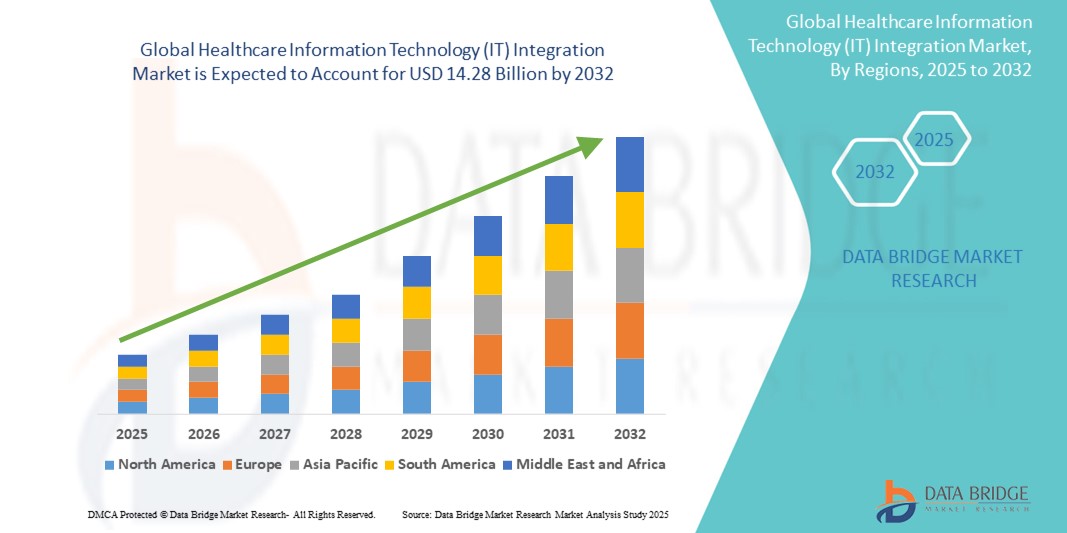
Healthcare Information Technology (IT) Integration Market Size
- The global healthcare information technology (IT) integration market size was valued atUSD 5.29 billion in 2024and is expected to reachUSD 14.28 billion by 2032, at aCAGR of 13.20%during the forecast period
- This growth is driven by factors such as the increasing adoption of electronic health records (EHRs) and telemedicine, which enhance patient care and operational efficiency. Regulatory pressures for data interoperability are also encouraging healthcare organizations to implement integrated IT systems that facilitate seamless data exchange
Healthcare Information Technology (IT) Integration Market Analysis
- Healthcare Information Technology (IT) Integrations are critical tools used in various eye surgeries, providing magnified, high-resolution views of the eye’s internal structures. They are essential for procedures such as cataract surgery, retinal surgery, and corneal transplants
- The demand for these microscopes is significantly driven by the increasing prevalence of age-related eye conditions and advancements in surgical techniques
- North America is expected to dominate the Healthcare Information Technology (IT) Integrations market due to with 40.05% share due to its well-established healthcare infrastructure and strong digital adoption
- Asia-Pacific is expected to be the fastest growing region in the Healthcare Information Technology (IT) Integration market during the forecast period with 22.05% share due to healthcare modernization across emerging economies
- The electronic prescribing systems segment is expected to dominate the Healthcare Information Technology (IT) Integration market with the largest share of 26.08% in 2025 due to the rising need for streamlined, accurate, and secure medication management across healthcare settings
Report Scope and Healthcare Information Technology (IT) Integration Market Segmentation
|
Attributes |
Healthcare Information Technology (IT) Integration Key Market Insights |
|
Segments Covered |
|
|
Countries Covered |
North America
Europe
Asia-Pacific
Middle East and Africa
South America
|
|
Key Market Players |
|
|
Market Opportunities |
|
|
Value Added Data Infosets |
In addition to the insights on market scenarios such as market value, growth rate, segmentation, geographical coverage, and major players, the market reports curated by the Data Bridge Market Research also include in-depth expert analysis, patient epidemiology, pipeline analysis, pricing analysis, and regulatory framework. |
Healthcare Information Technology (IT) Integration Market Trends
“Advancements in Cloud Solutions for Healthcare Data Management”
- Healthcare organizations are increasingly adopting cloud-based solutions to streamline data management, enabling efficient integration across systems
- There is a growing demand for real-time data integration for better patient outcomes, leading to faster decision-making
- Interoperability is becoming a critical trend as healthcare systems need to share data seamlessly, reducing barriers between different technologies
- Healthcare IT integration solutions are focusing on improving patient engagement by providing better access to healthcare information and services
- For instance, cloud-based platforms are being used to integrate patient data across various hospitals, leading to more coordinated care and improved overall efficiency
- In conclusion, the healthcare IT integration market is embracing cloud-based solutions and enhanced interoperability to improve patient care, streamline operations, and enable real-time data sharing across healthcare systems
Healthcare Information Technology (IT) Integration Market Dynamics
Driver
“Increased Demand for Data Security and Compliance”
- Healthcare organizations are focusing on advanced IT solutions to enhance data security and ensure compliance with regulations such as HIPAA
- Increased cyberattacks on healthcare data have prompted a stronger emphasis on encryption, authentication, and secure data governance
- The rise of digital health platforms and electronic health records (EHRs) calls for secure integration across multiple systems to safeguard patient data
- Many healthcare providers are investing in modern IT infrastructure to align with international security standards and avoid data breaches
- For instance, healthcare providers are adopting cloud-based systems with built-in security measures to protect sensitive patient information
- In conclusion, data security and compliance are pivotal drivers in the healthcare IT integration market, as organizations prioritize protection and regulatory adherence
Opportunity
“Expansion of Telemedicine Services”
- The growing demand for telemedicine services, especially post-pandemic, creates a significant opportunity for IT integration in healthcare
- Telemedicine platforms require seamless interoperability between virtual consultation tools, patient management systems, and medical devices
- Integrated IT solutions are essential for securely storing patient data, enabling real-time consultations, and monitoring health remotely
- Telemedicine can improve accessibility for patients in remote areas, reducing pressure on physical healthcare facilities
- For instance, telemedicine services are making it possible for healthcare providers to deliver timely care to rural populations
- In conclusion, the expansion of telemedicine offers a promising opportunity for IT integration solutions, driving innovation and improving healthcare access worldwide
Restraint/Challenge
“Integration Complexity and Legacy Systems”
- Integrating modern IT systems with outdated legacy infrastructure remains a major challenge for healthcare providers
- Many organizations still use old electronic health records or diagnostic systems that lack compatibility with current interoperability standards
- These compatibility issues lead to delays, higher costs, and disruptions in daily operations during integration efforts
- Staff often need extensive training to work with new systems, and internal resistance to technological change can slow down progress
- For instance, hospitals using decades-old software face significant hurdles when adopting cloud-based or AI-powered IT integration tools
- In conclusion, legacy system incompatibility and internal resistance pose significant barriers to effective healthcare IT integration
Healthcare Information Technology (IT) Integration Market Scope
The market is segmented on the basis of product, services, and end user.
|
Segmentation |
Sub-Segmentation |
|
By Product |
|
|
By Services |
|
|
By End User |
|
|
By Application |
|
In 2025, the electronic prescribing systems segment is projected to dominate the market with a largest share in application segment
The electronic prescribing systems segment is expected to dominate the Healthcare Information Technology (IT) Integration market with the largest share of 26.08% in 2025 due to the rising need for streamlined, accurate, and secure medication management across healthcare settings. These systems help reduce prescription errors, enhance patient safety, and improve overall communication between healthcare providers and pharmacies. Integration with electronic health records allows for real-time access to critical patient data, including medical history and allergies, which supports better-informed prescribing decisions. Regulatory support and government mandates in various regions have further accelerated the adoption of e-prescribing practices.
The hybrid microscopes is expected to account for the largest share during the forecast period in technology segment
In 2025, the hybrid microscopes segment is expected to dominate the market with the largest market share of 51.31% due to their ability to combine the strengths of both digital and optical technologies, offering enhanced imaging capabilities and greater flexibility for users. These microscopes are increasingly favored in clinical diagnostics, life sciences research, and medical education because they support real-time visualization along with high-resolution image capture and data sharing. The integration of advanced features such as automated focusing, remote access, and AI-powered image analysis further adds to their appeal. Healthcare institutions and research laboratories are adopting hybrid models to improve workflow efficiency and diagnostic accuracy. Their compatibility with telepathology and digital record-keeping also aligns with the growing trend of digitization in healthcare. For instance, laboratories are using hybrid microscopes to facilitate collaborative diagnostics across multiple locations, improving both speed and precision in clinical decisions.
Healthcare Information Technology (IT) Integration Market Regional Analysis
“North America Holds the Largest Share in the Healthcare Information Technology (IT) Integration Market”
- North America leads the global healthcare IT integration market with 40.05% share due to its well-established healthcare infrastructure and strong digital adoption
- The region benefits from high usage of electronic health records and early implementation of advanced IT integration systems
- U.S. Is expected to dominate the global healthcare information technology (IT) integration market with 35.4% market share, particularly in the north America region due to its well-established healthcare system, high adoption of electronic health records, and strong investment in health IT innovation
- Key players based in North America contribute to innovation and competitive advantage in healthcare IT solutions
- Supportive regulatory policies and funding from government bodies encourage continuous improvements in healthcare technology
“Asia-Pacific is Projected to Register the Highest CAGR in the Healthcare Information Technology (IT) Integration Market”
- Asia-Pacific is experiencing rapid growth in healthcare IT integration with 22.05% share due to healthcare modernization across emerging economies
- Countries in the region are implementing government initiatives to digitize healthcare and improve system interoperability
- India is expected to witness the highest CAGR with 2.9% market share in the global healthcare information technology (IT) integration market due to its rapid digital healthcare adoption, expanding infrastructure, and strong government support for health IT initiatives
- Increasing use of telehealth, rising healthcare awareness, and adoption of electronic medical records are accelerating IT integration
- Urbanization and expanding healthcare access are creating demand for scalable, tech-enabled healthcare systems
- The region presents attractive opportunities for global IT vendors looking to expand into healthcare technology markets across Asia
Healthcare Information Technology (IT) Integration Market Share
The market competitive landscape provides details by competitor. Details included are company overview, company financials, revenue generated, market potential, investment in research and development, new market initiatives, global presence, production sites and facilities, production capacities, company strengths and weaknesses, product launch, product width and breadth, application dominance. The above data points provided are only related to the companies' focus related to market.
The Major Market Leaders Operating in the Market Are:
- Allscripts Healthcare Solutions Inc. (U.S.)
- Oracle Cerner (U.S.)
- General Electric Company (GE Healthcare) (U.S.)
- IBM Corporation (U.S.)
- Siemens Healthcare GmbH (Germany)
- Lyniate (U.S.)
- InterSystems Corporation (U.S.)
- Summit Healthcare (U.S.)
- Epic Systems Corporation (U.S.)
- Orion Health (New Zealand)
- Redox, Inc. (U.S.)
- Nextgen Healthcare Inc. (U.S.)
- Interfaceware, Inc. (Canada)
- Koninklijke Philips (Netherlands)
- Oracle (U.S.)
- Qualcomm Life Inc. (U.S.)
- Capsule Technologies Inc. (U.S.)
- Cerner Corporation (U.S.)
- Infor Inc. (U.S.)
- McKesson Corporation (U.S.)
- Meditech (U.S.)
Latest Developments in Global Healthcare Information Technology (IT) Integration Market
- In June 2023, BoomerangFX, a cloud-based software provider offering practice management solutions for healthcare fields such as cosmetic dentistry, dermatology, medical spas, and women's health, entered into a strategic partnership with health tech leader DrFirst. The collaboration aims to launch an advanced e-prescribing solution designed specifically for aesthetic medicine practices across North America
- In May 2023, athenahealth announced that its integrated cloud-based platform, 'athenaOne'—which includes electronic health records, medical billing, and patient engagement tools—along with 'athenaOne Dental,' was selected by LCH Health and Community Services. The goal is to enhance both provider and patient experiences while supporting the organization's broader growth objectives
- In April 2023, Epic joined forces with Microsoft to integrate generative AI into electronic health records. The partnership involves embedding Microsoft’s Azure OpenAI Service into Epic’s EHR system to improve features such as interactive data analysis and natural language query capabilities, including enhancements to Epic’s SlicerDicer reporting tool
- In September 2021, Lyniate (US) introduced Lyniate Rapid, a healthcare API gateway and management solution developed to support healthcare teams in creating and securing APIs, including those based on Fast Healthcare Interoperability Resources (FHIR) standards
- In April 2021, Lyniate further strengthened its integration capabilities through the acquisition of the Datica Integration Business from Datica, Inc. (US). This acquisition enhanced Lyniate’s ability to help customers connect and consolidate data from multiple systems of record via FHIR-based frameworks
- In January 2021, Koninklijke Philips N.V. (Netherlands) announced an agreement to acquire Capsule Technologies, Inc. (US) as part of its Connected Care segment. This strategic move aimed to broaden Philips’ product portfolio in connected care and support its expansion in the health informatics space
SKU-
Obtenha acesso online ao relatório sobre a primeira nuvem de inteligência de mercado do mundo

- Painel interativo de análise de dados
- Painel de análise da empresa para oportunidades de elevado potencial de crescimento
- Acesso de analista de pesquisa para personalização e customização. consultas
- Análise da concorrência com painel interativo
- Últimas notícias, atualizações e atualizações Análise de tendências
- Aproveite o poder da análise de benchmark para um rastreio abrangente da concorrência
Metodologia de Investigação
A recolha de dados e a análise do ano base são feitas através de módulos de recolha de dados com amostras grandes. A etapa inclui a obtenção de informações de mercado ou dados relacionados através de diversas fontes e estratégias. Inclui examinar e planear antecipadamente todos os dados adquiridos no passado. Da mesma forma, envolve o exame de inconsistências de informação observadas em diferentes fontes de informação. Os dados de mercado são analisados e estimados utilizando modelos estatísticos e coerentes de mercado. Além disso, a análise da quota de mercado e a análise das principais tendências são os principais fatores de sucesso no relatório de mercado. Para saber mais, solicite uma chamada de analista ou abra a sua consulta.
A principal metodologia de investigação utilizada pela equipa de investigação do DBMR é a triangulação de dados que envolve a mineração de dados, a análise do impacto das variáveis de dados no mercado e a validação primária (especialista do setor). Os modelos de dados incluem grelha de posicionamento de fornecedores, análise da linha de tempo do mercado, visão geral e guia de mercado, grelha de posicionamento da empresa, análise de patentes, análise de preços, análise da quota de mercado da empresa, normas de medição, análise global versus regional e de participação dos fornecedores. Para saber mais sobre a metodologia de investigação, faça uma consulta para falar com os nossos especialistas do setor.
Personalização disponível
A Data Bridge Market Research é líder em investigação formativa avançada. Orgulhamo-nos de servir os nossos clientes novos e existentes com dados e análises que correspondem e atendem aos seus objetivos. O relatório pode ser personalizado para incluir análise de tendências de preços de marcas-alvo, compreensão do mercado para países adicionais (solicite a lista de países), dados de resultados de ensaios clínicos, revisão de literatura, mercado remodelado e análise de base de produtos . A análise de mercado dos concorrentes-alvo pode ser analisada desde análises baseadas em tecnologia até estratégias de carteira de mercado. Podemos adicionar quantos concorrentes necessitar de dados no formato e estilo de dados que procura. A nossa equipa de analistas também pode fornecer dados em tabelas dinâmicas de ficheiros Excel em bruto (livro de factos) ou pode ajudá-lo a criar apresentações a partir dos conjuntos de dados disponíveis no relatório.











